 Digital Vikingz

Content pruning in SEO is a review that keeps, refreshes, consolidates or removes each old page according to the queries the page earns. Content pruning matters for SEO because each query ends up with one current page, so ranking signals and visitors reach the page that answers. Digital Vikingz decides each page from four signals: earned queries, shared queries, topical map fit, and links and conversions. Topical map fit names the topical map node a page answers inside the site's border.
A refresh rewrites a page at the same URL, and a team that can find keyword cannibalization already knows which pages to consolidate. Removal stays a last resort for pages outside the topical map, or pages that earn no queries and hold no links. Pruning without losing rankings runs in batches, with redirects, internal links and sitemap entries changed together. The person who owns the topical map signs off each decision, and the Semantic SEO Audit issue map shows which pages to review. Teams that run a content configuration pass after each core update can fold the pruning review into that pass. Old pages that still rank become refreshes within Semantic Content Writing, so each URL keeps the history the URL has earned. One current page for each query is part of how a site earns topical authority.
What is content pruning in SEO?
Content pruning in SEO is a review that keeps, refreshes, consolidates or removes each old page according to the queries the page earns.
We read those queries in Google Search Console, because a page's age or traffic alone says little about the question the page answers. Several SEO guides use "content pruning" for removal alone, and the wider use covers the whole review, with removal as one decision.
The four decisions of content pruning are defined below:
- Keep: A kept page stays as published, because the page earns its queries and answers those queries in full.
- Refresh: A content refresh rewrites the outdated sections of one page at the same URL, so the URL keeps its links and ranking history.
- Consolidate: Content consolidation merges pages that answer one query into one surviving URL. The other URLs redirect to the survivor with a 301.
- Remove: A removed page returns a 404 or a 410, or redirects with a 301 when a closely matching page exists.
Noindex is a fifth option, chosen when visitors still use a page that search does not need. Each decision changes what Google reads on the site, which is why content pruning matters for SEO.
Why does content pruning matter for SEO?
Content pruning matters for SEO because each query ends up with one current page, so ranking signals and visitors reach the page that answers.
Consolidation joins the links of competing pages in one URL, a refresh brings an answer up to date, and removal takes an outdated answer away. Google's guide "Google Search's core updates and your website" was last updated on 10 December 2025. The guide says that deleting unhelpful sections made for search engines first can let the remaining content perform better.
Google's page "Creating helpful, reliable, people-first content" was last updated on 5 October 2026. The page warns that removing older content only to make a site seem fresh does not lift rankings. Published pruning results each come from one site, often with other changes made at the same time, so no typical traffic gain can be stated. One benefit pruning guides often claim, a saved crawl budget, depends on site size.
Does content pruning save crawl budget on a small site?
Content pruning saves no crawl budget worth counting on a small site, because Google's crawl budget guide addresses sites of 10,000 or more pages.
Google's guide "Optimize your crawl budget" was last updated on 22 July 2026. The guide names sites of 1 million or more pages that change weekly, and sites of 10,000 or more pages that change daily. A site of a few hundred pages prunes to fix competing pages and outdated answers, not crawl budget or index bloat. Competing pages and outdated answers show up in four signals per page.
How do you decide which pages to refresh, consolidate or remove?
Four signals decide which old pages are kept, refreshed, consolidated or removed: earned queries, shared queries, topical map fit, and links and conversions.
The four signals read for every URL are defined below:
- Earned queries: Earned queries are the searches that bring a page impressions in the Google Search Console Performance report, filtered by that page.
- Shared queries: Shared queries are searches that bring impressions to at least two URLs of one site, the sign that the pages compete.
- Topical map fit: Topical map fit names the topical map node the page answers inside the site's topical border.
- Links and conversions: Links and conversions count the backlinks, internal links and leads the page holds, which a removal would lose.
Topical map fit depends on the topical map node a page answers, which no traffic report shows. One topical map node decides one page, and a page with no node belongs on another site.
The table below reads the four signals across each row and gives one decision per row.
| Earned queries | Shared queries | Topical map fit | Links and conversions | Decision |
|---|---|---|---|---|
| Earned and answered | None | Inside the map | Any | Keep |
| Lost, or answered with outdated facts | None | Inside the map | Any | Refresh |
| Earned | Shared with another URL for one intent | Inside the map | Any | Consolidate |
| None | None | Outside the map, or inside with no queries | None, or links a 301 carries to a closely matching page | Remove |
| Not a search answer | None | Any | Visitors still use the page | Noindex |
Shared queries outrank the other signals, because a refresh of one page in a pair of competing pages leaves both pages competing.
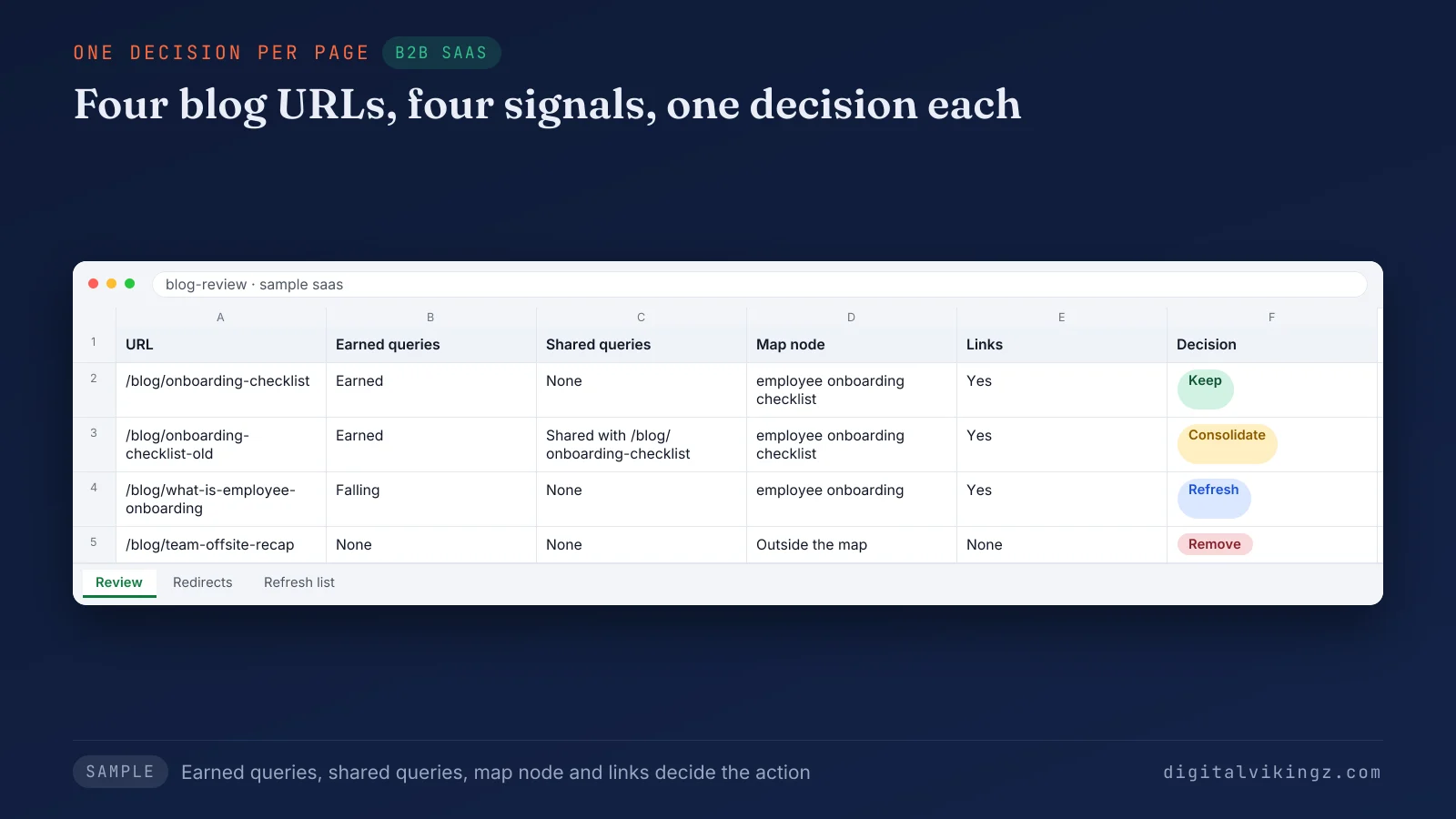
The sample sheet keeps one onboarding checklist, consolidates the older checklist into the kept one, refreshes a definition post, and removes an offsite recap. The first decision of content pruning that brings writing work is the content refresh.
When does a page need a content refresh?
A page needs a content refresh when the page still owns its queries, but its facts or coverage no longer match what searchers ask.
Google Search Console reveals the need as lost queries, as new queries the page does not answer, or as impressions that stopped turning into clicks. A refresh in content pruning rewrites the sections whose queries moved, adds the missing answers and updates every dated figure, price and screenshot. The URL, the H1 entity and the sections whose queries held stay the same, so the page keeps its links and ranking history.
Google's helpful content page lists changing a page's date without a substantial change to the content among its warning signs. The publish date changes only after the text has changed.
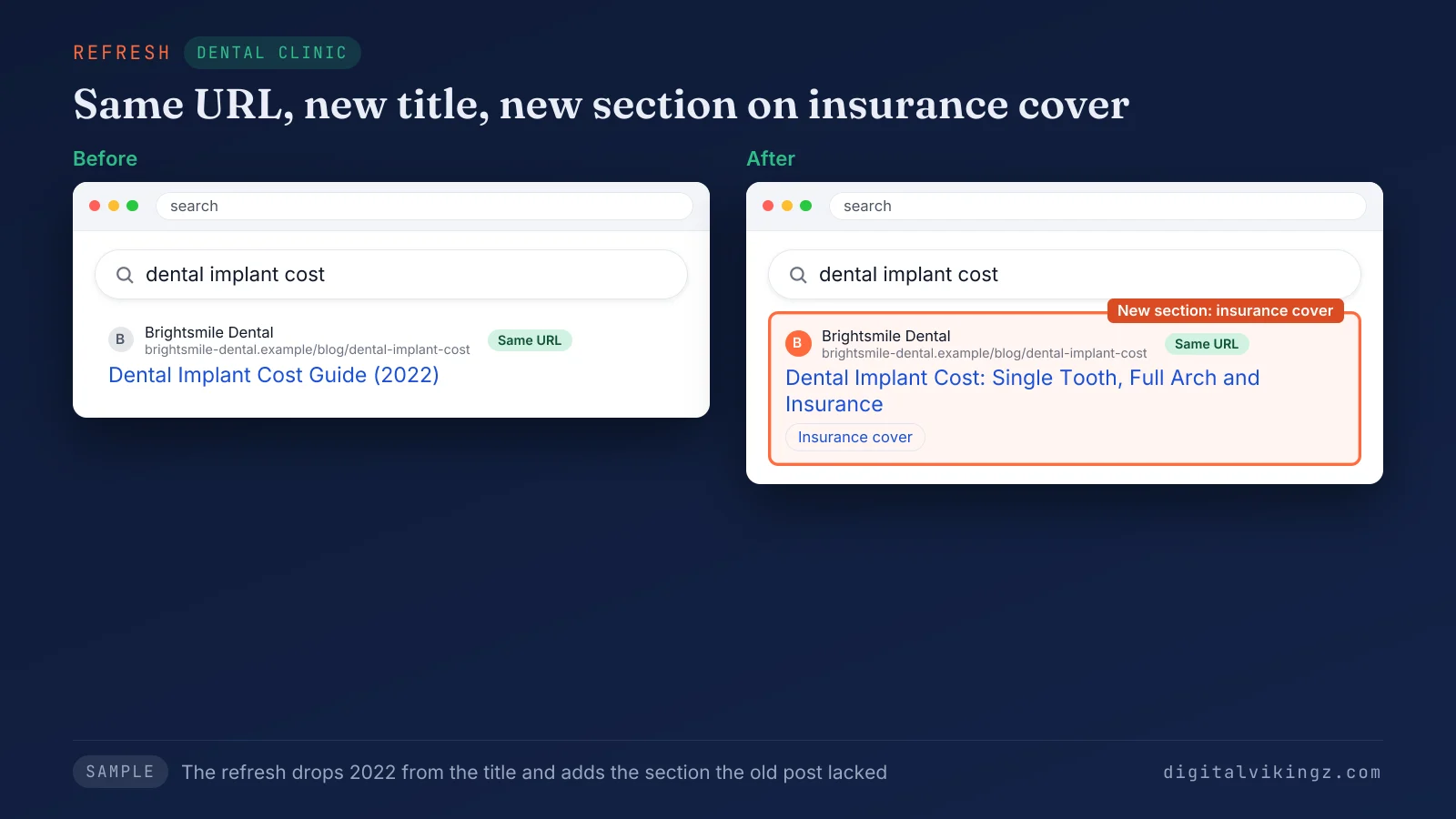
The sample result keeps the same URL, drops 2022 from the title, and adds a section on insurance cover that the old post lacked. A refresh fixes one page, while competing pages need consolidation.
When should competing pages be consolidated?
Competing pages should be consolidated once two or more URLs of one site earn the same queries for one intent and trade positions.
The surviving URL is the one that holds the most historical data on the query. Content consolidation is a writing task inside content pruning: the survivor gains the unique sections of the other pages before any redirect is set. Google's page "Redirects and Google Search", last updated on 14 April 2026, says a permanent redirect signals that the target should be canonical. Two pages sharing a few queries but answering different intents stay separate, and each page is rewritten toward its own question.
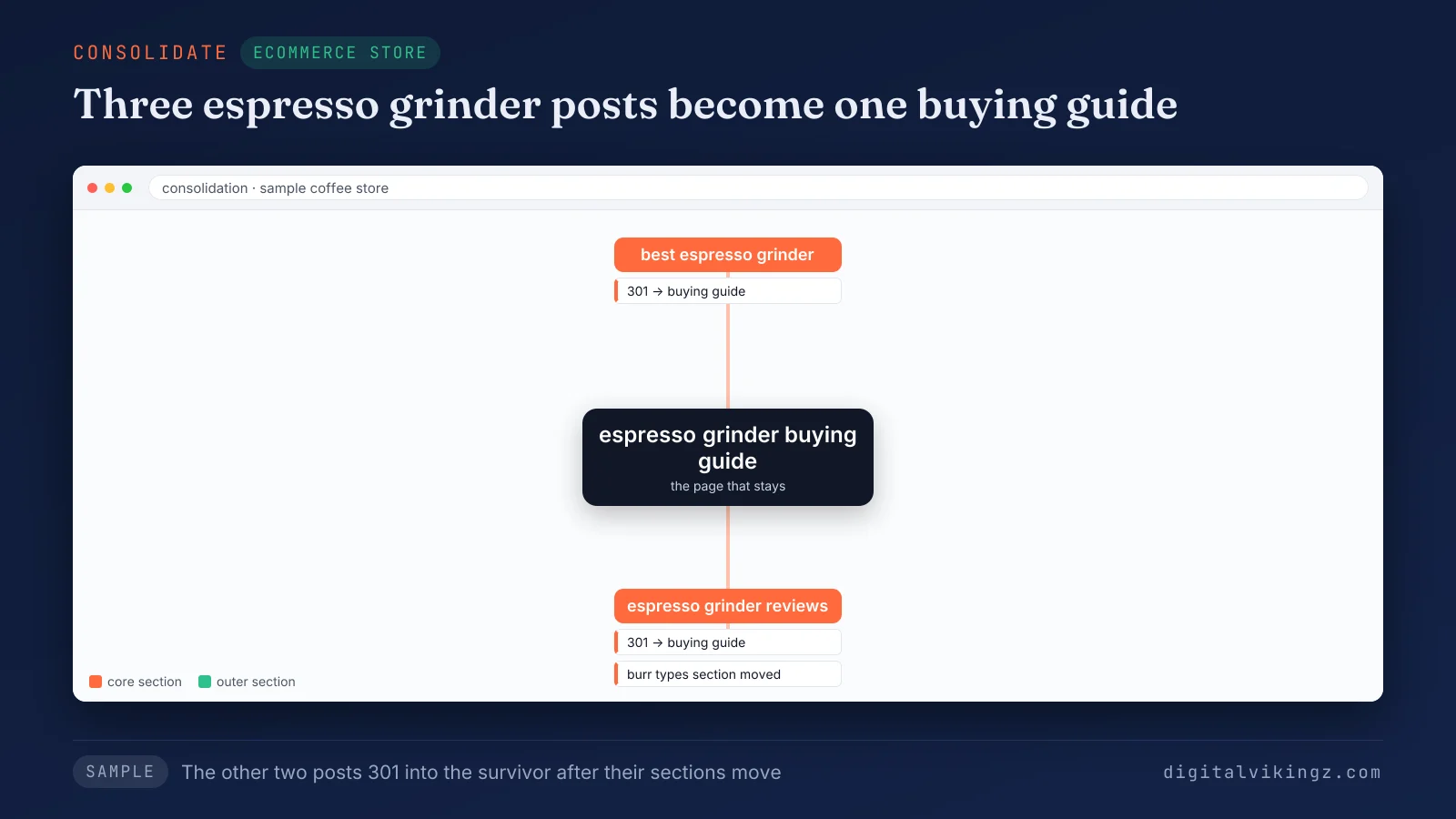
The sample map folds two espresso grinder posts into the buying guide with 301 redirects, after the burr types section moves across. A team that knows how to find keyword cannibalization already holds a list of the pages to consolidate. The merge steps, from moving sections to updating internal links, belong to the method to find keyword cannibalization in Google Search Console. A page with no survivor to join and no earned queries is removed instead.
When should an old page be removed?
An old page should be removed when the page sits outside the topical map, or earns no queries and holds no links or leads.
Google's core updates guide states "Deleting content is a last resort" and limits deletion to content that is beyond saving. Removal is the content pruning term for the decision to delete old posts. A page with links or leads keeps that value only through a 301 redirect to the closest matching page. A page with no closely matching target returns a 404 or a 410, and Google drops the URL from the index after recrawling the page.
A post outside the topical map belongs on another site, so a refresh never pulls the post back into scope. The XML sitemap and internal links stop pointing at the removed URL in the same content pruning batch.
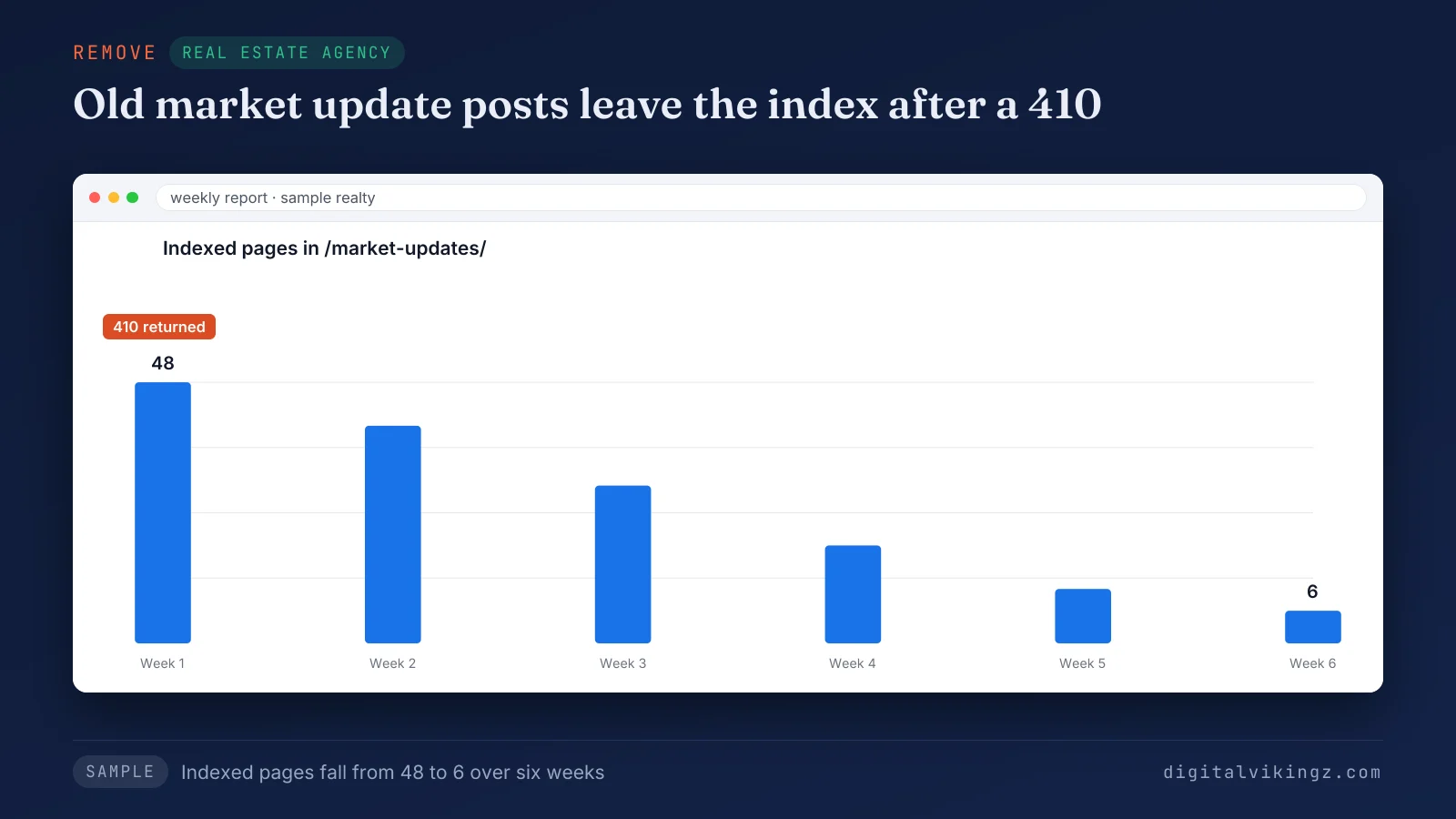
The sample chart shows indexed market update pages falling from 48 to 6 over six weeks after the old posts returned a 410. Low traffic on its own is not on the list of removal signals.
Is low traffic a reason to remove a page?
Low traffic is not a reason to remove a page, because a page with few visits can own a query, hold links or bring leads.
Traffic counts visits, while the four signals count what the page does for the site. Pruning guides from Semrush, Search Atlas, EDUCBA and SEO.com agree that links, conversions and purpose get checked before any removal. Content pruning treats a low-traffic page whose earned queries include a narrow query as a keep or refresh candidate, not a removal. Pages that pass the removal test then need the correct status code.
Should a removed page return a 404 or a 410?
A removed page can return a 404 or a 410, because Google treats every 4xx status code except 429 the same way.
Google's page "How HTTP status codes affect Google's crawlers" was last updated on 4 February 2026. The page states that indexed URLs returning a 4xx status code are removed from the index. The claim that a 410 leaves the index faster than a 404 has no support in that page. We return a 410 for pages removed by a content pruning decision, because the code records that the removal was deliberate. Status code changes belong to batches planned around rankings.
How do you prune content without losing rankings?
Content is pruned without losing rankings by deciding every URL first, changing pages in small batches, and reading the queries before the next batch.
The steps to prune content without losing rankings are listed below:
- Collect every indexable URL from the XML sitemap and a site crawl, with the topical map node each URL answers.
- Export the queries for each URL from the Google Search Console Performance report over the longest date range available.
- Mark shared queries, backlinks, internal links and leads next to each URL.
- Write one decision per URL before editing starts on any page.
- Change one section of the site per batch, releasing redirects, status codes and content edits together.
- Update the XML sitemap and every internal link that pointed at a redirected or removed URL.
- Read the queries of the changed pages ahead of the next batch.
Batches keep each ranking change traceable to one set of edits, a practice the Ahrefs (2024), Semrush (2024) and Search Atlas (2026) guides share. A batch released inside a core update rollout mixes the update's effect with the pruning's effect, so we wait for the rollout to finish. We log each URL with the decision, the redirect target and the date, so a later drop points to one batch. Rankings still move during any batch, and the log shows if a move came from the batch or from a change outside the site. The last open question of content pruning is how often the review returns.
How often should content be pruned?
Content should be pruned every 3 to 12 months, with the shorter interval for larger sites that publish often.
EDUCBA's 2026 guide suggests a review once or twice a year for small sites and quarterly reviews for larger ones. Conductor's guide, updated in 2026, suggests every six months for sites of up to 1,000 pages. We review old pages for content pruning every 90 days and after each core update, once the rollout is complete. A page with a dated figure gets a review date at publication, so decay is caught before the page loses queries. A fixed rhythm still needs one owner for the decisions.
Who should run a content pruning review?
A content pruning review should be run by the person who owns the topical map, because each decision changes the page that answers a query.
A writer carries out the refreshes and merges, and a developer sets the redirects and status codes. A content audit lists the problems of a site, and the pruning review turns the problems into one decision per page. A site with no topical map yet begins with the Semantic SEO Audit issue map, which ranks every finding by what the fix costs. Competing pages appear in the Semantic SEO Audit issue map under semantic dilution, with merge or removal as the fix. A first pruning review should start with a strategy call that sets the review's scope. Sites already on a review schedule ask how pruning sits beside a configuration pass.
How does content pruning differ from a content configuration pass?
Content pruning decides the fate of each old page, while a content configuration pass restructures pages in clusters that moved after a core update.
The pass changes heading order, definitions, links and section depth, and leaves the wording that built the page's history in place. Both start from the same Google Search Console export, and both can end in consolidation or removal. Sites that run a content configuration pass every 90 days can hold the pruning review inside the same pass. The eight steps used to run a content configuration pass start from the cluster read, not from single pages. A pruning review also settles a narrower question: refresh the old page or write a new one.
Should an old page be refreshed or replaced by a new post?
An old page should be refreshed rather than replaced when the page already ranks for the query, because a new URL starts with no history.
A second post written for the same query competes with the old page, and the two pages then need consolidation. A new post is the right choice for a query that asks for another intent, which makes the post a new topical map node. We write refreshes within Semantic Content Writing from a brief, the same way as new pages. Briefs, rewrites and checks for kept URLs come as refreshes within Semantic Content Writing. Content pruning reviews go wrong through five repeated mistakes.
Which content pruning mistakes cost rankings?
Five content pruning mistakes cost rankings, and each mistake throws away value that a different decision would have kept.
The five content pruning mistakes that cost rankings are listed below:
- Homepage redirects: A removed page redirected to the homepage sends visitors to an answer that misses each visitor's query. The remedy is the closest matching page or a 410.
- Robots.txt blocks: Google's crawl budget guide says URLs blocked in robots.txt stay in the crawl queue longer. The remedy is a 404 or 410.
- Noindex on a merge candidate: A noindexed page passes nothing to the surviving page. The remedy is a merge with a 301.
- Stale internal links: Links that still point at a removed URL lead to a dead end. The remedy is a link update in the same batch.
- Pasted merges: Two posts pasted together answer neither query in order. The remedy is one rewrite for one query.
The same cleanup also changes what AI search tools find on the site.
Does content pruning affect AI search answers?
Content pruning can affect AI search answers, because a consolidated site gives an answer engine one page per question instead of two.
Two pages that state different prices or definitions give an answer engine two conflicting versions of one business. No source we read in November 2026 measured the effect of pruning on AI citations, so we treat the effect as a side benefit.
Questions about content pruning
Content pruning raises six further questions: noindex, crawled pages, the Removals tool, redirect codes, paid tools and migrations.
Should a page be noindexed instead of removed?
A page should be noindexed instead of removed only when visitors still use the page but no search query needs the page. A page noindexed in content pruning stays live for email and menu visitors and passes no signals to other pages.
Should pages marked "Crawled - currently not indexed" be deleted?
Pages marked "Crawled - currently not indexed" should be reviewed with the four signals, not deleted on the status alone. Google's support article "Page indexing report" calls the status common and not necessarily a problem, so the status alone decides nothing in content pruning.
Does the Removals tool delete a page from Google?
The Removals tool in Google Search Console does not delete a page, because a removal request hides a URL from results for about six months. Google's support article "Removals and SafeSearch reports tool" names a 404, a 410 or noindex as permanent routes that content pruning uses.
Should a merge use a 301 or a 302 redirect?
A merge should use a 301 redirect, because Google reads a permanent redirect as a canonical signal and a temporary redirect as no such signal. A 308 redirect is also permanent and serves a merge in content pruning equally well.
Does content pruning need paid SEO tools?
Content pruning does not need paid SEO tools, because Google Search Console, a site-wide crawl and a spreadsheet hold the four signals. The Links report of Google Search Console samples the site's links, enough to spot pages that hold external links.
Should old blog posts be deleted before a website migration?
Old blog posts should be deleted before a migration only when the four signals mark them for removal, so the redirect map carries live decisions. Content pruning before a migration leaves fewer URLs to move and a redirect map with no dead targets.
What does content pruning leave on a site?
Content pruning leaves a site with one current page for each query the business serves, and no pages outside the topical map.
Google then weighs fewer and clearer pages, once the redirects are processed and the changed pages are recrawled. Each pruning review is part of how a site earns topical authority in semantic SEO. Topical authority rests on four factors, set out on the glossary page about how a site earns topical authority. Digital Vikingz runs content pruning reviews for B2B SaaS companies and local service businesses, and sets the first batch during a strategy call.