 Digital Vikingz
What Is Query Deserves a Page?
Query deserves a page is the test that decides if a search query earns its own URL or becomes a heading on an existing page, judged by prominence, demand and relevance to the business. In practice the test runs five checks against those criteria: demand, entity, similarity, predicate and pattern.

What are the five Query Deserves a Page metrics?
The five metrics are demand, entity, similarity, predicate and pattern, and a variation earns a page when enough of them pass.
Demand: the variation has search demand of its own. Entity: the variation names an entity the parent does not, such as a brand, a model or a location. Similarity: the top results for the variation differ from the parent's. Predicate: users attach different verbs to the variation. Pattern: the variation belongs to a template with many siblings, or spawns attribute queries of its own.
Koray Tuğberk Gübür introduced the test, named after Google's Query Deserves Freshness, and his local SEO article on Search Engine Land sets it out.
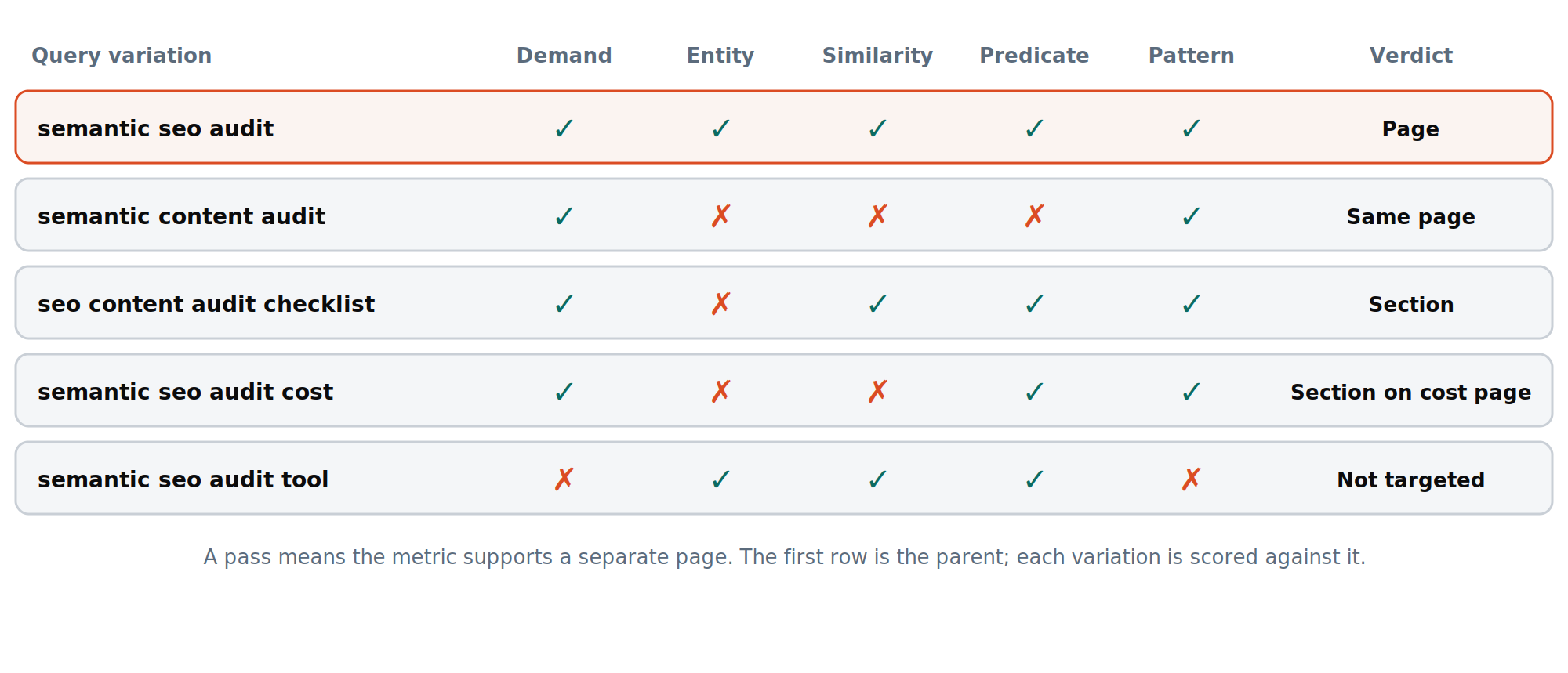
Digital Vikingz scores the count. Four or five passes make a page. Three passes make a page when one is entity or predicate, and a section otherwise. Two passes make a section, and one or none make a sentence.
How does Query Deserves a Page score the semantic SEO audit query network?
Applied to this site's audit queries, the test gives one page, two sections and one query left untargeted.
'Semantic SEO audit' and 'semantic content audit' share the entity, the top results and the predicates, so they share one page. 'SEO content audit checklist' keeps the entity and changes the predicate to 'follow' rather than 'buy', so it becomes a section on the audit page.
'Semantic SEO audit cost' has a distinct predicate on the same entity, and becomes a section on the existing cost page for the service line.
'Semantic SEO audit tool' names a different entity, a tool, and deserves a page only when the site offers one. Digital Vikingz offers none, so the query stays untargeted.
What happens when a site skips the Query Deserves a Page test?
Skipping the test either splits one intent across two pages or crowds several intents onto one page.
Two pages for one intent split the clicks, internal links and anchor text between them. Google's ranking systems guide states that deduplication hides very similar pages and shows only the most relevant. The site still pays to crawl, render and evaluate both.
One page for four intents gives each intent a paragraph, none a main component and none a full answer. The fix is the test run in reverse: split the intents that pass into their own pages.
Google Search Console shows both errors: two URLs trading impressions on one query week by week, or one URL with impressions across unrelated queries and no clicks.
How does the result overlap test settle Query Deserves a Page cases?
The overlap test counts shared top-ten results between two phrasings, and six or more shared results means one page.
A lapsed Google patent on query augmentation describes matching two phrasings by the results they share. Digital Vikingz treats the expired patent as design logic, not a guarantee.
Five or fewer shared results means checking the page type of the top results. Matching page types still mean one page, and different page types mean a second page.
Each target market gets its own count, because a top ten from the wrong country or language gives a wrong verdict.
Which cases override the Query Deserves a Page count?
Four cases override the count: distinct predicates, brand entities, dependent entities and a shifted center.
Distinct predicates open a page even when the entities look alike, once demand exists. A different entity with the same predicates also opens a page.
A brand or manufacturer entity earns its own page even on borderline demand, because brands carry a pattern of price, review and comparison queries. Dependent entities work the other way: two product models whose attribute values barely differ share one page, with a section per model.
A shifted center reruns the test. A query network's center sometimes moves from a brand to one of its products, and the page decisions around the new heaviest term are scored again.
What are the three outcomes of Query Deserves a Page?
The three outcomes are a page, a section or a sentence.
A page gets its own URL, main component and roadmap row. A section gets an H2 on the parent with its own id and opening sentence, so it lifts cleanly as a passage. A sentence gets a place in the parent's body, usually as an attribute value or a FAQ answer.
The topical map records which outcome each variation received, and why. Some page types go finer than a sentence: a table row, a filter value, a calculator input or a card.
A section is the most common outcome, because most variations fail at least three checks. A page count that matches the query count is the sign the test never ran.
- Koray Tuğberk Gübür, Search Engine Land: How semantics and topical authority improve local SEO
- Google Search Central: A guide to Google Search ranking systems
- US 9,916,366 B1: Query augmentation (Google, expired)
Patents and filings describe systems Google has invented. None is a confirmed ranking factor.
What should you read after query deserves a page?
 What is a topical mapEvery topic a site will cover, with a page decision for each.
 Query templatesA repeatable search pattern with a variable entity, such as [service] in [city].
 What is a content briefThe document that turns one row of the topical map into one page.
 What is topical authorityRanking across the whole network of queries around one topic.
 Semantic SEO StrategyYour topical map and 12-month publishing plan.
 Semantic SEO AuditA fixed-scope review of what holds rankings back.
 Talk to usMessage the team on WhatsApp
Questions about query deserves a page
How much demand is enough for Query Deserves a Page?
How does term weight change the similarity check?
Does the test apply to location pages?
Does the test apply to ecommerce filters?
Who decides borderline cases?
Can a section be split into its own page later?
Can two pages that pass the test still cannibalize each other?
Does Query Deserves a Page apply to blog posts?
Is Query Deserves a Page a Google system?
What data does the test need?
What happens to existing pages that fail the test?
See it applied to your site
The Semantic SEO Audit uses every term in the knowledge hub. Fixed scope, written deliverable.