 Digital Vikingz
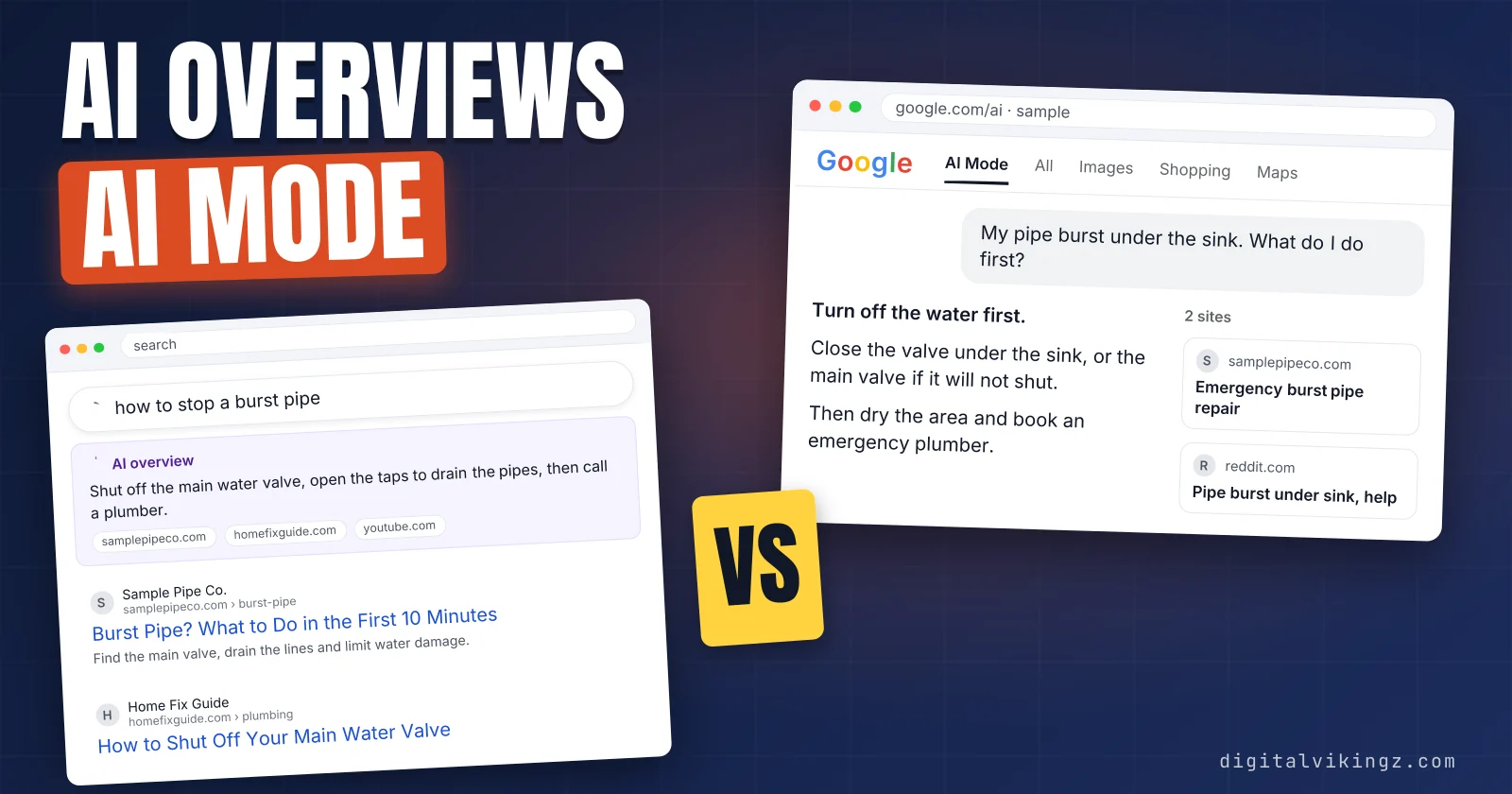
AI Overviews and AI Mode are the two generative AI features in Google Search, and both answer with links to supporting pages. AI Overviews appear on the Google results page for some searches, while AI Mode is a separate conversation a searcher opens on purpose.
Both features run on Gemini models and may use query fan-out, a method of running several related searches for one question. The full AI Mode picture sits in a guide to what Google AI Mode changes for business websites.
Ahrefs found that the two features usually reach the same meaning in different words, with AI Mode answers about four times longer. Google shows an AI Overview only when the summary is judged additive, while AI Mode answers far more queries.
The two features cite different pages because Google may run each one with different models and techniques. An AI Overview citation overlap tracker follows how often cited pages also rank in the top 10. Ahrefs found the same URLs cited in both features only 13.7% of the time.
Pew found clicks on a classic result in 8% of visits with an AI Overview, against 15% without one. Knowing why a page gets impressions and no clicks separates the AI Overview cause from other causes. No public study measures AI Mode clicks on their own, because Google Search Console counts both features inside Web search.
Teams that read the Google Search Console generative AI report see impressions from both features and no clicks. One page qualifies for both features once Google can index the page and show a snippet, so one strategy covers both.
A follow-up question carries a searcher from an AI Overview into AI Mode. Google tested hiding that path for some users on 13 November 2026.
Monthly AI Search Visibility checks read the two features apart for that reason. Google has not merged the two features, and searchers can still skip both through the Web filter.
What is the difference between AI Overviews and AI Mode?
AI Overviews appear on the Google results page for some searches, while AI Mode is a separate conversation a searcher opens on purpose. An AI Overview is the AI answer at the top of the results: an AI-generated summary with links to the pages that support the summary.
AI Mode, the AI tab in Google Search, answers in a longer AI response with links to supporting pages. The searcher can ask follow-up questions in the same thread. Google describes AI Mode as a new tab in Search that people can choose to use.
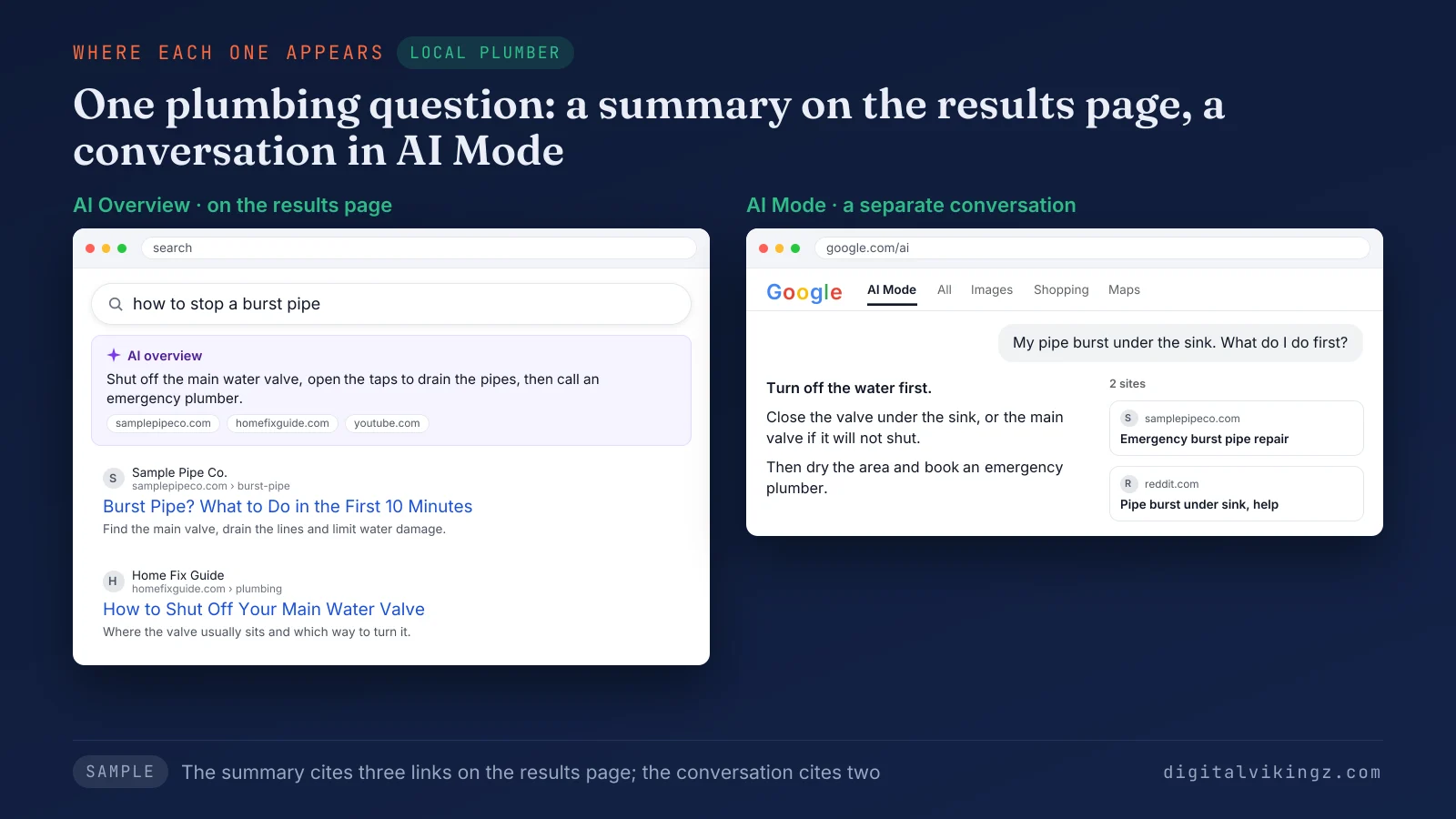
The sample plumber question returns an AI Overview with three links on the results page and an AI Mode reply with two links.
The main differences between the two features are compared in the table below:
| Attribute | AI Overviews | AI Mode |
|---|---|---|
| Where the feature appears | On the Google results page, above or among the links | In a separate AI Mode conversation |
| How the feature starts | Google decides, only when a summary is judged additive | The searcher chooses to open AI Mode |
| Interaction | One summary per search | A thread of follow-up questions |
| Answer shape | Short summary with links | Longer, multi-part response with links |
| Sources | Pages backed by top web results | Fan-out searches, the Knowledge Graph and shopping data |
The two features still share one engine underneath the differences.
What do both features have in common?
AI Overviews and AI Mode share three things: Gemini models, Google's Search index and the query fan-out method.
The three things both features share are listed below:
- Gemini models: Google runs both features on custom versions of its Gemini models.
- Search index: both features retrieve pages through Google's core ranking systems and link the pages that support the answer.
- Query fan-out: both features may run several related searches across subtopics for one question.
The fan-out steps belong to the wider story of what Google AI Mode changes for business websites. Our guide to what Google AI Mode changes for business websites walks through the fan-out steps and the full AI Mode definition. One engine underneath still produces two different answers to the same question.
Do the two features give the same answer?
An AI Overview and an AI Mode answer usually reach the same meaning in different words, an Ahrefs study of 730,000 response pairs found. Ahrefs measured 86% average semantic similarity between the paired answers, with only 16% of the words shared.
AI Mode answers ran about four times longer and named 3.3 entities each, against 1.3 in an AI Overview. The study used US data from September 2025 and was published by Ahrefs on 15 December 2025.
A business named in a short AI Overview can still be missing from the longer AI Mode answer. Google also decides when each of the two features appears at all.
Which searches trigger AI Overviews and AI Mode?
Google shows an AI Overview only when its systems judge the summary additive to classic Search, while AI Mode answers whatever a searcher asks. Google states that AI Overviews often do not trigger. AI Mode gives an AI-powered response for far more queries, according to Google.
Pew Research Center found an AI Overview on 18% of Google searches in a March 2025 panel of 900 US adults. Pew calls an AI Overview an AI summary.
The search types Pew linked to AI Overviews are listed below:
- Short searches: 8% of one- or two-word searches showed an AI Overview.
- Long searches: 53% of searches with 10 or more words showed an AI Overview.
- Question searches: 60% of searches starting with who, what, when or why showed an AI Overview.
Question searches about a business's service or product are the searches most likely to show an AI Overview. The two features' sources then decide which business websites the searcher sees.
How do AI Overviews and AI Mode choose different sources?
The two features choose different sources because Google may run each feature with different models and techniques. Google's own explainer adds that a different set of responses and links will likely appear for the same query.
A cited page is a page that shows up among the supporting links of an answer. Google states that AI Overviews are built to surface information backed up by top web results.
AI Mode also draws on the Knowledge Graph and real-world information beyond web pages. Google's May 2025 explainer counts shopping data for over 50 billion products behind AI Mode. Each follow-up question in AI Mode runs the search process again, with the earlier conversation as context.
The AI Overview side has a measured record of its own, kept in an AI Overview citation overlap tracker. Our AI Overview citation overlap tracker reconciles every study of how often cited pages also rank in the top 10. The overlap between the two features themselves has a measured value too.
How often do both features cite the same page?
AI Overviews and AI Mode cited the same URLs only 13.7% of the time in an Ahrefs study of 540,000 query pairs. The overlap rose to 16.3% when Ahrefs compared only the top three citations of each answer.
Ahrefs found no cited source at all in 11% of AI Overviews and in 3% of AI Mode responses. An earlier Ahrefs study found that 45% of AI Overview citations change between generations, so one snapshot can understate the overlap.
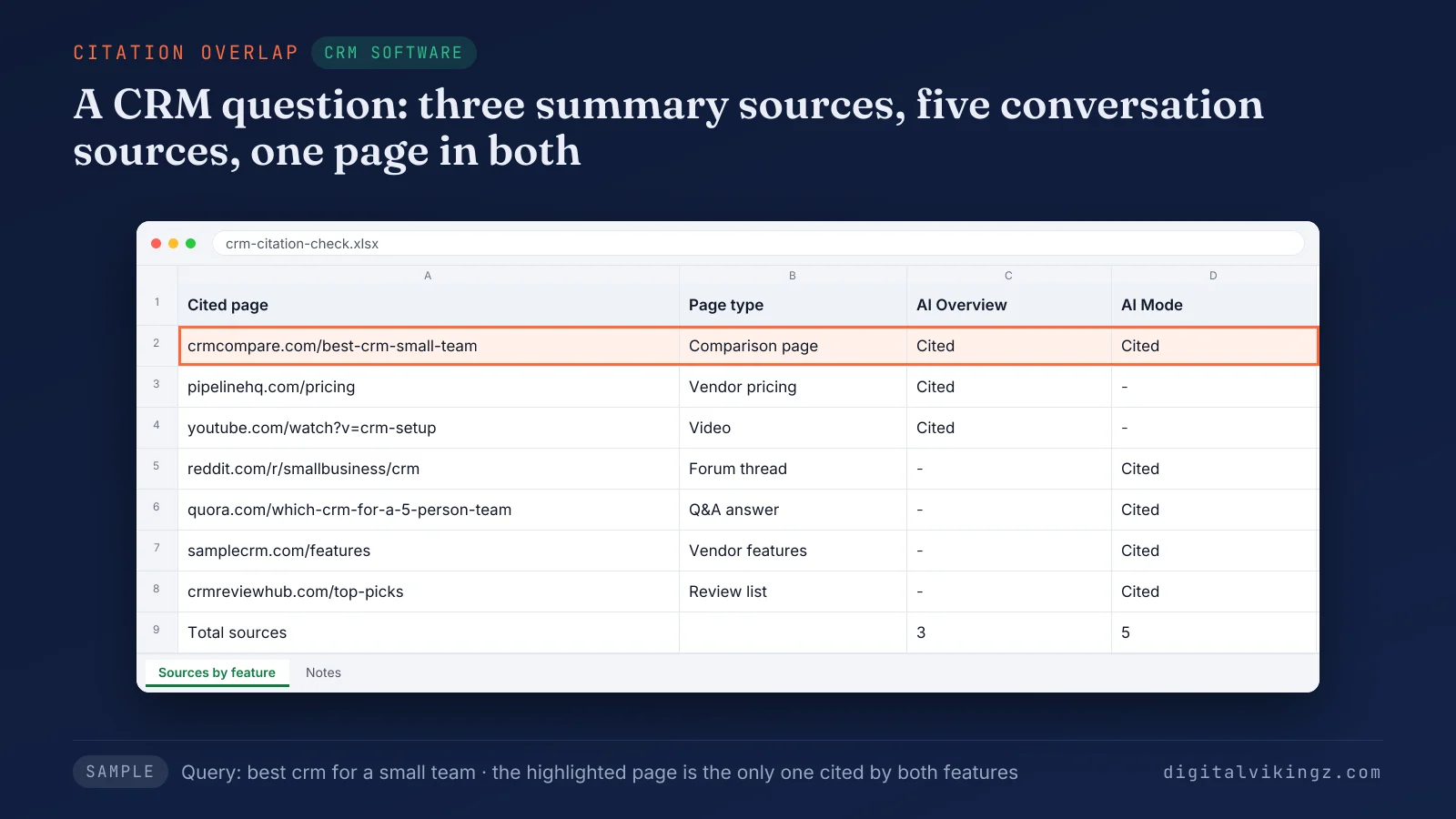
One sample CRM comparison page is the only link shared by the three-link AI Overview and the five-link AI Mode answer. Different citations in the two features lead to different clicks for the pages that are cited.
How do AI Overviews and AI Mode affect clicks?
AI Overviews are linked to fewer clicks on classic results in three independent studies, while AI Mode clicks have no public measurement yet.
The three studies of clicks next to AI Overviews are listed below:
- Pew Research Center, March 2025, 900 US adults: classic results drew clicks on 8% of visits with an AI Overview and 15% without one.
- Ahrefs, December 2025 data on 300,000 keywords: the top-ranking page had a 58% lower average click-through rate when an AI Overview appeared.
- Seer Interactive, 3,119 informational queries from June 2024 to September 2025: organic click-through rate with an AI Overview fell from 1.76% to 0.61%.
Pew found clicks inside the AI Overview on only 1% of visits. Seer also saw organic click-through rate fall to 1.62% by September 2025 on queries without an AI Overview. Seer's Q3 2025 data links citation with more clicks: 0.70% click-through rate when cited, against 0.52% when not.
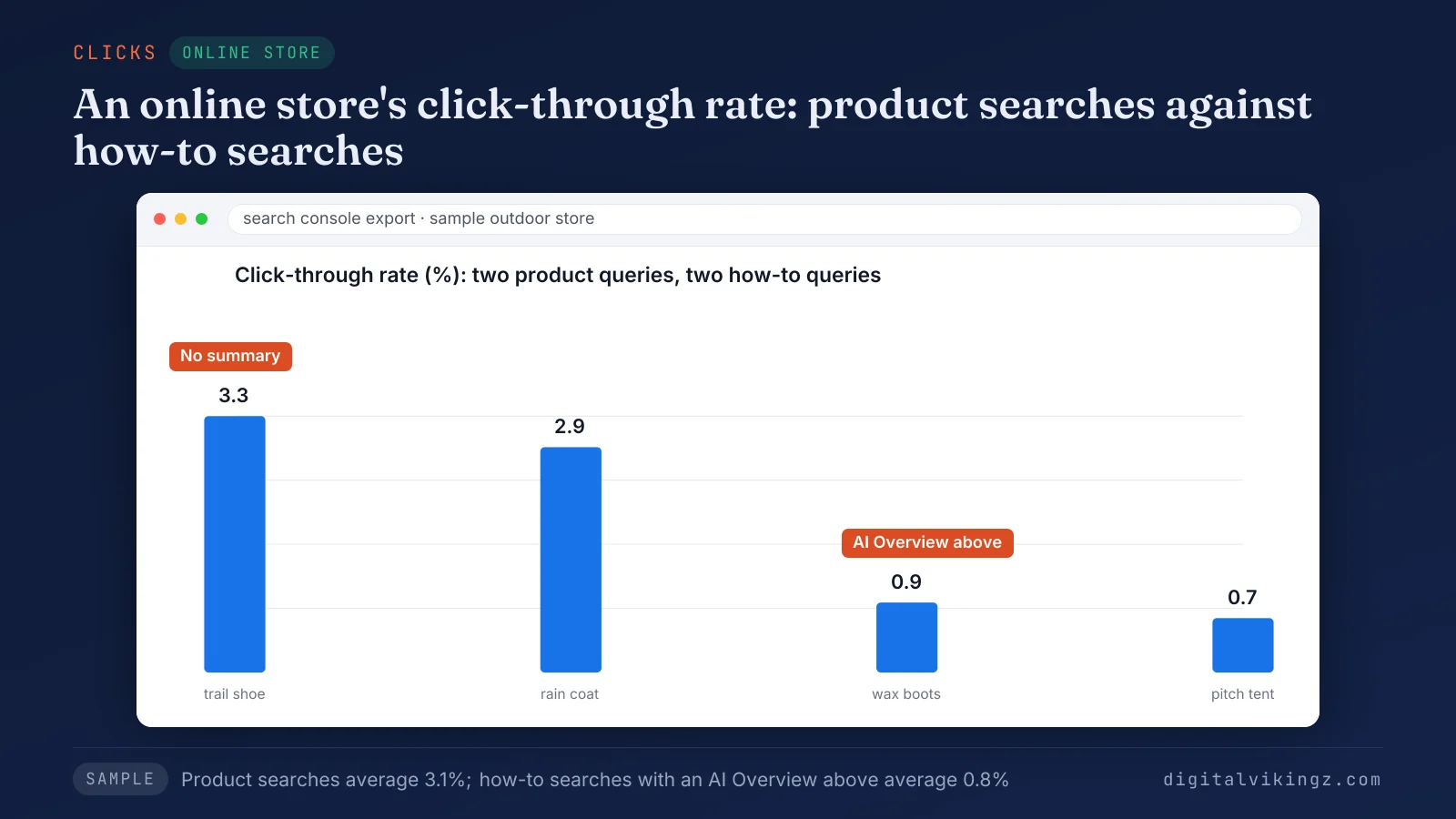
The sample store chart shows 0.8% click-through rate on how-to searches with an AI Overview, against 3.1% on product searches without one.
Knowing why a page gets impressions and no clicks takes several checks. Our diagnosis of why a page gets impressions and no clicks separates features above the result from title and intent causes. AI Mode clicks raise a harder question, because the reports blend both features.
Does AI Mode send fewer clicks than AI Overviews?
AI Mode clicks have no public comparison with AI Overview clicks, because Google Search Console counts both features inside Web search. One AI Overview takes one position, and every link inside the overview shares that position.
AI Mode follows the position rules of a results page, and a follow-up question counts as a new query. Google's generative AI performance report lists impressions from both features and no clicks. GA4 files clicks from both features under Organic Search, unlike the assistant visits covered in tracking ChatGPT traffic in GA4.
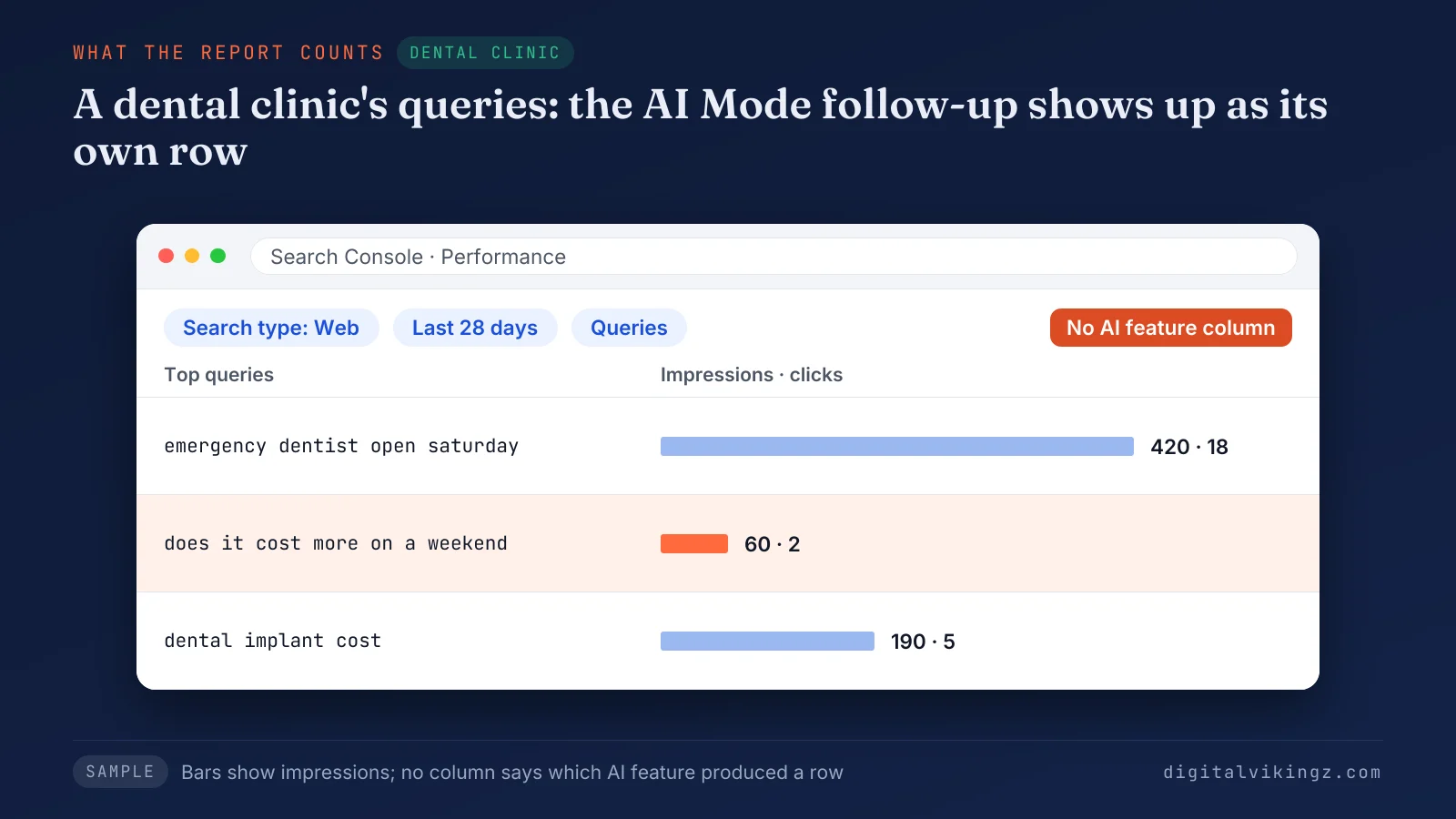
The sample dental rows show the AI Mode follow-up as its own query with 60 impressions and 2 clicks. The main query above shows 420 impressions and 18 clicks.
Teams that read the Google Search Console generative AI report see impressions by page. Our walkthrough shows how to read the Google Search Console generative AI report page by page. Citations stay the part a business can work on in both features.
How does one website earn citations in both AI Overviews and AI Mode?
One website earns citations in both features by meeting Google's Search requirements and answering each topic's follow-up questions. Google states that a page needs to be indexed and eligible for a snippet, with no additional technical requirements for either feature. An llms.txt file is not one of those requirements, because Google Search ignores the file.
The five steps that qualify one page for both features are listed below:
- Keep the page indexable and snippet-eligible, so both features can link the page.
- Open each section with a direct answer to one buyer question, so either feature can quote the passage.
- Cover the follow-up questions on the same page, because both features may run fan-out searches across subtopics.
- Avoid a new page for every fan-out question, which Google treats as scaled content abuse when made to manipulate AI answers.
- Keep Google Business Profile and Merchant Center details current, because Google lists both as best practices for AI features.
We apply the same five steps to every page we prepare for AI search visibility. The five steps also settle how many plans a business needs.
Does a business need two strategies, one for each feature?
A business does not need two strategies for AI Overviews and AI Mode, because Google applies the same Search requirements to both features. Google states that SEO best practices remain relevant and that neither feature needs special optimization.
The checks still need to run separately, because one page can be cited in one feature and missing from the other. Claims that each feature needs its own plan rest on different citations, not on different rules.
The way searchers move from one feature to the other shows why separate checks matter.
How do AI Overviews lead searchers into AI Mode?
AI Overviews lead searchers into AI Mode through a follow-up question, which continues the conversation in AI Mode. Google Search Help describes the move from an AI Overview into a deeper AI Mode conversation on mobile devices.
Google Search Help titles the move "Continue your conversation in AI Mode". The entry points into AI Mode are listed below:
- AI Mode tab: a tab in the results bar that opens AI Mode, added for US users on 20 May 2025.
- Ask anything box: a follow-up box under an AI Overview that sends the next question into AI Mode.
- google.com/ai: a direct address that opens AI Mode without a results page.
Search Engine Roundtable reported on 13 November 2026 that Google tested hiding the AI Mode tab and the Ask anything box for some users.
A searcher who follows an AI Overview into AI Mode meets a new answer with a new set of links. A business cited in the AI Overview has to earn a citation again in that new answer.
Entry points that change in tests are one reason monthly AI Search Visibility checks read both features. Our monthly AI Search Visibility checks run the same prompt set in AI Overviews and in AI Mode, then record each feature's citations. Tests on both entry points raise the question of a merger.
Has Google merged AI Overviews into AI Mode?
Google has not merged AI Overviews into AI Mode, and both features stayed separate in Google's documentation on 18 November 2026. Search Central still lists AI Overviews as one AI feature in Google Search and AI Mode as another.
Google Search Console Help describes AI Mode as a feature that expands on AI Overviews with a more interactive response. The November 2026 changes were tests for some users, not launches.
Posts that describe a merger usually describe the follow-up path from an AI Overview into AI Mode. A business should re-check both features after each reported test, because a missing entry point changes how searchers reach AI Mode.
Some searchers avoid both features altogether.
Can searchers skip both features?
Searchers can skip AI Mode by never opening AI Mode, and the Web filter shows only web links in place of an AI Overview. Google Search Help calls AI Overviews a core Search feature, like knowledge panels.
No Google setting switches AI Overviews off, according to Google Search Help. The Web filter appears after a search and lists only web links.
Classic web results still collect the clicks of searchers who choose the Web filter or never open AI Mode. AI Overviews, AI Mode and classic results now form three places where a buyer meets a business website.
Questions about Google's two AI features
Is AI Mode part of the Gemini app?
AI Overviews and AI Mode are features of Google Search, and the Gemini app is a separate Google assistant. All three run on Gemini models, which explains the shared name.
How many people use AI Overviews?
More than 1.5 billion people used AI Overviews by May 2025, according to Google. Google reported more than a billion users in March 2025, two months earlier.
Which sites do AI Overviews cite most often?
YouTube led AI Overview citations in Ahrefs' September 2025 data, while Quora appeared about 3.5 times more often in AI Mode. The figures describe one US data set and can shift as both features change.
Does a brand in an AI Overview also appear in AI Mode?
A brand named in an AI Overview had a 61% chance of appearing in the AI Mode answer to the same query, Ahrefs found. AI Mode answers named 2.5 times more people and brands than AI Overviews in the same study.
When did AI Overviews launch?
AI Overviews launched in the US in May 2024 at Google I/O, replacing the Search Generative Experience. AI Mode followed in Search Labs on 5 March 2025.
What is the first check for both Google AI features?
The first check for AI Overviews and AI Mode is whether crawlers can read the page buyers reach most and quote its answers. The free AI Visibility Checker reads up to five public pages and checks crawler access and answer readiness.
You can check one page with the AI Visibility Checker before a strategy call. Digital Vikingz is a semantic SEO agency. Our team prepares service and product pages for AI Overviews, AI Mode and the classic results, starting with a strategy call.