 Digital Vikingz
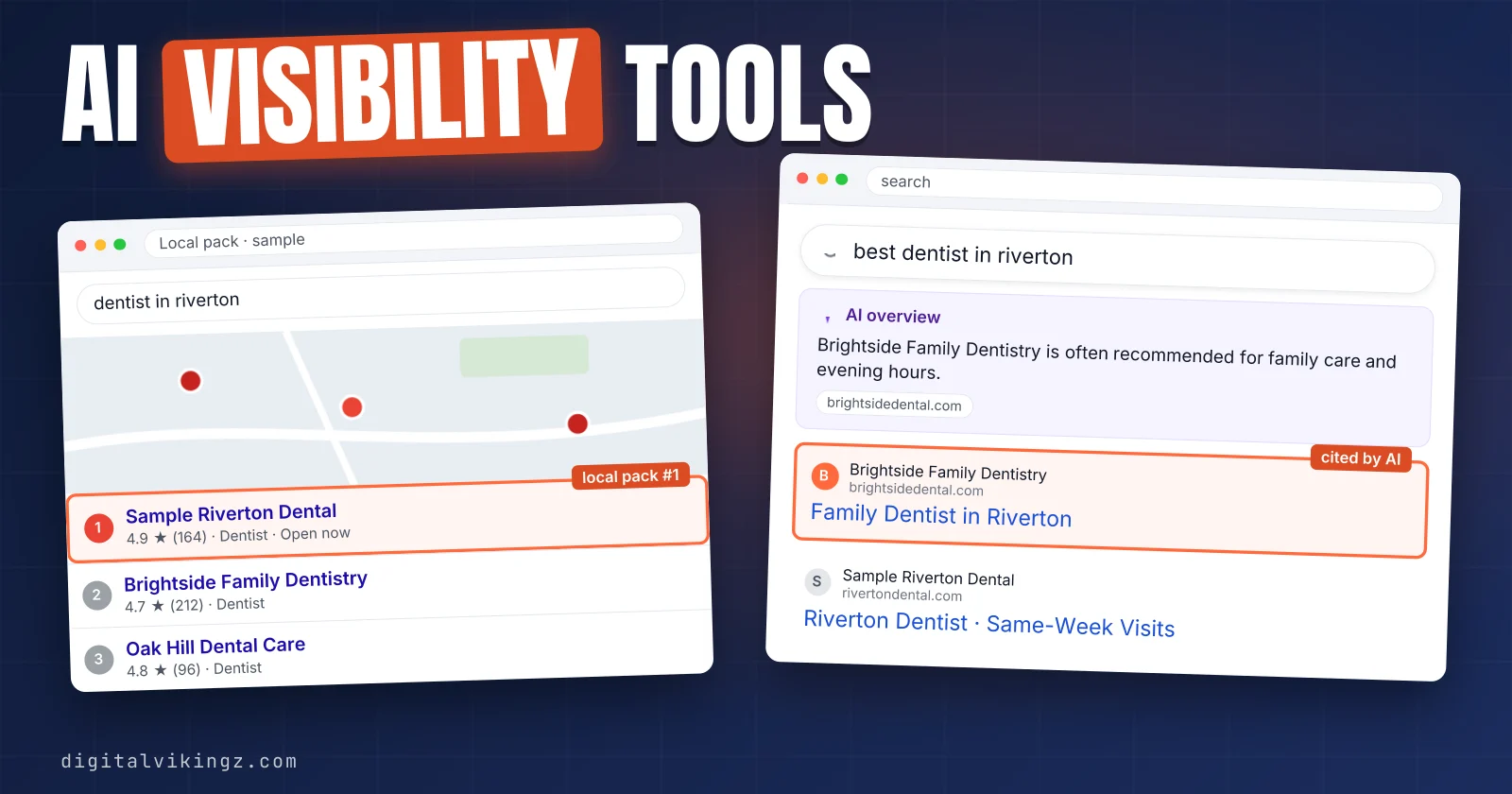
AI visibility tools are software that run a fixed prompt set across AI engines on a schedule and record brand mentions and citations. Five types exist: free first-party reports, one-off checkers, AI modules inside SEO suites, dedicated prompt trackers and home-built API checks.
The types differ most on engines covered, prompt allowance, repeated runs, kept answer text, collection method and price unit. Every feature and price below comes from the vendor's own page, read on 19 November 2026.
A tracker fits a situation when its prompt allowance, engines and locations match what a business must repeat each week. A tracker measures AI visibility and does not earn mentions or fix the pages AI answers cite.
Separate guides explain mention rate and citation rate, plus the steps for reading the Google Search Console generative AI report. Two more guides cover a manual check of what ChatGPT and AI Overviews say about a business and an enterprise LLM visibility framework. The AI Visibility Checker readiness check and the AI Search Visibility service cover the work around the numbers.
What is an AI visibility tool?
An AI visibility tool is software that runs a fixed prompt set across AI engines on a schedule and records brand mentions and citations.
Each run sends the same prompts to engines such as ChatGPT, Perplexity, Gemini and Google AI Overviews. The software then parses every answer and saves the result. Identical prompts on every run let the next reading compare like with like.
The software also logs position in the answer, sentiment and the competitors each answer names.
A rank tracker records where pages appear in search results, while an AI visibility tracker records whether an answer names the brand. SE Ranking draws the same line in the rank tracking question of its product FAQ.
Vendors also sell the same product as an LLM visibility tool, an AEO tool or a GEO tool. What the software records decides what a team can measure.
What does an AI visibility tool record?
An AI visibility tool records five things per answer: brand mentions, cited URLs, position in the answer, sentiment and the competitors named.
A brand that shows up in a ChatGPT answer earns a mention. A brand page that the answer links to earns a citation. Position shows whether the brand comes first or after rivals, and sentiment labels the tone.
Share of voice adds the mentions across a prompt set and compares the brand with named competitors.
Some tools keep the full answer. Ahrefs states that Brand Radar stores every response, and SE Ranking opens each metric into the AI response behind the number. A kept answer lets a team check a number against the words the engine used.
How each count becomes a rate is set out in our guide to mention rate and citation rate.
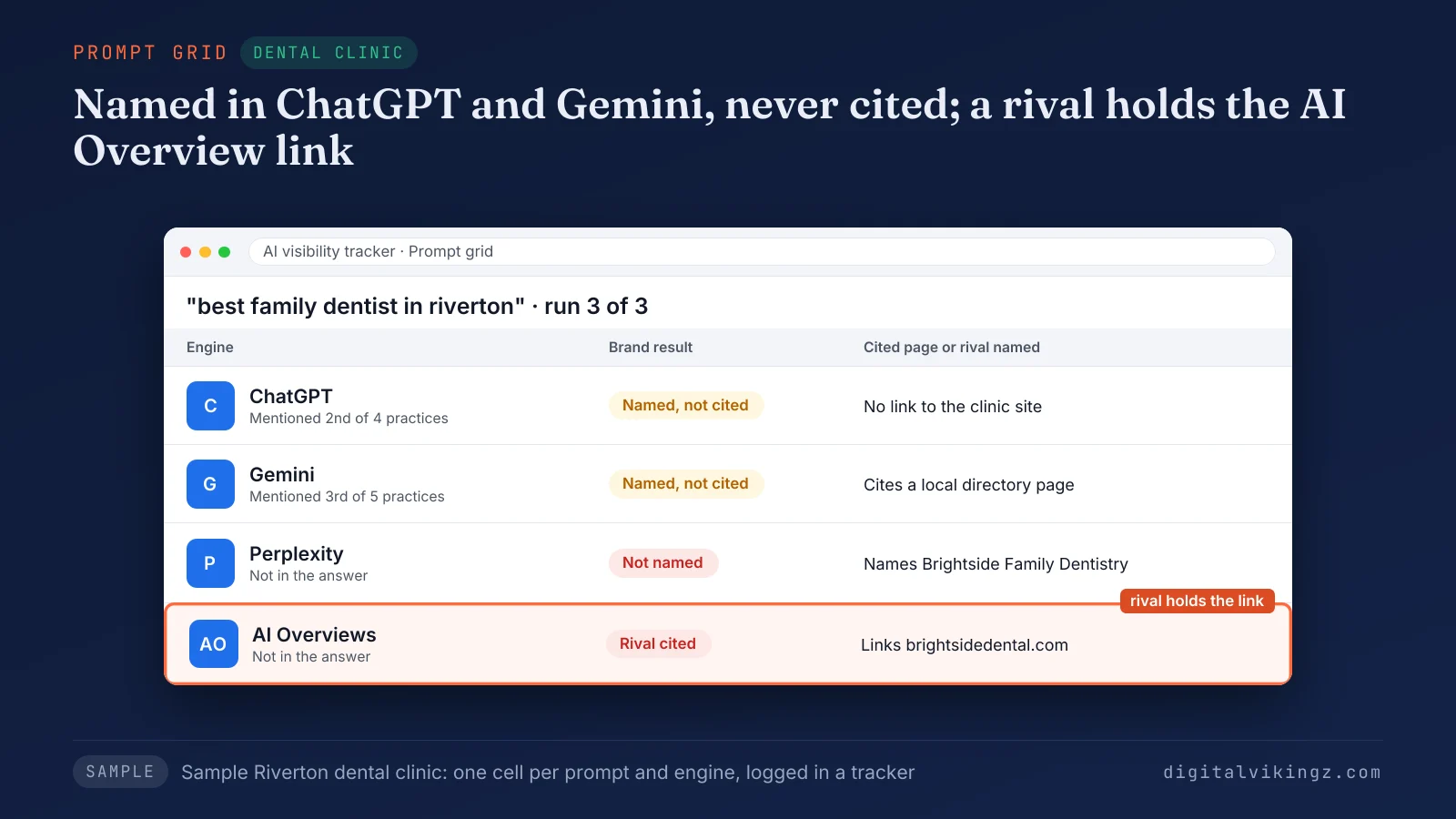
The dental sample shows the clinic named in ChatGPT and Gemini but not cited. A rival practice holds the AI Overview link in the same sample. Some products read the record once, and others repeat the record every day.
Is an AI visibility checker the same as a tracker?
An AI visibility checker is not the same as a tracker, since a checker takes one snapshot and a tracker keeps history.
A tracker reruns the same prompts on a schedule and adds each run to the history. SE Ranking's free check reads a domain and up to five competitors across AI Overviews, AI Mode, ChatGPT and Gemini. SE Ranking allows five free checks a day.
SE Ranking itself advises judging a score over 14 to 30 days, because AI answers change from one run to the next. Checkers and trackers are two of five tool types.
What are the types of AI visibility tools?
AI visibility tools fall into five types, grouped by who runs the prompts and where the answer data comes from.
The order runs from free reports to the deepest tracking, with home-built checks last. The five types are listed below:
- First-party reports: Google, Microsoft and OpenAI count a site's own appearances in their AI answers in free dashboards. Examples are the Google Search Console generative AI report, Bing Webmaster Tools AI Performance and ChatGPT Business Hub.
- One-off checkers: free vendor pages read a few AI answers once for a domain. SE Ranking's free check is one example.
- AI modules in SEO suites: an SEO platform adds prompt tracking beside its search tools. Examples are the Semrush AI Visibility Toolkit, Ahrefs Brand Radar and SE Ranking's SE Visible.
- Dedicated prompt trackers: products built only to run prompts and record AI answers. Peec AI and Profound are two examples.
- Home-built API checks: a prompt set goes to each AI provider's API on a schedule and lands in a sheet or database. Our own client prompt runs work the same way.
Content optimizers that grade a page against competitors run no prompts. The optimizers therefore sit outside the five types.
AI visibility tracking measures one part of AI SEO, the wider practice of earning mentions and citations that our AI SEO guide covers. Two of the five types cost nothing.
Which AI visibility tools are free?
Free AI visibility tools are the first-party reports from Google, Microsoft and OpenAI, plus one-off checkers on vendor sites.
The Search Console report covers AI Overviews and AI Mode and has been open to all websites since 31 August 2026. The report shows impressions, not clicks or queries. Google describes the report's impressions as "How often URLs from your site appeared in generative AI features in Search and Discover."
Bing Webmaster Tools AI Performance, in public preview since 10 February 2026, counts citations of a site's pages in Microsoft Copilot and Bing AI summaries.
ChatGPT Business Hub, an OpenAI beta opened on 10 November 2026, shows a verified business aggregated mentions, website clicks and discovery topics. OpenAI shows the Business Hub figures only above a privacy threshold.
None of the three reports shows the answer text, the prompts or the competitors named beside the site. Each metric and its limits are set out in our guide to reading the Google Search Console generative AI report.
Paid tools add the answer text and the competitors, which is where judging criteria start.
How do you judge an AI visibility tool?
An AI visibility tool is judged on seven criteria that decide whether its numbers can be trusted, not on feature count.
The seven criteria for judging an AI visibility tracker are listed below:
- Engines covered: the plan being priced includes the engines the buyers use. Coverage changes by plan, since Peec AI's Starter tracks 3 models and Ahrefs adds Claude only to custom prompts.
- Prompt control: the team enters its own prompts. Ahrefs separates its AI Visibility Index from Custom Prompts, because a database of other people's prompts answers a market question.
- Runs per prompt and frequency: how often the tool runs, daily, weekly or monthly, and how often each prompt repeats. Repeats matter, because the same prompt returns different answers between runs.
- Answer text kept: the full answer sits next to each number. A stored answer turns a disputed number into a sentence the team can read.
- Citation URLs captured: the tool logs the exact pages each answer cites. A cited page that never names the brand earns a link without a recommendation.
- Location and language: country, city and language are set per prompt. Semrush ties Brand Performance to one location and language.
- Export or API: CSV, API or connector access moves the data into the team's reports. Each paid tool in the table below documents CSV export, an API or both.
Results differ by engine, so an engine count matters only for the engines a business's buyers use. One criterion sits behind every engine column: how the tool collects the answers.
Do API answers match what users see in AI chat apps?
API answers do not always match what users see in AI chat apps, so the collection method changes what a tracker reports.
Some trackers collect answers through each engine's chat interface, and others call the model's API. SE Ranking states that its tracker opens each engine "in a real browser session, the same way a person would."
SE Ranking collects ChatGPT, Copilot, AI Overviews, AI Mode and Gemini through the interface and Claude through the API. Peec AI lists chat platforms and API models as separate choices on its pricing page.
Our own client prompt runs go through each provider's API, so our numbers carry the same limit. A buyer should ask which method each engine uses before comparing two trackers. The comparison table names the method wherever the vendor documents the method.
How do AI visibility tools compare on documented features?
AI visibility tools differ most on engines covered, prompt allowance and collection method, because every paid tool records mentions and citations.
The table compares eight tools on six documented features, using each vendor's own page as read on 19 November 2026:
| Tool (type) | Engines named | Prompts and frequency | Answer text and citations | Collection method | Export or API | List price |
|---|---|---|---|---|---|---|
| Google Search Console generative AI report (first-party) | AI Overviews, AI Mode, Discover | No prompts; searches by date | Impressions only; no answer text | Google's own data | Export; no API | Free |
| Bing Webmaster Tools AI Performance (first-party) | Copilot, Bing AI summaries, partners | No prompts; citation timeline | Citations, cited pages; no answer text | Microsoft's own data | Not stated | Free preview |
| Semrush AI Visibility Toolkit (suite module) | Google AI Mode, ChatGPT | 25 prompts, daily | Mentions, sentiment, share of voice | Not stated | 10 CSV exports a day | $99 a month |
| Ahrefs Brand Radar (suite module) | AI Overviews, AI Mode, ChatGPT, Perplexity, Gemini, Copilot, Claude | Own prompts; daily, weekly or monthly | Stores every response | Not stated | API and MCP on paid plans | From $50 a month; Index from $199 |
| SE Ranking SE Visible (suite module) | ChatGPT, Claude, Copilot, AI Overviews, AI Mode, Gemini | 25 daily prompts; SE Visible from 75 | Answer behind each metric; cited links | Browser sessions; API for Claude | CSV, API, MCP, Data Studio | In SE Ranking plans |
| Peec AI (prompt tracker) | ChatGPT, Perplexity, Gemini and more; 3 on Starter | 50 daily prompts on Starter | Visibility, position, sentiment, source gaps | Chat apps and APIs listed apart | CSV; data API from Pro | $95 a month Starter |
| Profound (prompt tracker) | Up to 10, including ChatGPT, Claude, AI Overviews | Custom prompts, daily | Citations, sentiment, all-time history | Not stated | CSV, JSON and API | Custom Enterprise price |
| Home-built API check (our method) | Any engine with a public API | Any prompts, own schedule | Full API answer, returned URLs | Provider APIs only | Own sheet or database | API fees plus build time |
Each cell describes the plan on the vendor page that day, and "Not stated" means that page did not say.
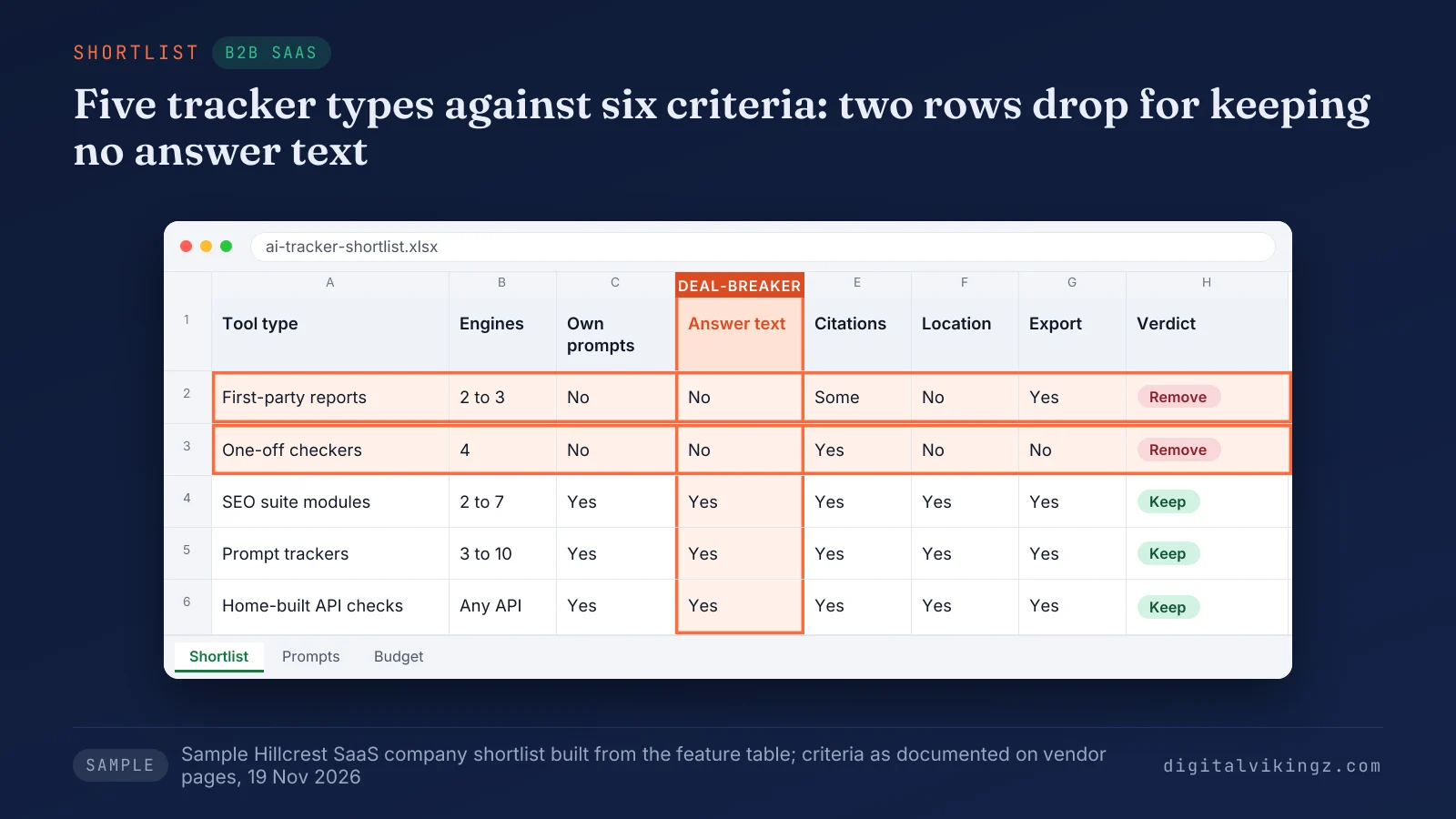
The SaaS team in the sample drops two rows, because neither row keeps the answer text the team needs for reviews. Price units differ as much as features.
How much do AI visibility tools cost?
Tracking AI visibility costs nothing in Google's and Bing's reports, and paid entry plans start at $50 to $99 a month.
Every price below was read on the vendor's own page on 19 November 2026. Buyers often call the units credits, and each vendor counts a credit differently. Paid tools charge by five units:
- Tracked prompts: the Semrush AI Visibility Toolkit costs $99 a month for 25 prompts, and 50 more prompts cost $60 a month.
- Checks: Ahrefs counts one prompt on one platform in one location as one check, and the $50 Basic package adds 2,500 checks a month.
- AI answers: Peec AI multiplies prompts by models by days, so Starter at $95 a month covers 4,500 answers.
- Seats and domains: Semrush charges $99 for each extra user licence and $99 for each extra domain or location, while Peec AI lists unlimited users.
- Quotes: Profound sells custom Enterprise plans after retiring its $399 and $499 self-serve plans in September 2026.
Claude costs more inside Ahrefs Brand Radar, where each Claude update uses 8 checks. A low entry price can still cost more once engines, locations and runs are multiplied. The right unit depends on the business situation.
Which AI visibility tool fits your situation?
A tracker fits a situation when its prompt allowance, engines and locations match what a business must repeat each week.
Four situations decide which tool type fits:
- One local business: the free reports plus a monthly manual check fit first. A suite module follows once the prompt list is fixed, such as the 25 daily prompts in Semrush's toolkit or SE Ranking's plans.
- Several locations or an online store: a tracker that sets country, city and language per prompt fits. SE Ranking documents 42 countries and 9 languages for SE Visible.
- An agency: a tracker with projects per client, shared prompt allowances and unlimited users fits, as Peec AI documents. A suite priced per seat, as Semrush documents, is the other route.
- An enterprise: a platform with custom prompt volumes, every engine the buyers use, an API and single sign-on fits.
No tool type wins every situation, so the shortlist starts from the situation. An AI visibility audit sets the prompts, engines and competitors before any tracker runs the prompts.
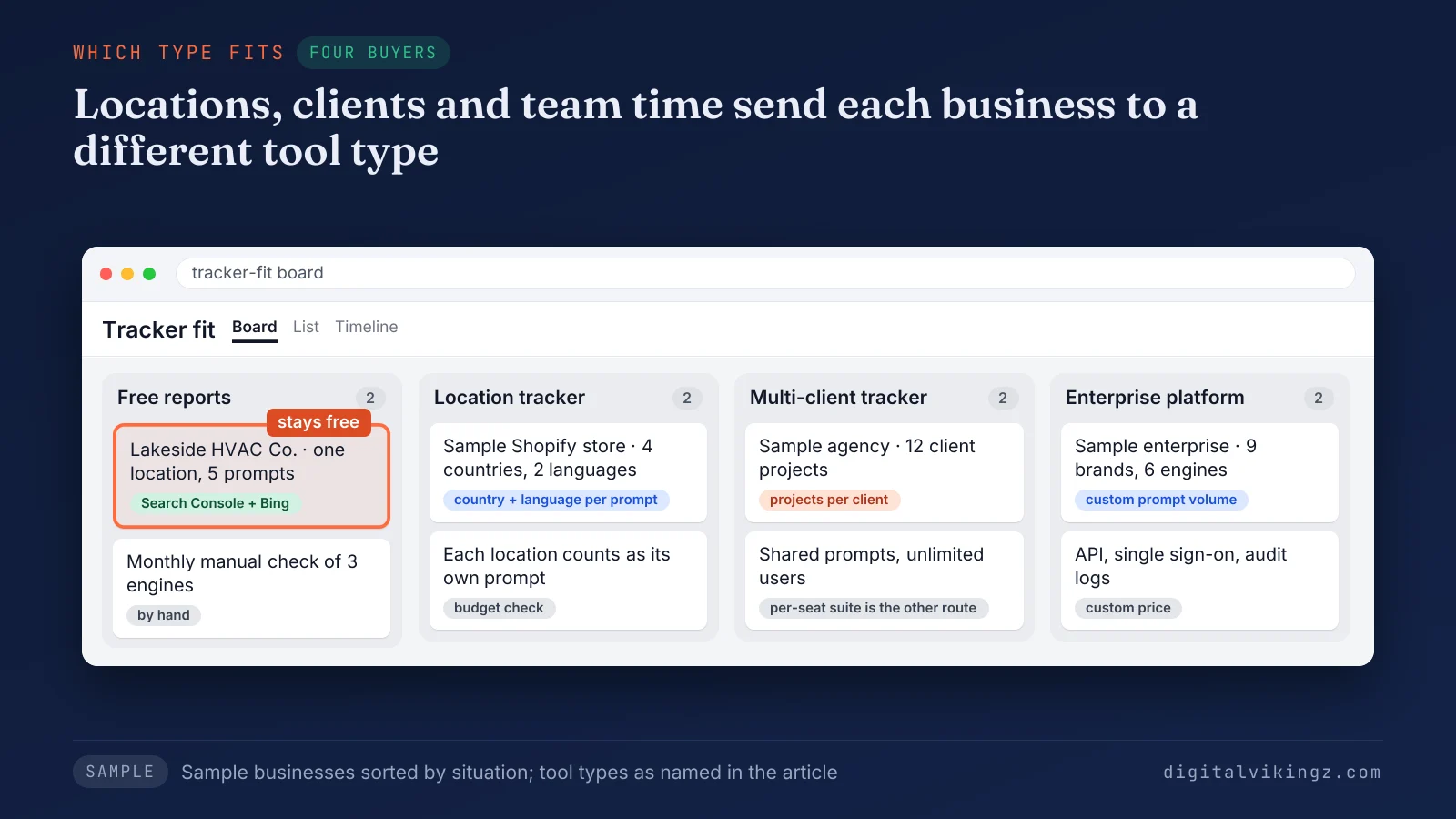
The HVAC firm in the sample stays on free reports. The store and the agency need location and project settings. A single business first asks when a paid tracker earns its cost.
When does a tracking tool earn its cost?
A tracking tool earns its cost when a fixed prompt set must run on several engines every week, a job too slow by hand.
Our manual method uses at least three runs per prompt on each engine. The same prompt can return a different answer on the next run.
Five prompts on four engines with three runs each make 60 readings a week, before any competitor is logged. The count grows again with every location or language the business serves.
The first baseline can still run by hand, using our manual check of what ChatGPT and AI Overviews say about a business.
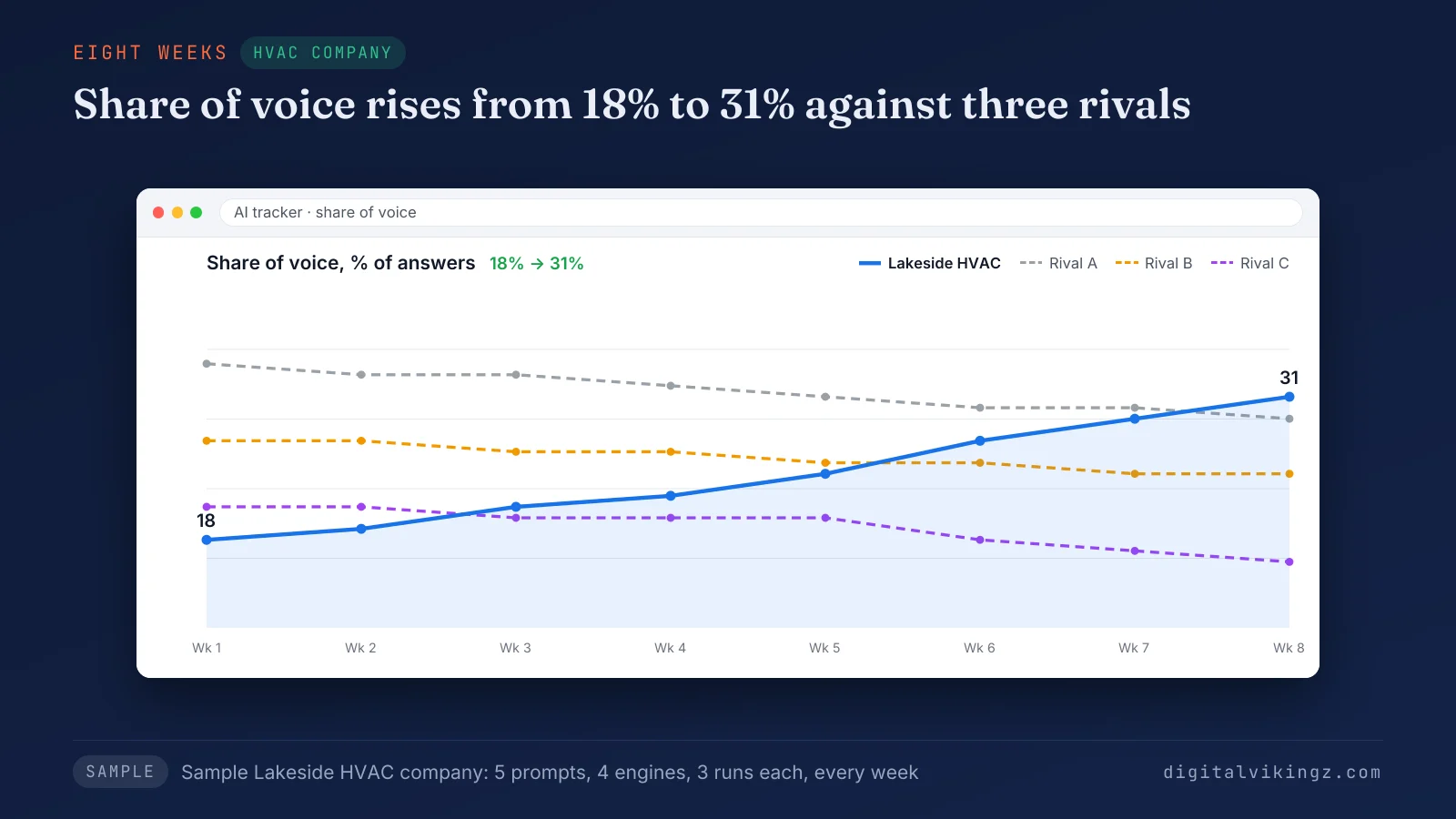
The HVAC sample rises from 18 to 31 percent over eight weeks. No single manual reading shows a trend of that kind. Large brands face the opposite question: which platform scales.
What should an enterprise LLM visibility platform include?
An enterprise LLM visibility platform should include custom prompt volumes, every engine the buyers use, API access, single sign-on and audit logs.
Semrush for Enterprise lists "Custom large-scale AI prompt tracking" and custom integrations with an API. Profound lists up to 10 answer engines on its Enterprise plan. Peec AI lists up to 26 LLM models on Enterprise.
Semrush for Enterprise lists single sign-on, team governance and audit logs. Profound lists CSV, JSON and API exports, and Peec AI Enterprise adds SSO and API access.
Both Semrush for Enterprise and Peec AI Enterprise offer daily or weekly tracking. Semrush for Enterprise and Profound Enterprise both show custom pricing instead of a list price.
How to weight the metrics and size a prompt set across many brands sits in our enterprise LLM visibility framework. Every platform also reports a score, and the scores do not line up.
Can you compare AI visibility scores across tools?
AI visibility scores do not compare across tools, because each vendor calculates its score with its own formula.
Semrush compares a brand's mentions across tracked prompts with the median mentions of competitors the toolkit picks automatically. Ahrefs defines share of voice as the percentage of AI responses in a topic set that mention or cite the brand. No industry standard fixes one formula, so equal scores from two vendors can describe different results.
Comparisons between trackers should use the raw counts each one records: mentions, citations and runs. A score is a measurement, and measurement is one part of the work.
What does an AI visibility tool not do?
A tracker measures AI answers, but the software does not choose the prompts, earn mentions, fix pages or explain why an answer changed.
Four jobs stay with people after a tracker is connected:
- Prompt choice: the tracker runs the prompts the team enters, so a weak prompt set gives a weak number faster. Prompts written from buyer questions keep the numbers tied to revenue, and the set needs review when the offer or the service area changes.
- Earned mentions: answers name brands that the cited sources name, so mentions come from content, listings and outreach. A tracker counts the mentions after the work is done.
- Page fixes: crawler access, answer-first passages and consistent entity facts sit on the site, outside any tracker.
- Cause of a change: the tracker records that an answer moved, and the cited sources show why. Reading the cited pages beside the kept answer text points to the cause.
We sell no tracking tool, and our work starts where the numbers stop. AI Search Visibility is the Digital Vikingz service built around the four jobs. Our AI Search Visibility service runs a fixed prompt set each month and fixes the pages and sources the answers cite.
An engagement starts with a 30-minute call, and the price follows as a written quote. Neither a tracker nor a service guarantees a mention, a citation or a ranking. Site fixes come before the first tracked prompt.
What should a site fix before tracking AI visibility?
A site should fix crawler access, entity clarity and answer-first page structure before tracking AI visibility, because a tracker only measures the result.
Crawler access decides whether ChatGPT, Perplexity, Claude and Gemini crawlers can read the pages at all. Entity clarity means every page names the business, the offer and the area in the same words. Answer-first structure puts a direct answer under each heading, so an AI engine can lift one passage whole.
The AI Visibility Checker reads robots.txt, the sitemap, the homepage and up to four sample pages. The checker reads each page the way a crawler that does not run JavaScript reads a site.
The check is free and shows the result with no sign-up. A robots.txt file that blocks AI crawlers gives every tracker an empty reading, whatever the plan costs.
The checker measures readiness, not mentions, so the check sits before a tracker, not in place of one. Search Console, rankings and pages beyond the five sampled pages stay outside the checker's view.
Sites can run the free AI Visibility Checker readiness check before paying for prompt tracking. Our own research for the comparison met a different limit: paid data access.
What limits did we hit with paid SEO data connectors?
Paid SEO data connectors stopped our research when credits or plan limits ran out, the same kind of usage cap that shapes tracker plans.
Our OpenSEO connector returned keyword and SERP data for one batch of four calls on 18 November 2026. Every later call failed on insufficient credits. The Ahrefs connector answered "Insufficient plan", and the Semrush connector reported no units left.
Neither result is a test of an AI tracking product, and we draw no score or ranking from either result. Each cap decided how much data arrived. The price units above therefore matter more than the entry price.
A buyer should map prompts, engines and runs against each plan's cap before signing. Vendor pages print tracker caps in advance, so a buyer can price the limits before the first run.
Our home-built API check has its own limit: a provider without a key is skipped. A lapsed key therefore leaves a gap in the record. The script reports every skipped provider, so the gap shows in the run log instead of passing unseen.
No provider key was set on 19 November 2026, so no model answers feed any table cell. We record each cap and each skipped provider with its date, next to the data the cap affected.
Buyers ask five more questions before choosing.
Questions about AI visibility trackers
Do AI visibility trackers offer free trials?
Some AI visibility trackers offer free trials, such as SE Ranking's 14-day trial with no credit card, while Semrush's toolkit offers none. Google's and Bing's AI reports need only a verified site.
Can a tracker show visits from ChatGPT?
A tracker records answers, not visits, so visits from ChatGPT and other assistants are read in analytics. GA4 separates those visits through a custom channel group for AI referrals.
Do AI visibility trackers cover Microsoft Copilot?
Some trackers cover Microsoft Copilot, and SE Ranking's SE Visible tracks Copilot on every plan with no engine add-on. Ahrefs re-tests the Copilot questions in its AI Visibility Index every month, on a 90-day reporting window.
Can a tracker measure AI answers by city?
Some trackers measure AI answers by city, such as Semrush's Brand Performance reports with more than 68,000 location options. SE Ranking counts each tracked location as a separate prompt, so city tracking multiplies the prompt count.
Are 'best AI visibility tools' lists written by vendors?
Most best-of lists for AI visibility software come from vendors, with six software companies in the top ten Bing results on 19 November 2026. The Semrush list places Semrush first, and the seo.com list places its owner's tool third.
How do you choose an AI visibility tool?
Choosing a tracker takes five steps that tie the choice to your prompts, engines, locations and budget.
The five steps to choose a tracker are listed below:
- Freeze a prompt set from buyer questions before opening any trial.
- List the engines your buyers use and match each one to a plan.
- Read the free Google and Bing reports for a baseline.
- Run a 14-day trial on the frozen prompts and keep the answer text.
- Price the plan in prompts, engines, locations and runs, not the entry price.
Each step reuses a criterion from the comparison, so the shortlist stays tied to documented features. A tracker chosen by the five steps measures the same prompts every week, so each new reading stays comparable. Measurement comes first, and the gains come from acting on the sources the answers cite.
The AI Search Visibility service covers both the tracking and the fixes. Digital Vikingz offers AI Search Visibility with a monthly citation report for teams that want both handled together.