 Digital Vikingz
Picture a homeowner with a phone between errands. She types maid service and her town, then taps the first profile with good reviews and a call button. This is a sample search, not a client record.
Cleaning company SEO puts a cleaning business in front of her. It rests on a clear profile, one page for each clean and a quote form that works on a phone.
This guide follows one quote request from the search to the booked clean. It covers the two buyers, the pages, the quote form, recurring work, towns, the profile and the count.
What is cleaning company SEO?
Cleaning company SEO is the work of making a cleaning business show up when people near it search for a clean. The result it aims at is a quote request, then a booked clean.
SEO for cleaning companies and cleaning business SEO name the same work. The owner counts jobs, and rankings are only the road that leads a searcher from the results page to the front door. Next comes the question of where those quote requests start.
Three jobs sit inside that work: being found, being trusted and being easy to ask. Every section below serves one of them.
Where do cleaning quote requests start?
Cleaning quote requests start in three places: the map pack, the organic results and AI answers. The map pack is the short list of businesses Google shows on the map for a local search.
Google's help page says, “Local results are mainly based on relevance, distance, and popularity.” A cleaning company can change relevance and popularity, and distance stays where the customer stands.
Relevance is how well the profile and the pages match what the customer typed. Popularity is how well known the business is. Organic results are the links below the map, and each one is a page.
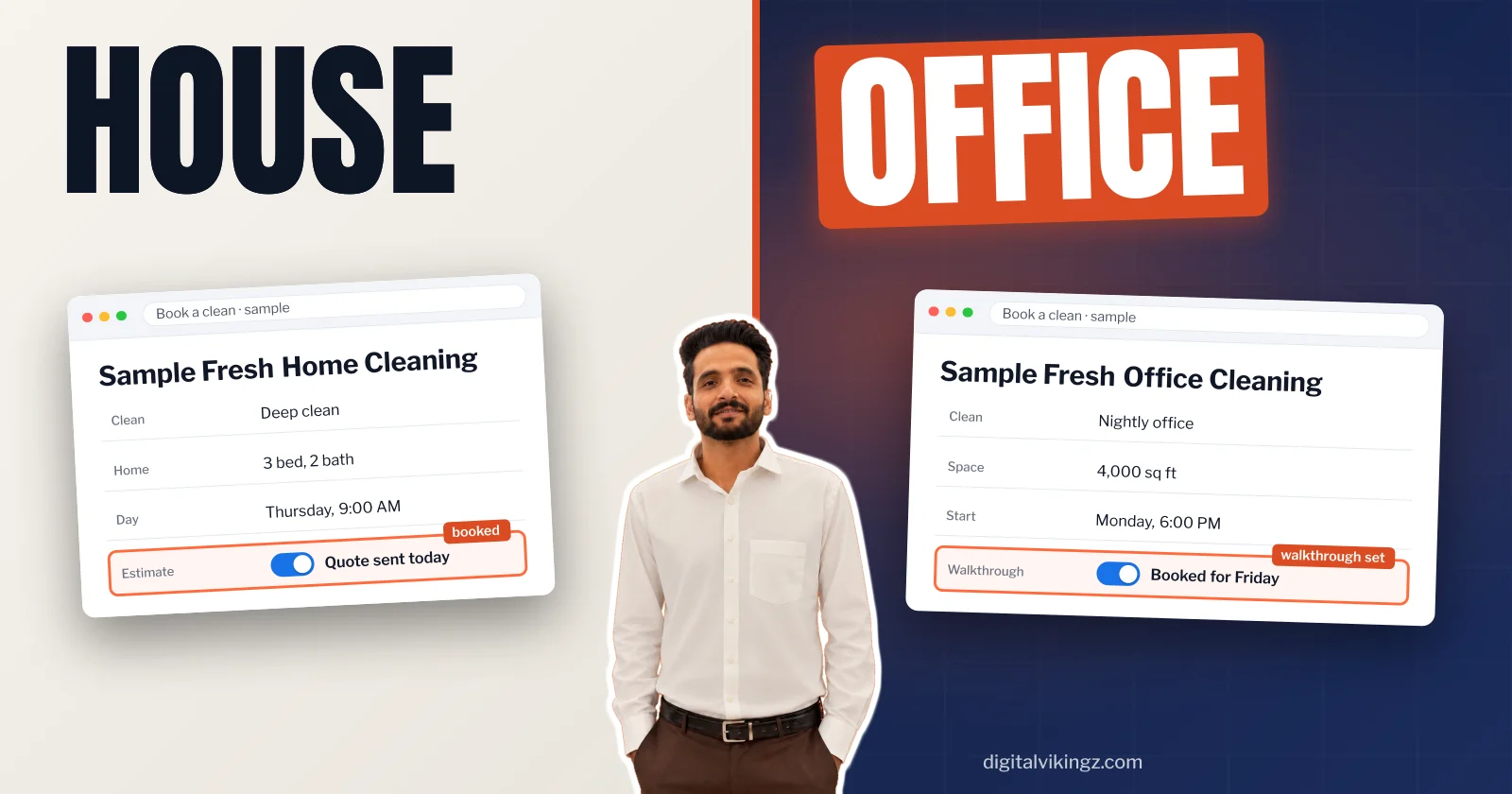
Take two sample searches, neither from a client. A homeowner searches maid service and her town. An office manager searches janitorial service and a city.
Each lands on a different set of pages. Why does that matter? One site has to answer both.
Our guide to local SEO against organic SEO separates the work for the map results from the work for the pages. AI answers are the third place, and we come back to them near the end. Our guide to how to rank higher on Google Maps covers the three factors in full.
Residential and commercial cleaning are two buyers with two sets of pages
Residential and commercial cleaning have different buyers, different search words and different proof, so each gets its own set of pages. Below: how each buyer searches, what each one checks and whether one page can serve both.
Residential cleaning covers homes, and the people who buy it call it house cleaning or maid service. Commercial cleaning covers offices and other buildings, and the people who buy it call it office cleaning or janitorial service.
The split is about the person typing. The homeowner decides alone and fast, while a building manager decides with a schedule, a contract and someone to answer to. That is our reading, and the next three sections test it.
How do residential and commercial buyers search?
A homeowner searches for house cleaning or maid service with a town. An office manager searches for office cleaning or janitorial service.
Our count of six guides on 22 November 2026 found house cleaning 37 times and residential cleaning 6 times. So the pages say house cleaning to the buyer and keep residential cleaning as the name of the group.
Query words decide which page can answer. Titled house cleaning, a page matches the homeowner. Titled janitorial service, a page matches the facilities buyer, and each title carries the words that buyer types.
What each buyer checks before asking for a quote
A homeowner checks the reviews and what the clean includes before asking for a quote. Google's AI Overview, read on 22 November 2026, lists background checks, bonding and insurance as trust signals.
An office manager checks the contract terms, the insurance and the schedule, and often has a cleaner under contract already. That is our reading. We found no owner thread about this, so these checks come from the pages we read and from Quora answers.
Different proof means a different page.
In our reading, a homeowner lets the crew into the house, so reviews carry the most weight. An office buyer weighs the contract first.
Should residential and commercial cleaning share one page?
No, residential and commercial cleaning should not share one page, because the buyer, the search words and the quote path differ. A small crew that does both can still run one website, with one hub for each buyer.
Take a sample company with six cleaners. It cleans homes by day and two offices at night.
One website serves both, with two hubs. A hub is the overview page for one buyer, and it links to that buyer's service pages.
The sample plan for that company is given below:
| Part of the site | Pages |
|---|---|
| Residential hub | Standard cleaning, deep cleaning, move-in and move-out cleaning, recurring cleaning |
| Commercial hub | Office cleaning, medical office cleaning, post-construction cleaning |
| Shared | About, contact |
That plan holds 11 pages, built in that order. One page for both buyers would answer neither of them.
Build first the hub that pays the bills today. The second hub follows once the first one has its pages.
Service pages state what each clean includes
A cleaning service page states what the clean includes, because the buyer cannot see the work until it is done. A dental practice builds one page for each treatment, and our guide to dental SEO shows that pattern.
The list also saves time on the phone, since the crew answers the same questions once on the page instead of on every call. Think of a restaurant menu.
The diner reads it before the table is set. A cleaning page shows the task list before the crew arrives.
Inclusions come before price on a cleaning business site, since the list is what a buyer compares. Below: the clean types that earn a page, the task list and the way a page explains price.
Standard, deep and move-out cleaning each need their own page
A cleaning company needs one page for each clean type it sells. For a house, that means standard cleaning, deep cleaning, and move-in and move-out cleaning.
Google's AI Overview on 22 November 2026 told owners to split residential, deep cleaning, move-out and move-in, and office and janitorial pages. Each page then matches one search, and the buyer who lands on it finds the answer without scrolling past three other cleans. A deep clean is a one-time reset of a lived-in home.
The move-out clean readies an empty home for the next person. Recurring cleaning gets its own section further down.
What should a cleaning service page say is included?
A cleaning service page lists the tasks the clean includes and the tasks it leaves out. The list names each room and the tasks done in it. Be specific.
A second list names the add-ons, so the buyer sees what costs extra. Write the leave-out list too. If windows are not included, say so on the page.
The buyer who finds out later writes a bad review. Here is a sample deep clean for a three bedroom home: baseboards and inside the oven sit in the add-on list.
Figure 1 compares the included tasks on a sample move-out page and a sample recurring page.
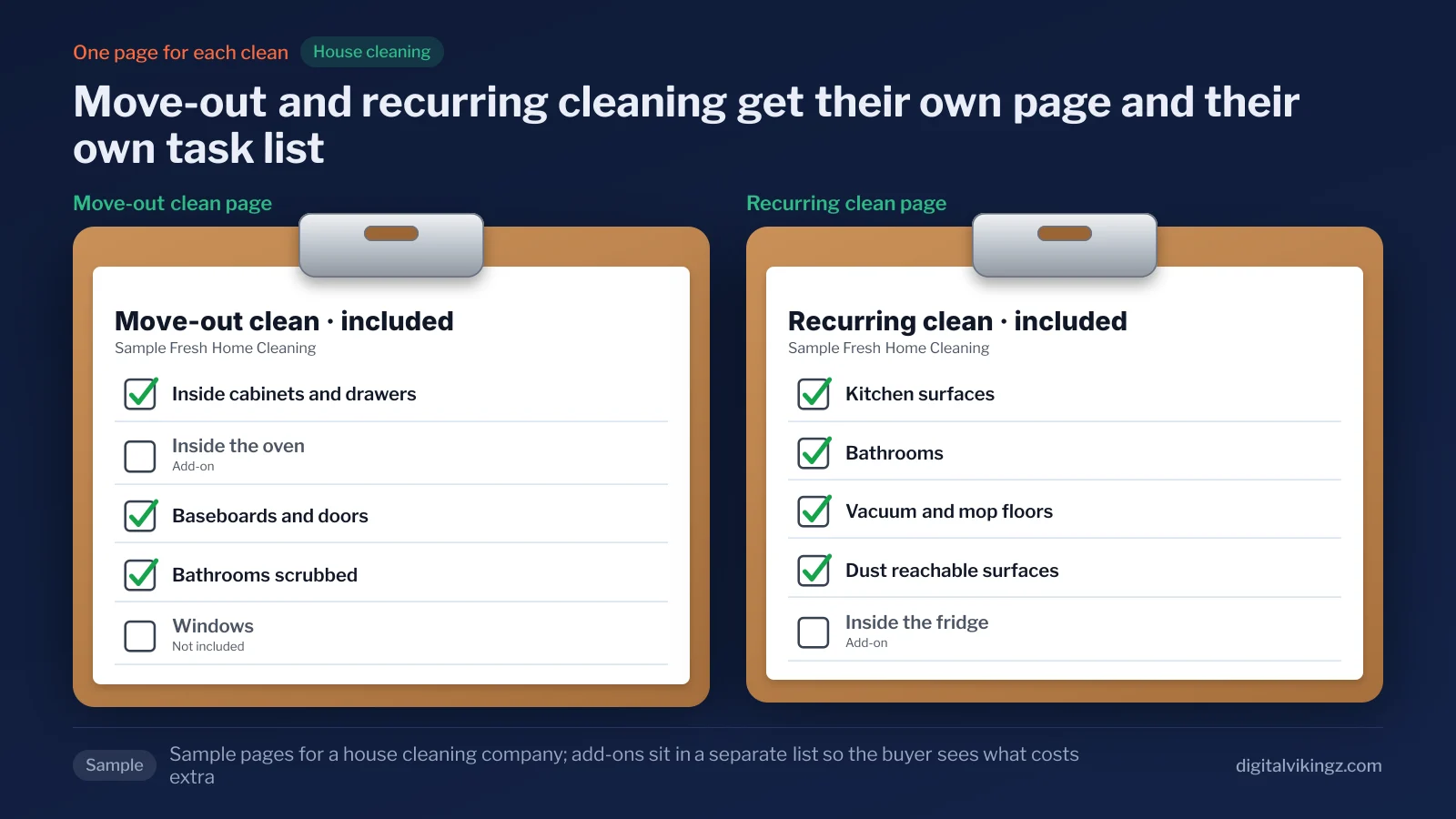
Look at the add-on list, because it is where the quote gets decided.
Price is explained by the factors that move it
A cleaning service page explains price by naming the factors that move it, such as home size, condition and frequency. Add-ons move it too.
We publish no cleaning prices here, because we have not measured a cleaning market. A company states a range only when its own booked jobs support it.
A buyer who sees only call for a quote has to guess. Seeing the factors, the buyer guesses better, and the call that follows is shorter. Price factors also protect the crew, because a buyer who reads home size and condition on the page expects questions about both.
How does a cleaning company's quote path work?
A cleaning company's quote path is the route from a search result to a booked visit. It is the step where cleaning company SEO turns a click into a quote request.
Three things sit on that route: the page the searcher lands on, the form or call button, and the reply the company sends back. Here is a sample path. A homeowner opens the website from the profile, picks deep cleaning, answers six fields and gets a reply the same day.
Count the steps between the search and the request. Each extra step may lose someone.
Below: what the form asks, whether an instant estimate helps and how a commercial quote starts.
What should a cleaning quote form ask for?
A cleaning quote form asks for the clean type, the place, the size of the space, how often, and a way to reply. A quote request is a completed form or a call that asks for a price.
Each field should change the quote, so the form drops any field the crew never uses. Ask less. Figure 2 shows a sample quote form for a house cleaning company, with the fields and the estimate panel.
The sample form has six fields: clean type, ZIP code, bedrooms and bathrooms, how often, preferred day and a way to reply. The homeowner in our opening is on a phone, so each field must work with a thumb.
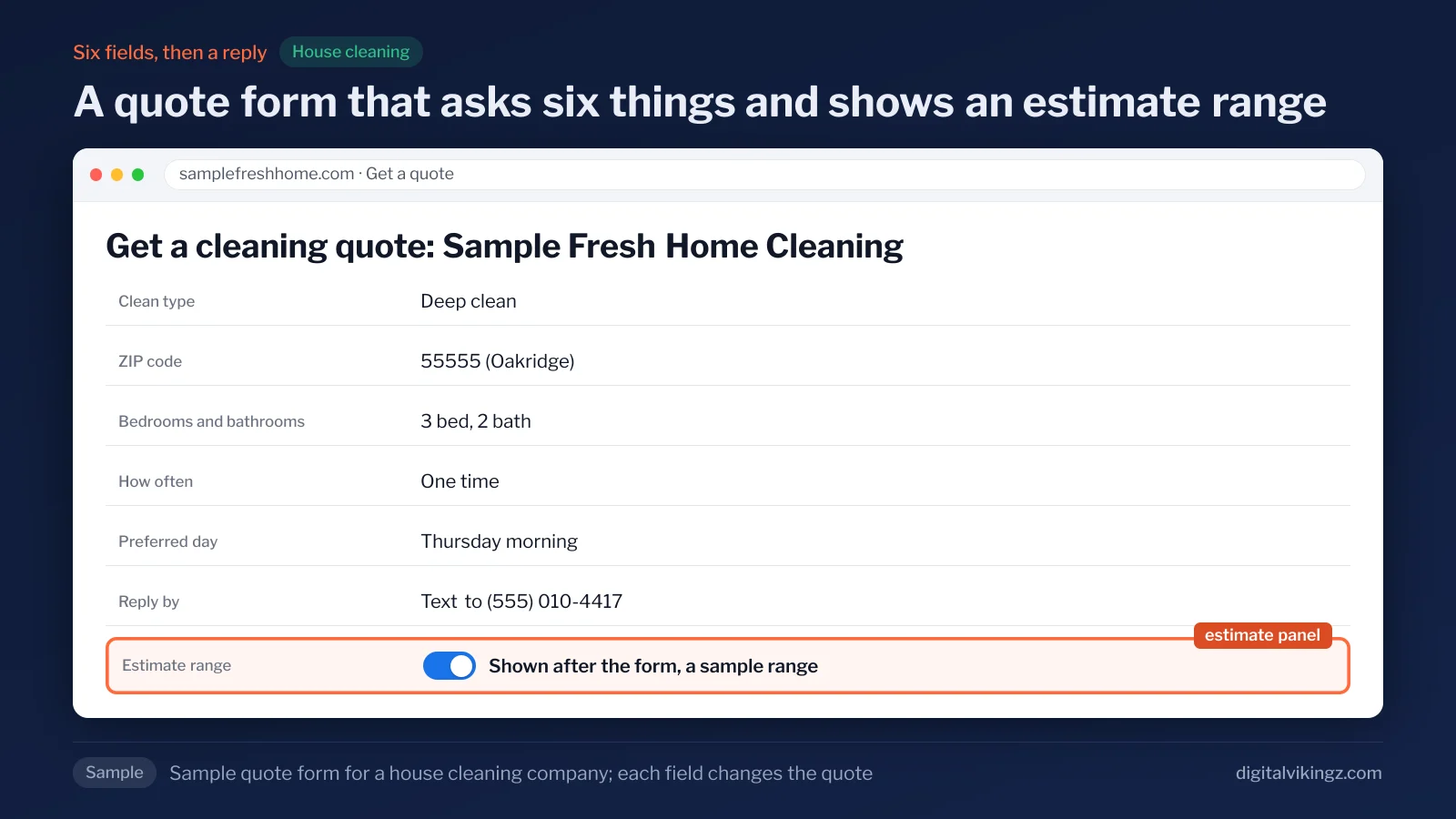
Look at how few fields the form holds before it asks for a phone number.
Too many fields lose people halfway. Too few send the crew to a house it cannot price.
Does an instant estimate help a cleaning company?
Yes, an instant estimate helps when it shows a range, states its assumptions and offers a visit for large jobs. One owner in a Quora answer we read on 22 November 2026 called online calculator quotes “the quickest way to lose money.”
That warning has a fair point. A large or unusual home goes to a visit or a call. Fair enough.
Nobody outside the company knows its margins, so the range has to come from its own booked jobs.
A range names a low and a high, and it says what each one assumes. A range with its assumptions beside it tells the buyer what the number depends on and tells the crew which jobs need a visit.
A commercial quote starts with a walkthrough
A commercial cleaning quote starts with a walkthrough of the space and the schedule. We would give the office cleaning page a walkthrough request in place of an instant range. That is our advice.
Owners in the Quora threads we read say these buyers are under contract elsewhere. So the page must be easy to find on the day they decide to switch.
Ask for the building type, the days the crew would come and how the crew gets in. Then offer the walkthrough. The schedule matters as much as the space.
Recurring cleaning pages turn one booked clean into a standing job
A recurring cleaning page sells the repeat visit, with the same tasks on a set schedule. The first clean wins the booking, and the schedule keeps it. Simple.
The thinking moves from one visit to the whole year. A standing job gives the company income it can plan around.
Does a recurring clean need its own page?
Yes, a recurring clean needs its own page, because the buyer wants a standing schedule and a one-time clean buyer wants a single visit. Two intents, two pages. A page that serves both answers neither well.
A one-time buyer may type move-out cleaning or deep cleaning. A standing-schedule buyer may type every two weeks.
HVAC companies sell maintenance plans the same way, as our HVAC SEO guide shows.
What does a recurring cleaning page state?
A recurring cleaning page states how often the crew visits, which tasks repeat and how the first visit differs. It also names the day window, so the buyer knows when the crew arrives.
Here is a sample: every two weeks, same tasks as the standard clean, and a first visit that adds a deep clean of the kitchen. State how a skipped visit works, if the company allows one.
Service-area pages need a local job behind each town
A cleaning service-area page needs something local behind each town: a booked job, a review or a neighbourhood the crew serves. Local proof means a fact that exists only because the crew works in that town. Below: whether every city gets a page and what a town page holds.
Swapping only the city name tells the buyer and Google nothing new.
Should a cleaning company build a page for every city?
No, a cleaning company should build a page only for a town it serves and can describe with local facts. None of the six guides we read on 22 November 2026 uses the word doorway.
Google's AI Overview told owners to avoid thin pages where only the city name changes. Our guide to service area pages without doorway pages sets the line.
Serve the town today? Give it a page.
Plan to serve it next year? Wait.
A town page names the neighbourhoods, the clean types and a local review
A cleaning town page names the neighbourhoods the crew visits, the clean types offered there and one review from the area. The quote form sits at the bottom. A neighbourhood name shows the crew knows the streets. A review from that area shows someone there was happy.
The sample town page holds three neighbourhood names, standard and deep cleaning, one review that names the clean, and the quote form. If the crew has no review from that town yet, the page waits.
How should a cleaning company set up its Google Business Profile?
A cleaning company sets up its Google Business Profile in four choices: the address, the category, the reviews and the matching details. For cleaning company SEO, these four decide how the profile reads in the map pack, because a cleaner who settles them first has a profile Google can read and a customer can trust.
Our Google Business Profile optimization guide covers every field, and this guide covers the four a cleaner decides first. The four choices come in that order below.
None of the four costs money. Each one costs a decision, and the decisions are made once. Then they sit there working.
Does a cleaning company show its address?
No, a cleaning company that cleans at the customer's location hides its address and sets a service area. Google's guidelines say, “If you’re a service-area business, you should hide your business address from customers.”
Google's own example is a plumber who runs the business from a home address and clears it. A company with a staffed office that receives visitors follows Google's hybrid rule instead.
The homeowner does not need the street address to book a clean, because the crew goes to her.
Our guide to local SEO for plumbers covers the same address choice. Our guide to service-area business on Google explains how the service area works.
Which category fits a cleaning company?
A cleaning company picks the most specific category in Google's list that matches the clean it sells most. Google's help page says, “Select a primary category that best describes your business.”
A company that sells both picks the category for the clean that earns more, then adds the other as a secondary category. In the picker, the company looks for names that match its cleans, such as house cleaning, commercial cleaning or janitorial.
Google's list can change, so check the picker on the day you set up.
Our guide to the Google Business Profile primary category gives five steps for the choice. Our guide to secondary categories covers the extras.
Reviews and photos name the clean and the neighbourhood
Reviews name the clean and the neighbourhood when the reviewer writes them, and the company's reply can repeat both. Google's help page says, “More reviews and positive ratings can help your business’s local ranking.”
Sample reply: thanks for booking the deep clean, and we will see you next month in Oakridge. Our guide to how to get more Google reviews covers the asking within Google's rules.
Photos show the crew, the vehicle and the finished rooms, each with a true caption. A review that says deep clean in Oakridge tells the next buyer and the map the same thing. Our guide to Google Business Profile photos covers what to upload and how often.
Name, address and phone must match on every listing
A cleaning company's name, address and phone, called NAP, should read the same on the website, the profile and every directory. Check four sources: the website, the schema, the profile and one directory.
A company with a hidden address lists its phone and service area on the site and keeps the home address off every page. A directory with an old phone number sends a customer to a dead line.
Figure 3 lists a sample cleaning company's name, address and phone on four sources, with the mismatches marked.
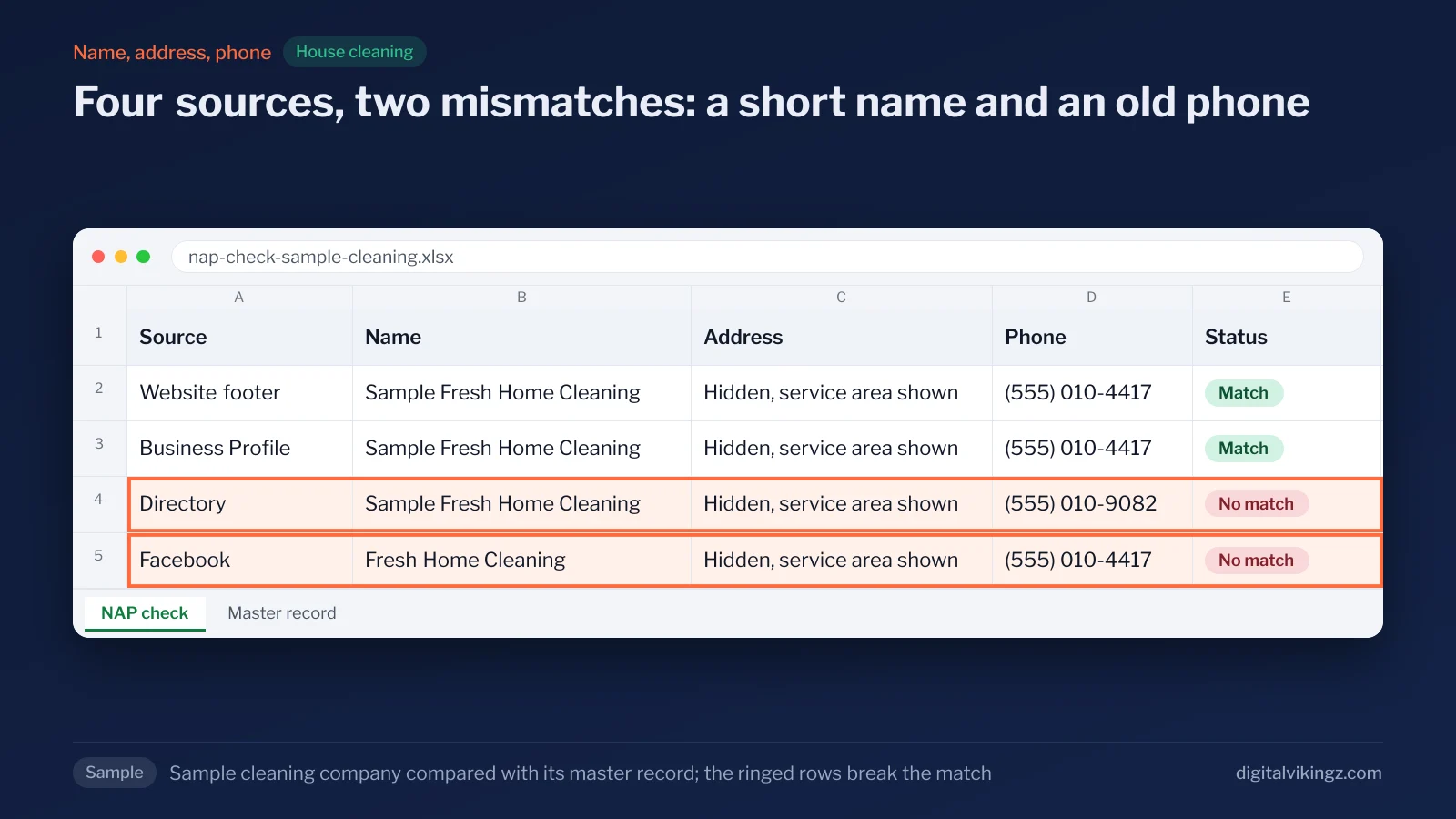
Look at the business name, because a short form on one source counts as a mismatch. A mismatch confuses the customer before it confuses any machine. The free AI Visibility Checker runs the local checks for name, address and phone.
What do the search results for cleaning company SEO show?
In our read on 22 November 2026, four organic results for cleaning company SEO were agency pages and three were software vendor pages. The eighth was a LinkedIn list of agencies.
Google's AI Overview in that read led with Business Profile work and dedicated service pages. No result came from a cleaning company, a forum or a directory. We read the results list as a picture of who sells to cleaners today, and it says little about who cleaners hire.
Google's Search Status Dashboard lists the November 2026 core update as started on 10 November 2026. We judge this plan by quote requests, because one week of rankings can move on any update.
How may Google read a search for a cleaner and a town?
Google filed a patent that describes splitting a local search into parts and checking each part against its own data. The document is US 2009/0019028 A1, Interpreting local search queries, assigned to Google LLC, filed 9 July 2007 and published 15 January 2009.
Its own example sends the word pizza to a local business index and the words New York to a map index. We read this as a reason to state the clean and the town as separate, clear facts on a page and a profile.
That advice holds even if the patent is not in use. Nobody outside Google knows whether this method runs in Maps today.
Even so, the habit is cheap. Write the clean on one line and the town on the next.
Can a cleaning company show up in AI answers?
Yes, a cleaning company can show up in AI answers, and no assistant publishes its full formula for picking one. BrightLocal's 2026 Local Consumer Review Survey of 1,002 US adults found that 45 percent had used AI tools for local business recommendations.
Our guide to how AI assistants choose a local business lists the five stages. Our guide to Perplexity SEO covers one assistant that cites its sources.
Someone who asks who is a good cleaner near me may get a short list of names. Reviews, listings and the website are the places an assistant can read.
How do you measure cleaning company SEO by booked cleans?
Cleaning company SEO is measured by quote requests and booked cleans, and clicks and impressions are only the steps before them. Clicks say the page was seen, and impressions say the listing appeared. Neither says whether the phone rang.
A quote log holds the numbers that decide what to fix. Counting booked cleans takes one sheet, and most owners already hold the facts in their phone and their inbox.
Rank reports show a position. The quote log shows a job. We would take the job.
A quote log records the clean type, the source and the outcome
A quote log is a sheet with one row for each quote request, its source, its clean type and what happened next. The sample below has three rows and is not client data:
| Date | Source | Buyer | Clean type | Outcome |
|---|---|---|---|---|
| Sample row 1 | Profile call | House | Deep clean | Booked |
| Sample row 2 | Website form | Office | Office cleaning | Walkthrough booked |
| Sample row 3 | Profile message | House | Move-out | Lost |
Search Console counts clicks and impressions for a page, and the log counts what happened next. Our guide to Business Profile UTM tracking tags the profile link so the sheet shows which requests came from it.
A phone call needs a line in the log by hand, because no tag follows it. Ask each caller how they found the company, and write it down the same day. Review the log once a month with two questions: which source sent the most booked cleans, and which clean type gets lost most often.
Questions cleaning company owners ask about SEO
Owners ask five things before they start. They ask whether it pays, whether a website is needed, how long it takes, what it costs and what it cannot do.
Is SEO worth it for a cleaning company?
Yes, SEO can be worth it for a cleaning company with the crew to take more quote requests. AI assistants read business profiles, listings, reviews and websites, as our guide to how AI assistants choose a local business explains.
The cost is time and work before the first request arrives. Crews that are already full do not need more requests, and crews with open days do.
Does a cleaning company need a website if it has a Business Profile?
Yes, a cleaning company needs a website, because the profile links to pages that state the clean types, the inclusions and the quote form. The profile earns the tap, and the website earns the quote request. Without the site, the profile has nowhere to send the buyer.
How long does cleaning company SEO take?
Cleaning company SEO shows first in the profile, where Google states that edits can take up to 3 days to appear. Map pack gains usually build over two to four months, in our experience.
Nobody outside Google can date a result for one cleaning company. The slower part is the pages and the reviews, because both need time to build. Our guide to how long local SEO takes splits the work by clock.
How much does cleaning company SEO cost?
We quote cleaning company SEO in writing after a strategy call, because the scope depends on the profile, the site and the service area. The one price we publish is for Daily Google Posts, which starts at $99 a month per Google listing.
The strategy call is where we read the profile, the site and the area, and then write the quote.
Our guide to local SEO pricing compares two surveys of providers.
What cleaning company SEO cannot do
Cleaning company SEO cannot promise a ranking, because Google states that no one can pay for a better local ranking. Google's help page says, “There's no way to request or pay for a better local ranking on Google.”
It also cannot fix late crews or weak cleaning, since the reviews will show them. Those reviews tell the next buyer what the crew is like. We have not run this plan on a cleaning company's profile, so this guide rests on Google's help pages and the guides we read.
Treat the plan as a method to test. The first quote log will probably show a gap in the pages, the profile or the form. Measure it with the quote log, and change what the log shows.
What should a cleaning company fix first?
A cleaning company fixes the profile first, then the quote form, then one page for each clean, then the count. The five fixes come in this order:
- Match the name, address, phone and category.
- Make the quote form work on a phone.
- Write one page for each clean type with its inclusions.
- Split residential and commercial.
- Start the quote log.
Do them in that order. The profile comes first, because every other step links back to it.
Our local SEO audit guide shows how to find what is broken in the profile and the site. Daily Google Posts keeps a profile posting every day, and our comparison of done for you Google Posts and scheduling tools explains the difference.
Cleaning is one of the trades on our local services page. We set up this plan in our Local SEO and Google Business Profile service, and the strategy call is the first step.