Digital Vikingz
Dental SEO is local SEO that ranks a dental practice in Google's map pack, organic results and AI answers for nearby patients. Google ranks dental practices in the map pack on three factors: relevance, distance and prominence.
A dental practice should give its Google Business Profile the Dentist primary category, patient-worded services, accurate hours and an appointment link. Treatment pages help the practice rank by matching each treatment search, such as dental implants in a town, to one page.
Reviews and listings help a dental practice rank because Google bases prominence partly on reviews and on links from other websites. The practice should measure SEO results in calls, direction requests, website clicks and booked appointments, split by office and treatment.
What is dental SEO?
Dental SEO is local SEO that ranks a dental practice in Google's map pack, organic results and AI answers for nearby patients. Dental searches add treatments, insurance plans and individual dentists to the usual local search.
Patients who say a practice shows up on the map mean the map pack, the three business listings Google shows beside a map. Organic results are the website pages below the map pack. AI answers are the replies of ChatGPT, Gemini and Google's AI Overviews.
SEO for dentists and local SEO for dentists name the same work. Dental SEO is measured in new-patient calls and booked appointments, not in rankings alone. Dental SEO starts with the searches a practice needs to win.
Which searches does a dental practice need to win?
A dental practice needs to win four types of patient search: general dentist searches, emergency searches, treatment searches and insurance searches.
The four types of patient search a dental practice targets are listed below:
- General dentist searches: "dentist near me" and "family dentist" with a town name.
- Emergency searches: "emergency dentist near me" and "same day dentist", where an open office matters most to the patient.
- Treatment searches: a treatment with a town, such as "dental implants in Lakeside".
- Insurance searches: a dentist that accepts the patient's plan, such as "dentist that takes my insurance near me".
Specialty searches such as "pediatric dentist" follow the same pattern as treatment searches. We ran one US search for "emergency dentist near me" on 19 November 2026.
Google returned a local pack, practice location pages, insurers' find-a-dentist tools and state directories. No SEO article appeared in that patient search. Every patient search ends on a map pack listing, an organic page, a paid ad or an AI answer.
Is dental SEO the same as Local Services Ads?
Dental SEO is not the same as Local Services Ads, because Local Services Ads are a paid Google channel. Google describes Local Services Ads as a way to receive leads directly from potential customers and pay only for related leads.
Google Ads search campaigns are a second paid channel outside SEO. Dental SEO covers the unpaid map pack, organic results and AI answers only. Unpaid map pack results follow three ranking factors that Google publishes.
How does Google rank dental practices in the map pack?
Google ranks dental practices in the map pack on three factors: relevance, distance and prominence. Google's local ranking help page states: "Local results are mainly based on relevance, distance, and popularity."
The same Google page heads the third factor "Prominence", so popularity and prominence name one factor.
Google defines the three local ranking factors as listed below:
- Relevance: "Relevance is how well a Business Profile matches what someone is searching for."
- Distance: "Distance refers to how far each business is from the customer who's searching."
- Prominence: "Prominence means how well-known a business is."
A dental practice gains relevance from its category, services and treatment pages, and prominence from reviews, links and listings. Distance favors the office closest to the patient, and no Google Business Profile setting moves an office closer.
Relevance starts with the Google Business Profile a dental practice sets up.
How should a dental practice set up its Google Business Profile?
A dental practice should give its Google Business Profile the Dentist primary category, patient-worded services, accurate hours and an appointment link. Google Business Profile was called Google My Business until 2021.
The profile settings that decide a dental practice's relevance are listed below:
- Choose Dentist as the primary category.
- List each treatment in patient words, such as teeth cleaning, dental implants, teeth whitening and emergency dental care.
- Add the online booking page as the appointment link.
- Enter the hours the front desk answers the phone, plus holiday hours in the special hours field.
- Add the attributes the profile editor offers, such as online appointments.
- Keep the business name to the registered practice name, with no added words such as "best dentist".
Google's guidelines do not permit unnecessary information in a business name. A breach can lead to suspension of the profile and loss of the map pack listing.
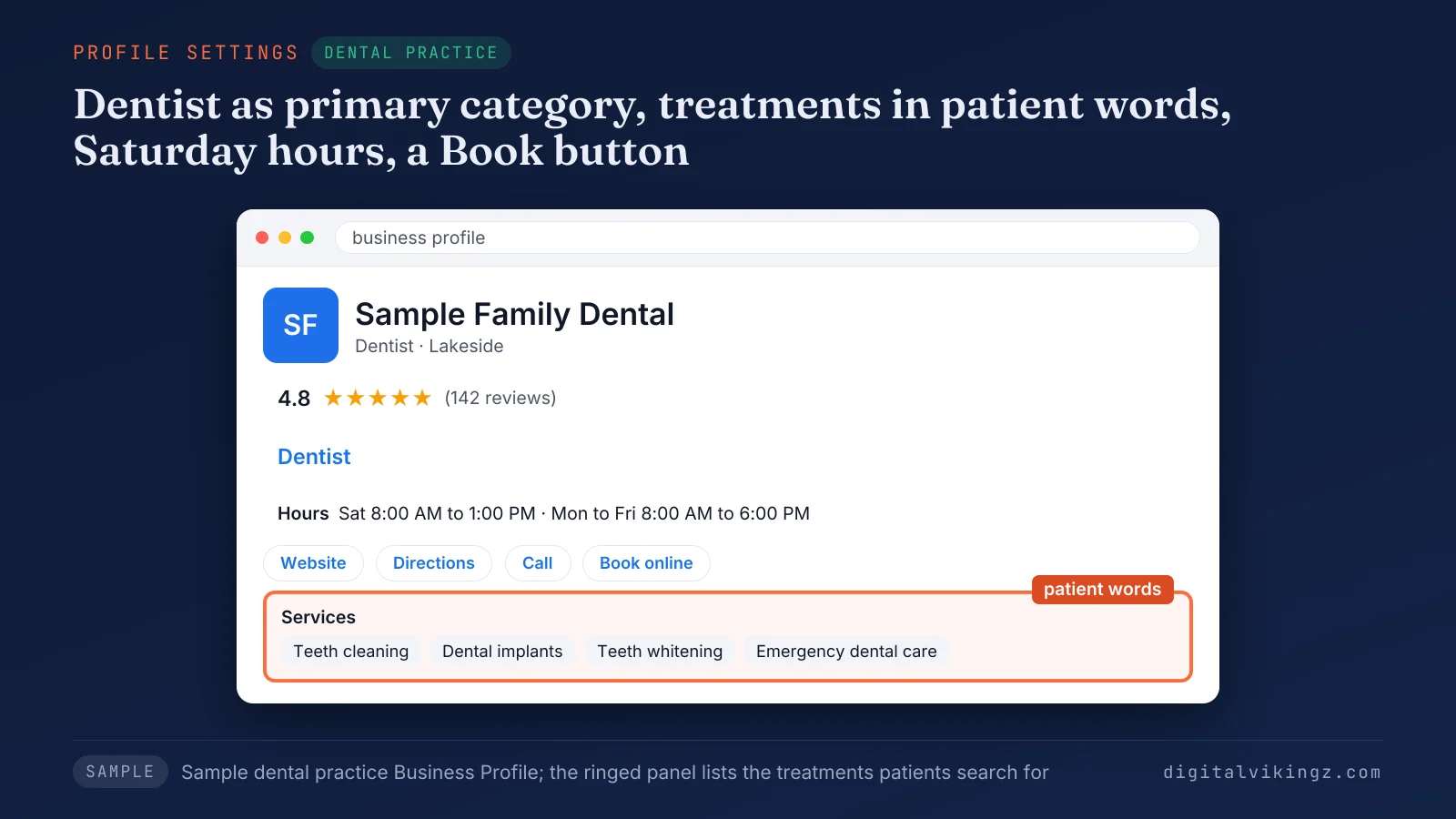
Figure 1 shows a sample profile for Sample Family Dental in Lakeside with Dentist as the primary category. The sample lists teeth cleaning, dental implants, teeth whitening and emergency dental care, with Saturday hours from 8:00 AM to 1:00 PM.
Each setting above is one part of Google Business Profile optimization. The primary category raises the first question for a practice that offers specialty treatments.
Should a general dentist add specialty categories such as Orthodontist?
A general dentist should leave specialty categories such as Orthodontist off the profile unless a credentialed orthodontist works at the office. Google's guidelines ask for categories that "complete the statement: 'This business IS a' rather than 'this business HAS a.'"
A dental practice that places implants IS a dentist and HAS an implant service. Google also asks for the fewest categories that describe the core business. Implants, whitening and clear aligners reach the map pack through the services list and treatment pages.
Dental clinic also passes the test, and Local Search Forum practitioners prefer Dentist as primary.
The category test works the same way for every specialty a practice offers. Our guide on how to choose the Google Business Profile primary category for a practice walks through the five steps. Associates who see their own patients raise a second profile question.
Should each dentist in a practice have a Google Business Profile?
Each dentist in a practice can have a separate profile when the dentist is public-facing and reachable at the office during stated hours. Google's guidelines state: "Doctors, dentists, lawyers, financial planners, and insurance or real estate agents are all individual practitioners."
Google's guidelines give the dental practice its own profile for the location, separate from each dentist's profile. Google adds: "The title of the Business Profile for the practitioner should include only the name of the practitioner, and shouldn't include the name of the organization."
A solo dentist at a branded practice shares one profile named in the format "[brand/company]: [practitioner name]". Practitioners on the Local Search Forum report that separate dentist profiles can split reviews and compete with the practice profile for the same searches.
Every profile, for the practice or for a dentist, sends patients to pages on the practice website.
How do treatment pages help a dental practice rank?
Treatment pages help a dental practice rank by matching each treatment search, such as dental implants in a town, to one page. Each treatment page names the treatment in patient words and the office where the practice offers the treatment.
Patients search "emergency dentist" and "kids' dentist" rather than clinical terms, so page titles use the patient words. Clinical facts on a treatment page come from the practice's own dentists, who review every clinical claim before the page goes live.
Treatment prices, outcomes and risks are statements for the practice's dentists to make, not for an SEO plan. Our Local SEO and Google Business Profile service builds one page per service and links each page from the profile.
A page for each dentist connects the treatments to a named, credentialed person. Emergency searches add one more condition: the patient needs an office open today.
How does a dental practice win emergency dentist searches?
A dental practice wins emergency dentist searches when its profile hours, emergency page and phone line show the same-day appointments the practice offers. Emergency dental searches use words such as "emergency", "same day" and "near me".
An emergency page states the office hours and how a patient books a same-day visit in its first lines. Holiday hours set in the profile's special hours field keep the map pack open status accurate on public holidays. The phone number on the profile rings the line the front desk answers during those hours.
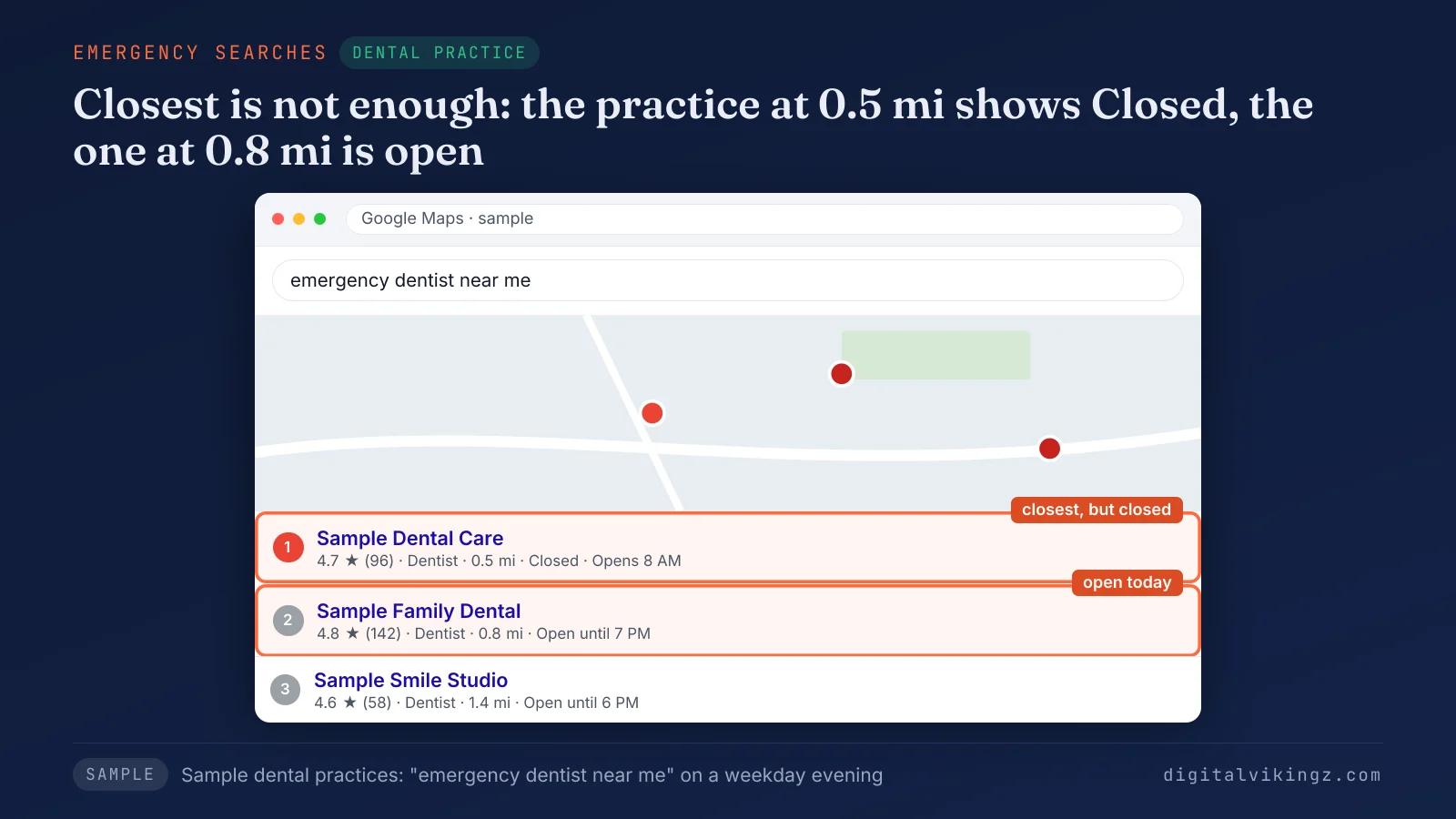
Figure 2 shows sample results for "emergency dentist near me" with three dental practices. Sample Dental Care sits closest at 0.5 miles but shows "Closed", while Sample Family Dental at 0.8 miles shows "Open until 7 PM".
Distance is the one ranking factor no profile setting moves for a dental practice. Our guide on how a business ranks higher on Google Maps explains what moves relevance and prominence instead. Treatment and insurance searches need a keyword plan of their own.
Which keywords should a dental practice target?
A dental practice should target keywords built from five slots: treatment, town, urgency, insurance plan and specialty. Patients type their own words into each slot, such as "implants", "kids' dentist" and "takes my insurance".
The table below routes one sample search from each slot to the page that answers the search:
| Slot used | Sample search | Page that answers |
|---|---|---|
| Treatment and town | dental implants Lakeside | Dental implants page |
| Urgency and town | emergency dentist Lakeside | Emergency dental care page and profile hours |
| Insurance plan and town | dentist that takes my insurance Lakeside | Insurance page |
| Specialty and town | pediatric dentist Lakeside | Children's dentistry page |
| Town only | dentist near me | Lakeside office page and the profile |
Every search lands on one page, so no two pages compete for the same search. The insurance page names each accepted plan as text and says how the office confirms coverage.
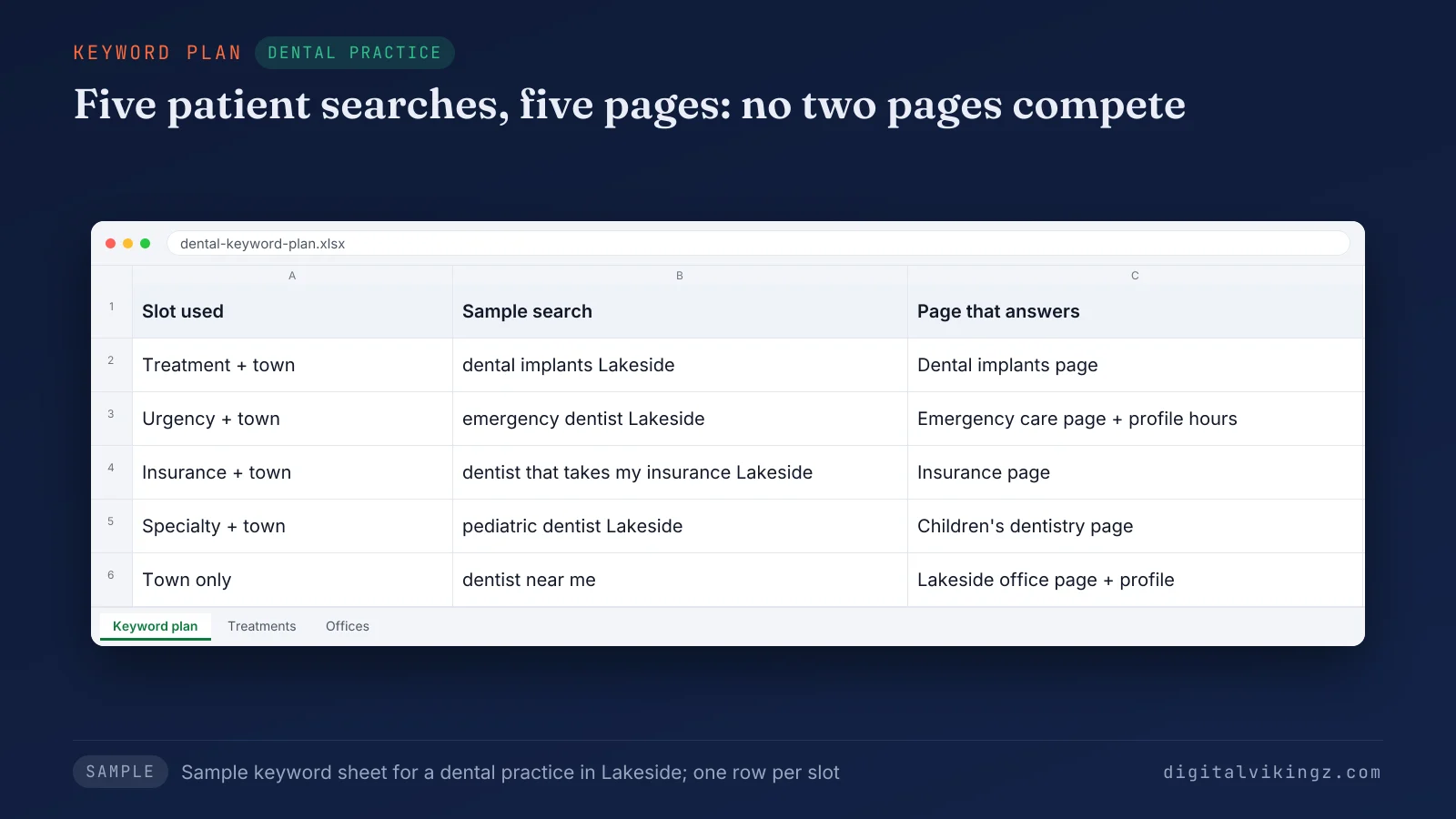
Figure 3 shows the same five sample searches in a keyword sheet, from "dental implants Lakeside" to "dentist near me". Pages and profiles earn trust once patients start leaving reviews.
How do reviews and listings help a dental practice rank?
Reviews and listings help a dental practice rank because Google bases prominence partly on reviews and on links from other websites. Google's help page states: "More reviews and positive ratings can help your business's local ranking."
A dental practice asks every patient at checkout, by front-desk QR card, then by email that evening. Google's review policy bars review incentives and selective requests for positive reviews.
The US FTC rule on consumer reviews, in force since October 2024, makes fake reviews and incentives tied to a sentiment unlawful. Google adds: "Positive reviews and helpful replies can help your business stand out."
Health privacy rules limit what a practice may say in a public reply, so the practice checks reply wording with its own compliance adviser. Review replies in dental SEO protect the reviewer's privacy and move complex issues to phone or email.
Getting more Google reviews depends on asking every patient the same way. Our guide on how to get more Google reviews within Google's rules gives the request wording for each channel. Directory listings add a second source of map pack prominence for a dental practice.
Do Zocdoc and Healthgrades listings help a dental practice rank?
Zocdoc and Healthgrades listings can help a dental practice rank when the name, address and phone match the profile and the website. Directory listings add mentions of the practice on websites the practice does not control.
BrightLocal's 2026 source study of 1,355 business locations names Zocdoc and Healthgrades as the industry directories that appear for dentists. A Healthgrades listing that still shows an old suite number splits the practice's facts between two addresses.
The practice owns its profile and its website, while each directory owns its listing pages. Several offices multiply every profile, page and directory listing a practice keeps.
How should a dental practice with several offices set up local SEO?
A dental practice with several offices should give each staffed office its own Google Business Profile and its own location page. Google's guidelines state: "All locations must also have the same category if they provide the same service."
Google's guidelines also state: "There should only be one profile per business." Each office therefore gets one profile and no more.
Each location page carries the office address, hours, dentists and the treatments offered at that office. Suburbs without an office stay as named towns on the nearest office page. A dental group with many offices follows the same rule at every address.
Location pages and service area pages answer different searches. Our guide to service area pages that do not become doorway pages explains where a location page ends. Every office then reports its own calls and bookings.
How should a dental practice measure SEO results?
A dental practice should measure SEO results in calls, direction requests, website clicks and booked appointments, split by office and treatment. Our monthly report for the Local SEO and Google Business Profile service tracks calls, direction requests, website clicks and map pack positions.
Google Search Console shows which treatment pages earn clicks from Google Search. Booked appointments come from the practice's own booking system, matched to the page or profile that sent the patient.
A ranking report alone does not show whether new patients booked. Patient names and health details stay out of every SEO report. Dental SEO shares these measures with SEO for other local service businesses.
How does dental SEO compare with SEO for other local service businesses?
Dental SEO shares profile, review and page work with other local service businesses and adds practitioner profiles, treatment pages and insurance searches. Plumbing SEO centers on emergencies at any hour, such as burst pipes and sewer backups.
HVAC SEO plans for two seasonal peaks, cooling in summer and heating in winter. Dental searches carry qualifiers the trades rarely use: a treatment, an insurance plan or a specialty.
Every local service website pairs a service with a city, and a dental practice fills the service with a treatment. A dental practice keeps the shared base and adds the dental qualifiers on top.
Semantic SEO for local service businesses builds the profile, page and review work into one plan. Our semantic SEO for local service businesses such as dental practices starts from that shared base. AI assistants read the same base before naming a dentist.
How do AI assistants choose a dentist to recommend?
AI assistants choose a dentist to recommend by matching the practice's facts across its profile, website, directories and reviews, then naming a short list. BrightLocal's 2026 Local Consumer Review Survey of 1,002 US adults found that 45 percent had used AI tools for local business recommendations.
Google states: "There are no additional requirements to appear in AI Overviews or AI Mode, nor other special optimizations necessary." A "family dentist in Lakeside" request gives the assistant a service, a place and a qualifier.
Insurance plans and same-day care work as qualifiers, so a dental practice states both as text.
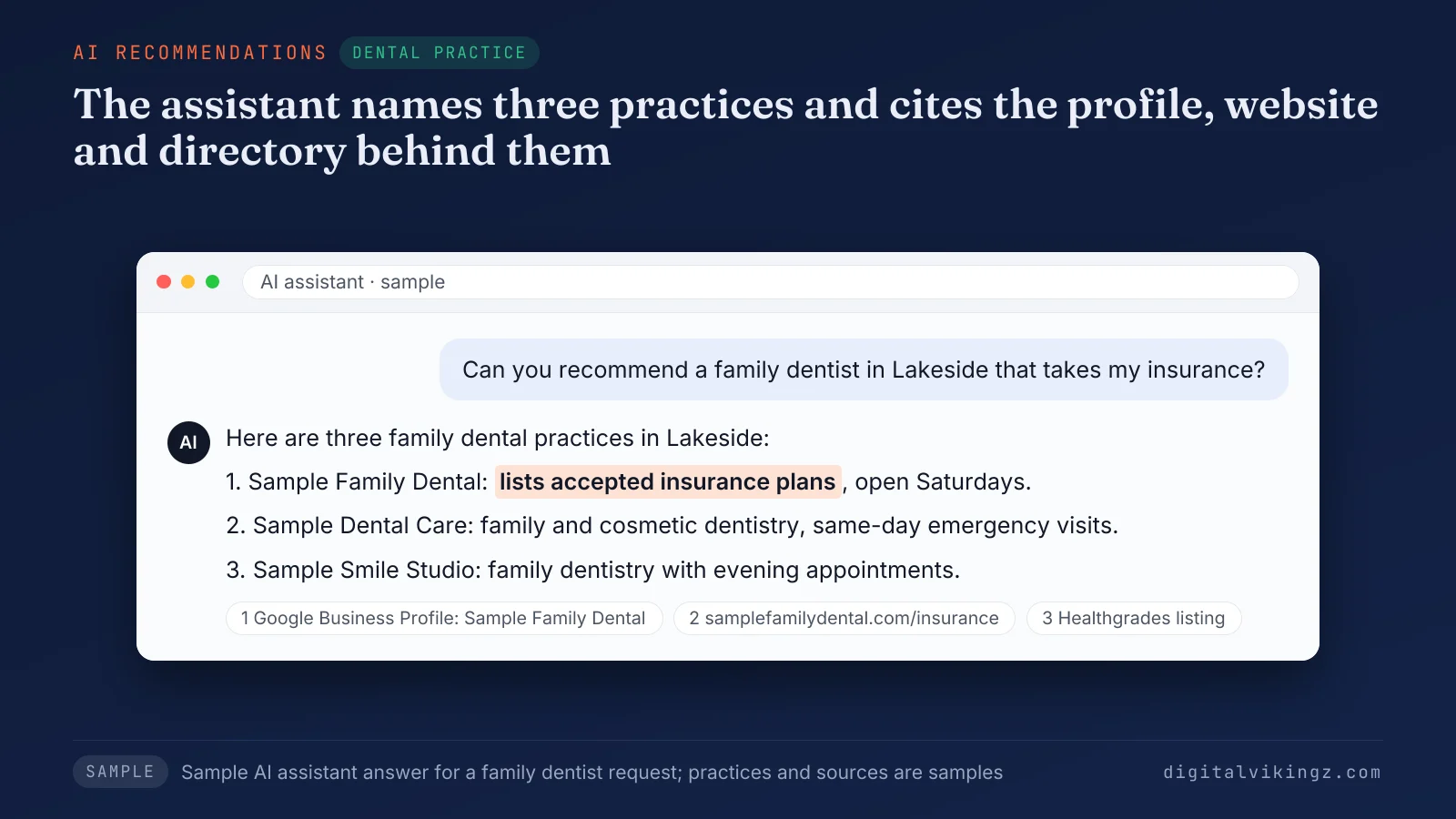
Figure 4 shows a sample answer naming Sample Family Dental, Sample Dental Care and Sample Smile Studio. The answer marks a Google Business Profile, a practice website and a Healthgrades listing as sources.
AI recommendation runs in five stages, from reading the request to naming a short list. Our guide on how AI assistants choose a local business to recommend explains each stage. Treatment facts in AI answers follow healthcare content rules.
Which healthcare SEO rules apply to a dental practice?
Healthcare SEO rules apply to every clinical page of a dental practice: a credentialed author or reviewer and a source for each clinical claim. Google's rater guidelines class medical content as content where a wrong answer causes harm.
Our editorial team drafts to the brief, and a credentialed clinician from the practice reviews every clinical claim. The clinician is named on the page in a reviewed-by line.
Healthcare and medical practices share these rules across every clinical page. Our semantic SEO for healthcare and medical practices applies the same rules to clinics beyond dentistry. A dental SEO company should work inside these rules.
How do you choose a dental SEO company?
A dental practice should choose a dental SEO company that shows its method in writing, reports calls and bookings, and promises no ranking.
The criteria for choosing a dental SEO company are listed below:
- Method: a written plan for the profile, treatment pages, reviews and listings before work starts.
- Ownership: manager access to the profile, so the practice keeps ownership of the profile.
- Reporting: calls, direction requests, website clicks and map pack positions every month for each office.
- Guarantees: none on rankings, because Google sells no better local ranking.
- Tactics: no keyword-stuffed business names, review incentives, review gating or fake offices.
Local SEO and Google Business Profile optimization is the service those five criteria describe. Our Local SEO and Google Business Profile optimization for dental practices covers the profile, the pages, the reviews and the monthly report.
Our closest published result is a US day spa with three locations. The day spa's Search Console data shows non-branded Google Search clicks up 42 percent in six months.
Appointment-based businesses share the profile, page and review work that dental practices need. Our day spa SEO case study shows the before and after windows read in Google Search Console. A 30-minute strategy call sets the scope for each office in writing.
Questions dental practice owners ask about SEO
How long does dental SEO take to work?
Dental SEO usually shows map pack gains over two to four months as reviews, posts and pages add up. Category and detail fixes are picked up within weeks, according to our Local SEO and Google Business Profile service.
How much does dental SEO cost?
Dental SEO from Digital Vikingz is priced monthly by the number of locations a practice has. Exact scope is quoted in writing after the strategy call.
Can a dental practice pay Google for a better map pack ranking?
No dental practice can pay Google for a better map pack ranking. Google states: "There's no way to request or pay for a better local ranking on Google."
Do review stars from a practice website show in Google results?
Review stars from a dental practice's own website do not show in Google results, because Google treats them as self-serving reviews. Google's review snippet rules exclude a business's own reviews from star results, including embedded Google review widgets.
Should a dental practice add "dentist near me" to its business name?
A dental practice should not add "dentist near me" or any other keyword to its business name. Google's guidelines tie the profile name to the name the practice uses on its storefront, website and stationery.
Do Google Business Profile posts help a dental practice?
Google Business Profile posts keep a dental practice's profile current. Google's local ranking help page did not name posts as a ranking factor when we read the page on 19 November 2026. Dental posts describe visits and services, never device or drug brands, because Google treats health and medical devices and medicines as regulated.
What should a dental practice fix first?
A dental practice should fix the primary category and services first, then practitioner profiles, treatment pages and the checkout review request.
The first fixes for dental SEO, in order, are listed below:
- Set Dentist as the primary category and list every treatment in patient words.
- Name each public-facing dentist's profile with the dentist's name only.
- Publish one page for each main treatment and each office.
- Hand every patient the review card at checkout.
Dental SEO gets a practice found on Google Maps, in organic results and in AI answers. A profile with a fresh post shows patients in the map pack that the practice is open and active.
Our daily Google posts written from the practice website keep the profile current without staff time. The free preview writes a sample post from the practice website before any plan starts. Digital Vikingz sets up the profile, pages and reviews for each office after a 30-minute strategy call.