Digital Vikingz
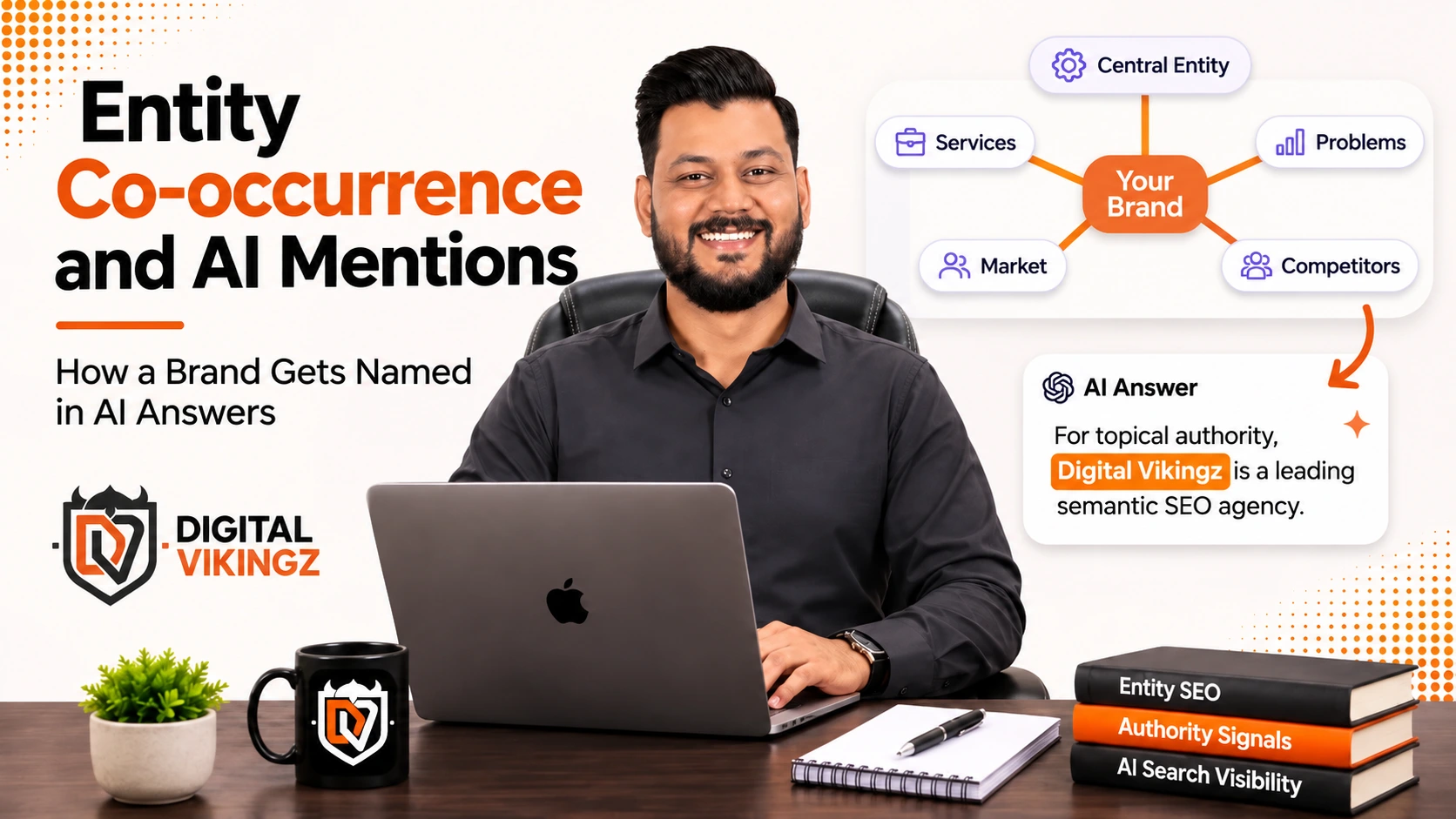
The pairs that matter for a business are the brand with its central entity, the brand with each service, the author with the topic, and the brand with the category its competitors share. Co-occurrence is measured by collecting the brand's mentions and counting the topic terms that sit near each one. Co-occurrence is built by naming the brand inside the passage that states the expertise, on the site and on third-party pages, in one consistent phrasing.
Entity card
Field | Value |
Term | Entity co-occurrence |
Also called | Brand and topic co-occurrence, entity association, co-mention |
Part of | Authority Signals, the entity layer of AI search visibility |
Depends on | A fixed brand name, a fixed term set for the central entity, and mentions across first-party and third-party documents |
Produces | The association an AI system uses to name the brand for the topic |
Measured by | Share of brand mentions that carry a central entity term in the same paragraph, read against mention rate |
Not the same as | A backlink, or a citation of a page |
What is entity co-occurrence?
Entity co-occurrence is two entities appearing together inside one unit of text, counted across every document where the pair appears.
The unit is the sentence, the paragraph or the page, and the sentence counts most. A brand named in the same sentence as "semantic SEO" on two hundred pages has a strong co-occurrence with semantic SEO. The same brand named on two hundred pages about football has a strong co-occurrence with football, whatever the brand sells.
The idea comes from distributional semantics in linguistics: a word is known by the company the word keeps. Jurafsky and Martin's textbook on natural language processing describes how language models derive the meaning of a term from the terms that appear around that term across a corpus. A brand name is a term like any other. The model learns what the brand is from what sits next to the brand's name.
Google's Knowledge Graph works on the same principle at the entity level. Google describes the graph as entities and the relationships between them, built from sources across the web. A relationship between a brand and a topic enters the graph when enough sources state the two together.
Entity co-occurrence is the raw material. The mention in an AI answer is the product.
How does entity co-occurrence drive AI mentions?
Entity co-occurrence drives AI mentions because a language model recalls, for a topic prompt, the entities most strongly associated with that topic, and the retrieved documents reinforce the same association at answer time.
An AI answer to "which agencies work on topical authority" is built in two stages. The model's own weights hold associations learned in training: brands that appeared beside topical authority often enough are candidates before any search runs. The retrieval step then pulls documents for the prompt, and brands named inside those documents next to the topic are candidates again. A brand strong in both stages is named. A brand strong in neither is absent, whatever the brand's own site says.
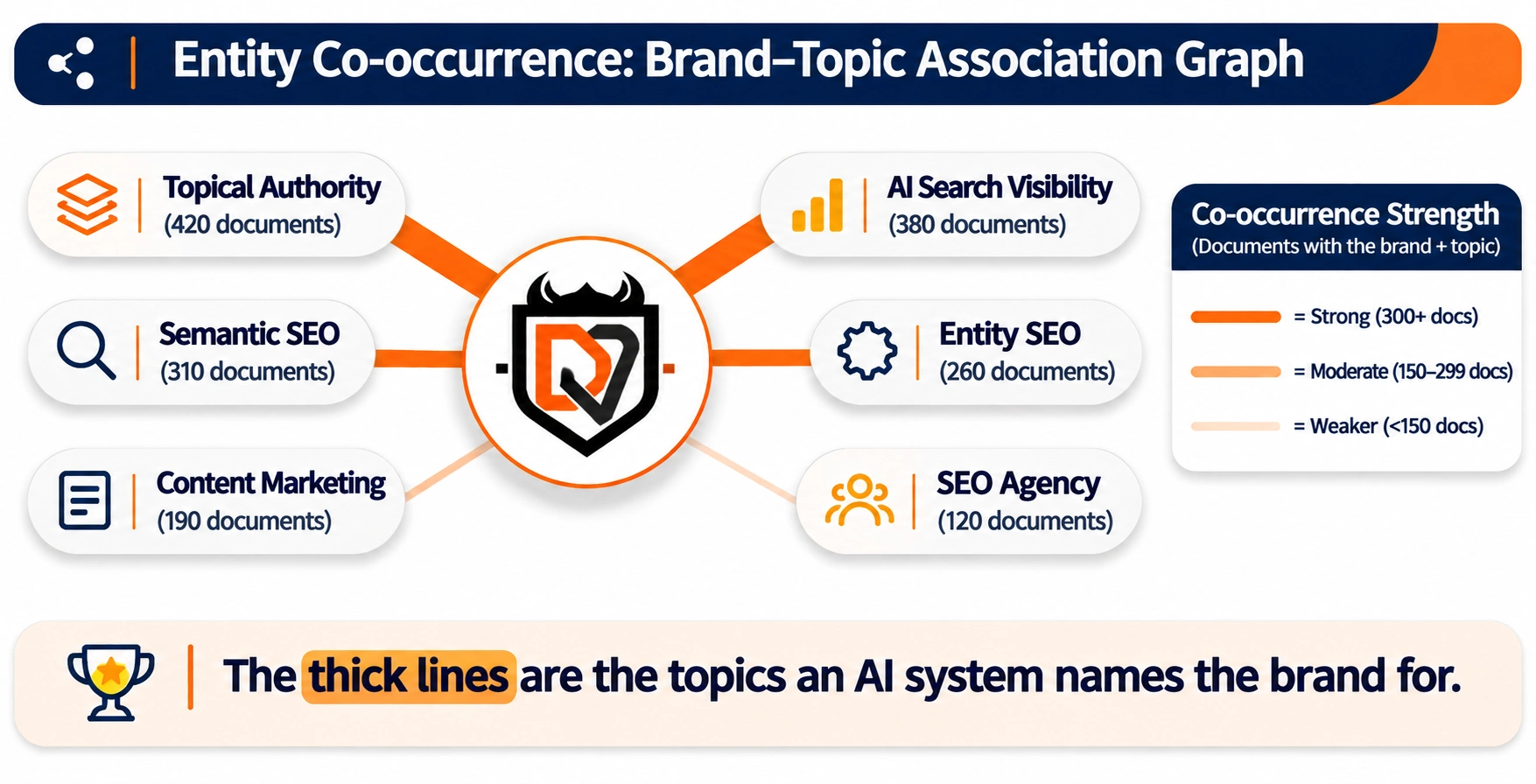
The image above shows the association as a graph. The brand sits at the centre. Each topic term is a node. The thickness of each line is the count of documents where the pair appears together. The thick lines are the topics the brand is named for.
How do training-time and retrieval-time co-occurrence differ?
Training-time co-occurrence is the association baked into the model from its training corpus, and retrieval-time co-occurrence is the association present in the documents fetched for one prompt.
Training-time association changes slowly, with each model release, and is built from years of pages. Retrieval-time association changes within weeks, as new pages are published and indexed. A new brand has no training-time association and earns mentions first through retrieval, on pages the systems fetch for the topic. The two sources are read together when mention rate is measured.
Which contexts count the most?
The same sentence counts most, the same paragraph next, the same page after that, and the same site least, with third-party pages weighing more than the brand's own pages.
A brand named in a sentence that states the topic is a direct association. A brand named in a footer on a page about the topic is a weak one. A brand that names itself beside the topic on its own site builds the association; a third party doing the same confirms the association, and the confirmation carries more weight because the brand did not write the sentence. That is our reading from prompt-set records across client properties; the systems publish no weighting.
Which co-occurrences matter for a brand?
Six co-occurrence pairs matter for a brand: the brand with its central entity, the brand with each service, the brand with the problems the services solve, the brand with its market, the author with the topic, and the brand with its category beside competitors.
The six pairs, where each forms and what each moves are listed below:
Pair | Where the pair forms | What the pair moves |
Brand and central entity | Definition sentence on every surface, third-party descriptions | Being named for the discipline |
Brand and each service name | Service pages, case write-ups, reviews naming the service | Being named for the specific job |
Brand and problem terms | Problem pages, forum answers, interviews describing the fault | Being named when a buyer describes the symptom |
Brand and market | Profiles, directories, press naming the country or sector | Being named for the market a prompt specifies |
Author and topic | Author pages, bylines, podcasts, conference listings | The brand's people named as sources |
Brand and category beside competitors | Listicles, comparison pages, award lists | Being named in recommendation prompts |
The last pair surprises most businesses. A page that lists the brand beside five competitors under the category name builds the brand's association with the category, because the model reads the list as a set of members. Exclusion from the lists the systems retrieve is the common reason an established brand is missing from recommendation answers.
How do you measure entity co-occurrence for a brand?
Entity co-occurrence is measured by collecting the brand's mentions, recording the topic terms within the same paragraph as each one, and computing the share of mentions that carry each term.
The steps to measure entity co-occurrence for a brand are listed below:
Fix the term set: the central entity, the service names, the problem terms and the market terms, in the exact phrasing the brand uses.
Collect the mentions. Search the brand name in quotation marks, in web search and in Bing, and add the mentions a monitoring tool reports. Exclude the brand's own domain for the third-party count and keep the brand's own pages as a separate set.
Open each mention. Record every term from the term set that appears in the same paragraph as the brand name, and whether the pair sits in one sentence.
Count per term: the number of mentions carrying the term, and the share of all mentions that figure represents.
Repeat steps 2 to 4 for each competitor named in the same AI answers as the brand, on the same term set.
Read the result against mention rate. A brand with a low share on the central entity term and a low mention rate has an association problem. A brand with a high share and a low mention rate has a retrieval problem on the pages that carry the pairs.
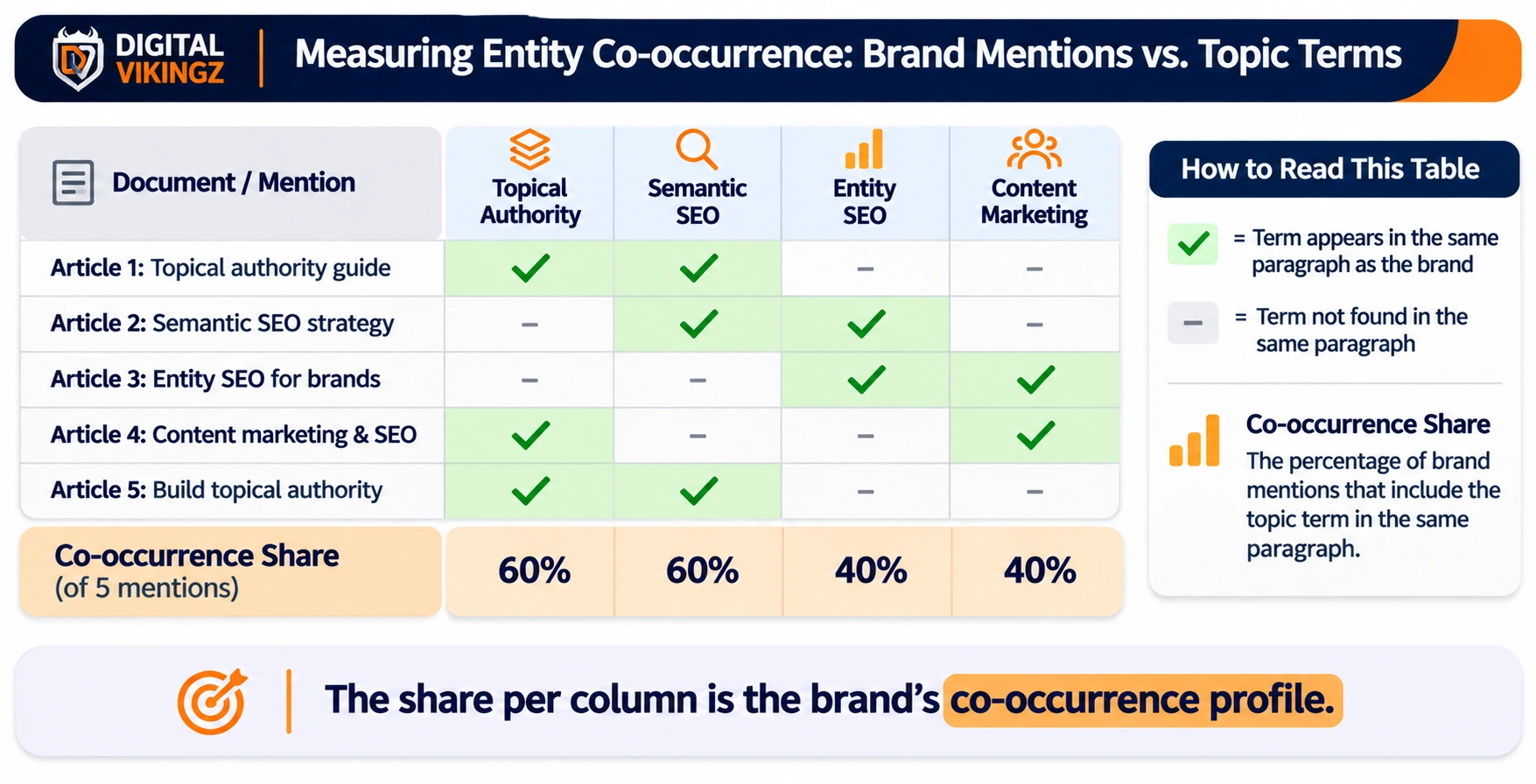
The image above shows the table step 3 produces. Each row is one mention. Each column is one term. The share per column is the brand's co-occurrence profile.
We run the measurement once before any authority work and once a quarter after. The first reading usually shows the brand strongly paired with its own name variants and weakly paired with the central entity, which is the drift the work corrects.
Does a brand mention without a topic term help?
A brand mention without a topic term adds little to co-occurrence, because the association being built is between the brand and the topic, and a bare mention supplies only the brand.
A bare mention raises brand recognition in the reader and supplies the model with nothing about what the brand does. A mention that reads "a semantic SEO agency" beside the name supplies the pair. The difference is one phrase in the sentence, and the phrase is what the measurement counts.
How do you build entity co-occurrence?
Entity co-occurrence is built by placing the brand name inside the sentence that states the topic, on the brand's own pages and on third-party pages, in one consistent phrasing.
The on-site and off-site actions that build entity co-occurrence are listed below:
One definition sentence everywhere. The sentence after "is" names the brand and the central entity, and the sentence reads the same on the site, the business profile, every social profile and every directory.
The brand inside the passage. Answering passages read "our semantic content audit returns" rather than "the audit returns", so the brand is in the sentence the systems lift.
Author pages tied to the topic. Each author's page names the topic in the first sentence, links to the author's work on the topic elsewhere, and is linked from each article's byline.
Third-party pages that state the pair. Guest contributions, podcast descriptions, interview intros and partner pages each carry the brand name and the central entity in one sentence, written by the brand where the host allows.
Category listings. Presence on the comparison pages and directories that the systems retrieve for recommendation prompts, under the category name the prompts use.
Reviews that name the service. Review requests that ask the client to name the service received, so the review carries the pair.
One name, no variants. The brand spelled one way, with the known variant declared as an alternate and never used in new text.
The order of work follows the measurement. The weakest pair with the most commercial value is built first, usually the brand with the central entity.
How does Authority Signals build entity co-occurrence?
Authority Signals builds entity co-occurrence by earning third-party pages that state the brand beside the topic, judged by whether the host page shares the topic and whether the pair sits in one sentence.
A placement is accepted when the host page is about the topic, the brand is named inside the passage about the topic, and the page is one the systems retrieve for prompts on that topic. A placement is declined when the host page is off topic, however strong its metrics, because the pair formed there is the wrong pair.
Authority Signals sets out the placement gate and the monthly read against mention rate. The service measures the co-occurrence profile before the first placement and after each batch, so the association is read as a trend and not assumed.
How is entity co-occurrence different from a backlink or a citation?
Entity co-occurrence is an association between two entities, a backlink is a link between two pages, and a citation is an AI answer linking one page as a source.
A backlink without the brand named beside the topic passes link signals and builds no association. A mention with the pair in one sentence and no link builds the association and passes no link signals. A citation links a passage and may or may not name the brand. The three are measured separately and move different outcomes. Brand mentions vs backlinks sets out the first two against each other, and mention rate vs citation rate sets out how the mention and the citation are read on one prompt set.
What dilutes a brand's entity co-occurrence?
Entity co-occurrence is diluted by mentions in unrelated contexts, by name variants that split the brand into several entities, and by several names for one service.
A sponsorship that places the brand on a hundred sports pages builds a strong pair with sport and a weaker profile for the discipline. Three spellings of the brand across directories build three weak entities instead of one. A service called an audit on the site, a review in proposals and an assessment in press builds three weak pairs where one strong pair was available.
The fix in each case is the same: fewer contexts, one name, one phrase per service. What is a central entity covers the one-entity rule the brand itself follows, and author and organization entities covers how the people and the organisation are declared once.
See which topics your brand is paired with
On a 30-minute call we pull your brand's mentions, mark the topic terms beside each one, and show you the two pairs that are missing. You leave with the first placement list, with or without an engagement.
Book a strategy call · Request the audit
Questions about entity co-occurrence
Is entity co-occurrence a Google ranking factor?
Google does not name co-occurrence as a ranking factor. Google describes the Knowledge Graph as relationships between entities built from web sources, and co-occurrence is how such relationships are observed in text. The term here describes the mechanism, not a confirmed signal.
How many mentions does a brand need before AI systems name the brand?
No system publishes a threshold. The practical reading is relative: the brand's co-occurrence share on the topic against the competitors named in the same answers. The brand is named when its share is comparable to theirs on the pages the systems retrieve.
Does co-occurrence on the brand's own site count?
Yes, as the base. The brand's own pages establish the pair, and third-party pages confirm the pair. A brand with no third-party confirmation is named less often than its own content suggests.
Can co-occurrence be built with press releases?
Press releases distributed to many hosts place the same pair on many low-value pages. The systems retrieve few of them. One interview on a page the systems retrieve for the topic outweighs a hundred syndicated copies.
Does a competitor comparison page on the brand's own site help?
Yes, when the page is accurate and the category name is used. The page states the brand as a member of the category beside the competitors, which is the pair recommendation prompts rely on.
How long does co-occurrence take to show in AI mentions?
Retrieval-time effects show within one to three months as new pages are indexed and retrieved. Training-time effects show at the next model release of each system and are outside the brand's control.
Does co-occurrence work for a person as well as a brand?
Yes, in the same way. An author named beside the topic across bylines, podcasts and profiles is named as a source. The author and the brand reinforce each other when the author's pages name the brand.
Which tools measure entity co-occurrence?
Mention monitoring tools collect the mentions. The co-occurrence count itself is a read of each mention against a term set, done in a spreadsheet or a script. No tool reports the share per term out of the box.
Does a wrong co-occurrence hurt?
A wrong pair dilutes rather than penalises. A brand paired strongly with an unrelated topic is named for that topic and less for its own. The fix is to stop adding to the wrong pair and build the right one.
Should the brand name appear in every heading to build co-occurrence?
No. The brand in every heading reads as stuffing to a reader and adds pairs with the brand's own navigation words. The brand belongs inside the passages that state the expertise, once per passage where the passage makes a claim.
Sources
Jurafsky and Martin, Speech and Language Processing, chapter on vector semantics and embeddings
Google Knowledge Panel Help: How Google's Knowledge Graph works