Digital Vikingz

Month two decides which queries earn a page, in what vocabulary, in what order. Month three publishes the first burst, updates the internal links behind the new pages, and reads query count and impressions per cluster against the baseline. Clicks and leads follow the query count, so the 90-day reading is coverage and reach, not revenue. The business's own work in those 90 days is answering the intake, supplying facts and proof, approving the map and reviewing pages on time.
Entity card
Field | Value |
Term | First 90 days of a semantic SEO engagement |
Also called | SEO onboarding, first quarter of an SEO engagement, SEO kickoff to first results |
Part of | A semantic SEO engagement |
Depends on | Access to Search Console, analytics and the CRM, a completed intake, and a named client contact for facts and approvals |
Produces | Baseline, source context statement, audit, topical map, vocabulary, briefs, templates, first published cluster, first reading |
Measured by | Documents delivered against the plan, pages published to brief, query count and impressions per cluster against the baseline |
Not the same as | A 90-day guarantee of rankings or leads |
What does month one of a semantic SEO engagement produce?
Month one of a semantic SEO engagement produces the baseline, the source context statement and the audit of the live site, so every later decision rests on a record of where the site stood.
The work of month one, split between the agency and the business, is listed below:
Who | What | Output |
Business | Completes the intake: business model, monetising pages, service area, audience, competitors, proof assets, brand vocabulary, past SEO history, publishing capacity | A 17-field intake, answered |
Business | Grants access: Search Console, analytics, the CRM, the CMS | Access confirmed |
Agency | Exports 16 months of Search Console data, runs the prompt set on each AI system, collects brand mentions, checks the CRM for a landing page field | The baseline |
Agency | Writes the source context: what the business sells, to whom, where, how money arrives; the central entity; the know and go intents | The source context statement |
Agency | Audits the live site: cannibalisation, dilution, index state, vocabulary drift, template faults, link graph | The audit, with one decision per page |
Both | A strategy call that confirms the central entity and the first cluster | A signed-off central entity |
The baseline is the document the whole engagement is read against. A reading in month three with no baseline is a number with no meaning, which is why the baseline is taken before anything on the site changes.
The source context statement is one page. The central entity is one noun phrase. Both are approved by the business before month two starts, because the map in month two inherits both.
What does the business do in month one?
The business answers the intake, grants access and names one contact who supplies facts and approvals within an agreed window.
The intake takes a business owner an afternoon. The access takes an administrator an hour. The contact is the person who knows what the business does well enough to answer a writer's fact questions, and who can approve a map and a page without a committee.
Month one slips when the intake comes back half answered, when access waits on a developer, or when the contact is a role rather than a person. Each of those is named in the first week so the slip is seen before the month ends.
What does month two of a semantic SEO engagement produce?
Month two of a semantic SEO engagement produces the topical map with a page decision per node, the vocabulary, the brief template, the page templates and the briefs for the first cluster.
The documents of month two are listed below:
The raw map. Every entity, attribute and query found around the central entity, with nothing decided.
The processed map. The raw map after attribute filtration and the page test, with a verdict per node: page, section, sentence or excluded, and a reason on each row.
The vocabulary. One name per entity, one verb per relationship, the allowed aliases and the banned variants, in a registry every writer reads.
The brief template. The four columns for the entity class: contextual vector, hierarchy, structure, connection.
The page templates. The components and their order for each page type, with the main content first in the HTML.
The internal linking rules. Outer to core, one canonical anchor per URL, the register of anchors.
The publishing roadmap. The first burst sized to the site, then a patternless rhythm, with the launch window set outside core updates.
The first briefs. One four-tab brief per page in the first cluster, each checked against the map before a writer sees one.
Technical fixes from the audit land in month two as well, when the business's developer or ours can apply them: redirects for the consolidations the audit decided, index corrections, schema that matches the visible page, and template changes the page templates require.
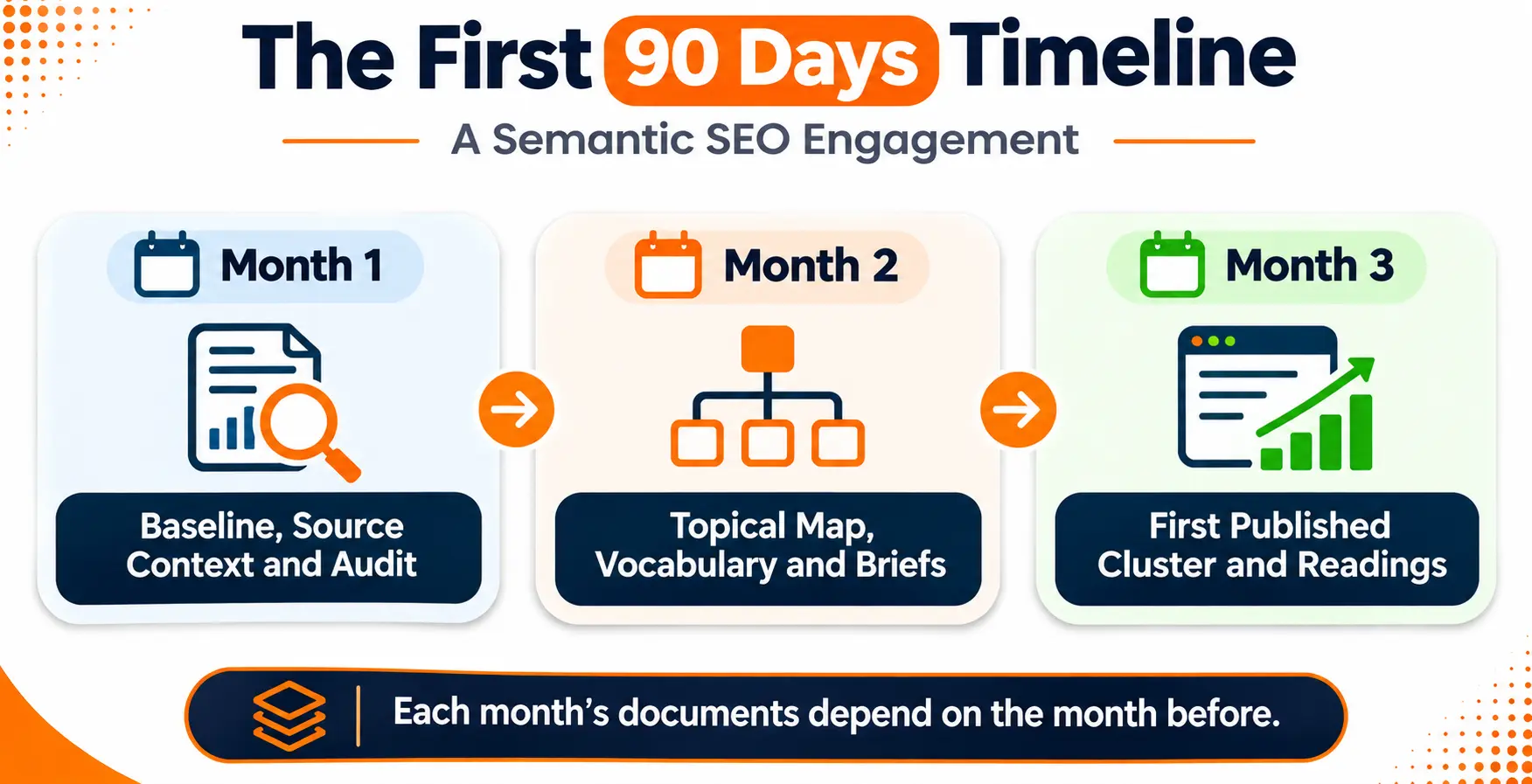
The image above lists the documents under each month. Nothing in month three exists without the month two documents, and nothing in month two exists without the month one baseline.
Which cluster publishes first?
The first cluster is the authority-first cluster: the hard, high-trust topic held by the strongest sources in the vertical, where the business has the expertise to compete.
An easy cluster first classifies the site with blogs. The hard cluster first classifies the site with the authorities, and every later cluster inherits that classification. When the site has no history at all in the knowledge domain, the first burst takes the middle-ground nodes that bridge to the hard cluster, and the hard cluster follows in the second burst. What is a topical map covers how the map is split into the core and outer sections the cluster sits in.
What does the business do in month two?
The business approves the processed map, answers the fact questions in each brief, and confirms the proof assets the briefs name.
The map approval is the largest decision of the engagement. The business reads the page decisions, flags any service or market the map misses, and signs the map off. A map approved in week six publishes in month three. A map that waits for a quarterly meeting publishes in month five.
The fact questions are the subject-matter inputs no agency can research: the process the business follows, the figures from its own work, the examples from its own clients with names removed. A brief with unanswered fact questions produces a page that states the obvious.
What does month three of a semantic SEO engagement produce?
Month three of a semantic SEO engagement produces the first published cluster, the internal links updated behind the new pages, the first prompt-set re-run, and the first reading per cluster against the baseline.
The sequence of month three is listed below:
Pages are written to the briefs and checked against them sentence by sentence. A page that fails goes back with the lines marked.
The first burst publishes, sized to the site's existing URL count, in the launch window the roadmap set.
Internal links are updated: the new pages link to the core, the existing pages that the map named link to the new pages, and the homepage links to the quality nodes.
The prompt set is re-run on each AI system and recorded against the month one run.
Search Console is read per cluster: query count, impressions, clicks and the lists of new queries on the published pages.
The evidence package is delivered: what changed, where, and what Search Console shows, with the panel per cluster and the window named.
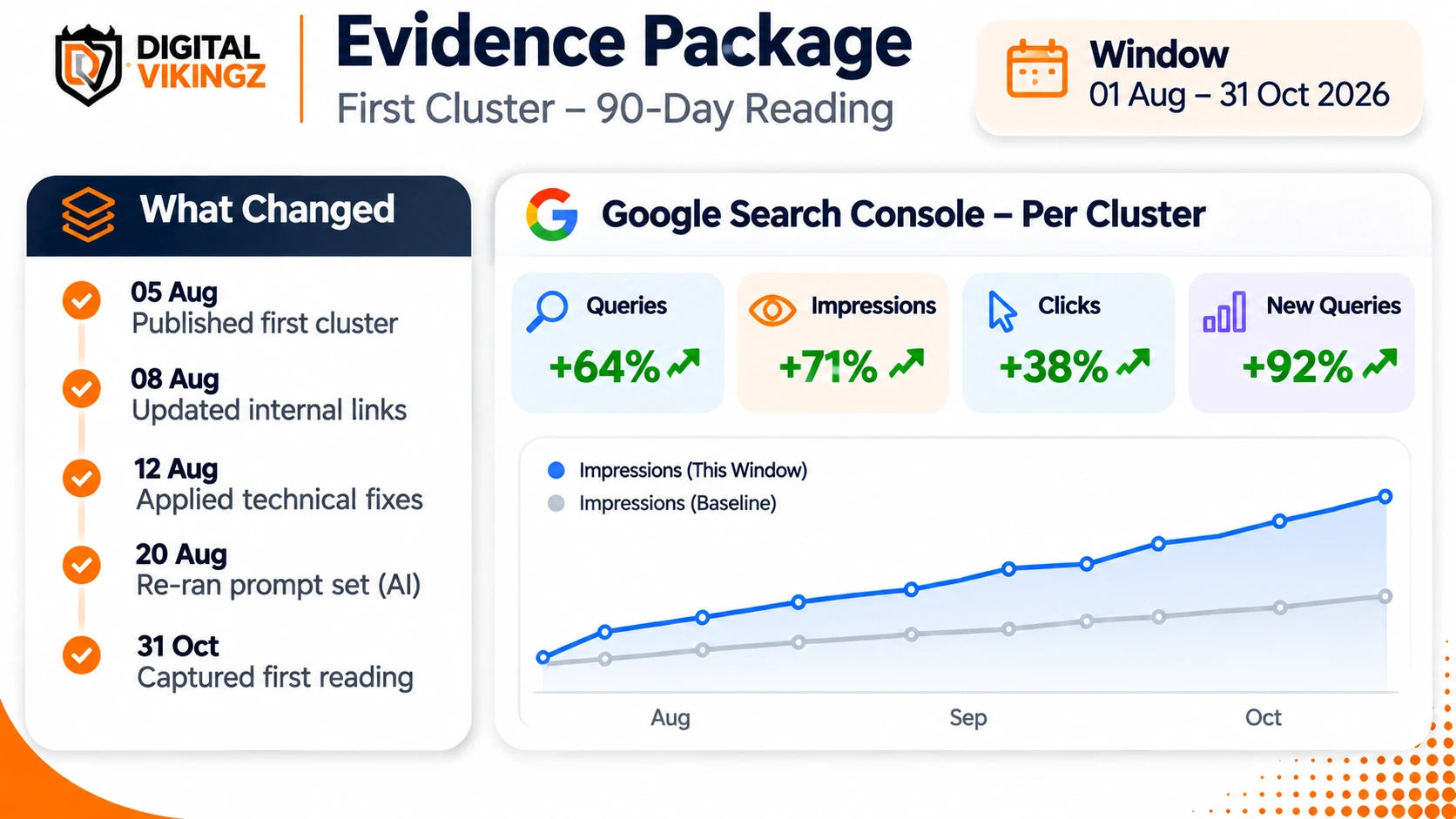
The image above shows the evidence package. The left column lists the changes with dates. The right column shows the Search Console panel per cluster. The window is named at the top, before any number.
What results show in the first 90 days?
The first 90 days show query count and impressions rising on the published cluster, new queries appearing on the new pages, and the first citations or mentions on the prompt set where the pages answered a prompt directly.
Query count and impressions move first because Google tests a new page across queries before the page settles. Clicks follow when the position settles, and leads follow the clicks by the length of the sales cycle. A 90-day report that shows rising query count on the right cluster is a report of an engagement working. A 90-day report that promises leads is a report of an engagement overselling.
Google's own guidance to businesses hiring an SEO states that four months to a year is usual before improvements are implemented and benefits appear. The 90-day reading sits inside that window and reads the leading indicators.
Can a site rank for its money terms in 90 days?
A site rarely ranks for its money terms in 90 days, because money terms sit on the core pages, and core pages rise as the outer pages around them earn history and pass relevance inward.
The exception is a site that already held history on the topic and lost position through a fault the audit fixed, such as cannibalisation or a blocked crawler. That site recovers inside the window. A new site builds toward money terms over the following quarters.
What does the business receive by day 90?
By day 90 the business holds the baseline, the source context statement, the audit, the processed topical map, the vocabulary, the brief template, the page templates, the linking rules, the roadmap, the first briefs, the first published cluster and the first evidence package.
Every one of those is a document the business keeps when the engagement ends. None is a licence, a dashboard login that expires, or a slide deck. A business that stops after 90 days holds the architecture and can produce from the map itself, which is the point of delivering documents rather than reports.
Semantic SEO Architecture lists the seven architecture documents in full, and the services page shows how the audit, the architecture and production fit together as three layers.
What makes the first 90 days fail?
The first 90 days fail through slow approvals, missing access, unanswered fact questions, scope added mid-quarter and a launch forced into a core update.
The causes of a failed first quarter and the prevention for each are listed below:
Slow approvals. The map waits three weeks for a meeting. Prevention: one named approver with a window agreed in week one.
Missing access. Search Console or the CRM arrives in week five. Prevention: access is a condition of the start date, not a task after the start.
Unanswered fact questions. Briefs go to writers with blanks. Prevention: the fact questions go to the contact the day the brief is written, and the writer starts when the answers return.
Scope added mid-quarter. A new service line or market is added in month two and the map is re-cut. Prevention: the source context fixes the scope in month one, and additions queue for the next quarter.
A launch forced into a core update. The burst publishes while rankings are being recalculated. Prevention: the roadmap sets the window, and a rollout announced inside the window moves the burst.
Each cause is visible by week two. A quarter that ends badly was usually a quarter whose first two weeks were not read.
How does the engagement continue after 90 days?
The engagement continues after 90 days as production on the roadmap at a patternless rhythm, a configuration pass after each core update and every quarter, and the same evidence package each month.
The second quarter publishes the next clusters in roadmap order, updates the links behind each one, and reads the first cluster's clicks as the positions settle. The content configuration pass runs after the first core update that lands on the new pages. Leads per cluster enter the report once the CRM landing page field has carried enough leads to read, as set out in how to attribute SEO to pipeline.
See what your first 90 days would contain
On a 30-minute call we open your site and your Search Console, name your central entity and the first cluster, and show you which month one documents your site already has and which are missing. You leave with that list, with or without an engagement.
Book a strategy call · See the services
Questions about the first 90 days of a semantic SEO engagement
Does the audit come before the architecture, or can both start at once?
The audit comes first, because the audit's page decisions feed the processed map. On a new site with few pages the audit is short and the two overlap inside month one.
How many pages publish in the first burst?
The burst is sized to the site's existing URL count, so a site with forty pages gets a smaller burst than a site with four hundred. The number is set in the roadmap, not promised in the proposal.
What if the business has no CRM?
The attribution model ends at the lead, read from form submissions grouped by landing page. The CRM field is recommended in month one and added when the business adopts one.
Can the business keep publishing its own posts during the 90 days?
Posts outside the map dilute the source during the one period the site most needs focus. The existing calendar pauses or is folded into the map, and the business's writers receive briefs from the map instead.
Who writes the pages in month three?
The agency's writers write them by default, or the business's writers from the agency's briefs in a hybrid. In both cases the check against the brief is done before publication by a named checker.
What does the business see in the first month besides documents?
Nothing on the live site, by design. Changes before the baseline is taken destroy the baseline. The first visible change is the technical fix batch in month two.
How is the first reading separated from seasonality?
The baseline holds the same window from the previous year where the site has that history, and the month three reading is compared with both the pre-engagement window and the year-ago window.
What happens if a core update lands in month three?
The burst moves to after the rollout completes, and the month three reading waits for a fortnight of settled data. The roadmap carries the new date, and the evidence package states the delay and the reason.
Is the strategy call in month one a sales call?
The strategy call confirms the central entity and the first cluster with the site open. The engagement is already agreed by then; the call is the first working session.
What if the business disagrees with the central entity?
The disagreement is settled before month two, because the map inherits the entity. The source context statement records both candidates and the reason for the choice, and the business decides with that record in hand.
How does the 90-day plan differ for an agency buying white-label?
The documents are the same and the roles differ: the reselling agency holds the client contact and the approvals, and the engagement timeline follows the reselling agency's approval speed. White-label semantic SEO sets out that arrangement.