Digital Vikingz
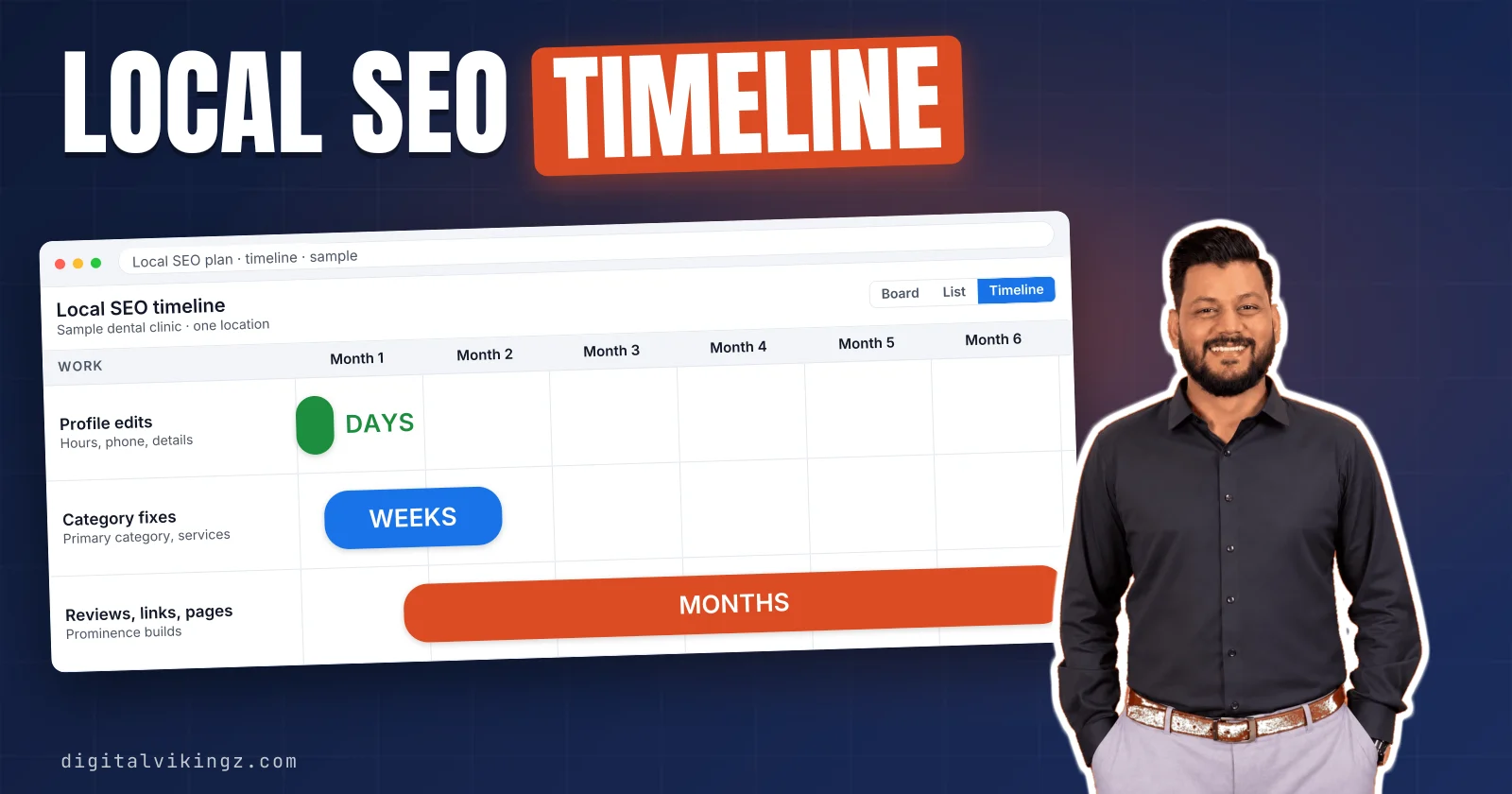
Local SEO, search engine optimization for a local business, takes days to months to work, because each part runs on its own clock.
Google states that Business Profile edits can take up to 3 days to appear. Category and detail fixes are picked up within weeks, and map pack gains usually build over two to four months, in our experience.
Reviews, links and pages build over months, at a pace set by competition, starting state and how much work ships. Calls and direction requests usually follow the rankings by several weeks, in our experience.
Progress shows first in a rank grid, the Business Profile performance counts and Google Search Console, read at fixed checkpoints. Slow local SEO points to wrong work when the profile, pages and review flow show no change by month two.
How long does local SEO take?
Local SEO takes up to 3 days for profile edits, Google states, while category fixes take weeks and map pack gains two to four months in our work.
Google Business Profile is the free listing behind the map pack, so most early local SEO work starts there. Many local SEO agency pages report noticeable gains in about 3 to 6 months. Crowded trades and cities can take 6 to 12 months or longer, according to the same agency pages.
Google's own SEO guide says some changes "might take effect in a few hours, others could take several months." A result in local SEO is a measured change. Examples are a higher map pack position, more Business Profile calls or more clicks to a service page.
The businesses and numbers in the figures below are samples, not client data. Each part of local SEO runs on its own clock, so the parts are worth separating.
What moves first in local SEO, and what takes months?
Google Business Profile edits and category fixes move first in local SEO, while reviews, links and new pages take months to add up.
Fast levers change what Google reads on the profile. Slow levers build the prominence Google weighs against nearby competitors.
The table below lists the main local SEO levers, the clock each one runs on and the source of that clock:
| Lever | Clock | Source of the clock |
|---|---|---|
| Hours, phone number and other Business Profile edits | Up to 3 days | Google statement |
| New business appearing in rankings | Up to a month after verification | Google statement |
| Primary category and detail fixes | A few weeks | Our experience |
| New or rewritten service pages | A few hours to several months | Google statement |
| Name, address and phone fixes across directories | Weeks to months | Our experience |
| Reviews | Months of steady requests | Our experience |
| Links and mentions from local sites | Months | Our experience |
The slow levers decide most map pack gains. A month of fast fixes is the start of local SEO, not the finish.
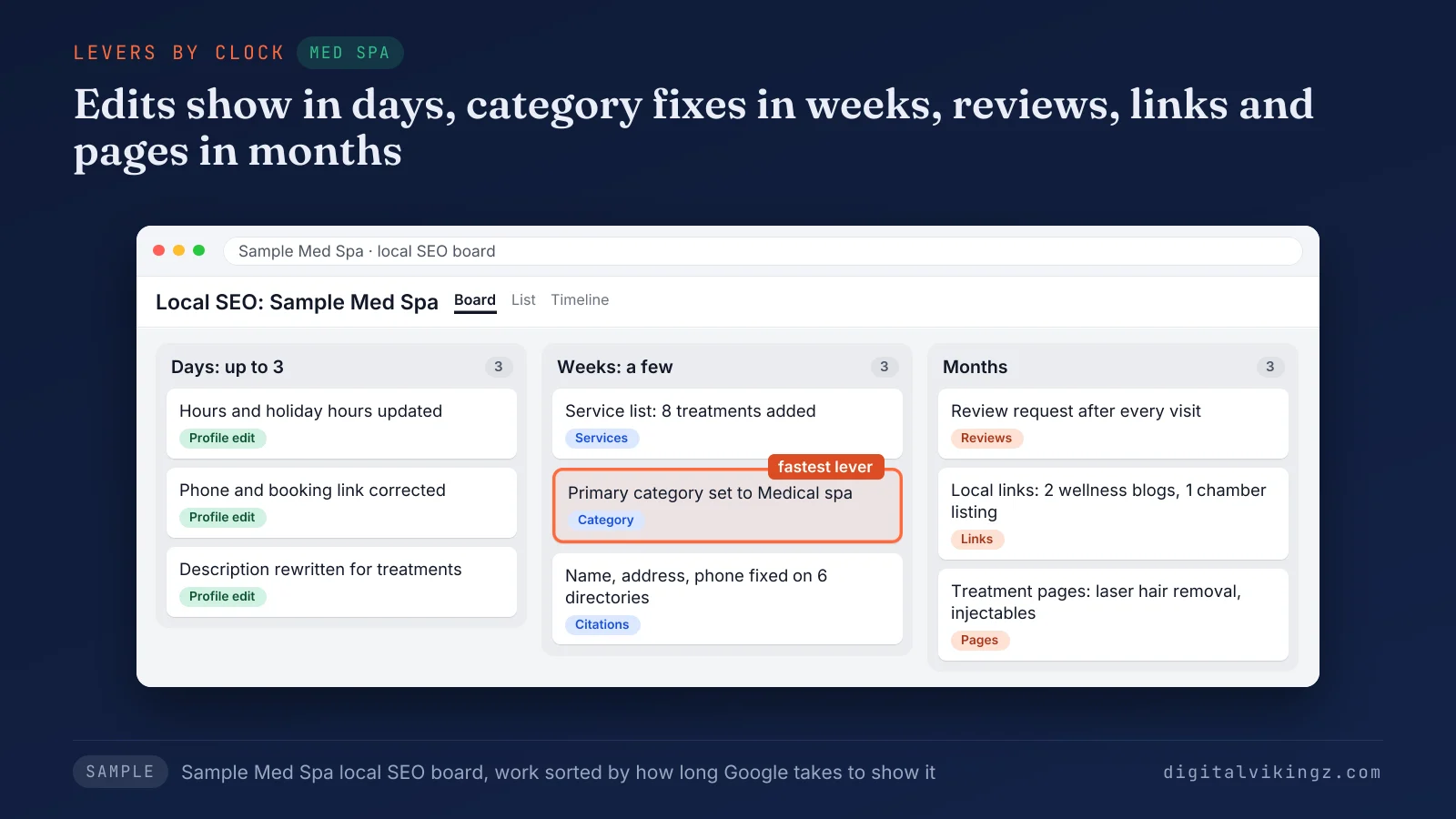
Figure 1 sorts the local SEO work for Sample Med Spa into days, weeks and months. Hours and holiday hours sit in days. The primary category and service list sit in weeks, and reviews, local links and treatment pages in months.
Every Business Profile field that can be filled is part of the fast group. Our Google Business Profile optimization guide covers each field in 13 steps.
How long do Google Business Profile changes take to show?
Google Business Profile changes such as hours, phone number and description usually show within 3 days, the limit Google states for edits.
Google's help page says changes to business info "can take up to 3 days to appear." Google Business Profile is the name Google gave Google My Business in 2021, so older guides still use the old name.
A new primary category shows on the profile within the same window. The map pack takes a few weeks to reflect the change, in our experience. Edits held in review past 3 days usually involve a field Google wants to check, such as the name or address.
The primary category is the fastest-moving lever in local SEO. Our guide on which primary category a Google Business Profile should use covers the choice step by step.
How long does a new Google Business Profile take to rank?
A new Google Business Profile can take up to a month to appear in rankings, and that month starts only once the profile is verified.
Google's help page states: "Rankings for new businesses can take up to a month to appear in search results." Google also states: "Only verified businesses can show their business info on Maps and Search."
Owners in Google's Business Profile community report verification loops lasting weeks or months. The local SEO clock stays at zero until verification ends.
Appearing in rankings is the first step. Climbing into the map pack for a competitive search usually takes the months the slow levers need.
Verification is Google's check that the owner runs the business at the stated address or service area. Our guide on how to verify a Google Business Profile covers each method.
How long do reviews, citations and links take to help local SEO?
Reviews, citations and links usually take months to help local SEO, because each one adds to prominence a little at a time.
Google's ranking page says prominence is "also based on info like how many websites link to your business and how many reviews you have." A steady flow of new reviews moves a profile more than a burst followed by silence, across our engagements.
Citation fixes depend on each directory's update schedule. A corrected name, address and phone can take weeks to spread, in our experience.
Links from local sites count only after Google crawls the linking page. Google's guide puts the effect of changes anywhere from hours to several months.
Reviews are the slow lever a Google Business Profile owner controls most directly. Our seven steps to get more Google reviews within Google's rules keep that flow steady.
What does a local SEO timeline look like month by month?
A local SEO timeline usually runs from profile fixes in the first weeks to map pack gains in months two to four.
The bands below are what we usually see for one location in a mid-sized city. Crowded trades or new businesses shift each band later.
The five bands of a typical local SEO timeline are listed below:
- Weeks 1 and 2: the Business Profile is checked, verified and corrected, and Google shows the edits within days.
- Month 1: the primary category, services and details are fixed, review requests start and service pages are planned.
- Months 2 to 4: service pages go live, reviews add up, and map pack positions start to move on the closest searches.
- Months 4 to 6: positions spread to more of the service area, and calls and direction requests rise behind them.
- Month 6 onward: gains compound on harder searches, and the work shifts to keeping reviews, posts and pages fresh.
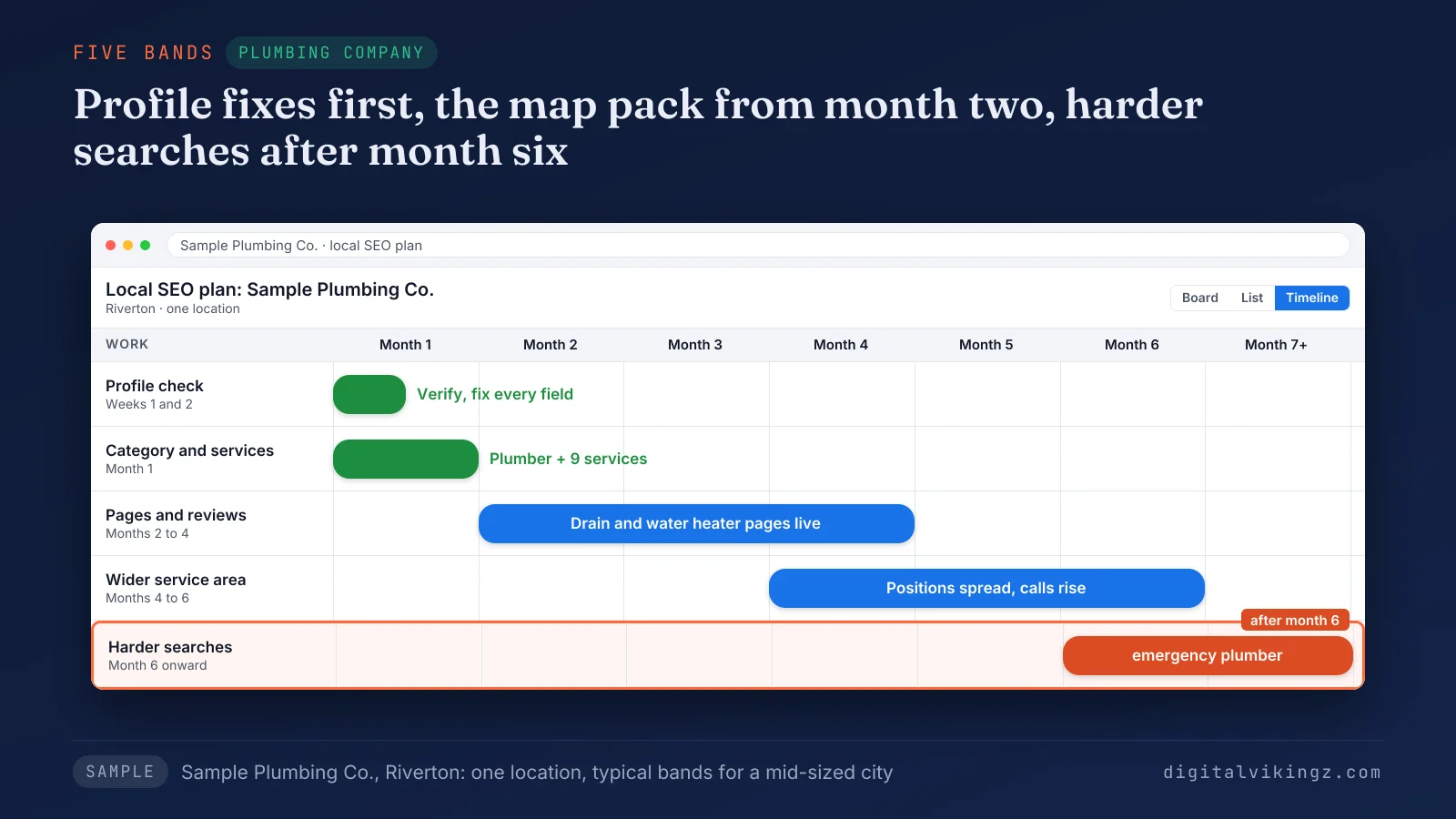
Figure 2 lays the five bands out for Sample Plumbing Co. in Riverton. The plan runs from the profile check in week 1 to emergency plumbing searches in month 6 and later.
Seasonal trades such as HVAC and roofing should compare each month of local SEO with the same month a year earlier. An agency engagement adds its own setup work to the first three months of local SEO.
When do calls and leads follow local SEO rankings?
Calls and leads usually follow local SEO rankings by several weeks in our experience, because a map pack position has to hold before customers act.
The Business Profile performance counts for calls, direction requests and website clicks rise a month or two after positions move, in our experience. Owners on the Local Search Forum report ranking in the map pack with one or two calls a month. Position alone is not the result.
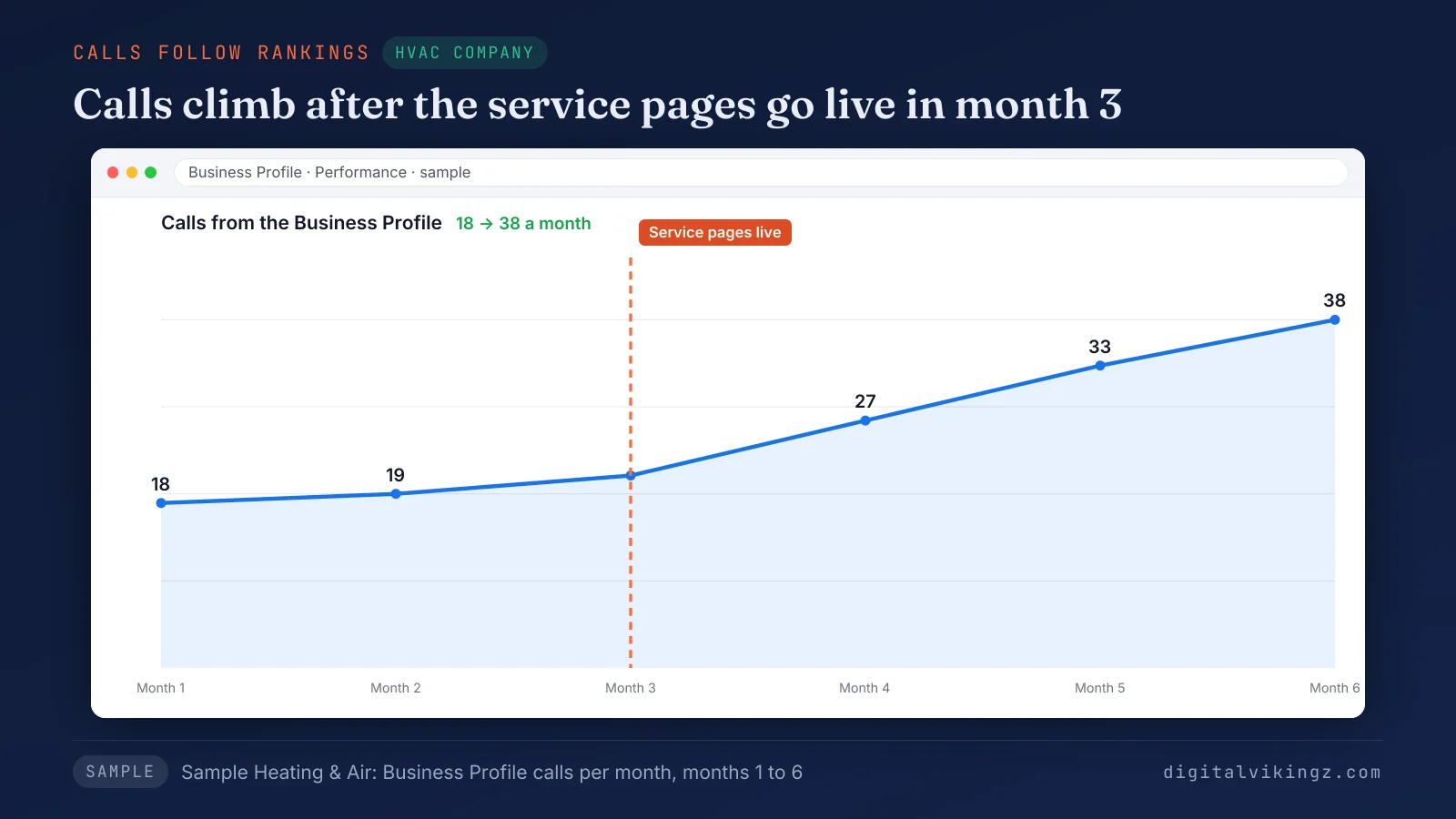
Figure 3 shows Business Profile calls for Sample Heating & Air rising from 18 in month 1 to 38 in month 6. The climb starts after the service pages went live in month 3.
HVAC calls also follow the weather, so a cooling or heating peak can hide or exaggerate the effect of local SEO.
The performance report inside the Business Profile counts each call, direction request and website click by month. Our guide to the Google Business Profile performance report explains what each metric counts.
What do six-month local SEO results look like?
Six-month local SEO results in our published case studies show Google clicks rising after the work ships, not during the first weeks.
Our custom kitchen maker case study shows Google clicks up 141%. The case study counts 1.25k clicks in the six-month program window and 3.01k in the six months after. The kitchen maker's daily impressions began rising in April 2026, inside the last weeks of the program window, according to the same case study.
Our shower screen glazier case study shows Google clicks up 42%. The glazier case study counts 1.12k clicks in the program window and 1.59k in the six months after.
Both results count Google Search clicks to the website, the local SEO signal that takes longest to show, in our experience.
The kitchen maker's pages for nearby towns carried part of that gain. The kitchen renovation SEO case study lists the pages that gained and their clicks before and after.
What sets the pace of local SEO?
Five factors set the pace of local SEO: competition, starting state, distance, work shipped each month and season.
Google's ranking page says local results are "mainly based on relevance, distance, and popularity." Popularity is the factor the same page calls prominence further down. Each factor below acts through one of the three.
The five factors that set the pace of local SEO are listed below:
- Competition: the number and strength of businesses in the same category near the searcher. A dentist downtown waits longer than a dentist in a small town.
- Starting state: a verified profile with years of reviews moves faster in local SEO than a new profile with none.
- Distance: a business ranks fastest near its address or service area, and the map pack farther out takes longer.
- Work shipped: pages, reviews and posts that go out every month keep the clock running, and gaps stall progress.
- Season: demand for heating, cooling, roofing and pest control rises and falls, which changes how fast calls show the work.
More reviews and citations alone do not guarantee movement when closer competitors in the same category already fill the map pack.
Relevance, distance and prominence are the three factors Google describes for the map pack. Our guide on how to rank higher on Google Maps explains each factor and the seven steps that act on them.
Why does local SEO take longer for a new business?
Local SEO takes longer for a new business because a new profile starts with no reviews, history or links.
Owners on the Local Search Forum describe a clinic six months old with 15 reviews, facing competitors that have hundreds. A new business gains ground fastest on searches close to its address, in our experience. Thin services that older competitors neglect move early too.
Google's one-month window for new businesses is the earliest point rankings appear, not the point a new profile catches up. Owners in a hurry usually ask next whether any part of local SEO works in 30 days.
Can local SEO work in 30 days?
Local SEO can work in 30 days for profile edits and category fixes, but map pack gains on competitive searches rarely arrive that fast.
Google's guidance on hiring an SEO warns: "No one can guarantee a #1 ranking on Google." A first month usually shows corrected profile details and a working review flow, in our work. The Business Profile performance counts make their first moves in the same month.
How do you tell if local SEO is working?
Local SEO is working when map pack positions, Business Profile actions and service page clicks rise at fixed checkpoints, read against the same period before.
Google's SEO guide says you "likely want to wait a few weeks to assess whether your work had beneficial effects." One day's search proves nothing.
The table below lists four local SEO checkpoints, what to check at each one and what the check proves:
| Checkpoint | What to check | What the check proves |
|---|---|---|
| Week 2 | Profile edits live, category and hours correct | Google has accepted the fixes |
| Month 1 | Review requests going out, service pages planned, rank grid baseline saved | The slow levers have started |
| Month 3 | Rank grid against the baseline, Search Console impressions for the service pages | Positions and visibility are moving |
| Month 6 | Calls, direction requests, website clicks and booked jobs against the six months before | The work is turning into customers |
A rank grid, the Business Profile performance report and Google Search Console cover every row of the table. Booked jobs and calls matter more than any score a report invents for the website.
A rank grid is the first of the three tools to show movement.
How does a rank grid show local SEO progress?
A rank grid shows local SEO progress by checking map pack positions at many points across a service area.
Map pack positions change with the searcher's location, so a single search shows one point of a wider picture. Grids vary from run to run, so the trend across several checks matters more than any one grid.
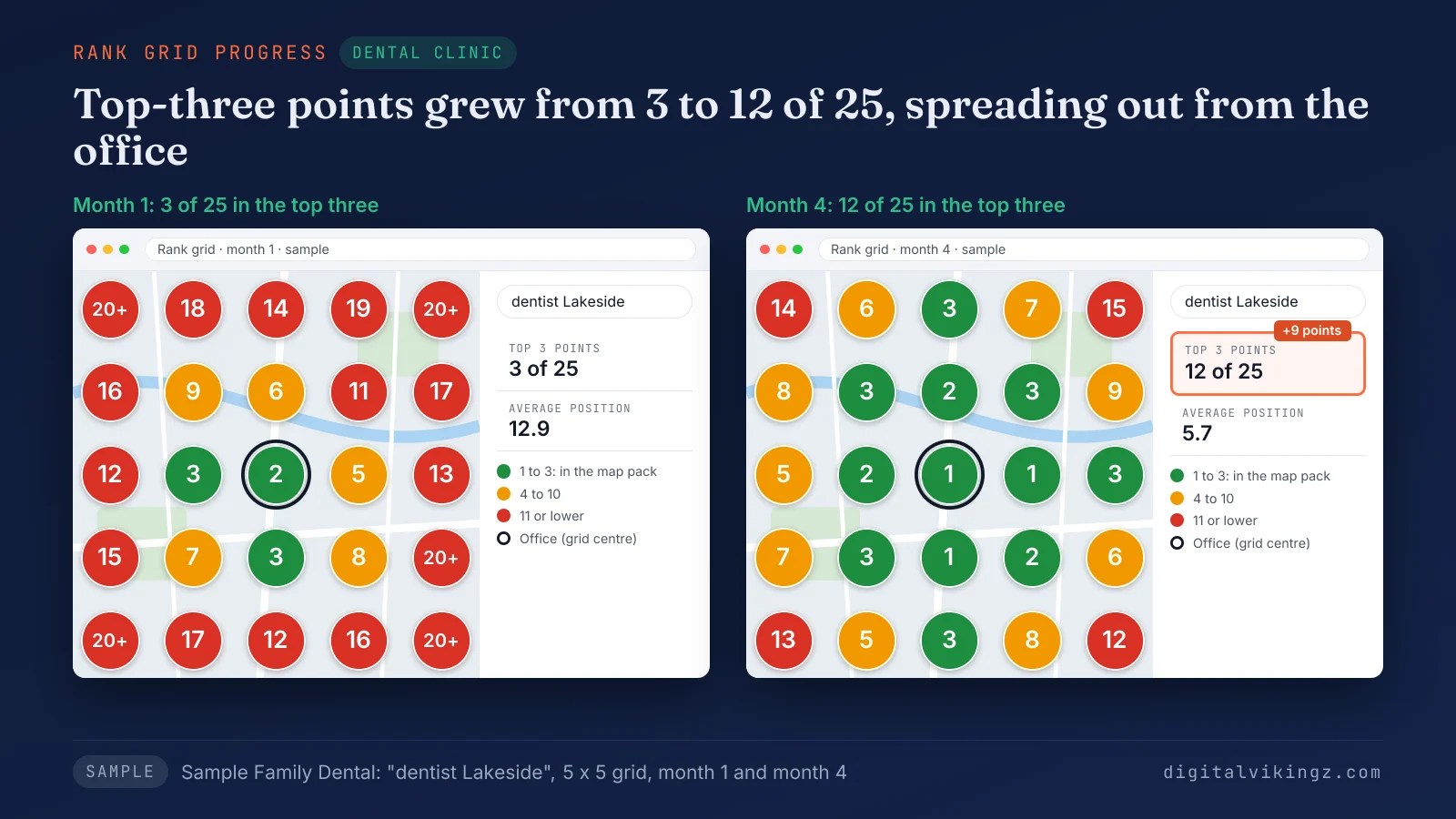
Figure 4 compares rank grids for Sample Family Dental for the search dentist Lakeside. The grid shows 3 of 25 points in the top three at month 1 and 12 of 25 at month 4.
Local SEO gains that start at the office and spread outward match the timeline above.
Does a Google core update reset the local SEO timeline?
A Google core update does not reset the local SEO timeline, but positions can swing during the rollout and settle afterwards.
The Google Search Status Dashboard dates the start of the November 2026 core update to 10 November 2026. The same dashboard records 12 days 4 hours for the March 2026 rollout and 11 days 21 hours for the May 2026 rollout.
Rankings read during a rollout reflect the update more than the local SEO work. Progress on the timeline is best judged in the weeks after the rollout ends. A shared slip among nearby competitors in those weeks means the timeline pauses, not resets, and the planned work carries on.
When does slow local SEO mean the work is wrong?
Slow local SEO means the work is wrong when the profile, pages and review flow show no change by month two, in our experience.
Every sign below can be checked from the Business Profile, the website and the monthly local SEO report.
The five signs that slow local SEO comes from the work, not the market, are listed below:
- Unchanged profile: the primary category, services and description read the same as before the work began.
- Missing pages: no service page or town page has gone live after two months.
- Unindexed pages: Search Console shows the new pages as not indexed weeks after launch.
- Silent review flow: the review count has not moved because no request goes out after each job.
- Report without customers: the monthly report lists tasks and scores but no calls, direction requests or booked jobs.
A hard market shows the opposite pattern. The work ships every month, the rank grid creeps outward, and competitors with more history still hold the top spots.
A local SEO service should show each month's profile updates, posts, review replies and pages in one report. Our Local SEO and Google Business Profile Optimization with a monthly report works that way, and the report shows what each month added.
Book a strategy call to have your profile and pages checked against these five signs.
How do you tell if your local SEO agency is working?
A local SEO agency is working when each monthly report shows shipped work and a change in map pack positions, Business Profile actions or booked jobs.
"Local SEO takes time" is a fair answer in month two only when the report also lists what shipped that month. Domain authority and website health scores do not measure local progress, so a report built on them leaves the main question open.
Ask the agency for the rank grid baseline, the performance counts and the list of pages published since the start.
Reports that show rankings and tasks but never calls or jobs are a common reason owners change provider. Our page on an agency that reports rankings instead of results covers what an independent audit checks.
What can stop the local SEO clock?
Four events can stop the local SEO clock: a suspension, a request to verify again, an address move and a duplicate profile.
The four events that can stop local SEO progress on a Google Business Profile are listed below:
- Suspension: Google removes the profile from Maps and Search until a reinstatement request succeeds.
- Verification request: Google asks the owner to verify again, and the profile can lose visibility until the check ends.
- Address move: a new address changes distance for every search, so positions rebuild around the new location.
- Duplicate profile: two profiles for one business split reviews and signals until the duplicate Google Business Profile is merged or removed.
The local SEO clock restarts from the last stable state once the event is fixed, not from zero, across our engagements.
Each event makes the profile disappear or drop sharply instead of moving slowly. Our guide to a business not showing on Google Maps walks through each cause and its fix.
Do AI assistants pick up local SEO work on the same timeline?
AI assistants pick up local SEO work on a similar timeline, because they read the same profiles, reviews and websites that move the map pack.
ChatGPT, Gemini and Google's AI answers draw on business profiles, review sites and business websites to name a local business, in our research. AI recommendations lag the same signals as the map pack, so the months of work count twice, in our experience.
Specific reviews and consistent facts across sources help an assistant choose one business over another.
Questions about how long local SEO takes
Does local SEO still work in 2026?
Local SEO still works in 2026, because Google still shows a map pack and a Business Profile for most searches with local intent.
The November 2026 core update changes rankings for some businesses, not the need for a complete profile, reviews and service pages.
Should you run Google Ads while local SEO builds?
Google Ads can bring calls while local SEO builds, and the two work side by side instead of replacing each other.
Ads stop when the budget stops, while local SEO gains keep working after the months of building them.
What happens if you stop local SEO?
Stopping local SEO does not erase gains at once, but positions can slip as competitors keep adding reviews, posts and pages.
A profile with no new reviews or posts for months gives nearby competitors room to pass the profile in the map pack.
Do Google Business Profile posts speed up local SEO?
Google Business Profile posts show customers an active business, but Google does not list posts as a local SEO ranking factor.
Posts help a customer choose between profiles, which makes posts a conversion lever more than a ranking lever.
Can anyone guarantee a map pack ranking by a date?
No one can guarantee a map pack ranking by a date, and Google warns that no one can guarantee a #1 ranking on Google.
A local SEO provider can commit to the work each month and to reporting the result, not to a position.
What should you do first to make local SEO work sooner?
Local SEO works sooner when the fast levers are fixed in week one and the slow levers start the same month.
The four first steps that start the local SEO clock early are listed below:
- Verify the Google Business Profile and correct every field.
- Set the most specific primary category and list every service.
- Send a review request after every finished job.
- Save a rank grid and the performance counts as the month 1 baseline.
Digital Vikingz also keeps profiles active for home-service businesses with a new post every day. Our Daily Google Posts for plumbers, HVAC and roofing companies let you preview today's post for your own business.