 Digital Vikingz

Google generates Knowledge Panels automatically and does not take applications, so the work is on the sources Google reads. A Knowledge Panel is not a Business Profile; the profile is the local listing a business creates, and the panel is the entity card Google builds. Once a panel appears, the business claims the panel through Google's verification and suggests corrections, and the panel then follows the sources as they change.
Entity card
Field | Value |
Term | Knowledge Panel for a business |
Also called | Brand Knowledge Panel, Knowledge Graph panel, entity panel |
Part of | Authority Signals, the entity layer |
Depends on | An entity home page, consistent corroborating sources and brand search demand |
Produces | A panel on the brand's own search results page and a stable entity for AI systems to name |
Measured by | Panel presence on the brand query, the Knowledge Graph Search API result, and branded query count |
Not the same as | A Google Business Profile listing |
What is a Knowledge Panel and how does one differ from a Business Profile?
A Knowledge Panel is the information card Google generates for an entity from its Knowledge Graph, and a Business Profile is the local listing a business creates and manages itself.
The differences between the two are listed below:
Dimension | Knowledge Panel | Business Profile |
Who creates the card | Google, automatically, from the Knowledge Graph | The business, through Google Business Profile |
What triggers the card | A search for the entity's name, where Google has a confident entity | A local search or a brand search near the business |
What the card shows | Description, logo, founder, founding date, social profiles, related entities | Address, hours, reviews, photos, posts, directions |
How the card is changed | Claim the panel, suggest edits, change the sources Google reads | Edit the profile directly |
Which business has one | Any brand Google recognises as an entity, with or without a location | A business with a physical location or service area |
A local business often has both. The profile shows the place. The panel shows the organisation. Google merges the two in some brand searches, and the merged card still draws its organisation facts from the Knowledge Graph.
Google's own documentation states that Knowledge Panels are generated automatically and that information comes from a variety of sources. The panel is read, not written.
How does Google decide to show a Knowledge Panel?
Google shows a Knowledge Panel when the Knowledge Graph holds the brand as a distinct entity, the facts about the brand agree across the sources Google trusts, and searches for the brand name show that people want the entity.
Three conditions sit behind that sentence. The entity exists: Google has a node for the brand, separate from other businesses with similar names. The facts agree: the description, the founder, the founding date and the location read the same on the brand's site, its profiles and third-party pages. The demand exists: the name is a query people type, which tells Google a card is useful.
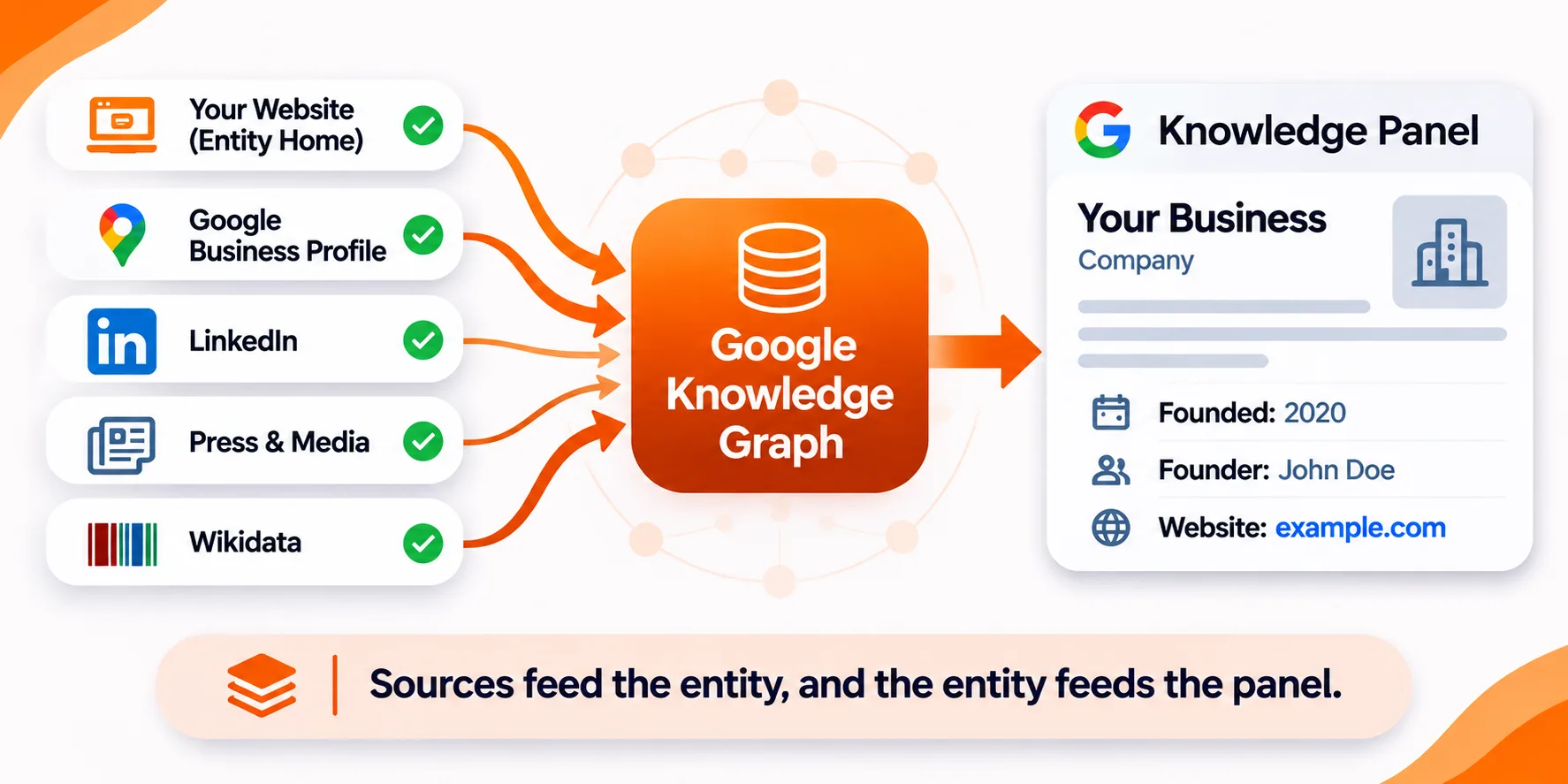
The image above shows the flow. Sources feed the entity. The entity feeds the panel. A disagreement between sources weakens the entity, and a weak entity shows no panel.
A new business fails on all three at first. The order of work fixes the first two, and the third follows from marketing that makes people search the name.
How do you get a Knowledge Panel for a business?
A business gets a Knowledge Panel by building one entity home page, writing one description used everywhere, marking the organisation up with schema, earning corroborating sources, raising brand search demand, and claiming the panel once one appears.
The steps to get a Knowledge Panel for a business are listed below:
Build the entity home. One page on the brand's own domain, usually the About page, that states what the brand is, who founded the brand, when, where, and what the brand does, in plain sentences. Every other source is checked against that page. The term entity home comes from Jason Barnard of Kalicube, who documented the pattern.
Fix the description sentence. The sentence after "is" names the brand, its class and its market, and that sentence is used word for word on the site, the business profile, every social profile and every directory.
Mark the organisation up. Organization schema on the entity home with name, alternateName for any known variant, url, logo, founder as a Person, foundingDate, address where one exists, and sameAs links to every profile the brand controls.
Earn corroboration. Profiles and listings on sources Google reads for organisations: the business profile, LinkedIn, Crunchbase, industry directories, the company register where public, and press or interviews that repeat the description. A Wikidata item is created when the brand meets Wikidata's notability rules, with references to independent sources.
Raise brand search demand. Campaigns, talks, podcasts and content that make people type the name. Branded query count in Search Console is the measurement.
Watch the brand query. Search the brand name each month. A panel appears first as a small card, often with the description from the entity home or a corroborating source.
Claim the panel. Use Google's "Get verified" flow from the panel to prove the business owns the entity, then suggest edits for any wrong fact. Google reviews suggestions against the sources.
Maintain the sources. A rebrand, a new founder page or a moved office is updated on the entity home first, then everywhere else, so the panel follows.
We run steps 1 to 4 in the first month of entity work and read steps 5 to 7 quarterly. The panel arrives when the three conditions are met, and the month that happens is not predictable.
Does a business need a Wikipedia page?
A business does not need a Wikipedia page to get a Knowledge Panel, because Google draws on many sources, and most businesses do not meet Wikipedia's notability requirements.
Wikipedia is one strong corroborating source among several. A Wikidata item with independent references, consistent profiles and press that repeats the description can be enough for a brand with search demand. An attempt to create a Wikipedia article that fails notability review is deleted and leaves nothing behind. The time is better spent on the sources the brand can legitimately earn.
How long does a Knowledge Panel take?
A Knowledge Panel takes months for most businesses, and the time depends on how quickly the sources agree and how much the brand name is searched.
A brand with a clean entity home, five consistent profiles and steady branded searches can see a panel within a few months of the work. A brand with conflicting names across directories, or with a name shared by other organisations, takes longer because the entity must first be separated from the others. No one outside Google sets the date.
Can a Knowledge Panel be bought?
A Knowledge Panel is never bought, because Google generates the panel from the Knowledge Graph and offers no paid route to one.
Services that sell a guaranteed panel sell the entity work above, or sell nothing. The work is the same either way, and the outcome depends on sources and demand, not on payment.
How do you fix a wrong or merged Knowledge Panel?
A wrong or merged Knowledge Panel is fixed by claiming the panel, suggesting the correction, and changing the sources that produced the error, because the panel follows the sources.
The common panel faults and the fix for each are listed below:
Wrong description. The panel shows a description from a directory or an old press page. Fix: correct the entity home and the source the panel quotes, then suggest the edit from the claimed panel.
Merged with another entity. The panel shows a founder, logo or location from a business with a similar name. Fix: add disambiguating facts to the entity home and schema, such as founding date, location and the full legal name, and suggest the edit with evidence.
Old logo or name. The panel shows a retired brand mark. Fix: update the logo in the Organization schema and on every profile, then suggest the edit.
Missing social profiles. The panel shows no profile links. Fix: sameAs links in the schema and matching links from each profile back to the entity home.
Panel disappeared. The entity lost confidence after a source changed. Fix: find the source that changed, restore agreement, and wait for the recrawl.
Suggested edits are accepted when the sources support the change. A suggestion with no source behind the change is declined, and the fix starts with the sources again.
How do you measure progress toward a Knowledge Panel?
Progress toward a Knowledge Panel is measured by the brand search results page each month, the Knowledge Graph Search API response for the brand name, and the branded query count in Search Console.
The brand search results page shows the panel when one exists and shows the sources Google ranks for the brand when none does; the pages ranking there are the pages Google reads about the brand. The Knowledge Graph Search API returns entities matching a query with a result score, so a brand appearing in the response with a rising score is an entity gaining confidence before any panel shows. The branded query count tracks the demand condition.
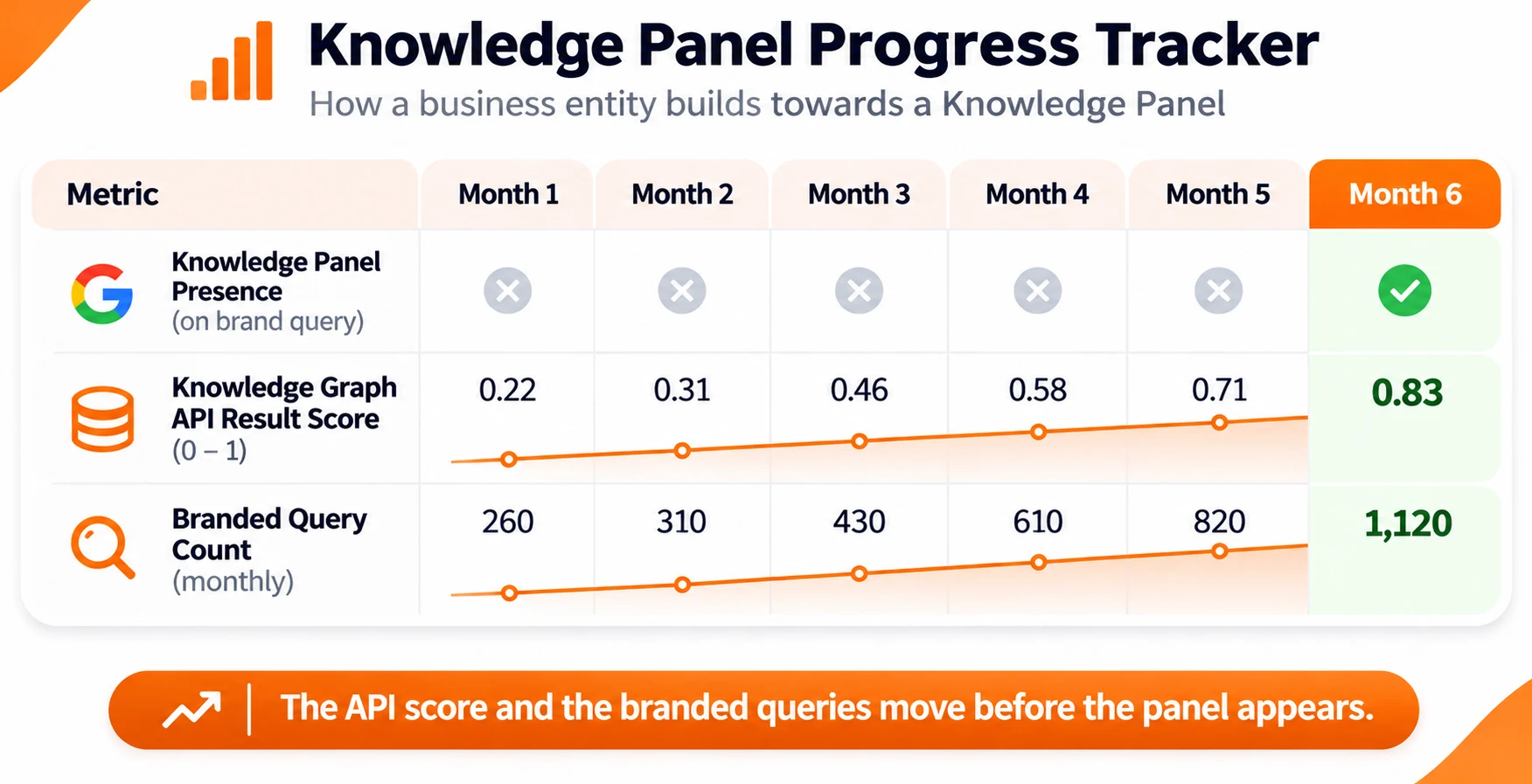
The image above shows the three readings on one monthly tracker. The API score and the branded queries move first. The panel follows.
How does Authority Signals build a Knowledge Panel?
Authority Signals builds a Knowledge Panel by fixing the entity home and the description in the first month, then earning corroborating sources that repeat the description on pages Google reads for organisations.
The entity work and the mention work are the same work seen from two sides. A placement that names the brand beside its central entity on a trusted page corroborates the entity for the Knowledge Graph and builds the co-occurrence that AI systems read. Authority Signals sets out the placement gate and the monthly read, and entity co-occurrence explains the second side.
How does a Knowledge Panel relate to AI mentions?
A Knowledge Panel and AI mentions rest on the same entity: a brand Google holds as one node with agreed facts is the brand AI systems name with the right description.
A panel is Google's visible confirmation that the entity exists and the facts agree. The same consistency is what lets a language model attach the brand to the topic and describe the brand correctly. A business that earns a panel usually sees its mention rate rise in the same period, and a business with a merged or wrong panel usually sees AI systems repeat the error. Mention rate vs citation rate sets out how that mention side is measured.
What mistakes stop a Knowledge Panel from appearing?
A Knowledge Panel is stopped by name variants across sources, several About pages, schema that disagrees with the visible page, and attempts to force sources that fail review.
The mistakes that stop a Knowledge Panel are listed below:
Name variants. The legal name on the register, a short name on social profiles and a third spelling in press. Google sees three weak entities.
Several About pages. A company page, a story page and a team page each describing the brand differently. The entity home is one page.
Schema that disagrees with the page. A founder in the markup who is not named on the page, or a founding date that differs from the register.
Forced sources. Wikipedia articles deleted for notability, Wikidata items without references, and paid directory listings with invented facts. Each one adds disagreement or adds nothing.
No demand. A perfect entity nobody searches for. The panel waits for the searches.
Author and organization entities covers how the organisation and its people are declared once, which prevents the first three mistakes.
See what Google holds about your brand
On a 30-minute call we open your brand search results page and the Knowledge Graph API response, read your entity home against your profiles, and name the first disagreement to fix. You leave with the source list, with or without an engagement.
Book a strategy call · Request the audit
Questions about getting a Knowledge Panel for a business
Does a Google Business Profile create a Knowledge Panel?
No. The profile creates the local listing. The panel comes from the Knowledge Graph. A business with a profile and no panel has a place entity and no organisation entity yet.
Does Organization schema alone produce a panel?
No. Schema states the facts on the brand's own page. The panel needs those facts corroborated elsewhere and the name searched. Schema is the first step, not the whole.
Can a sole trader or a personal brand get a Knowledge Panel?
Yes, as a Person entity. The entity home is the person's own site, the schema is Person, and the corroboration comes from profiles, bylines, talks and press about the person.
What happens to the panel after a rebrand?
The panel follows the sources. The entity home is updated first with the new name and the old name as an alternate, then every profile, then the schema. The panel updates after the recrawl, and the old name stays as an alias so the entity is not split.
Should the brand suggest edits before claiming the panel?
Anyone can suggest an edit, and a claimed panel's suggestions carry the owner's standing. Claim first where the verification flow is available, then suggest.
Does a Knowledge Panel improve rankings?
A panel is a sign the entity is understood, not a ranking signal in itself. The consistency that produces the panel is the same consistency that helps the brand's pages be understood, and that is where the ranking effect, where any exists, comes from.
How many corroborating sources are enough?
No fixed number. The practical reading is agreement: five sources that state the same facts outweigh fifty that disagree. Start with the sources Google already ranks on the brand query.
Can two businesses with the same name both get panels?
Yes, when each is a distinct entity with distinguishing facts: different locations, founders, dates and classes. The entity home of each states those facts, and the schema carries them.
Is a Wikidata item safe to create for a small business?
Only when the item meets Wikidata's notability rules and every statement has an independent reference. An item that fails review is deleted, and repeated attempts harm the editor account used.
Does the panel show reviews?
A merged card for a local business shows profile reviews. An organisation panel without a location shows no reviews. Reviews live on the profile and on third-party platforms, not in the Knowledge Graph entry.
What is the first thing to fix on a brand with no panel?
The description sentence. One sentence, one spelling of the name, used everywhere. Every later step repeats that sentence, and nothing corroborates a description that changes from page to page.