Digital Vikingz
HVAC SEO is local SEO that ranks a heating and cooling company in Google's map pack, organic results and AI answers. Google ranks HVAC companies in the map pack on three factors: relevance, distance and prominence.
The Google Business Profile should carry the primary category HVAC contractor, a full services list, named service areas and staffed hours. Each peak is planned with cooling pages and posts in April and May, and heating pages and posts in October and November.
An HVAC company wins emergency no-heat and no-AC searches when its profile hours, emergency page and phone line promise the same after-hours service. Target keywords come from five slots: service, equipment, town, urgency and season. Results are measured in calls and booked jobs against the same season a year earlier.
What is HVAC SEO?
HVAC SEO is local SEO that ranks a heating and cooling company in Google's map pack, organic results and AI answers. The work targets repair, installation, tune-up and emergency searches in the towns the company serves.
The map pack is the block of three business listings with a map that Google shows for local searches. Owners often call the map pack the 3 pack. HVAC searches peak twice a year, for cooling in summer and for heating in winter.
SEO for HVAC companies and HVAC SEO name the same work. HVAC SEO is measured in answered calls and booked jobs, not in rankings alone. The searches an HVAC company needs to win fall into four types.
Which searches does an HVAC company need to win?
An HVAC company needs to win four types of search: seasonal repair, emergency, maintenance and equipment searches. We ran one search each for "ac repair near me" and "furnace repair near me" on 18 November 2026.
Each search showed directories and dealer locators above local HVAC companies' own pages.
The four types of HVAC search, and the part of HVAC SEO each one tests, are listed below:
- Seasonal repair search: "ac repair near me" in July or "furnace repair near me" in January tests the services list and repair pages.
- Emergency search: "emergency hvac repair open now" or a no-heat search tests the hours, reviews and emergency page.
- Maintenance search: "ac tune-up" or "furnace tune-up" before each peak tests the tune-up and maintenance plan pages.
- Equipment search: "heat pump installation" or "Carrier furnace repair" tests the equipment and brand pages.
Paid ads can sit above the map pack for all four types and follow other rules.
Is HVAC SEO the same as Local Services Ads?
HVAC SEO is not the same as Local Services Ads, because Local Services Ads are a paid Google channel. Owners often call Local Services Ads the ads at the top.
Google describes Local Services Ads as a way to receive leads directly from potential customers and pay only for related leads. Bought leads from lead platforms are a second paid channel outside SEO.
HVAC SEO covers the unpaid map pack, organic and AI results only. Unpaid map pack results follow three published Google ranking factors.
How does Google rank HVAC companies in the map pack?
Google ranks HVAC companies in the map pack on three factors: relevance, distance and prominence. Google states the three factors on its local ranking help page. The same model applies to every heating and cooling company, as our guide on how to rank higher on Google Maps explains.
Google defines the three local ranking factors as listed below:
- Relevance: "Relevance is how well a Business Profile matches what someone is searching for."
- Distance: "Distance refers to how far each business is from the customer who's searching."
- Prominence: "Prominence means how well-known a business is."
An HVAC company gains relevance from its category, services and pages. Prominence comes from reviews, links and listings. Distance favors the HVAC company closest to the searcher, so towns far from the base are harder to win in the map pack.
Google's service area help page does not say the service area setting raises the ranking in each listed town. Relevance starts with the Google Business Profile an HVAC company sets up.
How should an HVAC company set up its Google Business Profile?
An HVAC company should give its Google Business Profile the primary category HVAC contractor, a full services list, named service areas and staffed hours. Google Business Profile was called Google My Business until 2021.
The profile settings that decide an HVAC company's relevance are listed below:
- Choose HVAC contractor as the primary category.
- Add secondary categories only for work done, such as Air conditioning repair service or Furnace repair service.
- List each service in homeowner words: AC repair, furnace repair, heat pump installation and AC tune-up.
- Set up to 20 service areas by town or postal code, within about 2 hours of driving.
- Enter the hours a person answers the phone, plus holiday hours in the special hours field.
- Keep the registered business name, with no added words such as "24 hour AC repair".
Google's guidelines forbid unnecessary information in a business name. A breach can lead to a Google Business Profile suspension and loss of the map pack listing. A home-based HVAC company hides the address and shows service areas instead.
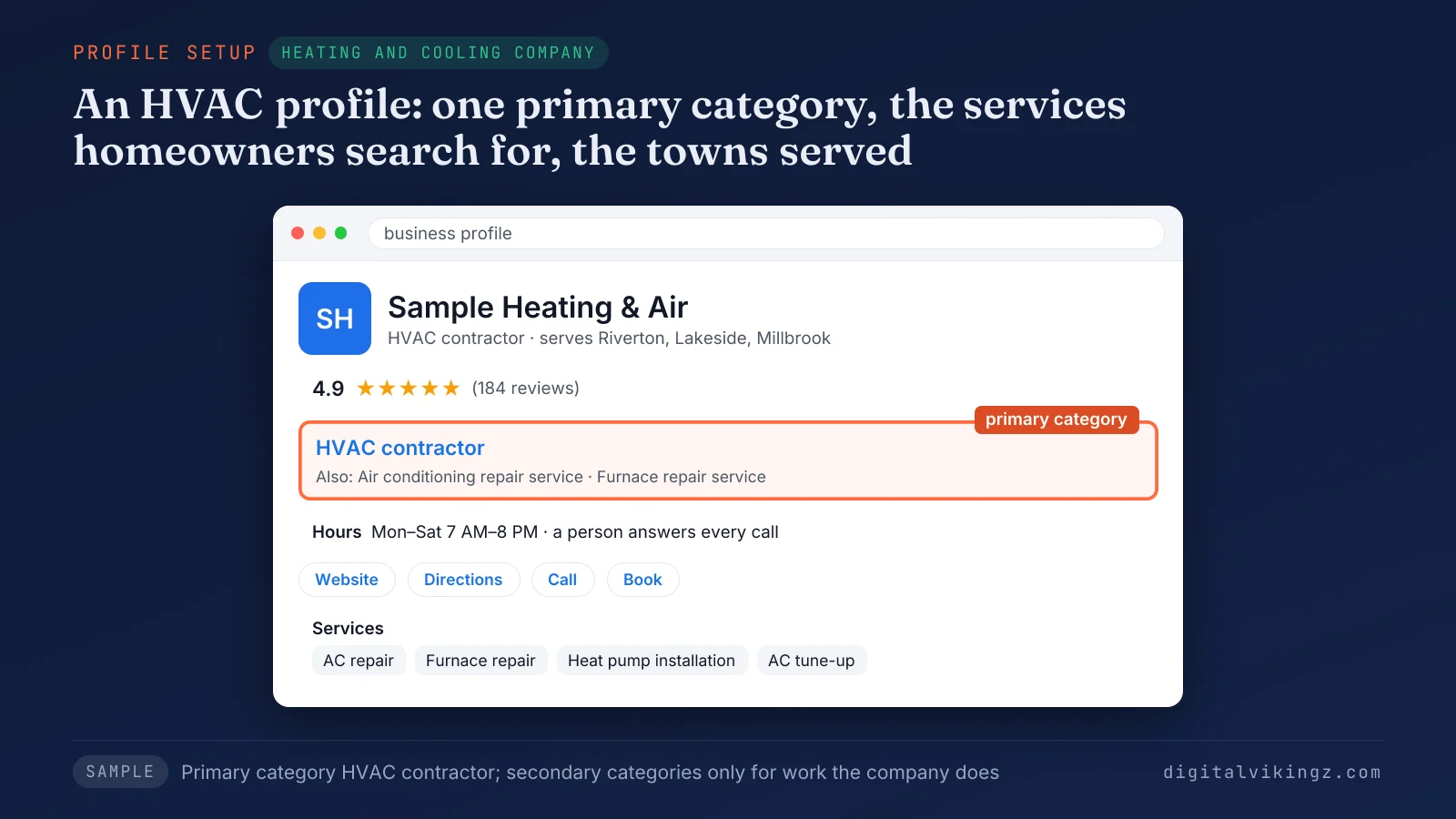
Figure 1 shows Sample Heating & Air with HVAC contractor as the primary category. The sample lists AC repair, furnace repair, heat pump installation and AC tune-up for Riverton, Lakeside and Millbrook.
The primary category decides which searches the profile matches first. Our guide on how to pick the Google Business Profile primary category sets out the test for each category. A seasonal category question follows.
Should an HVAC company switch its primary category each season?
An HVAC company should keep HVAC contractor as the primary category all year, because a change of primary category can trigger re-verification. Google's help page warns that a category edit can lead to a request to verify the business again.
Changing the primary category can hurt rankings for the searches the old category matched. Some local SEO guides advise a seasonal switch, and others keep one primary category all year.
Seasonal focus can sit in the services list, the posts and the seasonal pages, while the map pack category stays fixed. The seasonal pages and posts follow a calendar set before each peak.
How does an HVAC company plan SEO for summer and winter peaks?
An HVAC company plans each peak by preparing cooling pages and posts in April and May, and heating pages and posts in October and November. The months suit a US company in a climate with hot summers and cold winters.
The first hot or cold week sets the exact date. Owners talk about a busy season and a slow season, and the calendar names both.
The four seasons of an HVAC SEO calendar, with the work each season needs, are listed below:
- Spring, March to May: AC tune-up posts, refreshed AC repair and installation pages, and review requests after each tune-up.
- Summer, June to August: emergency AC repair named first on the profile, the emergency page and posts about no-AC calls.
- Fall, September to November: furnace tune-up posts, refreshed furnace and heat pump pages, and maintenance plan renewals.
- Winter, December to February: no-heat emergency service on the profile, the emergency page and posts about furnace repair.
Spring and fall are the shoulder seasons, when the phone is quieter and the next peak is prepared. Summer and winter are the two peaks.
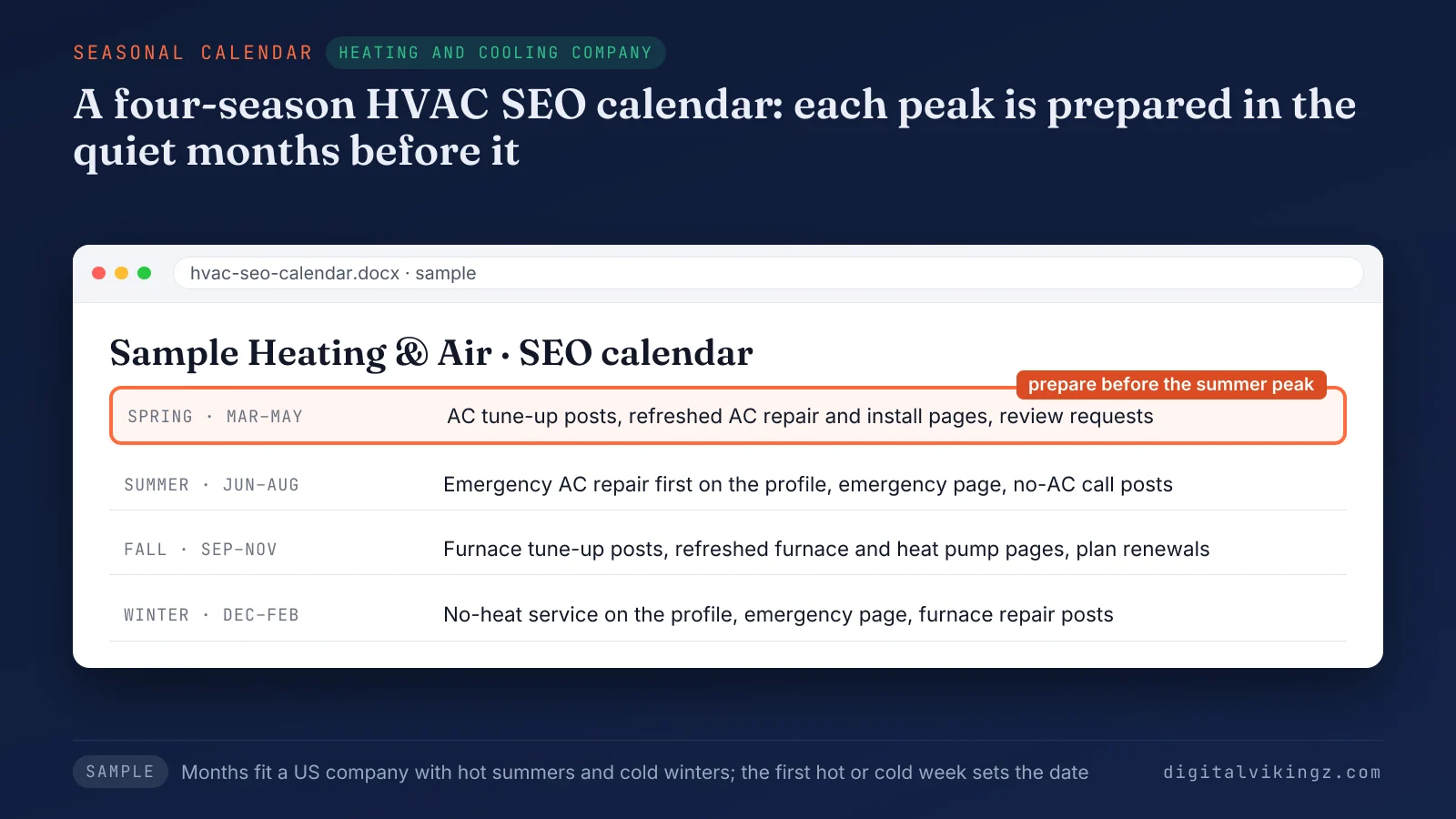
Figure 2 shows a sample calendar with one row per season, the searches that rise and the work done before each one. Google Business Profile posts carry each season's message to the map pack listing.
What should an HVAC company post before each peak?
An HVAC company should post one seasonal job, tune-up offer or service note per Google Business Profile post before each peak. Useful HVAC subjects include an AC tune-up offer in spring, a furnace tune-up offer in fall and a no-heat service note in winter.
Google's local ranking help page did not name posts as a ranking factor when we read the page on 18 November 2026. Posts keep the profile current for searchers.
Post examples differ by trade, and HVAC posts name furnaces, AC units and tune-ups. Our 12 Google Business Profile post examples include three ready posts for HVAC companies. Tune-up posts need a maintenance plan page on the website to send searchers to.
Do maintenance plan pages bring calls in the shoulder seasons?
Maintenance plan pages can bring calls in the shoulder seasons, because tune-up searches rise before each peak. A maintenance plan page names the visits per year, the systems covered, the towns served and the way to book.
Homeowners search for a tune-up or a maintenance plan, so the page uses both words. Tune-up visits in spring and fall also give the HVAC company review requests outside the peak.
Planned work fills the quiet months, and emergency work fills the peaks. Emergency no-heat and no-AC calls are the most urgent calls an HVAC company gets.
How does an HVAC company win emergency no-heat and no-AC searches?
An HVAC company wins emergency no-heat and no-AC searches when its profile hours, emergency page and phone line promise the same after-hours service. Emergency HVAC searches use words such as "emergency", "24 hours", "open now" and "same day".
An HVAC emergency page names the failures that need a technician the same day: no heat, no AC and a heat pump that stopped running. The page states the hours, the towns and the after-hours call arrangement in its first lines.
Reviews that mention a night or holiday repair give the next emergency searcher proof. The phone on the profile and the page should ring a person outside office hours, not a voicemail.
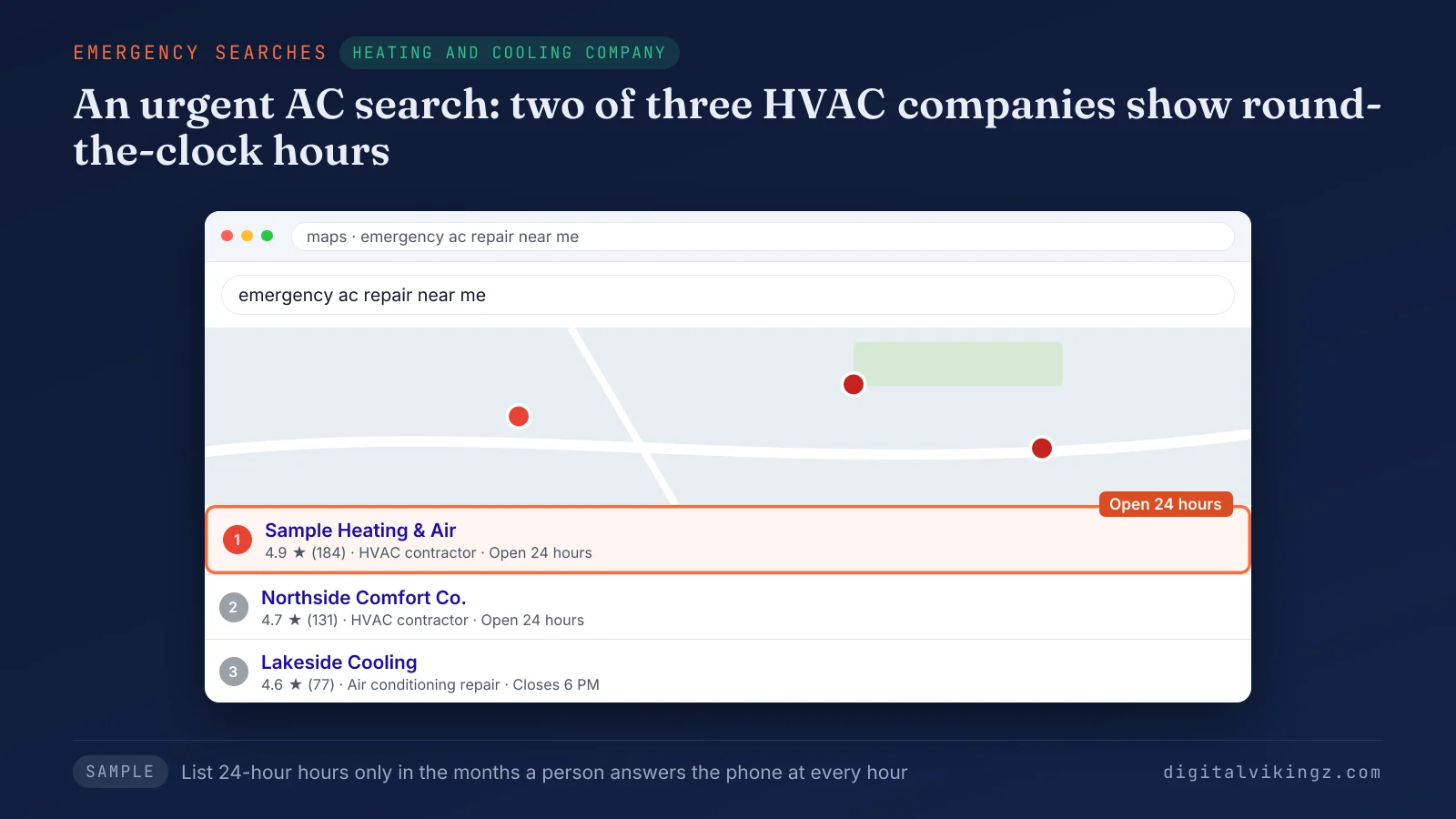
Figure 3 shows sample local results for "emergency ac repair near me" with three HVAC companies. Two of the three companies show "Open 24 hours", and the third closes at 6 PM. Listed hours decide whether the map pack listing shows round-the-clock service.
Should an HVAC company keep 24-hour hours all year?
An HVAC company should list 24-hour hours only in the months when a person answers the phone at every hour. Google treats business hours, including special hours, as profile information for customers.
Google's local ranking page links complete and accurate information to local results, not round-the-clock hours.
A company with night crews only in summer and winter changes the regular hours on its map pack listing when the crews start and stop. Holiday closures go in the special hours field before the date. Emergency words also form one slot of the keywords an HVAC company targets.
Which keywords should an HVAC company target?
An HVAC company should target keywords built from five slots: service, equipment, town, urgency and season. Homeowners search with words such as AC, furnace and heat pump, so service pages use those words before "HVAC".
The table below shows the five keyword slots, with sample words, a sample search and the page that answers each slot.
| Slot | Sample words | Sample search | Answered by |
|---|---|---|---|
| Service | repair, installation, replacement, tune-up | "furnace repair near me" | Service page |
| Equipment | AC, furnace, heat pump, mini-split, boiler, brand names | "Carrier furnace repair" | Equipment or brand page |
| Town | each town in the service area | "ac repair Lakeside" | Town page |
| Urgency | emergency, 24 hour, open now, same day | "emergency hvac repair open now" | Emergency page and profile hours |
| Season | spring, summer, fall, winter | "ac tune-up" in April | Seasonal page and posts |
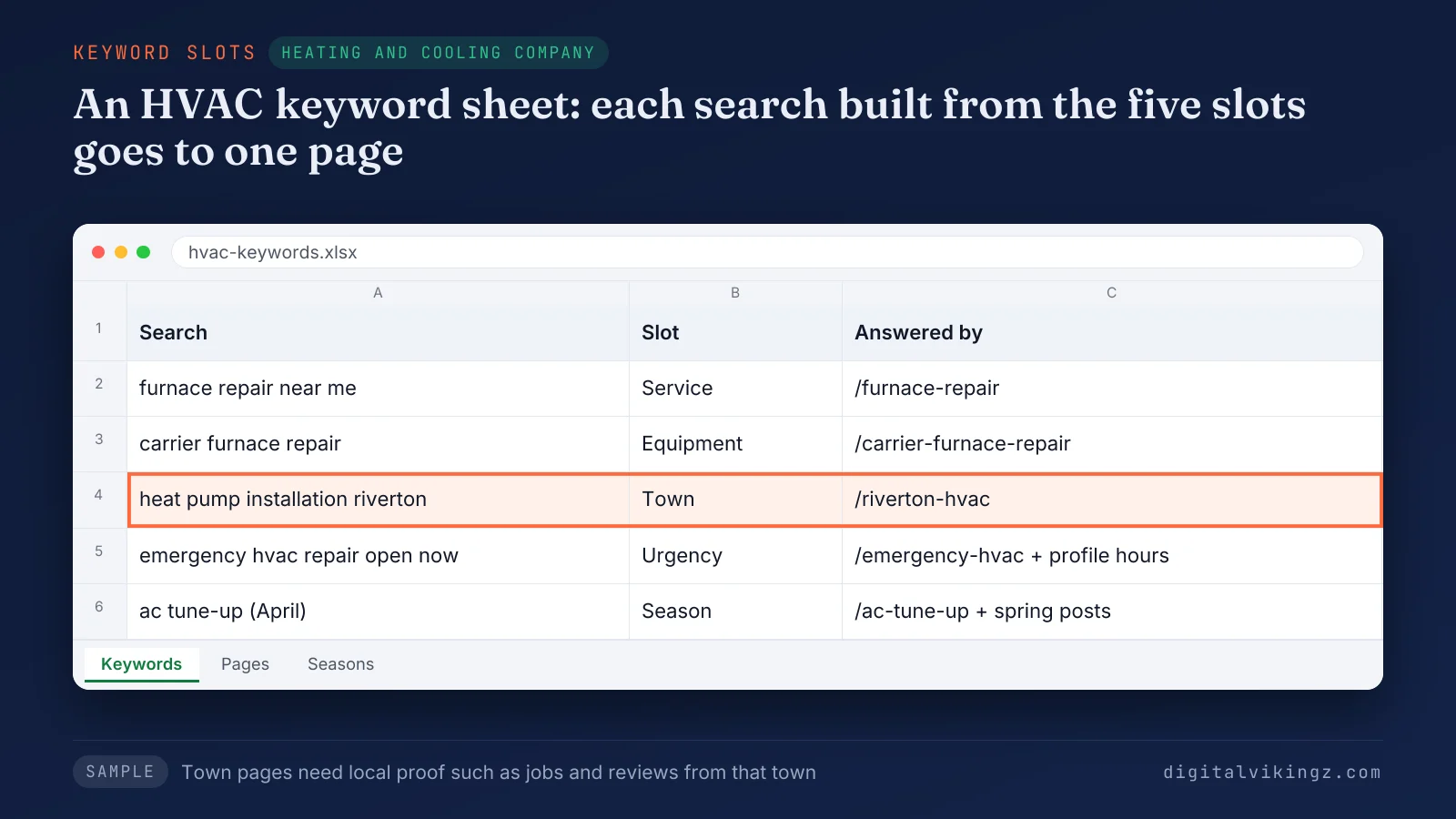
Figure 4 shows five sample searches, such as "heat pump installation Riverton", each routed to one page.
A town page earns its place only with local proof, such as jobs and reviews from that town. Town pages copied with only the town name swapped become doorway pages, which Google treats as spam.
Our guide to service area pages that rank in each town without becoming doorway pages sets out the checks for each town. Each town page also gathers reviews for prominence.
How do reviews and listings help an HVAC company rank?
Reviews and listings help an HVAC company rank, because Google bases prominence partly on reviews and on links to the business. Google says prominence is also based on how many websites link to a business and how many reviews the business has.
Google states that "More reviews and positive ratings can help your business's local ranking." An HVAC company builds map pack prominence by asking for a review after each emergency repair and each tune-up visit.
Google's review policy forbids incentives for reviews and selective requests for positive reviews. Our guide on how to get more Google reviews without breaking Google's rules sets out seven steps. "Positive reviews and helpful replies can help your business stand out," according to Google.
Listings on Yelp, Facebook, Apple Maps and Bing should show the same name, address and phone as the profile. HVAC companies also hold a listing type most trades lack: manufacturer dealer listings.
Do manufacturer dealer listings help an HVAC company?
Manufacturer dealer listings can help an HVAC company appear in more searches, because dealer locators rank for customer HVAC searches. Our 18 November 2026 searches, one each for "ac repair near me" and "furnace repair near me", put Trane and Carrier dealer locators top five.
A dealer listing names the company on a manufacturer's website and adds a listing with the same name and phone. Each dealer program sets its own entry rules, so the listing follows the brands the company installs.
Listings, reviews and pages show their value in seasonal calls.
How should an HVAC company measure SEO results by season?
An HVAC company should measure SEO results by comparing calls and booked jobs with the same season a year earlier. A July result compared with March shows the weather, not the SEO work.
Google Search Console shows the searches and pages that bring clicks from Google Search. An HVAC company can filter those searches by words such as furnace or AC.
Our monthly report tracks calls, direction requests, website clicks and map pack positions for each location. Calls that never become booked jobs point to the call handling, not the HVAC SEO.
Google clicks for an Australian access equipment hire company rose 51 percent in the six months after its semantic SEO program with us. The access equipment hire SEO case study sets out the work behind that result. Heating and cooling companies share the measurement model of every local service business.
How does HVAC SEO compare with SEO for other local service businesses?
HVAC SEO shares the profile, review and page model of other local service businesses, and differs in its two seasonal peaks. Plumbing SEO centers on emergencies at any hour, such as burst pipes and sewer backups.
Roofing SEO centers on storm damage and roof replacement jobs. Storms and burst pipes arrive without warning, while summer and winter peaks arrive on a calendar. An HVAC company plans pages and posts around the season, and a plumber plans pages and posts around urgency.
The calendar gives an HVAC company weeks to prepare before demand rises. The shared model is semantic SEO for local service businesses: one business, its services, its towns and the searches that connect them.
We set out that model in semantic SEO for HVAC and other local service businesses. Plumbing companies share the most steps with heating and cooling companies.
Which HVAC SEO steps carry over from local SEO for plumbers?
Profile setup, the emergency page, the answered phone and the job and town keywords carry over from local SEO for plumbers. The profile setup carries the same fields: primary category, services, service areas and hours.
The emergency page carries the same promise of hours, towns and an answered phone. The job and town keywords work the same way, with HVAC job names in place of plumbing job names.
HVAC SEO adds two slots that plumbing SEO rarely needs: season and equipment. Furnace, heat pump and mini-split pages have no plumbing equivalent.
Our guide to local SEO for plumbers covers emergency plumbing searches in the same order. Both trades also compete in AI answers.
How do AI assistants choose an HVAC company to recommend?
An AI assistant chooses an HVAC company by matching the service, the town and any qualifier, such as "open now", against sources about each company.
A request such as "furnace repair open now in Lakeside" carries all three: the service, the town and the qualifier. An HVAC page that names the equipment, the towns and the emergency hours gives an assistant facts to cite.
Profiles, reviews and listings that state the same facts make the HVAC company easier to recommend.
AI assistants choose a local business in five stages, from reading the request to naming a short list. Our guide to how AI assistants choose which local business to recommend explains each stage. Consistent facts across sources are also what an HVAC company should ask an SEO company to build.
How do you choose an HVAC SEO company?
An HVAC company should choose an SEO company by its method, its reporting on calls and booked jobs, and the owner's control of every account.
The checks that separate one HVAC SEO company from another are listed below:
- Method: a written plan for the profile, the seasonal calendar, the emergency page and the keyword slots.
- Reporting: monthly calls, booked jobs and map pack positions by service and season, not traffic alone.
- Ownership: the HVAC company owns the Google Business Profile, the website, Google Search Console and Google Analytics.
- Promises: no guaranteed map pack position, since no SEO company controls Google's local ranking.
- Proof: published results for other local service businesses, such as case studies with dates.
Each check ties back to the work above: the profile, the seasonal plan, the emergency page, the keyword slots and the measurement by season.
An SEO company that keeps the profile or website logins leaves the HVAC company unable to move the work. Our Local SEO and Google Business Profile Optimization service follows that method for heating and cooling companies.
Book a strategy call through our Local SEO and Google Business Profile Optimization for HVAC companies to see the plan for your towns. Owners still ask a few direct questions before the work starts.
Questions HVAC company owners ask about SEO
How long does HVAC SEO take to work?
Map pack gains for an HVAC company usually build over two to four months as reviews, posts and pages add up, in our work. Category and detail fixes are usually picked up within weeks.
How much does HVAC SEO cost?
HVAC SEO is priced by the number of locations and the work included, so one location needs less work than several branches. Our Local SEO and Google Business Profile service is billed monthly and quoted in writing after a strategy call.
Can one Google Business Profile rank for HVAC and plumbing?
One Google Business Profile can rank for HVAC and plumbing searches, but the primary category decides which trade the profile matches first. Google allows one profile per business, so plumbing work relies on secondary categories, services and plumbing pages on the website.
Should an HVAC company build a page for each equipment brand?
An HVAC company should build brand pages only for brands the company installs or repairs often, because brand searches name equipment homeowners already own. A Carrier furnace repair page earns its place when Carrier furnace repairs are a regular job.
Does HVAC SEO work for a new HVAC company?
HVAC SEO works for a new HVAC company, starting with a complete profile and the first reviews from early jobs. A new company competes first in the towns closest to its base, where distance favors the new company.
Can an HVAC company pay Google for a better map pack ranking?
No HVAC company can pay Google for a better map pack ranking. Google states: "There's no way to request or pay for a better local ranking on Google."
What should an HVAC company fix first before the next peak season?
An HVAC company should fix the Google Business Profile first: the HVAC contractor category, the services list, the service areas and the hours. Review requests after every tune-up come next, then the seasonal and emergency pages, then call tracking by season.
Each fix moves the HVAC company closer to the map pack before demand rises. HVAC SEO turns seasonal and emergency searches into booked jobs.
Daily Google posts keep the profile current through both peaks without office time. Our Daily Google Posts for heating and cooling companies start at $99 a month per Google listing, with a free sample post first.