 Digital Vikingz
Roofing SEO is local SEO for roofing companies that wins map pack and organic results for roof repair, roof replacement and storm damage searches. Roofing SEO differs from SEO for other local service businesses in four ways: storm-driven demand, insurance-claim searches, rare high-value jobs and wide service areas.
The work is worth the cost for a roofer that buys leads, because map pack and organic calls go to one company, not several. Roofing companies rank in the Google map pack on relevance, distance and prominence, the three local ranking factors Google names.
A roofer should set up a Google Business Profile with "Roofing contractor" as primary category, a hidden address, service areas and its roofing services. Reviews affect a roofer's map pack ranking through prominence, and Google states that more reviews and positive ratings can help local ranking.
A roofing website needs a page per roofing service, a page per town with its own demand, and project and review pages. Storm damage pages help a roofer after hail or wind when the pages are live and indexed before storm season starts.
A roofing company should target six query templates: service plus city, near me, storm or emergency, roofing material, roof inspection and insurance-claim help. Results are measured in calls, booked inspections and Google Search Console queries by service and town, not in lead counts.
Map pack gains usually take two to four months in our client work, and category and profile fixes are picked up within weeks. Search work builds calls a roofing company owns, while Local Services Ads and lead platforms send calls only while the company keeps paying.
AI assistants name roofers whose profile, website and reviews state the same facts, and an owner can start without an agency. A roofing SEO company is chosen by its reporting on calls and booked inspections, its roofing page plan and its refusal to guarantee rankings.
What is roofing SEO?
Roofing SEO is local SEO for roofing companies that wins map pack and organic results for roof repair, roof replacement and storm damage searches. The same work covers AI answers, where Google AI Overviews and AI assistants name roofing companies for the same searches.
Local SEO is the branch of search engine optimization for businesses that serve a defined area. Owners also search for the same work as "SEO for roofing companies", "SEO for roofers" or "roofing contractor SEO".
A homeowner types "roof repair near me", "roof replacement [city]" or "storm damage roof repair" when ready to call a roofer. Roofing owners often call the map pack "the three-pack" or "showing up on Google Maps".
The work has four parts: the Google Business Profile, the website pages, the reviews and the measurement. Roofing searches behave differently from other local trades, and the differences decide the work.
How does roofing SEO differ from SEO for other local service businesses?
Roofing SEO differs from SEO for other local service businesses in four ways: storm-driven demand, insurance-claim searches, rare high-value jobs and wide service areas.
The four roofing differences from other local trades are listed below:
- Storm-driven demand: roofing searches rise after hail and wind events, so storm pages need to be live before the season.
- Insurance-claim searches: homeowners search for help with roof damage claims, so storm pages describe the inspection report the roofer provides.
- Rare high-value jobs: a homeowner buys a new roof once in many years, so buyers check reviews, project photos and license details first.
- Wide service areas: roofers travel across many towns, and Google's distance factor favors profiles near the searcher.
SEO for a roofer covers the search side of storm and insurance work, never the claim advice.
Semantic SEO for local service businesses sets the shared structure of profile, service and location pages. The roofing layers below sit on top of how semantic SEO works for local service businesses in general. Many roofing owners first ask whether SEO beats bought leads.
Is roofing SEO worth the cost for a roofer that buys leads?
Roofing SEO is worth the cost for a roofer that buys leads, because map pack and organic calls go to one company, not several. Lead platforms can sell one homeowner request to several roofers, and the fastest reply often wins the job.
A bought lead is often a homeowner still collecting quotes, so many roofing leads never become booked jobs. Door knocking brings storm jobs, and the work stops on the day the crew stops knocking.
A roofing company that ranks for "roof repair [city]" receives calls from homeowners who chose the company themselves. A homeowner who searches by service and town already needs the work, so the call starts with intent.
A new roofing company should keep one paid channel running while the profile and pages gain rankings. Owned calls start in the Google map pack.
How do roofing companies rank in the Google map pack?
Roofing companies rank in the Google map pack on relevance, distance and prominence, the three local ranking factors Google names. The map pack is the block of usually three Google Business Profile listings with a map for local searches such as "roof repair near me".
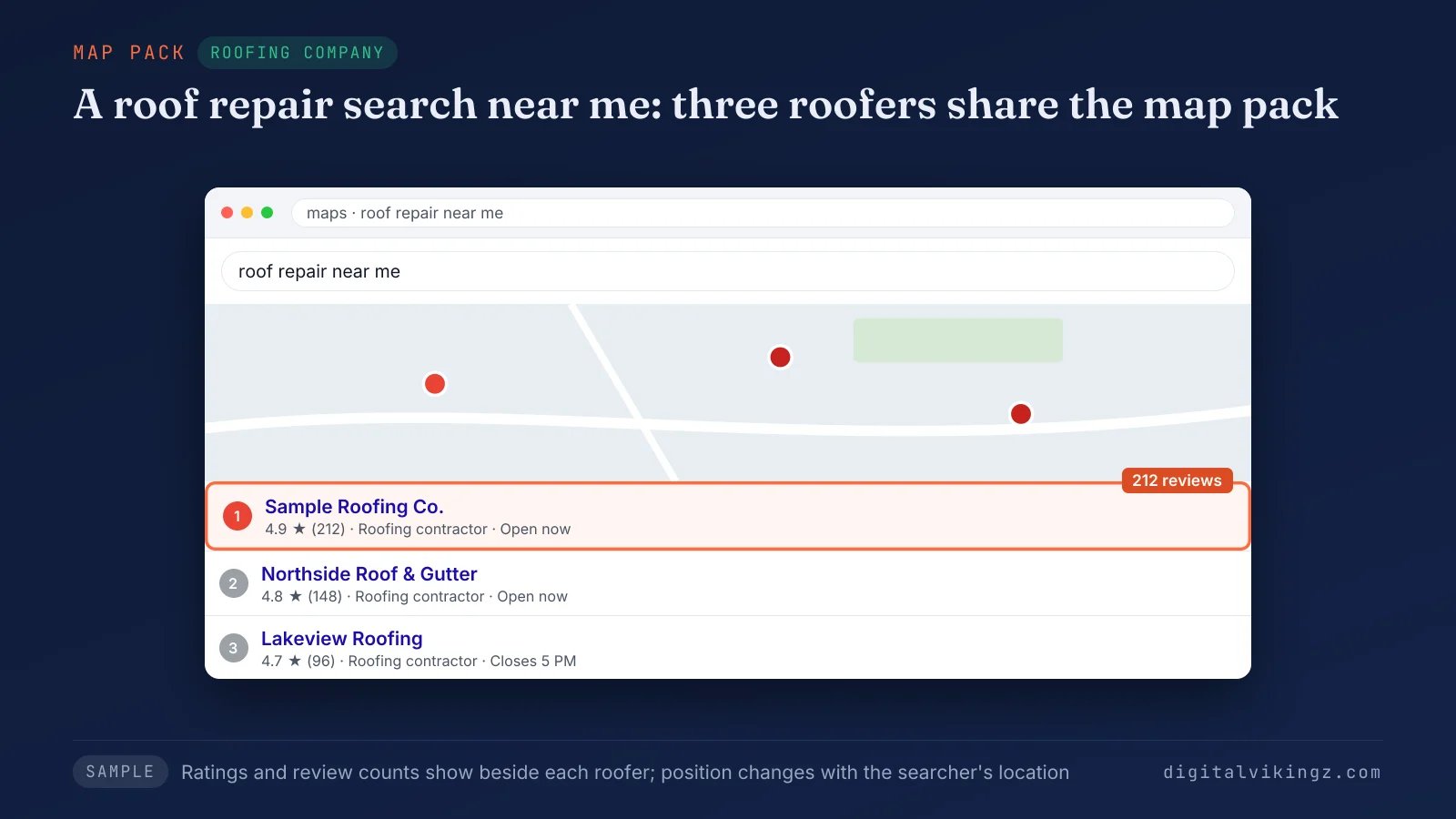
Three roofers in the sample map pack for "roof repair near me" show ratings of 4.9, 4.8 and 4.7 with 212, 148 and 96 reviews. The map pack is the first target of local SEO for roofers.
Google's local ranking help page states that "local results are mainly based on relevance, distance, and popularity". The same page calls the third factor prominence.
Relevance is how well a profile matches the search. The primary category and the listed services decide which roofing searches a profile can match.
Distance is how far the roofer's business location sits from the searcher, and no profile setting changes that factor. Prominence is how well-known the business is, and Google bases prominence partly on links from other websites and on reviews.
A roofer controls two of the three factors: relevance and prominence. Map pack positions change by the searcher's exact location, so one town's result never stands for the whole service area. Relevance starts with the Google Business Profile setup.
How should a roofer set up a Google Business Profile?
A roofer should set up a Google Business Profile with "Roofing contractor" as primary category, a hidden address, service areas and its roofing services. Google Business Profile, or GBP, is the product formerly called Google My Business.
The steps to set up a roofer's Google Business Profile are listed below:
- Choose "Roofing contractor" as the primary category, and add secondary categories such as "Siding contractor" only for services offered.
- Hide the business address when crews work at customers' homes, as Google asks of service-area businesses.
- Add up to 20 service areas within about 2 hours' driving time of the base, as Google's guidelines set out.
- List each roofing service, such as roof repair, replacement, inspection and storm damage repair.
- Use the company's real-world name, with no added keywords such as a city or "roof repair".
- Upload photos of finished roofs and crews, and add a Google post when storm inspections open.
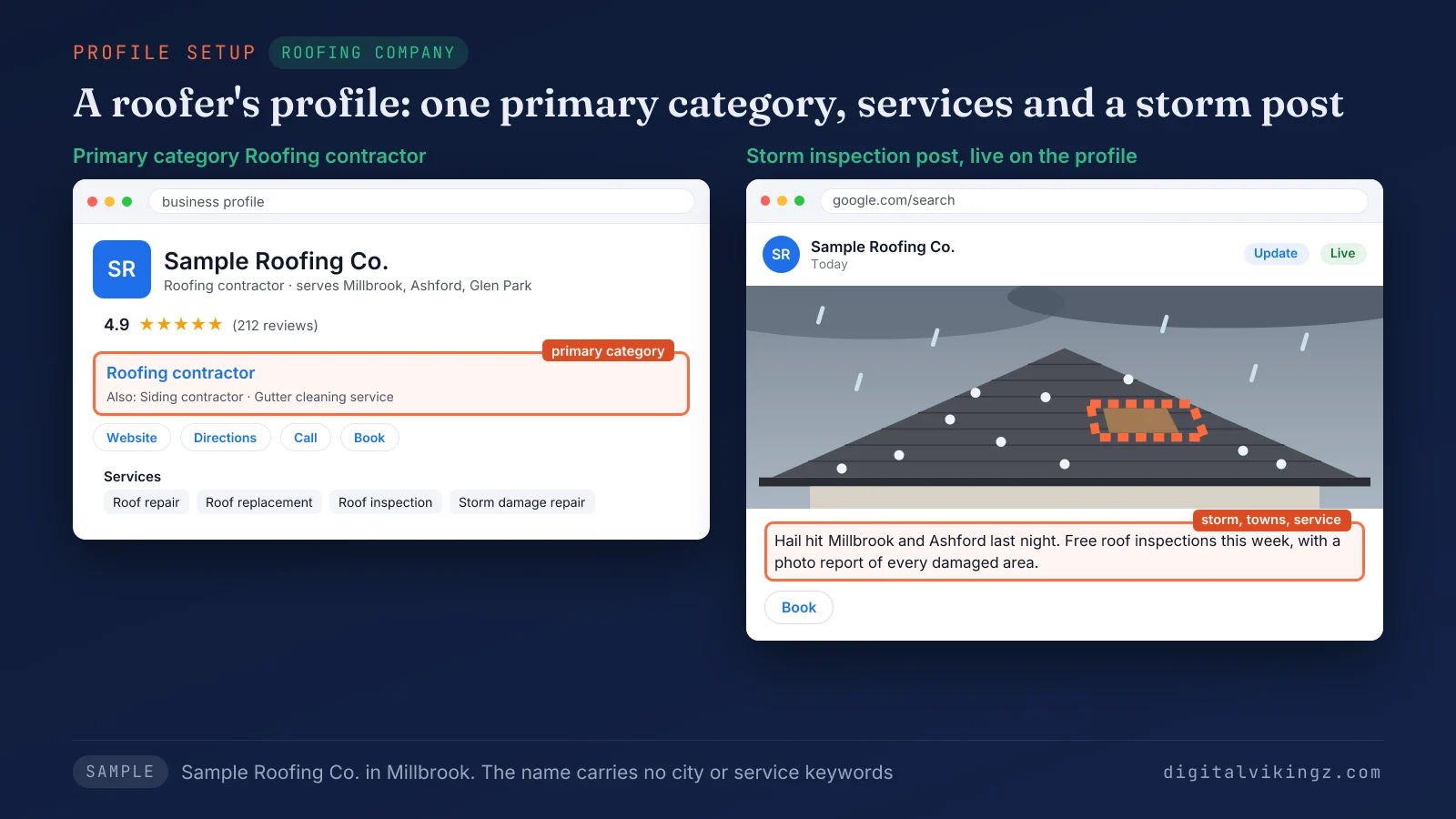
The sample profile shows "Roofing contractor" as the primary category, two secondary categories and a storm inspection post. Google can suspend a profile with extra words in the name, so keywords belong in services and posts.
The primary category decides the first roofing searches a profile matches. Roofers with gutter or siding work can follow the rules for choosing a Google Business Profile primary category. A complete profile needs reviews for prominence.
How do reviews affect a roofer's map pack ranking?
Reviews affect a roofer's map pack ranking through prominence, and Google states that more reviews and positive ratings can help local ranking. Review count and star rating show beside each roofer in the map pack.
Google publishes no target review count. The useful benchmark is the review count of the three roofers already in the map pack for "roof repair [city]".
Google's Maps content policy forbids incentives for reviews and forbids asking customers to include specific content in a review. A roofer should ask every customer after each finished job, because selective requests for positive reviews break Google's policy.
Google notes that "positive reviews and helpful replies can help your business stand out". Reviews that mention a hail repair or roof replacement in a named town add the words homeowners search for, without any prompt from the roofer.
Reviews win the map pack, and the website wins the organic results.
Which service and city pages does a roofing website need?
A roofing website needs a page per roofing service, a page per town with its own demand, and project and review pages.
The page types a roofing website needs are listed below:
- Service pages: one page each for roof repair, roof replacement, roof inspection, storm damage repair and each roofing material the company installs.
- City pages: one page for each town with its own search demand and local proof, such as projects or reviews from that town.
- Storm damage page: one page for hail and wind damage repair, updated before each storm season.
- Project pages: finished roofs with the town, the material and photos, which give city pages their local proof.
- Reviews page: customer reviews grouped by service and town, linked from each service page.
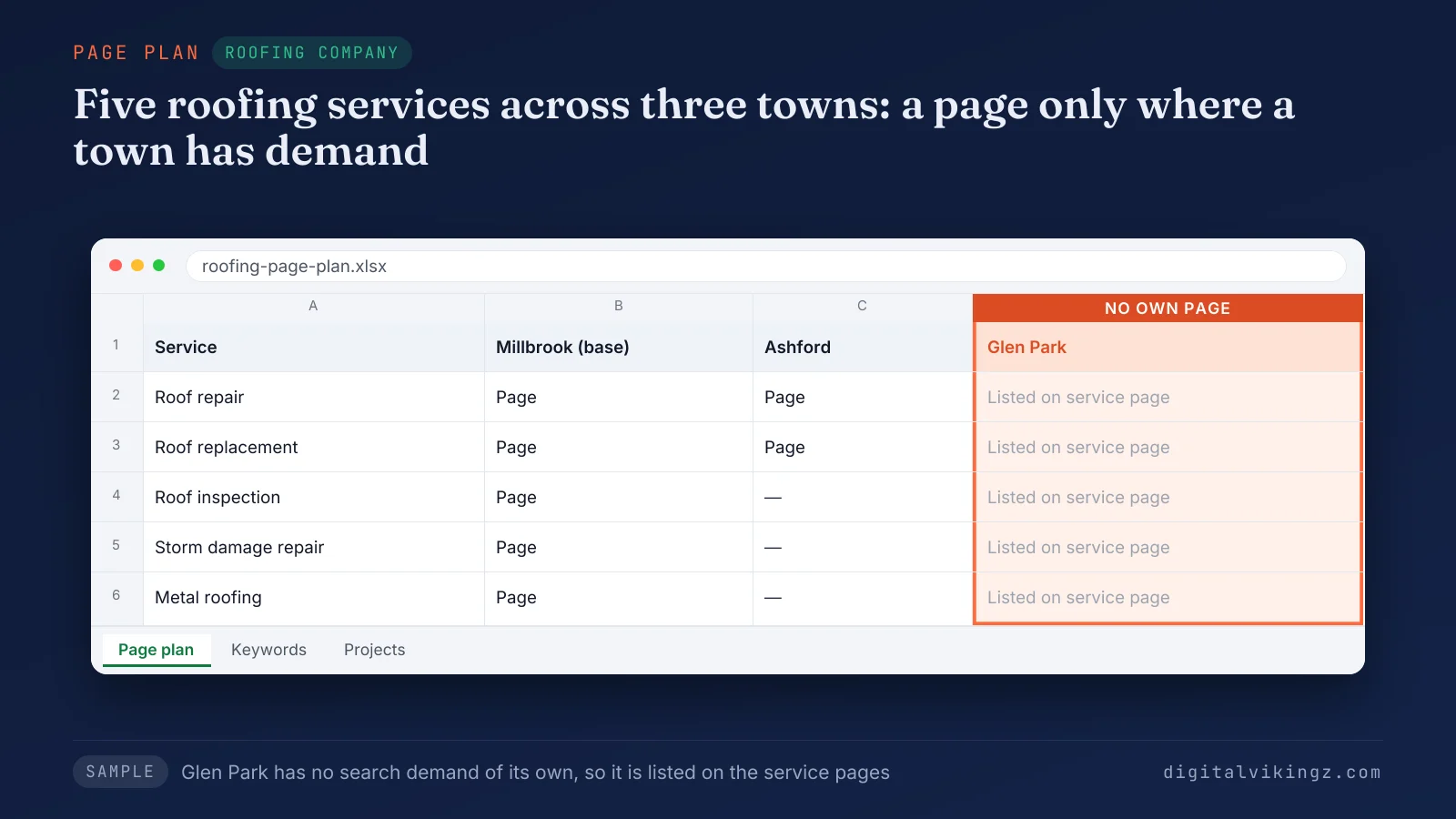
The sample grid gives Millbrook five service pages and Ashford two, and lists Glen Park on the service pages only. Google's spam policies name "pages targeted at specific regions or cities that funnel users to one page" as doorway abuse.
A roofer's city page earns a place in organic results only with facts specific to that town, such as local projects and reviews.
Service area pages need different facts for every town covered. The test for when a town earns a page is in our guide to service area pages that rank without becoming doorway pages. One page type matters most in a storm.
How do storm damage pages help a roofer after hail or wind?
Storm damage pages help a roofer after hail or wind when the pages are live and indexed before storm season starts. Google states that "crawling can take anywhere from a few days to a few weeks".
A storm damage page published after the storm can therefore miss the first searches.
A storm damage page names the damage types, such as hail, wind and fallen branches, the towns covered and the inspection the company offers. The page describes the roofer's inspection and photo report, not the homeowner's insurance policy.
Google Business Profile posts should announce storm inspections in the affected towns within a day of the event. A storm post follows a short pattern: the event, the towns, the service and one button.
Storm searches are one of six query templates a roofing website covers.
Which keywords should a roofing company target?
A roofing company should target six query templates: service plus city, near me, storm or emergency, roofing material, roof inspection and insurance-claim help. Keyword research for a roofer groups searches into query templates. A query template is a search pattern with one changing slot.
The six roofing query templates and the page each one needs are listed below:
- Service plus city: "roof repair [city]" and "roof replacement [city]", answered by a service page or a city page.
- Near me: "roofer near me" and "roofing company near me", answered mainly by the Google Business Profile.
- Storm or emergency: "storm damage roof repair [city]" and "emergency roof repair", answered by the storm damage page.
- Roofing material: "metal roofing contractor [city]" and "shingle roof replacement", answered by a material service page.
- Roof inspection: "roof inspection [city]" and "roof inspection near me", answered by the inspection page.
- Insurance-claim help: "insurance roof claim help", answered by a section of the storm damage page.
A broad keyword such as "roofing" can bring visits from students, suppliers and job seekers, and few calls. Each roofing page targets one template, so two pages never compete for the same search.
Each template's clicks show in Google Search Console, and the profile report shows the calls.
How do you measure roofing SEO results?
Roofing SEO results are measured in calls, booked inspections and Google Search Console queries by service and town, not in lead counts. The Google Business Profile performance view shows calls, directions requests and website clicks from the profile. A sudden fall in those calls has its own checks, covered in what to check when Google Business Profile calls drop.
Google Search Console shows the queries, clicks, impressions and average position for each page of the roofing website. A roofer should filter the Google Search Console queries by service words, such as "repair" or "replacement", and by town names.
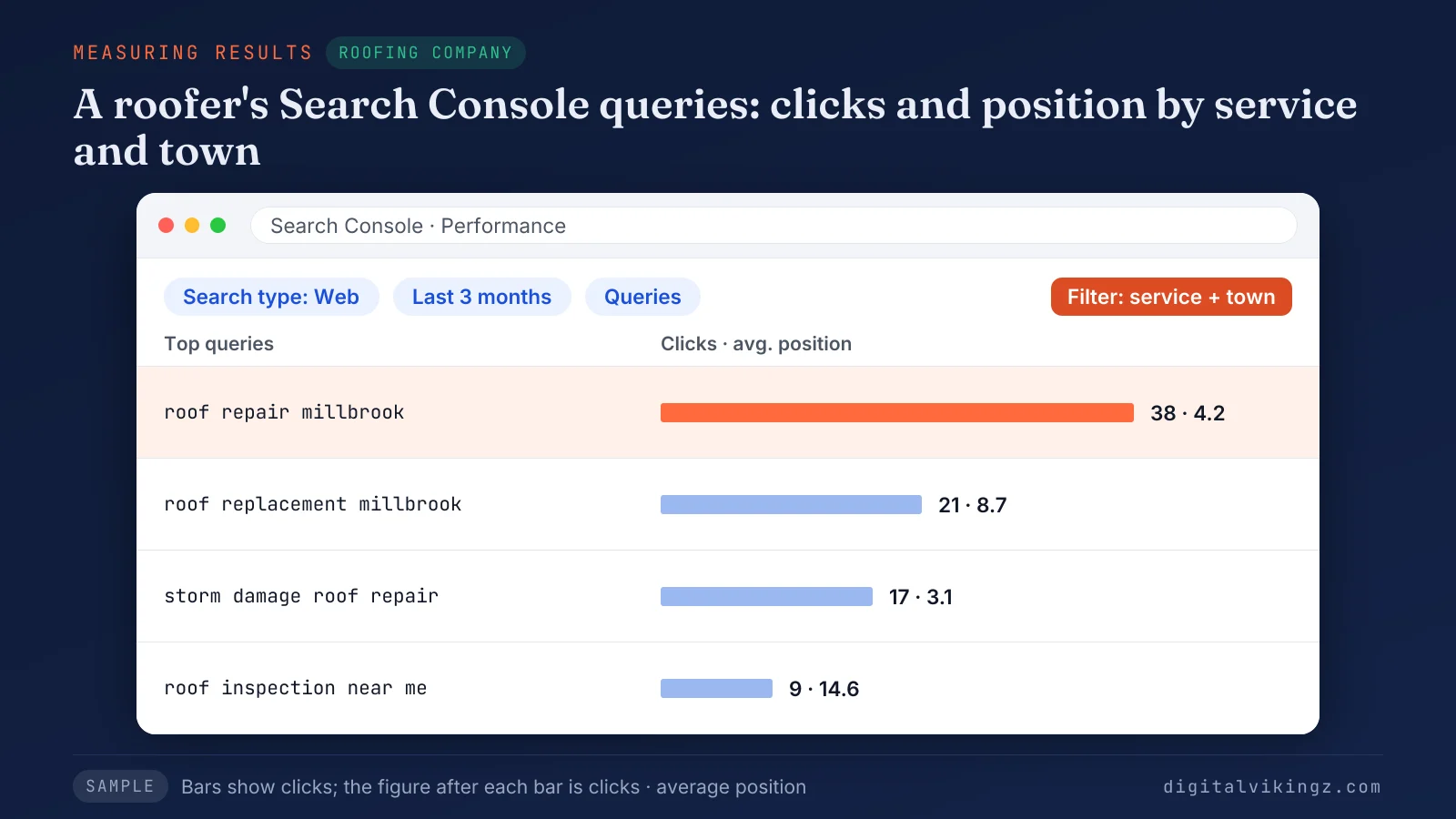
The sample report shows 38 clicks at position 4.2 for "roof repair millbrook" and 9 clicks at position 14.6 for "roof inspection near me". Roof replacement earns 21 clicks at position 8.7, and storm damage roof repair earns 17 clicks at position 3.1.
Booked inspections come from the company's own call log or CRM, matched to the page or the profile that sent each call. A report full of leads and no booked inspections shows traffic, not roofing jobs.
Our glazier SEO case study reads results in Google Search Console. Google clicks rose 42% in the six months after the program in our shower screen glazier SEO case study. Every roofing owner next asks how long the numbers take to move.
How long does roofing SEO take to work?
Roofing SEO usually takes two to four months for map pack gains in our client work, and category and profile fixes are picked up within weeks.
Organic rankings for roof replacement and city pages can take six to twelve months in competitive metro areas, according to published agency estimates. The time depends on the number of roofers competing in the area, the age of the website and the reviews the profile already holds.
Category fixes come first, because relevance decides which searches the profile can match. Storm pages therefore go live months before the season, not after the first hail. The wait is the main reason roofing owners compare SEO with paid leads.
How does roofing SEO compare with Local Services Ads and lead platforms?
Roofing SEO builds calls a roofing company owns, while Local Services Ads and lead platforms send calls only while the company keeps paying. Local Services Ads are Google's paid ads for service businesses, shown above many trade searches.
Paid channels can send calls within days, which suits a new roofing company or storm surge.
The table compares the three channels on when calls start, when calls stop and whether a lead is shared:
| Channel | Calls start | Calls stop | Lead shared with other roofers |
|---|---|---|---|
| Roofing SEO | Two to four months for map pack gains | Rankings hold while the profile and pages stay current | No |
| Local Services Ads | Soon after approval | When the budget ends | No |
| Lead platforms | Soon after sign-up | When payments end | Often |
We see roofers keep one paid channel for speed and build rankings for the calls that stay.
Local SEO and Google Business Profile optimization covers the profile, pages and reviews together. We run Local SEO and Google Business Profile optimization for roofing companies as a monthly service priced per location. AI answers and in-house work sit beside the channel choice.
Do AI assistants recommend roofing companies?
AI assistants such as ChatGPT and Gemini do recommend roofing companies, and consistent facts across the profile, website and reviews help a roofer get named.
Service pages that name the towns, the jobs and the materials give an assistant facts the assistant can repeat about a roofer. No public rule from OpenAI or Google lists the exact signals behind a roofer recommendation, so consistency is the safe base.
How AI assistants choose a local business depends on facts the assistant can confirm across several sources. Our guide explains how AI assistants choose a local business to recommend, with checks a roofer can run.
Can a roofer do roofing SEO without an agency?
A roofer can do roofing SEO without an agency for the profile setup, the review requests and the core service pages. City pages, storm page timing, technical SEO fixes and Google Search Console reporting take longer and suit a specialist.
Owners who start alone should follow the six profile steps above and publish one page per roofing service first. A weekly hour for review requests and profile updates keeps the profile active.
Doing the work alone costs time instead of fees, and the time competes with jobs on the roof. Owners who hire help need a way to choose an SEO company.
How do you choose a roofing SEO company?
A roofing SEO company is chosen by its reporting on calls and booked inspections, its roofing page plan and its refusal to guarantee rankings.
The questions to ask a provider before signing are listed below:
- Ask for a sample report that shows calls, booked inspections and Google Search Console queries by service and town.
- Ask which service pages, city pages and storm pages the company plans, and which towns get no page.
- Ask how the company sets up the Google Business Profile categories, service areas and review requests.
- Ask for results read in Google Search Console from a comparable local service business.
- Refuse any guarantee of a map pack position, because Google states that no one can request or pay for a better local ranking.
- Check the price basis, because monthly fees depend on the number of locations, towns and pages.
A kitchen renovation SEO case study shows that evidence. Google clicks rose 141% in the six months after the program in our kitchen renovation SEO case study. The kitchen maker's site has service pages for nearby towns, the structure a roofer's website needs.
The FAQ covers cost and narrower questions.
Questions about roofing SEO
How much does roofing SEO cost?
Roofing SEO agencies that publish prices commonly quote between $1,000 and $5,000 a month, set by market size and the number of towns. Digital Vikingz prices Local SEO and Google Business Profile work by the number of locations and quotes the scope in writing after a strategy call.
Does a roofing company with a Google Business Profile still need a website?
A roofing company with a Google Business Profile still needs a website, because organic results rank web pages, not profiles. The profile links to the website, and the website answers buyer questions about services, towns and past roofs before the call.
Can a roofer create a Google Business Profile for each town?
A roofer can create a Google Business Profile only for a town with its own staffed location; a service-area business keeps one profile under Google's guidelines. Other towns belong in the profile's service areas and on the website's city pages.
Can a roofer rank in towns outside the office area?
A roofer can rank in organic results for towns outside the office area through city pages with local proof. The map pack in a distant town still favors roofers based closer to the searcher, so organic city pages carry the wider reach.
Does a roofing website need blog posts?
A roofing website can rank for more searches with guides that answer homeowner questions, such as choosing between metal and shingle roofs. Each guide links to the matching service page, so the homeowner moves from the question to the service and the call.
What should a roofing company fix first?
A roofing company should fix the Google Business Profile first, then the service pages, then the storm damage page before the next storm season. Review requests start with the next finished job, and Google Search Console tracking starts on the same day.
The order follows the work above: relevance first, then the organic pages, then the storm window. Each fix shows in the profile performance view and Google Search Console.
Digital Vikingz is a semantic SEO agency. Roofing SEO applies our semantic SEO method: one set of facts on the profile, the pages and the reviews.
Daily Google posts keep a roofer's profile active between jobs and after storms. A free preview shows the daily Google posts our AI agent would write from a roofing company's website.