 Digital Vikingz
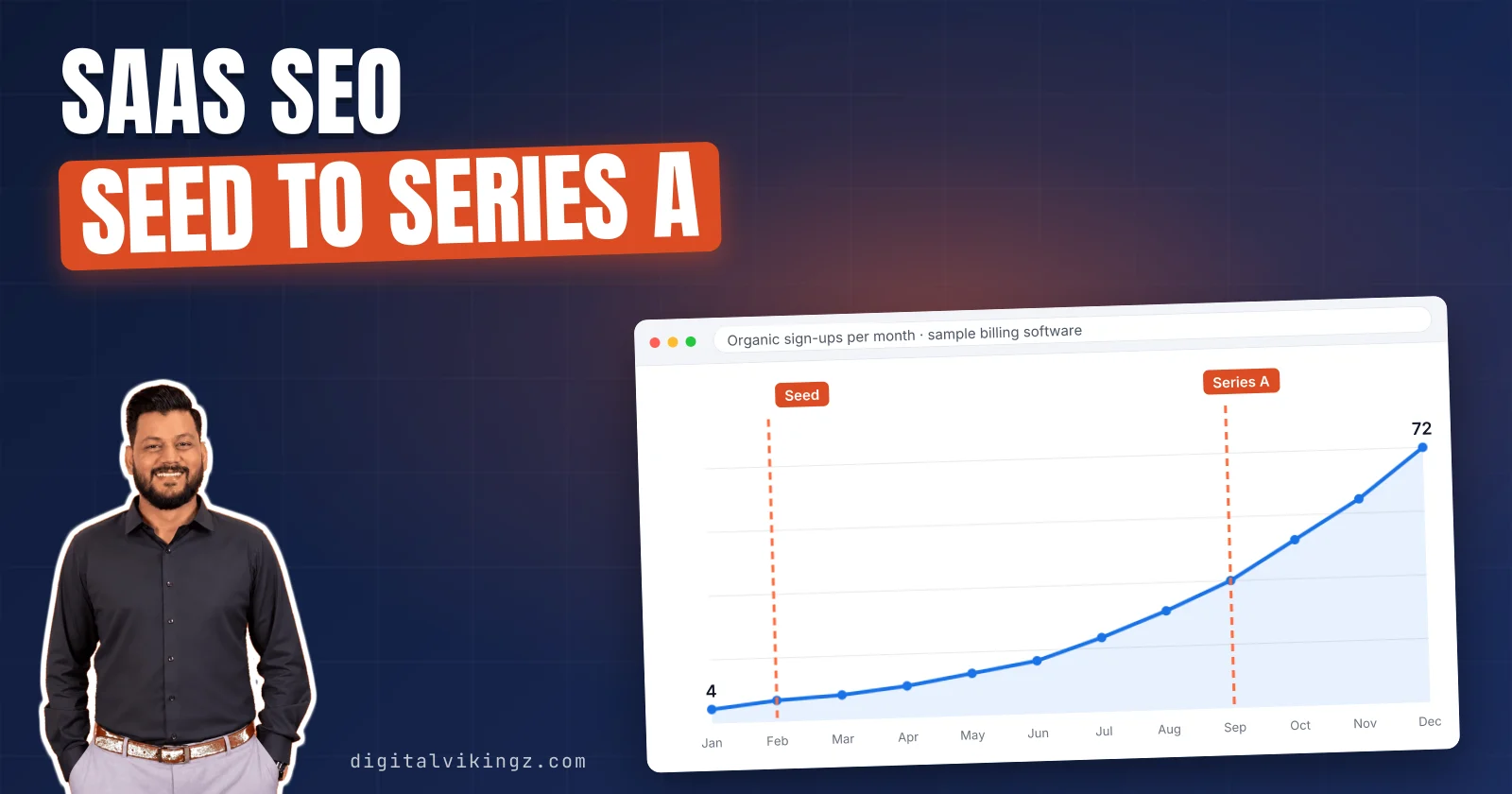
SaaS SEO is search engine optimization for a software-as-a-service company, built around the queries buyers run before a trial or a demo. SEO for SaaS startups adds one constraint: the funding stage decides which pages come first.
A SaaS startup at seed stage builds foundations: Google Search Console, crawlable pages, a product page and use-case pages. A SaaS startup after product-market fit builds a topical map with integration, comparison and alternatives pages. A Series A SaaS startup adds a content system, earned links, AI answer visibility and pipeline reporting.
Each stage ends when Search Console and the CRM show the signals that stage targets. An SEO agency fits once the ideal customer profile is stable and the page plan outgrows founder hours.
What is SaaS SEO?
SaaS SEO is search engine optimization for a software-as-a-service company, built around the queries buyers run before a trial or a demo. SEO for SaaS startups adds one constraint: the funding stage decides which pages come first.
SaaS SEO is measured by trials, demos and pipeline, not by traffic alone. Software buyers behave differently from shoppers, so the page plan differs too.
The four ways SaaS SEO differs from SEO for other websites are listed below:
- Long sales cycles: Buyers read several pages before a purchase, so pages answer each step from problem to purchase.
- Several decision makers: A buying committee reads different pages, from the use-case page to the security page.
- Trial or demo conversion: The conversion is a signup or a demo request, not a checkout.
- Subscription revenue: A customer who stays pays every month, so retention pages and help content also rank.
The page set that SaaS SEO builds changes again between sales-led and product-led startups.
How does B2B SaaS SEO differ for sales-led and product-led startups?
B2B SaaS SEO builds demo request pages for a sales-led startup and self-serve signup pages for a product-led startup.
A sales-led startup builds problem pages from the questions heard on sales calls. Security and procurement pages answer the buying committee. Comparison pages carry the shortlist that the committee reads.
A product-led startup builds use-case pages, integration pages and template pages that end in a self-serve signup. Both growth motions need the same SEO foundations at seed stage.
The plan below takes the point of view of a sales-led B2B SaaS startup at seed stage. Founder-led sales and outbound are the first channels in that plan. Each stage of the plan starts from one decision: when to start SEO.
When should a SaaS startup start SEO?
A SaaS startup should start SEO at seed stage with foundation work, and scale content production after product-market fit. The funding stage sets the budget, the team and the stability of the product's positioning. The pages therefore change by stage.
The table below lists the goal, the pages built and the owner of SEO work at each funding stage of a SaaS startup.
| Funding stage | SEO goal | What gets built | Who does the work |
|---|---|---|---|
| Seed stage | Be found for the product and the product's core use cases | Google Search Console, crawlable pages, a product page, three to five use-case pages | The founder, with a freelancer for technical fixes |
| After product-market fit | Win buyers who compare products | A topical map, integration pages, comparison and alternatives pages | A first marketing hire or a SaaS SEO agency |
| Series A | Turn search into a measured pipeline channel | A content system run from briefs, earned links, AI answer visibility, pipeline reporting | An SEO lead with an agency or a content team |
The next three sections give the build list for each funding stage of the roadmap.
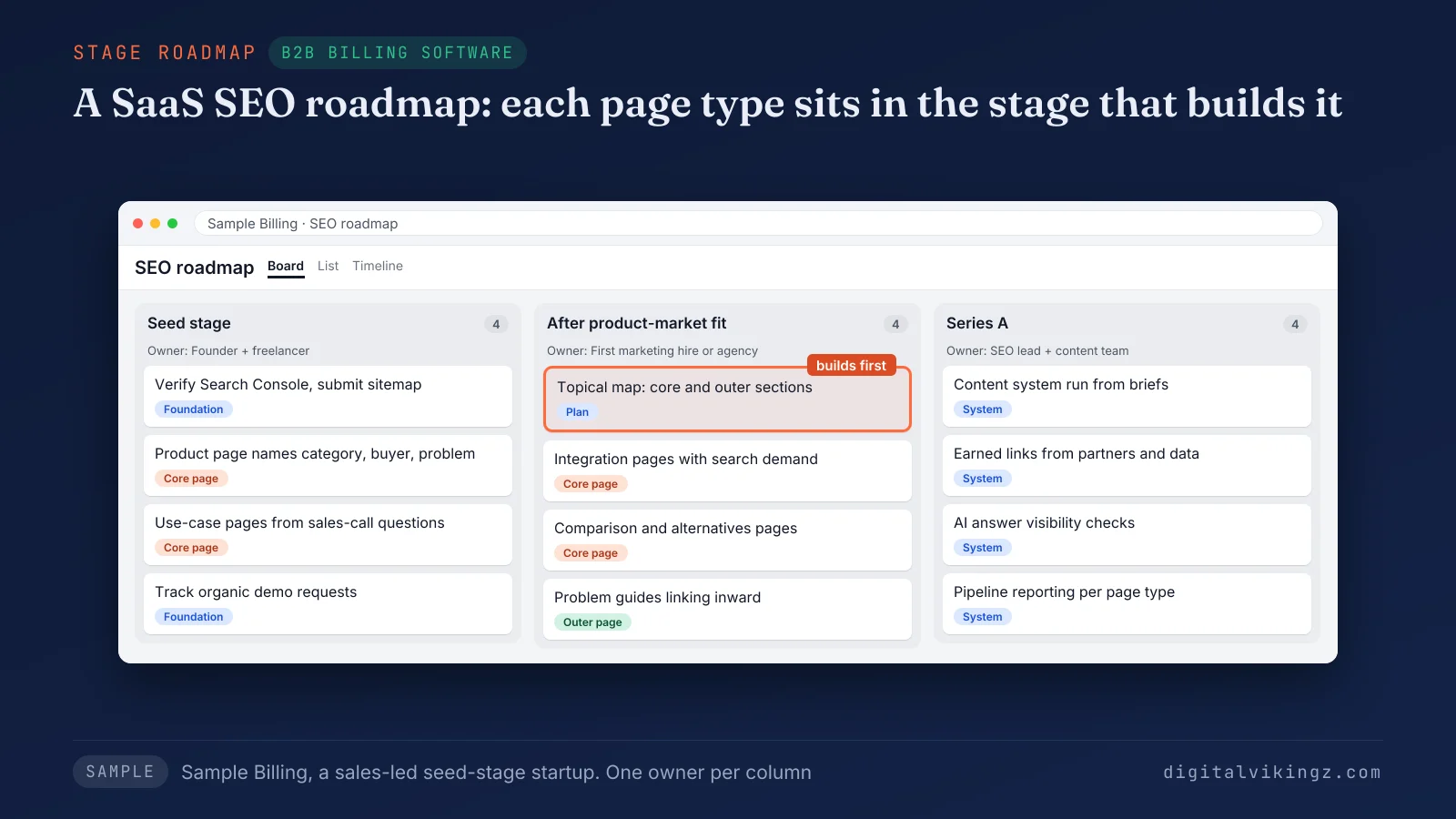
The sample board turns the stage table into task cards, with one owner per column. A founder with a short runway weighs early SEO as a good investment before product-market fit against faster channels.
Is SaaS SEO a good investment before product-market fit?
SaaS SEO is a good investment before product-market fit for foundation work, while a large content program waits until the buyer's words are known.
Positioning and the ideal customer profile (ICP) change before product-market fit, so early pages get rewritten. Foundation work costs little, and every later page depends on that work.
Problems that sales calls repeat in the same words become the target queries. A new-category product has few direct queries, so first pages target the problem and the incumbent tool.
Paid search and outbound bring the first customers sooner, while SEO pages keep working after the spend stops. Seed stage builds the foundations first.
What should a SaaS startup build at seed stage?
A SaaS startup at seed stage builds six SEO foundations that every later page depends on.
The six SEO foundations a seed-stage SaaS startup builds are listed below:
- Verify the domain in Google Search Console and submit the XML sitemap.
- Serve the product, pricing and use-case pages as HTML that carries the main content without waiting for JavaScript.
- Write one product page that names the category, the buyer and the problem in the opening paragraph.
- Publish three to five use-case pages built from the questions buyers ask on sales calls.
- Keep the app, login and staging URLs out of Google's index, so the index holds marketing pages only.
- Track demo requests or signups from organic search as conversions in the analytics tool.
Google processes JavaScript web apps in three phases, crawling, rendering and indexing, according to Google Search Central. Rendering can wait in a separate queue. Key content therefore belongs in the crawlable HTML of a SaaS site, not in client-side scripts.
The product page and the use-case pages are the pages that later links and blog posts point to, so both come first. The foundation list comes with a second list: the work a SaaS startup should skip at seed stage.
What should a SaaS startup skip at seed stage?
A SaaS startup at seed stage skips the SEO work that pays off only once positioning, demand data and site authority exist.
The SEO work a seed-stage SaaS startup leaves until later is listed below:
- Broad category terms: Head terms such as "[category] software" need authority that the new domain does not have yet.
- High-difficulty blog posts: Posts on obvious head keywords compete with publishers that have years of links.
- Programmatic template pages: Template pages need unique data per page, or they become thin copies of each other.
- Bulk links: Bought or bulk links add risk before the site has pages worth linking to.
- A paid tool stack: Paid SEO tools buy speed, and seed-stage work needs Search Console and one keyword tool.
Each skipped item returns in a later stage, after product-market fit or at Series A. Founders describe publishing a few posts on obvious keywords and seeing no movement. A short build list and a longer skip list keep seed-stage SEO possible with no budget.
Can a SaaS startup do SEO with no budget?
A SaaS startup can do seed-stage SEO with no budget, because Google Search Console is free and founder hours replace paid tools.
The founder writes use-case pages from sales-call notes, because the founder hears the buyer's words first. Search Console shows which queries already bring impressions and clicks. That free report replaces a paid keyword tool at seed stage.
Free tools cover every foundation on the seed-stage list. The budget question returns after product-market fit, when the page plan grows past founder hours.
What should a SaaS startup build after product-market fit?
A SaaS startup after product-market fit builds a topical map, then integration pages, comparison pages and alternatives pages for buyers who compare products.
A topical map is the list of every topic a site will cover. The list is split into a core section that sells and an outer section that teaches. The core section of a SaaS site holds the pages buyers decide on.
The outer section explains the problem and links inward. The map decides which pages the startup builds, and in which order.
The seven steps of the method are set out in our guide on how to build a topical map. Product, use-case and comparison pages come before broad blog posts, and blog posts link buyers inward to them.
Query templates such as "[product] [integration] integration" turn one page type into a set of pages. The SaaS startup builds one page per integration with demand and skips integrations nobody searches.
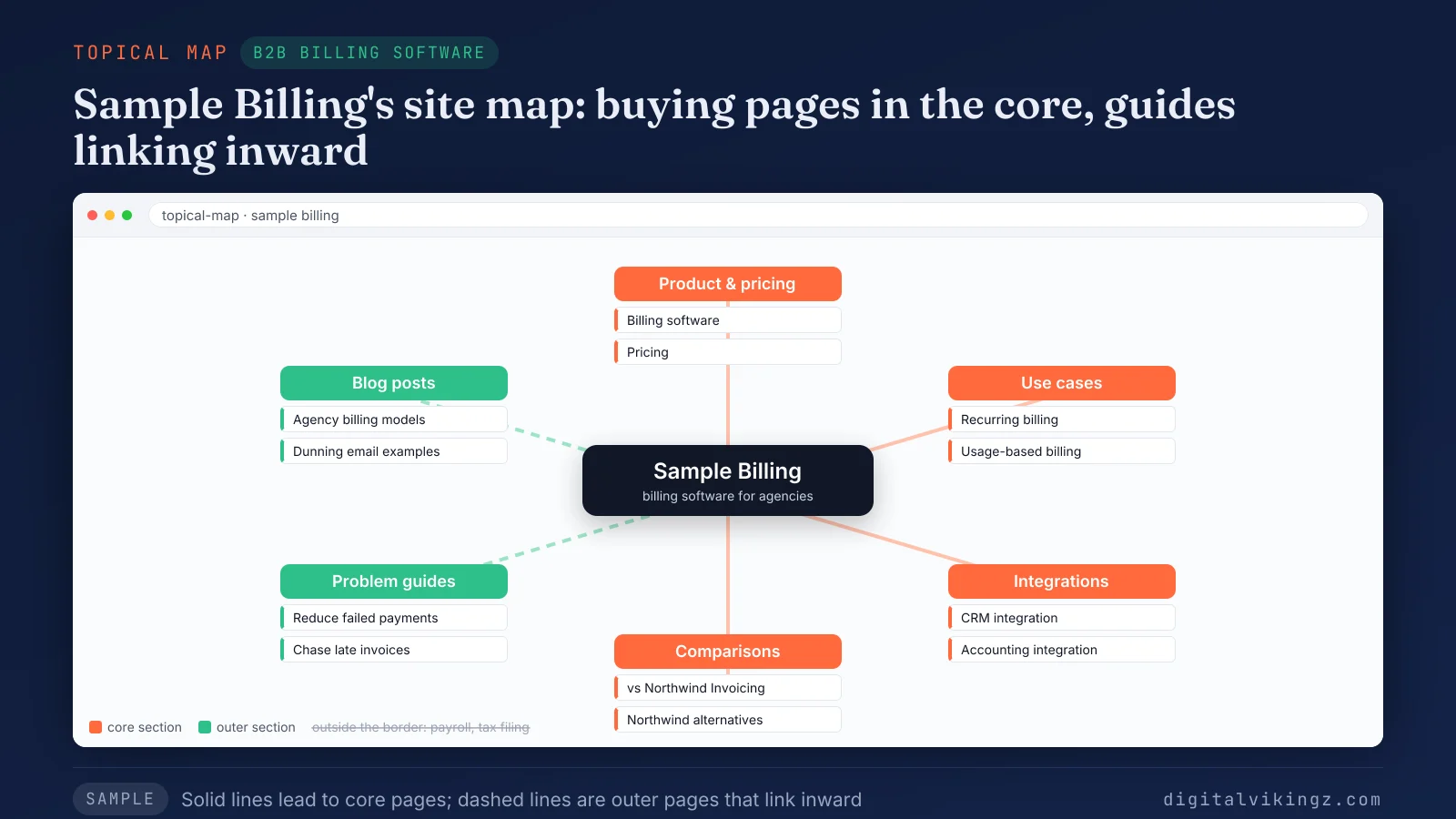
Blog posts and problem guides sit in the outer ring of the sample map and link to the pages in the core. The first marketing hire or an SEO agency takes over page production after product-market fit. Comparison and alternatives pages need a clear trigger before they enter the plan.
When do comparison and alternatives pages enter a SaaS SEO plan?
Comparison and alternatives pages enter a SaaS SEO plan after product-market fit, once buyers name competitors on sales calls or in Search Console queries.
A comparison page compares the product with one named competitor. An alternatives page lists replacements for one competitor. Buyers who compare options before switching read both page types.
Each page type is structured around the query template the page answers, such as "[competitor] alternatives". Our guide on how to structure SaaS comparison pages covers vs, alternatives and category pages.
Comparison pages complete the second stage of the SaaS startup plan, after the topical map and the integration pages. The third stage begins at Series A.
What should a SaaS startup build at Series A?
A SaaS startup at Series A builds four SEO systems: a content system run from briefs, earned links, AI answer visibility and pipeline reporting.
The four SEO systems a Series A SaaS startup builds are listed below:
- Content system: Every page is written from a content brief, so new writers keep one structure and one set of terms.
- Earned links: Integration partners, customer stories and data assets earn links to the pages that compete for buyers.
- AI answer visibility: Pages state the category, use cases and comparisons in passages that AI assistants can quote.
- Pipeline reporting: Organic demos, trials and pipeline are reported per page type to the leadership team.
The programmatic and broad category pages skipped at seed stage return at Series A. The site now has the authority, the links and the data those pages need.
An SEO lead owns the plan at Series A, and an agency or writers produce the pages from briefs. The third system decides how a SaaS startup gets cited in AI answers.
How does a Series A SaaS startup get cited in AI answers?
A Series A SaaS startup gets cited in AI answers when product pages state category, use cases and comparisons in passages assistants can quote.
AI answers in ChatGPT and Google AI Overviews quote answer-first passages from pages that rank in search and answer the buyer's decision. The stage plan therefore feeds both channels.
The product's name, category and main use case read the same way on the site, the review profiles and the partner directories. Comparison and alternatives pages answer the prompts buyers type, such as "[competitor] alternatives for [segment]".
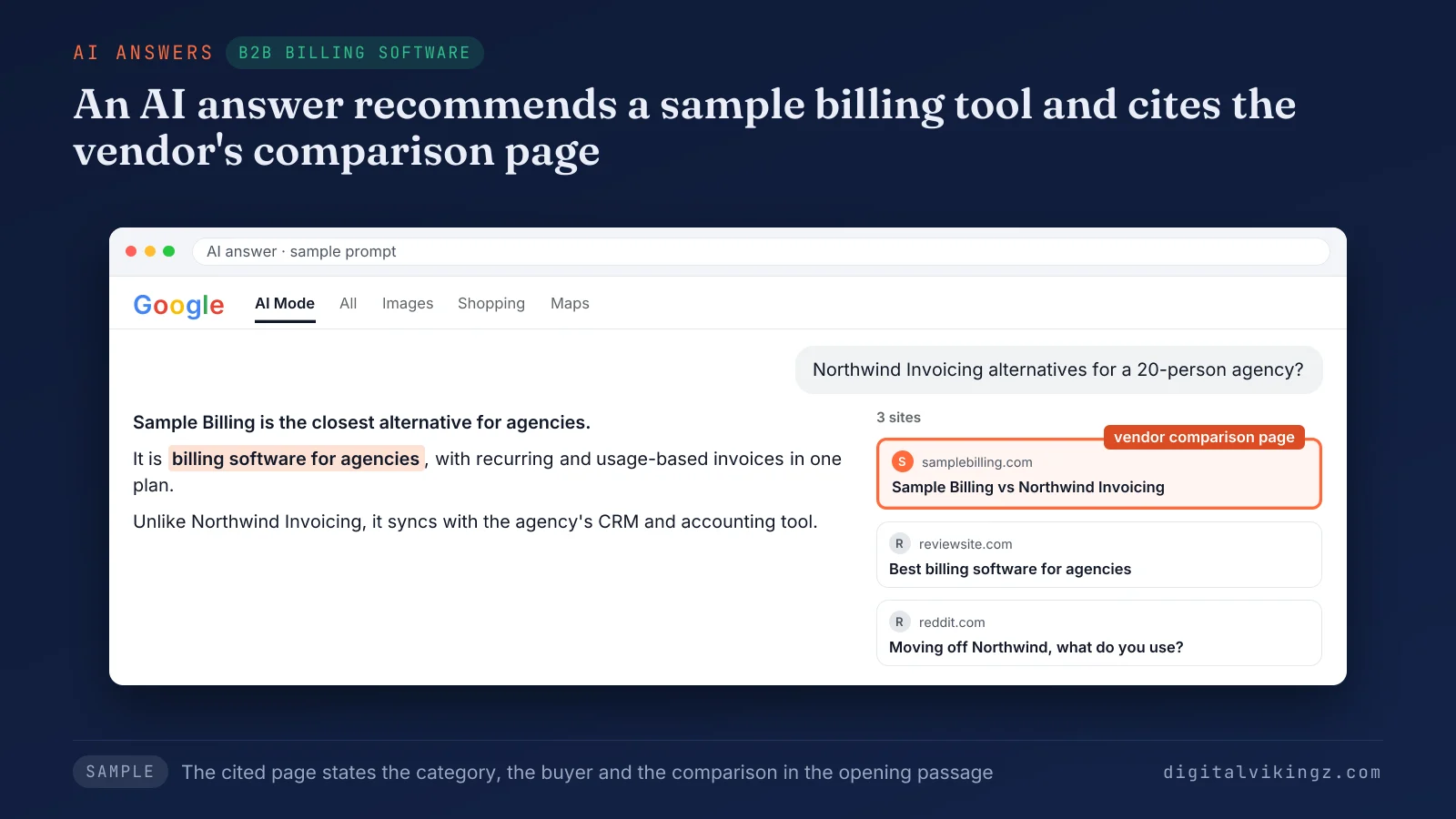
The cited source in the sample answer is the vendor's own comparison page, not a review site. A monthly AI visibility check on a handful of category prompts shows which SaaS pages earn a citation.
The AI Visibility Checker for SaaS pages tests crawler access, entity clarity and answer readiness on one URL. Citations and rankings both depend on a second system: the backlinks a SaaS startup needs to rank.
Does a SaaS startup need backlinks to rank?
A SaaS startup needs backlinks to rank for competitive category and comparison queries, and few links for narrow use-case and integration queries.
Competitive queries are held by domains with years of links. Links show search engines which site the market cites.
An integration listed on the partner's directory is one of the first links a SaaS startup earns. Authority link building for a SaaS startup draws on customer stories, original data and integration partners.
Bought links and link packages add risk and stay out of the plan at every funding stage. Our Authority Link Building for SaaS startups earns entity-aligned links and brand mentions. Links, pages and citations all feed the signal that a stage is complete.
How do you know a SaaS SEO stage is complete?
A SaaS SEO stage is complete when Google Search Console shows impressions for the stage's target queries and the stage's conversion starts to arrive.
We compare equal 28-day windows in Search Console, so a seasonal week does not read as progress.
The table below lists the Search Console signal and the conversion signal that close each funding stage.
| Funding stage | Search Console signal | Conversion signal |
|---|---|---|
| Seed stage | Product and use-case queries gain impressions, and non-branded queries appear beside brand queries | The first demo request or signup from organic search |
| After product-market fit | Comparison and integration queries gain impressions, and striking-distance queries in positions 11 to 20 move into the top 10 | Demo requests or trials arrive each month from comparison and use-case pages |
| Series A | Query count grows in each cluster quarter on quarter | Pipeline sourced from organic search appears in the CRM |
Growth in query count per template is the leading indicator of a stage, and pipeline is the outcome.
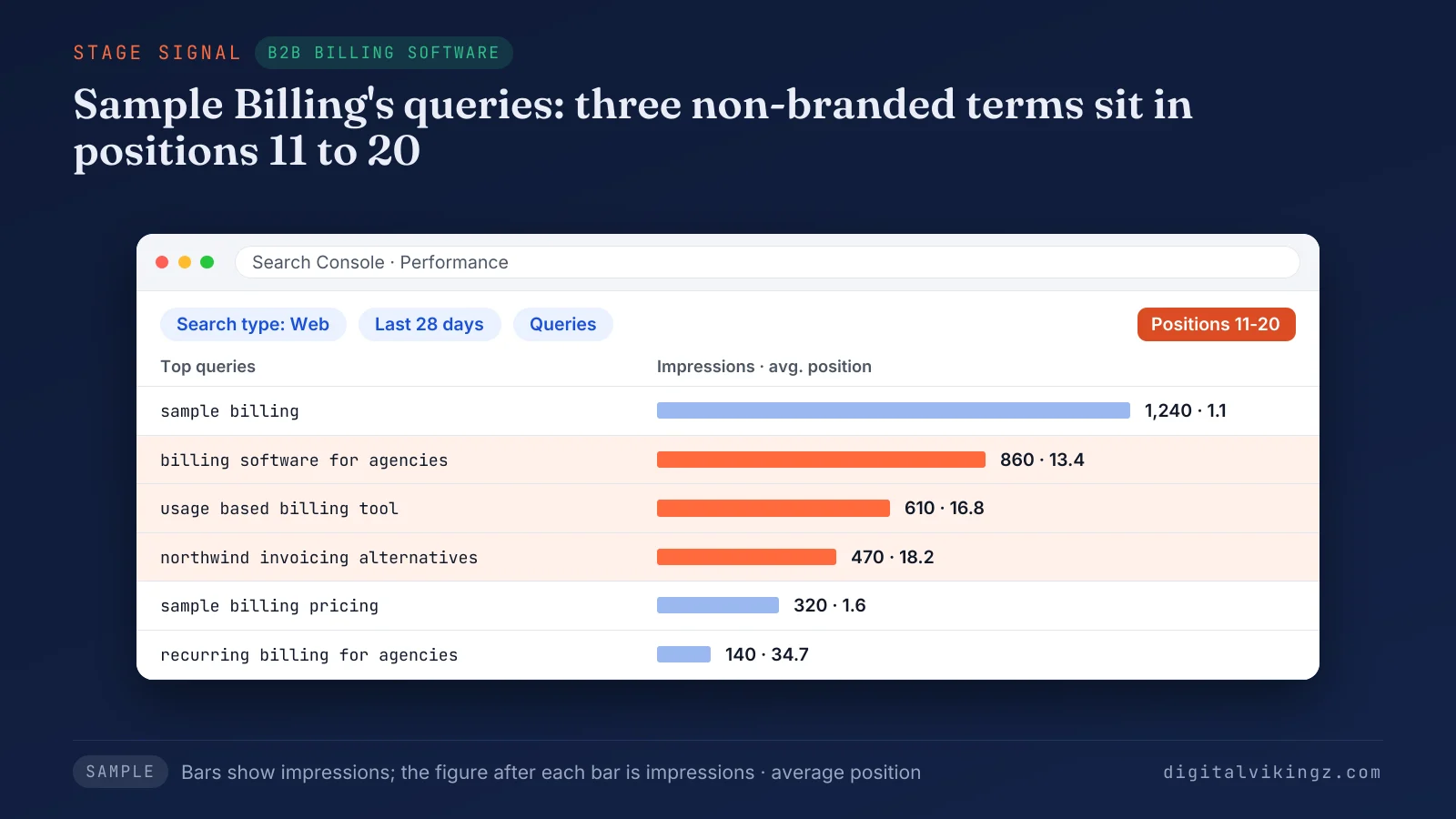
The highlighted rows are the striking-distance queries the next stage pushes into the top 10. The same signals feed the numbers a Series A board reads.
Which SaaS SEO numbers should a Series A board see?
A Series A board should see four SaaS SEO numbers: organic pipeline, organic demos or trials, non-branded query count and AI answer citations.
Pipeline comes from the CRM source field, query count from Search Console, and citations from a fixed set of category prompts checked each month.
Traffic alone stays off the board report, because traffic can rise while demos stay flat. Attributing organic leads to pipeline needs a CRM source field and one rule for the first touch.
Our guide on how to attribute SEO to pipeline sets out the data sources and the report. The same board decides when a SaaS startup should hire an SEO agency.
When should a SaaS startup hire an SEO agency?
A SaaS startup should hire an SEO agency after product-market fit: the ICP is stable, positioning is owned in-house, and pages outgrow founder hours.
The ways a SaaS startup staffs SEO at each funding stage are listed below:
- Founder: The founder runs the six foundations at seed stage.
- SEO consultant or freelancer: A consultant or freelancer fixes technical issues and reviews the plan at seed stage.
- SaaS SEO agency or first marketing hire: An agency or a first hire produces the topical map and the comparison page set after product-market fit.
- SEO lead with an agency: An in-house SEO lead owns the plan at Series A, and an agency or writers produce the pages.
SaaS SEO cost depends on the number of pages per month, the link work and the reporting. Agency quotes should therefore be compared scope line by line.
An agency fits when the startup can supply product facts and sales-call questions each month. Semantic SEO for SaaS and B2B software starts from one list of page types and the services that build each type.
The page types and services are listed on our page on semantic SEO for SaaS and B2B software. Stage fit is the first of five questions used to choose a SaaS SEO agency.
How do you choose a SaaS SEO agency?
A SaaS SEO agency is chosen by asking five questions about stage fit, page types, reporting, review points and dated proof.
The five questions to ask a SaaS SEO agency before hiring are listed below:
- Ask which pages the agency would build first at your funding stage, and why.
- Ask to see a topical map or page plan from a past engagement, with client names removed.
- Ask how organic demos, trials and pipeline will be reported, and how often.
- Agree on a review point and the leading indicators checked there, instead of a ranking promise.
- Ask for case studies that compare dated Search Console windows, not undated traffic charts.
The answers show how the agency plans, reports and proves results at the startup's funding stage. An agency that guarantees rankings or promises results in weeks fails the review-point question. Rankings depend on competitors and on Google updates that no agency controls.
Dated proof names the start and end of each window, so seasonal swings do not pass as growth.
Our embedded recruiting firm SEO case study compares equal 28-day windows: non-branded Google impressions grew from 228 to 4.61K. The client is a US recruiting firm that places recruiters in startups, not a software company.
The embedded recruiting firm SEO case study shows the windows, the queries and the AI citations behind that figure. The same five questions apply to a generalist SEO agency.
Can a generalist SEO agency do SaaS SEO?
A generalist SEO agency can do SaaS SEO when the agency has built SaaS page types before and reports on pipeline, not rankings alone.
A SaaS specialist knows the comparison, integration and use-case page types from earlier work. The specialist also knows the trial funnel and the demo funnel.
A generalist agency without that history learns the SaaS page types on the client's budget. The five questions in the list above separate the two faster than the agency's label does.
The right partner depends on the funding stage the SaaS startup is in.
Questions about SEO for SaaS startups
SEO for SaaS startups raises six further questions: results timelines, agency commission, tools, programmatic SEO, new software categories and consultants.
How long does SaaS SEO take to show results?
SaaS SEO typically shows first signals in 3 to 6 months and compounding results in 6 to 12 months, according to published agency ranges. Search Console impressions move first, and demos follow the pages that reach the top 10.
Should a SaaS startup pay an SEO agency on commission?
A SaaS startup should agree on leading indicators and a review point with an SEO agency instead of paying on commission. Rankings and pipeline also depend on product, pricing and sales work that the agency does not control.
Which SEO tools does a SaaS startup need?
A SaaS startup needs Google Search Console and one keyword tool at seed stage, and adds a crawler and rank tracking after product-market fit. Tools buy speed, and the plan decides which pages get built.
Is programmatic SEO right for a SaaS startup?
Programmatic SEO suits a SaaS startup after product-market fit, when each template page carries data or setup steps for one integration or use case. Template pages with the same text and a swapped name stay thin and rarely rank.
Does SaaS SEO work for a new software category?
SaaS SEO works for a new software category through problem queries and incumbent alternatives queries, because buyers search the problem before the category name. The category page follows once buyers start searching the new category term.
What does a SaaS SEO consultant do?
A SaaS SEO consultant plans and audits SEO for a software company, while the startup's team or an agency produces the pages. A consultant fits seed stage, when the founder writes and needs a technical review.
What does a staged SaaS SEO plan give a startup?
A staged SaaS SEO plan gives a startup one set of pages per funding stage, so SEO spend follows the previous stage's evidence. Seed stage builds foundations, product-market fit builds the comparison page set, and Series A builds the systems that report pipeline.
Pages planned from one topical map are how semantic SEO builds topical authority that Google and AI answer engines recognise. Digital Vikingz plans the stages inside a Semantic SEO Strategy with a topical map and a 12-month roadmap.
Book a strategy call to scope a Semantic SEO Strategy for SaaS startups.