 Digital Vikingz

Concept pages publish first, because a location page without concept authority behind it is a thin template. A location earns its own page only when the query network treats that place as a distinct entity with its own attributes, and each location page is written from a fixed template with variable local facts, never from a body copied across cities. Each location page and its Google Business Profile form one entity, and the whole is measured per location in Search Console and in the CRM.
Entity card
Field | Value |
Term | Semantic SEO for a multi-location business |
Also called | Multi-location SEO, multi-site local SEO, location page architecture |
Part of | Semantic SEO Architecture, local and multi-location cluster |
Depends on | One central entity, a concept core, a page decision per location and one business profile per location |
Produces | A topical map with a concept part and a locale part, a location page template and a per-location measurement |
Measured by | Query count and leads per location page, and profile actions per business profile |
Not the same as | A city page for every place the business can drive to |
What changes in semantic SEO for a multi-location business?
Semantic SEO for a multi-location business changes one thing: location becomes an attribute of the central entity, and the core section of the topical map splits into a concept part and a locale part.
A single-location business has one central entity and one place, and the place sits in the brand definition. A multi-location business has the same central entity and several places, and each place is an attribute value the way size or type is an attribute value for a product.
The split follows from that. The concept part holds the pages about the service, the condition, the process and the price, with no place in them. The locale part holds one page per location that passes the page test, with the place in the title and the local facts in the body. The concept pages carry the authority. The location pages carry the proximity.
Koray Tuğberk Gübür's article in Search Engine Land on how semantics and topical authority improve local SEO sets out the principle that local pages inherit relevance from the topical authority of the site around them. We build the concept part first on every multi-location engagement for that reason.
How is the topical map split for a multi-location business?
The topical map for a multi-location business is split into three parts: a concept core with no location inside, a locale core with one page per qualifying location, and an outer section of informational pages that link into both.
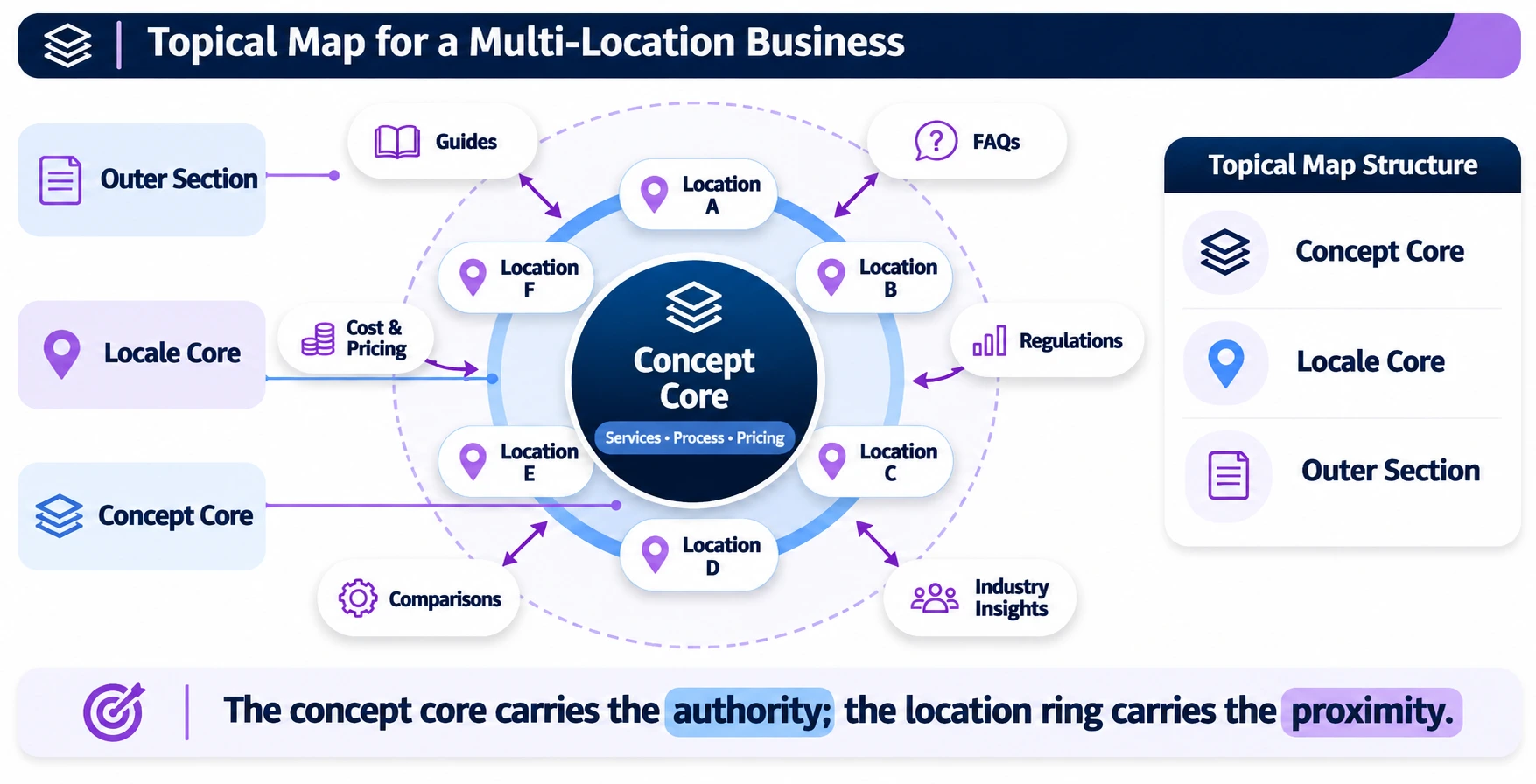
The image above shows the three parts. The concept core sits at the centre. The location pages form a ring that links to the core. The outer nodes link to whichever part they support.
Which locations earn a page?
A location earns a page when the query network treats that place as a distinct entity with its own attributes: searches that name the place with the service, a business presence at the place, and facts that differ from the other locations.
The five-check page test applies to places the same way the test applies to any query variation: demand, a different entity, low similarity to the existing pages, a recurring pattern, and a distinct predicate. A city with searches for the service, a staffed address, local reviews and local regulations passes. A suburb with no searches of its own and no presence is a line on the nearest location page. Query Deserves a Page holds the test.
Why do concept pages publish before location pages?
Concept pages publish first because concept pages build the historical data on the service, and location pages inherit that data through internal links instead of earning it from nothing.
A location page published onto an empty site competes with every directory and every national brand on the city query, with no site authority behind the page. The same page published onto a site that already ranks for the service queries starts with the site's record. The order is concept first, locations second, and new locations added to a site that already holds the concept part.
How is a location page written so each one is distinct?
A location page is written from one fixed template whose variable blocks carry the facts that differ by place, and whose shared blocks stay short and link to the concept pages instead of repeating them.
The variable blocks of a location page are listed below:
Identity block. Location name as the business names the place, street address, phone, hours and the map, matching the business profile character for character.
People block. The team at that location, with names, roles and credentials, linked to their author or profile pages.
Services at this location. The subset of services offered at the place, each one linked to its concept page, with any local variation stated.
Local proof. Reviews, projects or outcomes tied to that location, with dates.
Local conditions. The regulations, climate, housing stock, insurer rules or other facts that change how the service is delivered at that place.
Directions and access. Parking, transit, service radius and travel fee where one applies.
Local questions. The questions searchers in that place ask, drawn from the location's own Search Console queries and calls.
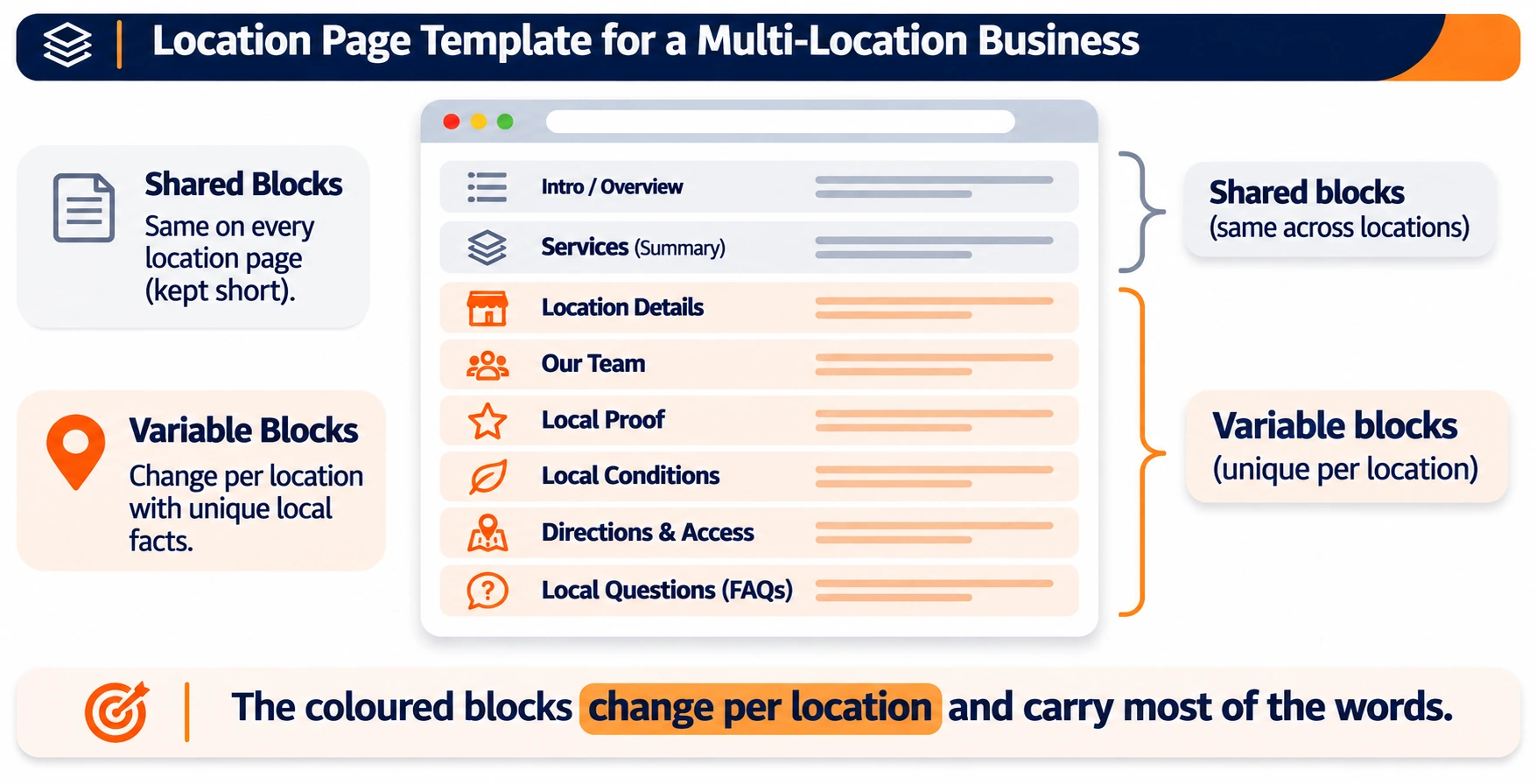
The image above shows the template. The grey blocks are shared across locations and kept to a sentence or two each. The coloured blocks change per location and carry most of the words.
Should every location page repeat the service descriptions?
A location page should not repeat the service descriptions, because the description belongs to the concept page and a repeat on every location page reads as one page in many copies.
The location page names the service in one sentence, states what differs at that place, and links to the concept page with the service's canonical anchor. The reader who wants the full description is one click away, and the search engine reads one description on one URL.
How do location pages and Google Business Profiles form one entity?
A location page and its Google Business Profile form one entity when the name, address, phone, categories and hours match, the profile's website field points to that location page, and the page links back to the profile.
One profile per location, named as the business is named with no city or keyword appended. The profile's primary category matches the central entity's class. The location page carries LocalBusiness markup with the same values the profile shows. A mismatch between the two is read as two entities, and both lose.
The profile ranks on proximity and the page ranks on relevance, and the two reinforce each other when the entity is one. Google's Business Profile guidelines set the naming and category rules the profile side follows.
How are the pages of a multi-location site linked?
The pages of a multi-location site are linked so that every location page links up to a locations hub and across to the concept pages, every concept page links down to its locations through one block, and no location page links sideways to other cities.
The link rules for a multi-location site are listed below:
A locations hub lists every location page with its address and one line of local context, grouped by region when the count is large.
Each location page links to the hub and to each concept page for the services the location offers, using the concept page's canonical anchor.
Each concept page carries one block that lists the locations offering that service, linked with the location's name as the anchor.
Region pages exist only when a region has its own query network and several locations inside it; otherwise the hub carries the grouping.
Location pages never link to other location pages in body text. A city-to-city link ring adds no relevance and reads as a template artefact.
Outer informational pages link to the concept page for depth and to the nearest location page only when the page is about that place.
The direction is the same as on any topical map: outer to core, locale to concept, and the hub as the one page that holds all locations.
How is semantic SEO measured per location?
Semantic SEO for a multi-location business is measured per location page in Search Console, per profile in Business Profile performance, and per location in the CRM through the landing page on each lead.
Search Console is filtered to each location page for query count, impressions and clicks, and the city plus service queries are read separately from the brand plus city queries. Business Profile performance gives calls, direction requests and website clicks per profile. The CRM records the landing page on each lead, so leads are counted per location and per concept page. How to attribute SEO to pipeline sets out the tagging that makes the CRM count possible.
A location whose page earns query count and whose profile earns calls is working. A location with profile calls and no page queries has a page problem. A location with page queries and no calls has a profile problem or a proximity ceiling.
How does Semantic SEO Architecture handle a multi-location site?
Semantic SEO Architecture handles a multi-location site by producing the concept core and the locale core as two sections of one topical map, with the page decision recorded per location and the template fixed before any location page is written.
The architecture names the central entity once, runs the page test on every candidate location, writes the location template with its variable blocks, and sets the link rules above as part of the internal linking document. Location pages are then produced in sequence after the concept core is live.
Semantic SEO Architecture lists the seven documents the engagement produces. On multi-location sites in healthcare and real estate, the locale core is where most of the page decisions fall.
What goes wrong on multi-location sites?
Multi-location sites go wrong through doorway pages, location pages for places with no presence, duplicate bodies, a separate domain per city, and profile names stuffed with keywords.
The common faults on multi-location sites are listed below:
Doorway pages. Many pages that differ only by place name and funnel to one destination. Google's spam policies name doorway pages as a violation.
Pages for places with no presence. A city page where the business has no address, no team and no reviews. The page fails the page test and the profile rules.
Duplicate bodies. One service description pasted onto every location page, so the site holds one page in forty copies.
A domain per city. Authority split across domains that each start from nothing.
Keyword-stuffed profile names. A profile named with the city and the service appended, against the Business Profile guidelines, splitting the entity from the page.
Each fault is the same mistake: treating the place as a topic instead of as an attribute. The fix is the split described above, applied to the pages that already exist before any new location is added.
Map your locations against your concept pages
On a 30-minute call we list your locations, run the page test on each, and show you which concept pages are missing beneath them. You leave with the publishing order, with or without an engagement.
Book a strategy call · Request the audit
Questions about semantic SEO for a multi-location business
How many locations justify this architecture?
Two. The split between concept pages and location pages applies as soon as there is more than one place, because the second location page is where the duplicate body usually begins.
Does a service-area business without offices use the same model?
The concept part is identical. The locale part differs: a service-area business has one profile per staffed base and a service-area page per region served, not a page per town, and the pages state the radius and travel terms.
Should location pages sit under /locations/ or at the root?
Under one folder, so the hub and the location pages share a path and the concept pages sit elsewhere. The folder name is the business's own word for its places.
How do franchises handle the template?
One template owned by the franchisor, with the variable blocks filled by each franchisee from a form. Franchisees do not write body copy, which keeps the shared blocks identical and the local blocks true.
Can a location page rank for queries without the city name?
Rarely, and the page is not built for that. Service queries without a place belong to the concept pages. A location page ranks for place plus service and for the brand plus place.
What happens when a location closes?
The page states the closure, lists the nearest open location, and is redirected to that location after the profile is marked closed. The link from the hub is updated in the same batch.
Should each location have its own blog?
No. Informational pages belong to the outer section of the one map and link to the concept pages. A post about a local topic links to the location page the post concerns.
How are reviews handled across locations?
Each profile collects its own reviews, and each location page shows reviews for that location only. Reviews are never pooled onto one page, because the pooled page misrepresents each place.
Do location pages need different images?
Yes. Photographs of the actual place, the actual team and the actual work there, with file names and alt text naming the location. Stock images shared across locations are one more duplicate block.
How often is the locale part reviewed?
The locale part is reviewed at every configuration pass, with the location pages read as one cluster. A location whose query count falls while the others hold is read on its own before anything is changed.
Can two nearby locations cannibalise each other?
Yes, when their pages carry the same local blocks or the same suburbs in their text. Each page names the suburbs that location serves and no others, and shared suburbs are assigned to one page.
Sources
Koray Tuğberk Gübür, Search Engine Land: How semantics and topical authority improve local SEO
Google Business Profile Help: Guidelines for representing your business on Google