 Digital Vikingz
Your manager asks for an AI share of voice number, and two tools can give you two different ones. AI share of voice is your brand's share of the brand presence in AI answers, counted over a fixed set of prompts.
AI share of voice equals your brand mentions divided by all tracked-brand mentions, times 100. We recommend dividing by all tracked-brand mentions, because the shares of all brands then add up to 100%.
Three counting rules change AI share of voice without any change in what the assistants said. Read AI share of voice as a trend and as a gap to named competitors, never as a single absolute figure.
What is AI share of voice?
AI share of voice is your brand's share of the brand presence in AI answers, counted over a fixed set of prompts. Tracked brands are you and the competitors you name. Put another way, the figure is a share of mentions.
Take a sample scene. A marketing lead at a project tool asks ChatGPT for the best tool for agencies and counts which of five brands the answer names.
The wider discipline is covered in our guide to what AI SEO is. We read nine guides on the topic on 22 November 2026, and each defines the term a little differently. Classic share of voice works on rankings, and the AI version works on answers.
AI share of voice against SERP share of voice
SERP share of voice weights rankings and search volume, while AI share of voice counts brand names inside generated answers. An AI answer lists brand names in running text, so the count uses those names instead of ranking positions or a click curve.
Picture a sample plumber who ranks third in the results for "water heater repair". In an AI answer, the same plumber is either named or left out. The count rests on the word mention, so the next heading fixes the term.
What counts as a mention in an AI answer?
A mention is the brand name written in the text of one AI answer. A linked source is a citation and is counted apart from mentions. Count the company name, its short name and any agreed spelling as one brand.
Here is a sample. A made-up dental practice, Bright Dental Studio, also gets written as "Bright Dental". Both spellings land in one brand column.
With the mention fixed, the formula is short.
The AI share of voice formula
AI share of voice equals your brand mentions divided by all tracked-brand mentions, times 100. Ahrefs, in its AI share of voice guide, divides responses that mention your brand by responses that mention any tracked brand.
No single standard formula exists. Vendor guides set their own.
Tracked-brand mentions are the mentions of you and the competitors you named. Numbers make the formula checkable, so a worked example follows.
A worked example with sample counts
The numbers below are a made-up sample, not client data. They come from 20 prompts run on two assistants, which gives 40 answers.
| Brand | Answers naming the brand, out of 40 | Share of 54 mentions |
|---|---|---|
| Brand A (you) | 14 | 25.9% |
| Brand B | 22 | 40.7% |
| Brand C | 12 | 22.2% |
| Brand D | 6 | 11.1% |
| Total | 54 | 99.9% (rounding) |
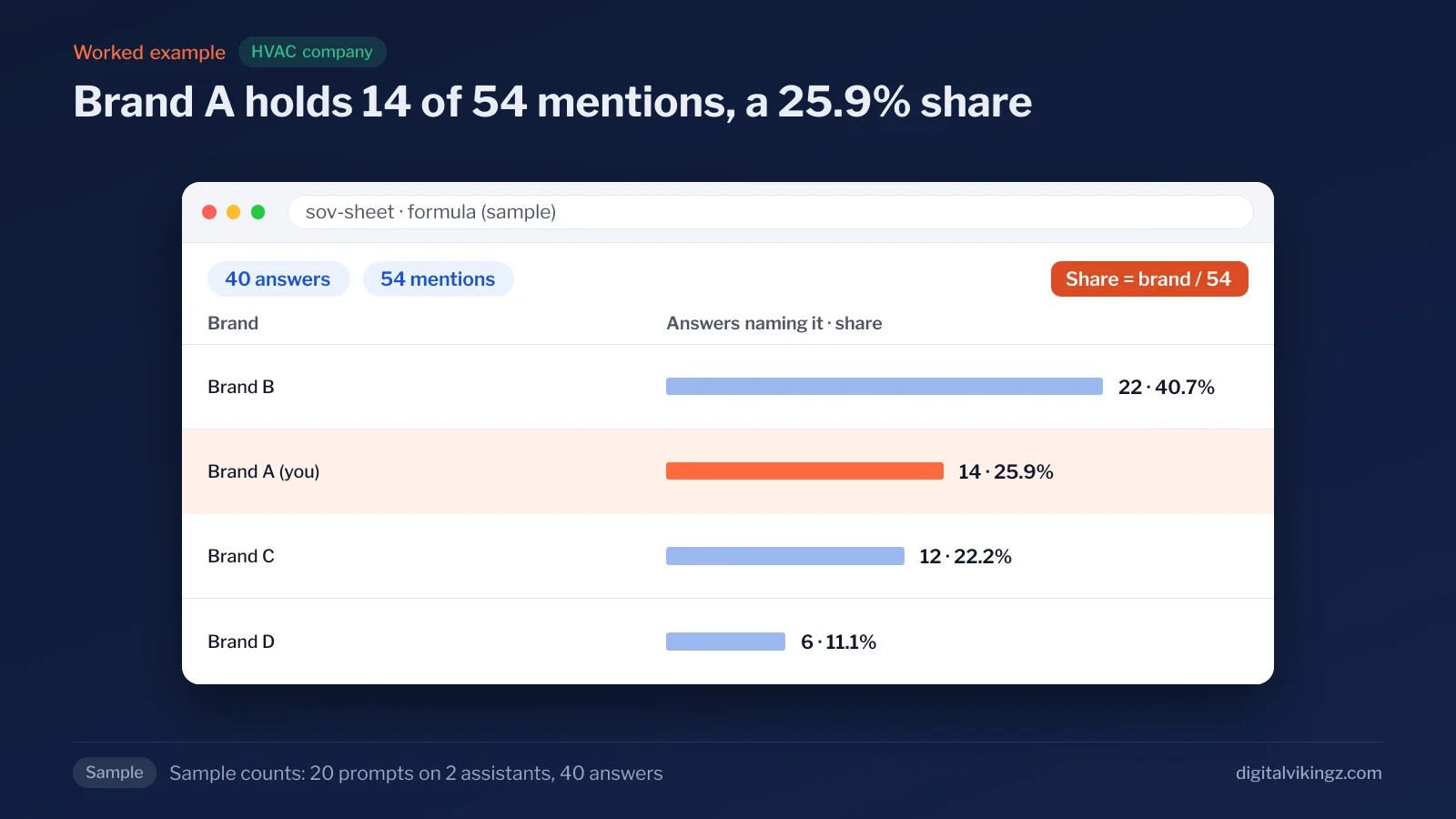
Sample counts for four tracked brands across 40 answers, made up for the guide; they are not client data.
Brand A is named in 14 of 40 sample answers. The 40 sample answers hold 54 brand mentions, counted once per brand per answer. Brand A holds 14 of those 54 mentions, so its AI share of voice is 25.9%.
The same 14 answers can give three numbers, depending on the denominator.
Which denominator should you use?
We recommend dividing by all tracked-brand mentions, because the shares of all brands then add up to 100%. The same 14 answers produce 35.0%, 41.2% or 25.9%, depending on the denominator.
Three denominators appear in the guides we read. A figure with no denominator beside it cannot be checked. Of the 40 sample answers, 34 name at least one tracked brand.
| Denominator | Count | Brand A | What it is |
|---|---|---|---|
| All answers | 40 | 14 / 40 = 35.0% | The share of answers that name you |
| Answers that name any tracked brand | 34 | 14 / 34 = 41.2% | The form in the Ahrefs guide |
| All tracked-brand mentions | 54 | 14 / 54 = 25.9% | Our pick |
The choice is a convention. Write the denominator next to every figure in the report. The denominator is one fixed input, and three more must stay fixed too.
What you fix before you count
Four inputs stay fixed between runs: the prompt set, the assistants, the competitor list and the date range. Change any input and the number moves for a reason that has nothing to do with visibility. We come back to that when a figure shifts.
Start with the prompts, because every other input is applied to them.
Which prompts go in the set?
A prompt set is the fixed list of buyer questions you run on every assistant, every time. We suggest starting with 20 buyer questions, then growing the set once the method runs smoothly.
The guides we read use examples from 5 prompts up to 200. Split the set into category prompts, which name no brand, and branded prompts, which do. The headline figure uses the category prompts.
For a sample dental clinic, "best dentist for implants in Tampa" and "emergency dentist open Sunday near me" are category prompts. The same prompts then run on named assistants.
Assistants and locations
ChatGPT, Gemini, Perplexity and Google AI Overviews each answer differently, so each gets its own column. Ahrefs notes that the same brand can perform very differently across platforms.
When an assistant shows no answer for a prompt, log a blank as a blank. How Perplexity picks sources is covered in our guide to Perplexity SEO.
Location is one more input. The distortions section says how it moves the number. The last input is the set of brands you compare against.
Who goes on the competitor list?
The competitor list is the set of named brands you count next to your own. We suggest three to five competitors, the brands a buyer would put on a shortlist.
The guides we read disagree on list size. Ahrefs shows two competitors in its example, and Alex Birkett suggests six to eight. The sample below shows how the list alone moves the share.
| List | Brand A share |
|---|---|
| All four brands | 14 / 54 = 25.9% |
| Without Brand D | 14 / 48 = 29.2% |
| Brand A against Brand B only | 14 / 36 = 38.9% |
Removing Brand D lifts Brand A from 25.9% to 29.2%, with no change in what the assistants said. Freeze the list for a quarter. Adding or dropping a brand restarts the baseline.
The date range
The date range is the window in which the prompts run, and the window length stays the same in every report. We suggest running the set weekly and reporting the trend monthly.
Pick one reporting window, for example one calendar week, and run on the same weekday. How many runs fit inside the window comes later. With the inputs fixed, the next question is how to count inside them.
Counting rules that change the number
Three counting rules change AI share of voice without any change in what the assistants said. The rules are one mention per answer or every mention, position weighting and volume weighting.
The first rule decides how often one answer can score.
One mention per answer or every mention?
Count one mention per brand per answer, because a brand named three times in one answer still holds one place there. The sample table shows both rules on the same answers.
| Rule | Brand A count | Total | Brand A share |
|---|---|---|---|
| One mention per answer | 14 | 54 | 25.9% |
| Every mention (sample) | 31 | 114 | 27.2% |
The same sample gives 25.9% under one rule and 27.2% under the other. A long answer that repeats a brand pushes the second figure up, which is why the rule stays fixed.
Order inside the answer is the next rule.
Position weighting and volume weighting
Position weighting gives more points to the first brand named, and volume weighting gives more to prompts that more people ask. Ahrefs' own example turns a basic 67% into a weighted 31% on the same responses.
Ahrefs weights by AI-adjusted prompt volume and says its impressions are modeled. Nobody outside the assistants sees actual prompt volume, so a volume weight rests on a model.
Here is a position sample. With 3, 2 and 1 points for the first, second and later brands, Brand A holds 29 of 137 points. That is 21.2%, against 25.9% unweighted.
Start unweighted, and add a weight only when a report needs one. With the rules chosen, the count can run in a sheet.
How do you measure AI share of voice in a spreadsheet?
Measure AI share of voice in a spreadsheet by logging the brands each answer names, then dividing counts by the total. The steps to measure AI share of voice in a spreadsheet are listed below:
- Write the four inputs on a first tab.
- List the prompts in column A, with the assistant and the run in columns B and C.
- Paste each prompt into its assistant and read the whole answer.
- Enter 1 under each tracked brand the answer names and 0 under the rest.
- Add up each brand column, then add the column totals together.
- Divide each brand total by the grand total and format the result as a percentage.
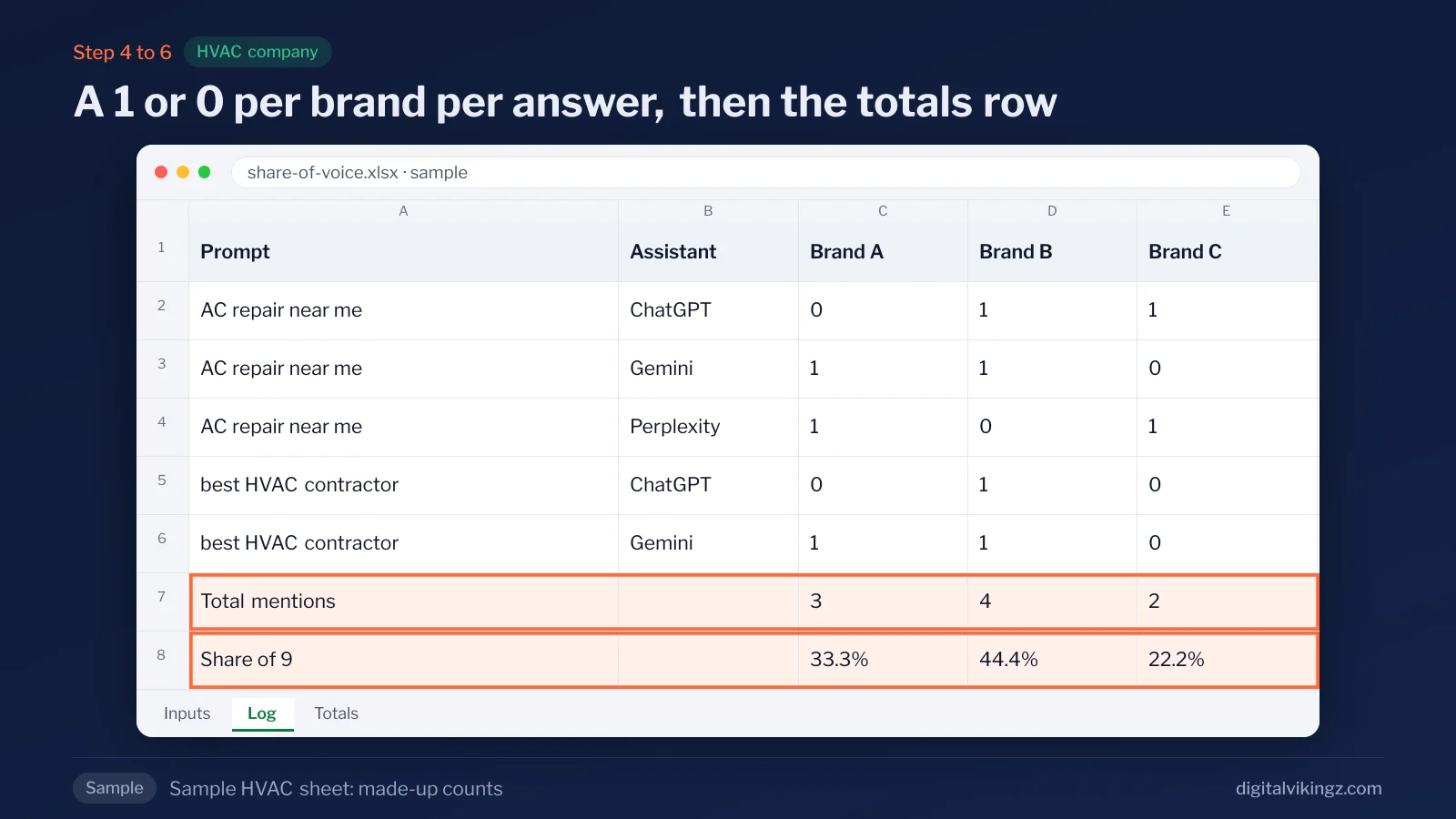
Sample sheet for a project tool; the counts are made up for the guide.
Take a sample HVAC company. Its row for "AC repair near me" shows a 1 under the company on Gemini and a 0 on ChatGPT.
Twenty prompts on three assistants in three runs make 180 answers to read each week. Ahrefs counts five prompts on three assistants in two locations as 30 checks. At 180 answers a week, hand counting starts to strain.
When does a tool earn its cost?
A tool earns its cost when running the set by hand takes more time than reading the results. Ask three things: what counts as a mention, which denominator, and how many runs per prompt.
A tool that shows one percentage and hides the denominator gives a number nobody can check. Start with our free AI Visibility Checker, then run the prompt set.
Who runs the monthly count is a staffing choice, covered in our guide to in-house semantic SEO or an agency. Whichever method runs, three distortions can mislead the number.
Distortions that move the number
Several distortions can move AI share of voice while the brand's standing stays unchanged. Three follow, one per heading, and each comes with its fix.
The first sits in the prompts themselves.
Branded prompts
A branded prompt names your company, so the answer usually names your company too. A set with five branded prompts out of 20 starts with five answers that name the brand.
Keep branded prompts on a separate tab and leave them out of the headline figure. Compare a sample pair. "Is Bright Dental Studio good for implants?" names the clinic, while "best dentist for implants in Tampa" does not.
The next distortion is how often a prompt runs.
Too few runs and volatile answers
Assistants can answer the same prompt differently on two runs, so one run per prompt gives a noisy share. Ahrefs advises trusting trends that persist across several reporting periods, because single answers vary between runs.
We suggest three runs per prompt in the same week, and the report shows the range. Three sample runs of one prompt set give 22%, 26% and 31%. Report the middle run and the range, which is 22% to 31% in the sample.
None of the nine guides we read states how many runs make the share stable. We have not tested that number ourselves. Location and wording change the answer too.
Location and persona
Location changes who gets named, so Ahrefs counts one check as one prompt on one assistant in one location. A sample prompt shows the effect. "Best HVAC contractor near me" returns different companies for a user in Tampa and a user in Denver.
Persona wording, such as "for a CFO" or "for a small agency", belongs inside the prompt text and stays fixed. We have not measured how far persona wording moves the share.
Fix one location per run and write the location in the log. With the traps named, the number can be read.
How do you read the number?
Read AI share of voice as a trend and as a gap to named competitors, never as a single absolute figure. Ahrefs also tells readers to compare against competitors and against their own past figures before any benchmark.
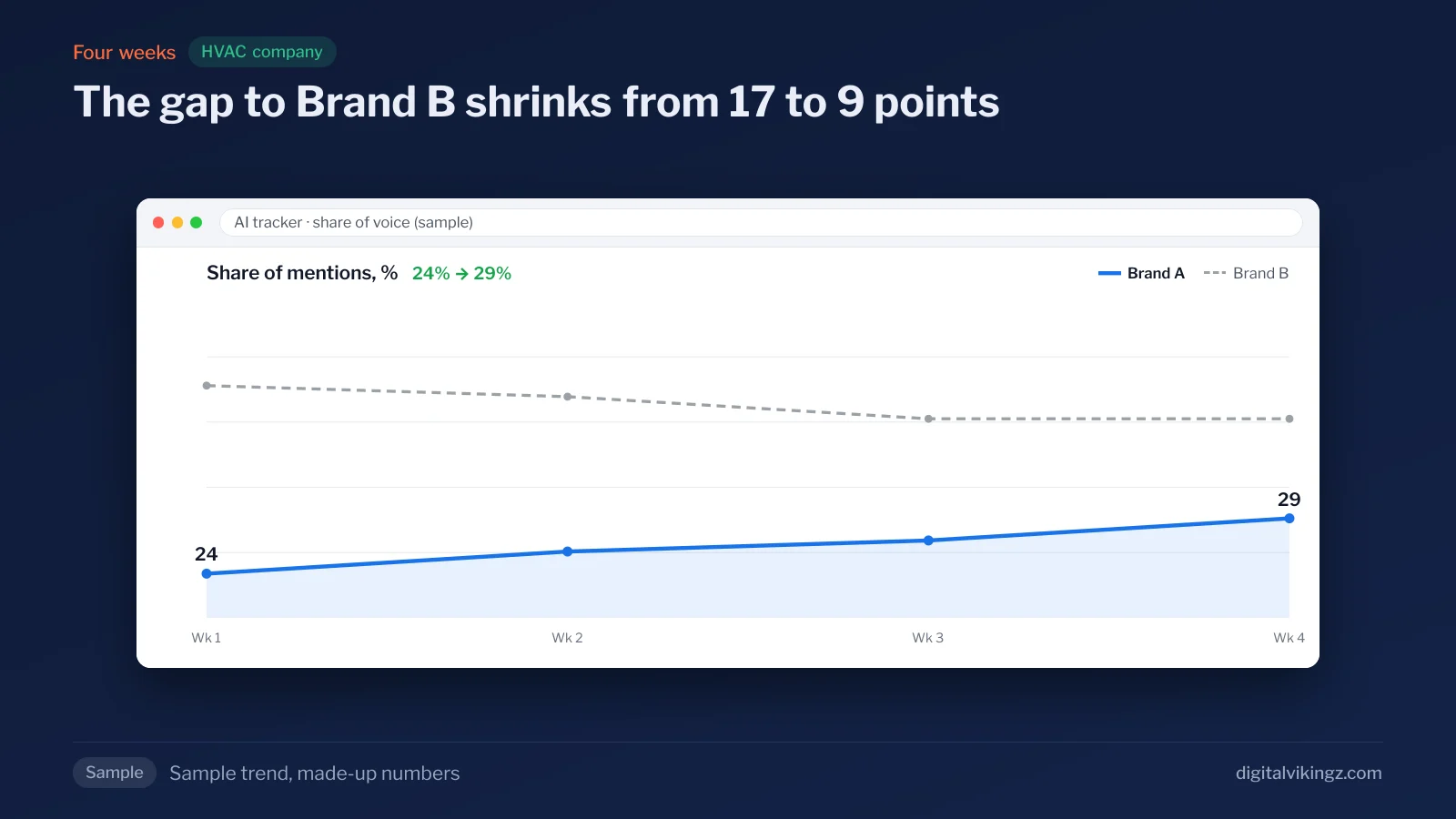
Sample trend for two tracked brands, made up for the guide.
Brand A rises from 24% to 29% over four sample weeks, and the gap to Brand B narrows from 17 points to 9. Mark any week that had too few runs. The first reader question is what counts as good.
What is a good AI share of voice?
No agreed benchmark exists for a good AI share of voice, so compare against your own past figures first. Four tracked brands split evenly at 25% each.
Ahrefs says no universally good score exists, and its benchmark advice depends on matching platforms, prompts and period. A benchmark from another set is not your benchmark. When the number moves, the cause is one of three.
Why did the number change?
A change in AI share of voice has three possible causes: your visibility, your measurement or the assistant. Ahrefs lists the same three causes: your visibility, your measurement and the AI systems.
First, answers began to name you more or less often. Second, you edited the prompts, brands, assistants or counting rule. Third, the assistant changed its model or its sources.
The competitor sample shows a measurement change: 25.9% became 29.2% with the answers untouched. Rerun the old setup once before blaming visibility.
How does AI share of voice fit with the rest of AI search visibility?
AI share of voice is one measure inside AI search visibility, next to mention rate, citation rate and enterprise tracking. Our AI Search Visibility service includes monthly prompt tracking.
Every item below ties back to the count in the formula and the sheet. First comes the vendor naming, then the neighbouring measures.
How vendor guides define it
Vendor guides name and divide the figure differently, so a number from one tool does not match another tool's. The table shows four guides as we read them on 22 November 2026.
| Guide | Name it uses | What it divides |
|---|---|---|
| Ahrefs | AI share of voice | Responses that mention your brand by responses that mention any tracked brand, plus a volume weighted variant |
| Similarweb | Mention share, beside brand visibility | Mentions of a brand by all brand mentions |
| LLM Pulse | Share of voice, beside mention rate and citation rate | Brand mentions by mentions of the brand and selected competitors |
| HubSpot | AI share of voice | Brand mentions by total mentions across the prompt set |
Our enterprise guide files share of model under mention rate. Two of these neighbours are separate counts, and one paragraph says how.
Mention rate and citation rate
Mention rate and citation rate each count one brand's presence, while AI share of voice compares brands. Our guide to mention rate versus citation rate separates the two counts.
Enterprise tracking
Enterprise tracking adds governance and a reporting cadence to the same count. Our enterprise LLM visibility guide covers that setup.
That guide also covers why one snapshot misleads and how often to rerun the set. The last neighbour is the question owners ask next: does the share bring customers?
Does a higher share bring more customers?
A higher AI share of voice shows more presence in answers, and the figure does not show more customers. Ahrefs states that visibility is not the same thing as outcomes.
Visits from assistants show up in analytics, and our guide to tracking ChatGPT traffic in GA4 shows where. The share says how often you are named. Your analytics say what happens after the name.
How do you report AI share of voice?
Report AI share of voice as one scope line, one trend line and one gap to a named competitor. The scope line names the platforms, the location, the prompt count, the runs, the period and the denominator.
A sample slide shows the three lines:
Scope: 20 category prompts, ChatGPT, Gemini and Perplexity, 3 runs each, US, 3 to 30 November, all tracked-brand mentions.
Trend: 29%, up from 24% four weeks ago.
Gap to Brand B: 9 points, down from 17.
Ahrefs says always to report the scope. Every figure on the slide inherits it. Each line points back to an earlier choice: the formula, the denominator, the prompt set, the trend and the gap.
Questions about AI share of voice
Can a local business measure AI share of voice?
Yes, a local business can measure AI share of voice when each prompt names the town or neighbourhood. A sample prompt is "emergency plumber in Brooklyn".
Can you compare AI share of voice across industries?
No, shares from two different prompt sets are not comparable, because the prompts and competitors differ. Each industry needs its own set and its own baseline.
Can a new brand have an AI share of voice of zero?
Yes, a new brand can sit at 0% until an assistant names the brand in one tracked answer. The trend line starts from that zero.
Does a negative mention count?
A negative mention counts as a mention, and the tone goes in a separate column. The share counts presence, so tone needs its own log.
What if two brands share one name?
Add the owner or the category to the prompt and the log, so each name points to one brand. Read the whole answer before you enter a 1.
Can an agency run the count for a client?
Yes, an agency can run the same sheet for a client, and the client keeps the data. The client can then rerun the sheet without the agency.
Where to start
Pick 20 buyer prompts, name three to five competitors and run the set once today. Then count, read and report the share with the rules above.
Digital Vikingz can run the same sheet for you each month. We quote AI Search Visibility with monthly prompt tracking in writing after a strategy call.