 Digital Vikingz
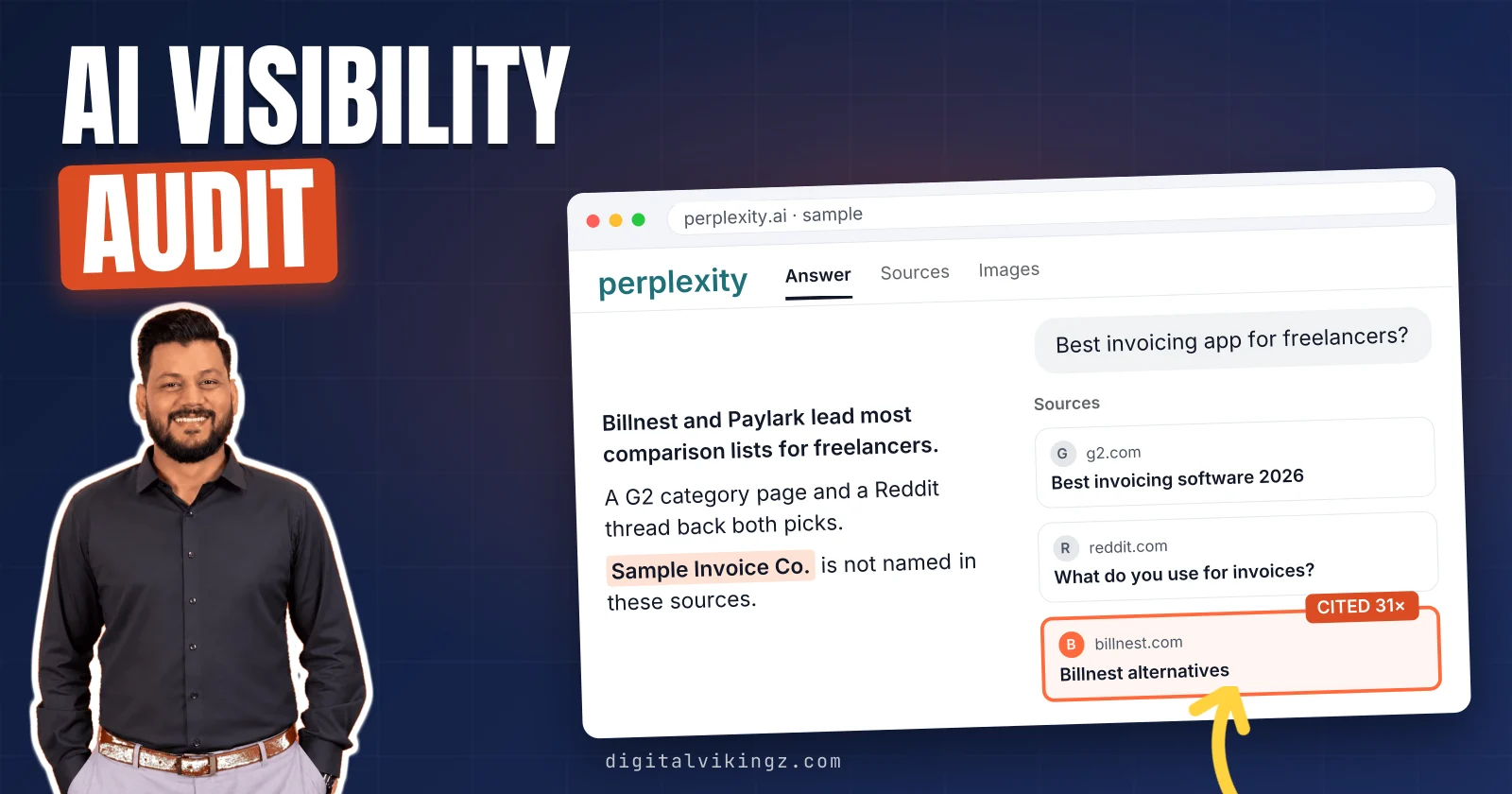
An AI visibility audit is an off-site diagnosis of the sources AI assistants cite for a buyer's prompts and the competitors those sources name. The audit runs eight checks, from a buyer-language prompt set to a directory and entity tracker, then hands over a 90-day plan.
A competitor baseline runs for at least two weeks before any engine is diagnosed, because AI answers change from run to run. Every cited source is sorted by type, and the gaps where at least two competitors appear without the brand are ranked into three tiers.
The 90 days run three streams, listing fixes, outreach and objection fixes, and end in a rerun with the same prompts, engines and competitors. The audit hands over working files instead of a single score, so every finding traces back to a prompt, an answer and a source.
What is an AI visibility audit?
An AI visibility audit is an off-site diagnosis of the sources AI assistants cite for a buyer's prompts and the competitors those sources name. The audit logs mentions, citations and descriptions per engine across ChatGPT, Gemini, Perplexity, Claude, Google AI Overviews and AI Mode.
Our method treats the audit as the off-site half of AI search visibility, built around the sources outside the brand's own site. Buyers also call the work a GEO audit, an AEO audit or an LLM visibility audit.
Each diagnosis ends in a 90-day plan and a rerun, so the findings turn into dated work. The audit goes further than a self-check, which stops at the answers themselves.
How is an AI visibility audit different from an AI visibility check?
An AI visibility check records what AI assistants say about one business, while the audit traces the answers to their sources. A check fits one owner with a spreadsheet and an afternoon. The prompts and the answer log from a check are the raw material the audit starts from.
The audit adds a competitor baseline, a citation map, source gaps, objections, a listing tracker and a 90-day plan. A first look needs no audit: start with the self-check of what ChatGPT and AI Overviews say about your business.
A second boundary separates the audit from on-site checks.
How is an AI visibility audit different from an on-site AI readiness check?
An on-site AI readiness check tests whether crawlers can read and quote the pages, while the off-site audit tests sources outside the site. Readiness checks cover crawler access, entity clarity, page structure and answer readiness, which the free AI Visibility Checker tests. Entity clarity includes the structured data that states page facts for machines.
Google states a page must be "indexed and eligible to be shown in Google Search with a snippet" to appear as a supporting link. Most GEO audit checklists in search results test AI citation readiness on the site itself.
The term has its own page: what AI citation readiness covers, page by page. The off-site audit runs in eight steps.
How do you run an AI visibility audit?
An AI visibility audit runs in eight steps, from a prompt set in the buyer's words to a tracker of directory and entity fixes. Steps 1 to 3 measure the brand's position; steps 4 to 6 explain why competitors are named; steps 7 and 8 list the fixes.
We collect every answer through each engine's API or a connected tracker. One collection method holds from baseline to rerun.
The eight steps of the audit are listed below:
- Build a prompt set from buying keywords in the buyer's words.
- Run a competitor baseline for at least two weeks.
- Diagnose each engine by where the brand is weak.
- Map every cited source by type.
- Read the pages AI cites for competitors.
- List the source gaps in three tiers.
- Trace each objection AI repeats to its source.
- Track directory and entity fixes.
The prompt set decides what every later step measures.
Step 1: Build a prompt set from buying keywords in the buyer's words
The prompt set turns the keywords that bring buyers into 20 to 50 prompts per engine in our method, phrased the way buyers ask an AI assistant. Enterprise brands with several clusters run 30 to 60 prompts per topic cluster, the range our enterprise framework sets.
The prompt types match the self-check, so the self-check's answer log carries straight into the audit with branded and non-branded results kept apart. We write prompts from the buyer's words, never from the brand's site copy, because prompts built from the site test the site against itself.
A med spa adds the town to each buying prompt, such as "best med spa for laser hair removal in Westbrook". Each prompt then runs against named competitors.
Step 2: Run a competitor baseline for at least two weeks
The competitor baseline in our method runs every prompt against three to five named competitors for at least two weeks before any conclusion is drawn. Each prompt in the audit runs several times per engine on different days. Every result is read as a share of runs, never as one answer.
Mention rate is the share of generative answers that name a brand in the answer text. Citation rate is the share of generative answers that link to a page on the brand's domain as a source.
The baseline keeps both numbers in separate columns, as the difference between mention rate and citation rate requires. Share of voice compares the brand's mentions with each competitor's mentions on the same prompts.
A two-week window evens out the run-to-run changes that make a single check unreliable. The collection method matters as much as the window.
Do API answers match what buyers see in the ChatGPT app?
API answers do not always match what a signed-in buyer sees in the ChatGPT app, so the audit never mixes the two. Signed-in answers can change with memory, location, account settings and the model in use. An API call carries none of those signals.
We query the engines through their APIs or a connected tracker and never script the consumer chat apps. The audit therefore compares API answers with API answers, from the baseline to the day-90 rerun.
Each engine is then read on its own.
Step 3: Diagnose each engine by where the brand is weak
Engine diagnosis reads the baseline one engine at a time, because a brand can be named in one assistant and absent from the next. The weakness pattern points to the next check, not to a proven cause.
The table below pairs each weakness pattern with the check our audit runs next and where the fix usually sits.
| Weak in | What the audit checks next | Where the fix usually sits |
|---|---|---|
| Google AI Overviews and AI Mode only | Whether the pages those answers cite rank in Google Search, and whether the brand's pages are indexed with a snippet | Rankings and indexing of the pages that answer the prompts |
| ChatGPT, Perplexity, Gemini or Claude, while Google AI features name the brand | Whether the pages those engines cite mention the brand, and whether OAI-SearchBot and PerplexityBot can read the site | Off-site sources (steps 4 to 6) and crawler access |
| One topic in every engine | Whether any page answers that group of prompts | A new page or section |
| Every engine and every topic | Whether the brand appears in any source the category's answers cite | Source gaps and listings (steps 6 and 8) |
| Named everywhere, described wrongly | Which sources state the wrong or negative claim | The objection log (step 7) |
OpenAI states that "Sites that are opted out of OAI-SearchBot will not be shown in ChatGPT search answers". No engine publishes the weight given to each source, so the table names checks rather than causes.
A brand that ranks in Google Search and is still not cited in ChatGPT or Perplexity is a common row 2 case. Absence despite strong rankings has a page of its own: a page that ranks in Google yet is not cited by AI.
Step 4 lists every source behind those answers.
Step 4: Map every cited source by type
The citation map lists every domain cited in the baseline, sorted by how many answers cite the domain and reclassified by source type. The map shows which sources shape the answers for each prompt group.
Google says AI Overviews and AI Mode may use a "query fan-out" technique, "issuing multiple related searches across subtopics and data sources". The AI visibility audit records the fan-out queries wherever the collection method exposes them. Each fan-out query names a sub-question the brand must answer somewhere.
We reclassify every cited domain by hand, because tracker labels mix review sites, publishers and forums into one bucket.
The seven source types in the citation map are listed below:
- Owned: the brand's own site, profiles and documentation.
- Competitor-owned: a competitor's site, comparison pages and alternatives pages.
- Directory or review: listings and review platforms such as Google Business Profile, Yelp or G2.
- Editorial: publishers, trade media and "best of" lists written by an editor.
- Community: forums, Reddit threads, Q&A sites and video comments.
- Ecosystem: partner, marketplace and integration pages.
- Analyst: research firms and industry reports.
Brand names, domains and numbers in the figures and tables below are samples, not client data.
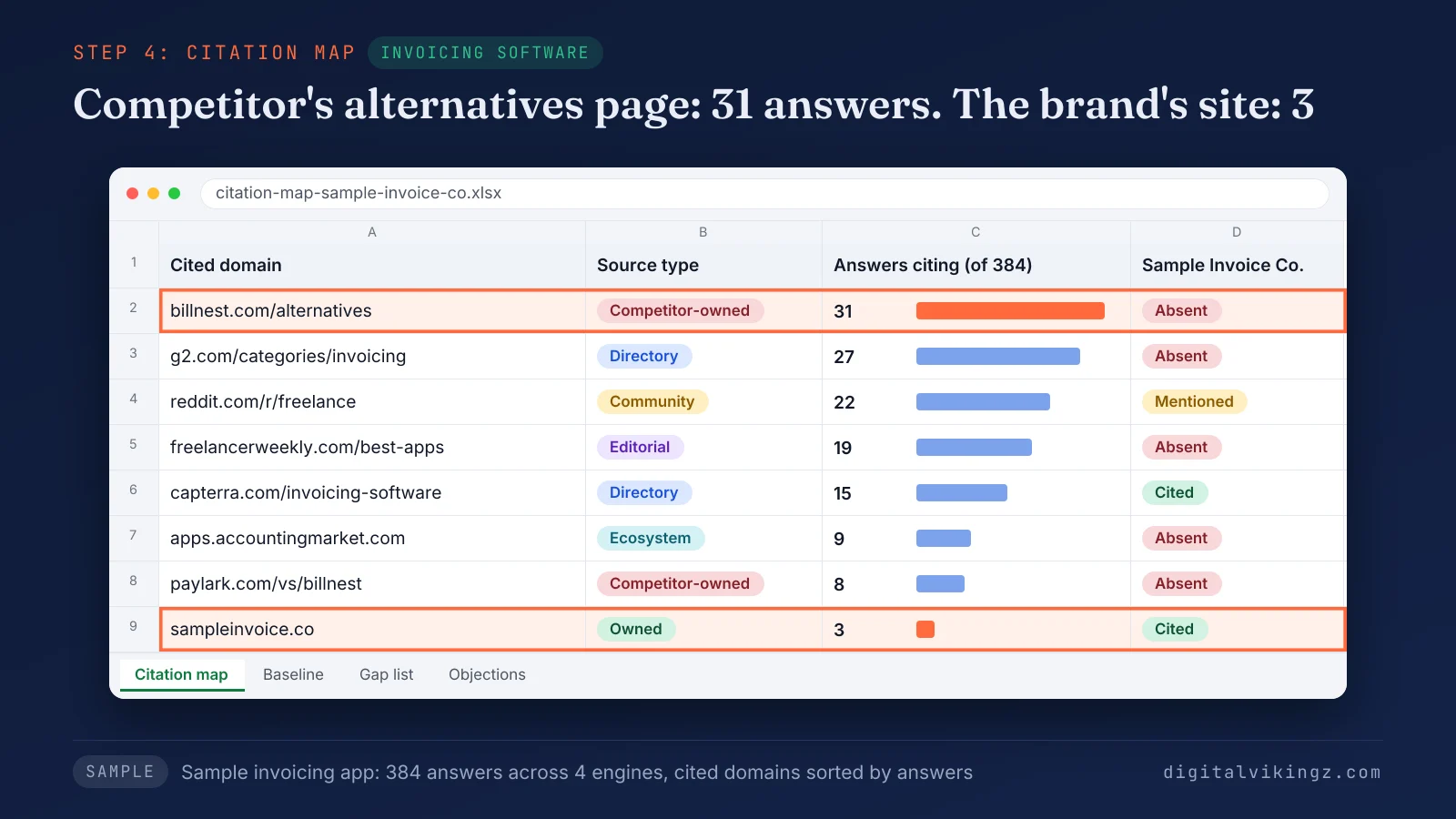
Figure 1 shows a sample invoicing app cited in 3 of 384 answers while one competitor's alternatives page is cited in 31. Competitor-owned rows lead to step 5.
Step 5: Read the pages AI cites for competitors
Reading the pages AI cites for competitors shows which formats, claims and comparisons the engines lean on when they name those competitors. A competitor whose own site is cited across many answers usually publishes comparison and alternatives pages that the engines read as category references.
Our audit then samples the most-cited URLs until every source type in the citation map has at least three examples.
The three facts recorded for each sampled URL are listed below:
- Format: listicle, comparison table, review, thread, profile or guide.
- Date: the publish or last-update date shown on the page.
- Brand presence: whether the brand appears, and how the page describes the brand.
The fair answer to a competitor's comparison page is a comparison page with a published method and the brand's own weak points. The question owners ask, why AI names a competitor and not them, usually has an answer in the sampled pages.
Pages that name competitors and leave the brand out form the gap list.
Step 6: List the source gaps in three tiers
The source-gap list in our method collects pages where at least two competitors appear and the brand does not, ranked by how often the engines cite them. Listicles, comparison pages, alternatives pages, profiles and discussion threads make up most off-site sources on the audit's gap list.
The three tiers in our source-gap list are listed below:
- Tier 1: cited in 10 percent or more of the tracked answers; outreach starts here.
- Tier 2: cited in 3 to under 10 percent of the tracked answers; outreach follows Tier 1.
- Tier 3: cited in under 3 percent of the tracked answers; kept for later or for content ideas.
Our tiers use shares of tracked answers instead of raw counts, so the cut-offs hold for a 20-prompt set and a 50-prompt set alike. Pages owned by a competitor or by a vendor that sells in the category are marked DO NOT PITCH and stay listed for context.
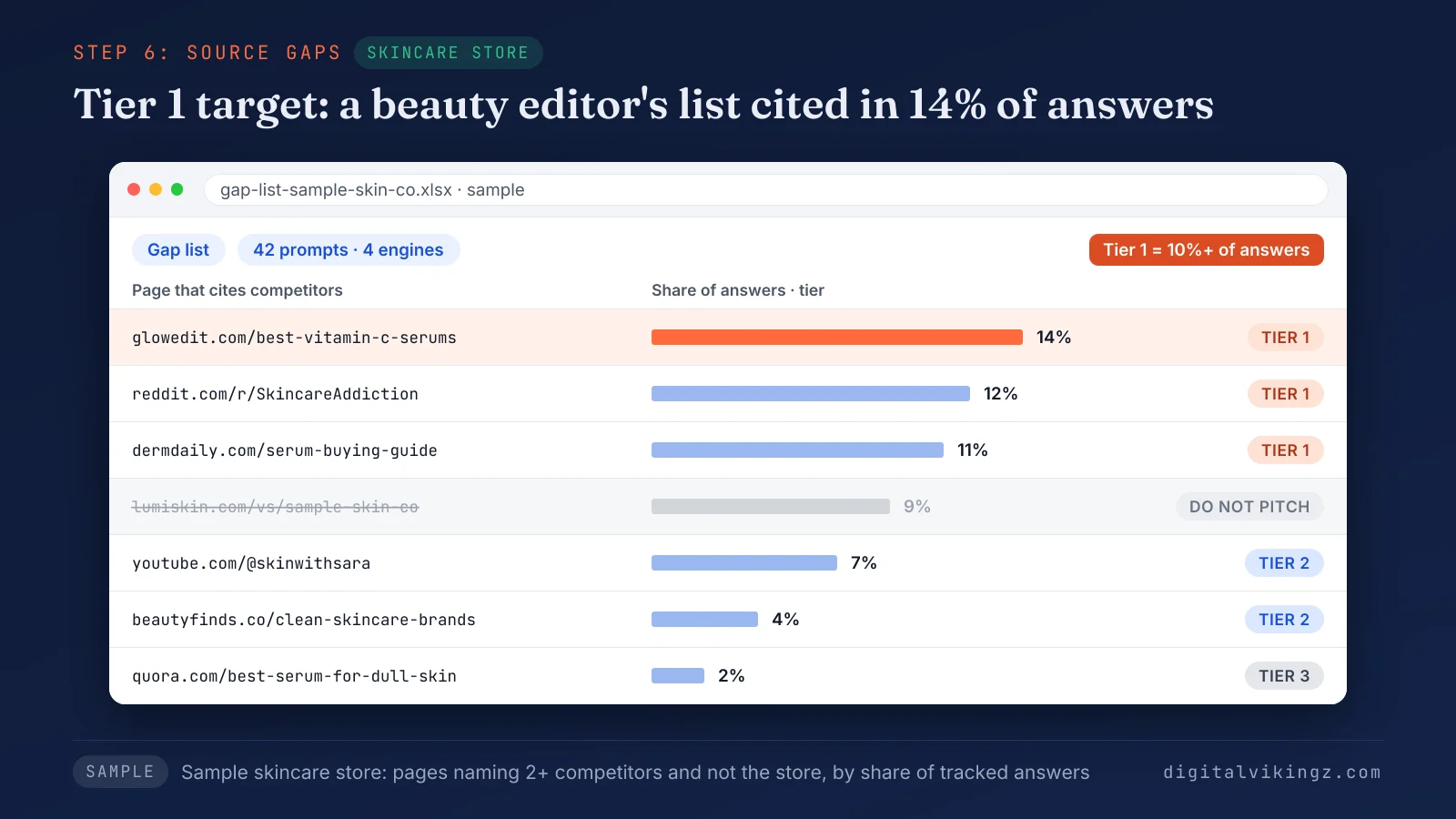
Figure 2 shows a sample skincare store missing from a beauty editor's list cited in 14 percent of answers, the store's first Tier 1 target. A Tier 1 mention counts even without a link, the point behind why brand mentions now beat backlinks.
Other pages name the brand and repeat an objection.
Step 7: Trace each objection AI repeats to its source
The objection log lists each wrong or negative claim AI repeats about the brand, the source page stating the claim and a status. Sentiment scores flag tone, while the audit's objection log names the claim and the source behind the claim.
The four objection statuses in the audit are listed below:
- OUT OF DATE: the source states an old fact; the fix is to correct or update that source.
- COMPETITOR FRAMING: a competitor's page sets the claim; the fix is a counter page in the format the citation map shows winning.
- ACCURATE: the claim is true today; the fix belongs to the product or service, and the brand answers the claim openly.
- UNVERIFIED: the claim is not confirmed yet; recent customer reviews and the owner decide the status.
We read recent customer reviews before marking an objection out of date, since live complaints mean the claim is still true.
The table below shows a sample objection log for a law firm, with one row per repeated claim.
| Claim AI repeats | Source page | Status | Next action |
|---|---|---|---|
| "Handles only family law" | An old legal directory profile | OUT OF DATE | Update the profile with the approved practice areas |
| "No office in Riverton" | A closed-office entry on a map directory | OUT OF DATE | Add the listing to the step 8 tracker |
| "Higher fees than Competitor A" | A competitor's comparison page | COMPETITOR FRAMING | Publish a fee comparison with a stated method |
| "Slow to return calls" | A review site thread | UNVERIFIED | Check the last 12 months of reviews with the owner |
Two of the four sample claims trace back to listings, which step 8 tracks.
Step 8: Track directory and entity fixes
The directory and entity tracker lists every listing that describes the brand, with one status per field: PRESENT, NOT APPEARING, DUPLICATE, CHECK or UNVERIFIED. Directory listings affect AI recommendations, because AI assistants read each listing as a source of business facts and reviews.
The AI visibility audit builds the tracker from the directories in the citation map. Industry directories and standard profiles join the tracker, such as Google Business Profile, Bing Places, Apple Business Connect, LinkedIn, G2 for software and Healthgrades for clinics. Any directory that lists competitors and not the brand gets a flag.
The fields recorded for each listing in the tracker are listed below:
- Name.
- Description.
- Category.
- Pricing wording.
- Review count.
- Rating.
- Last review date.
- Claimed status.
PRESENT means the listing exists and matches the approved facts; NOT APPEARING means competitors are listed and the brand is not. DUPLICATE marks a second listing for the same location, and CHECK marks a field that disagrees with the approved facts.
A field that is not confirmed is UNVERIFIED and is never guessed. A listing that claims a figure the brand never approved gets a row of its own. Every listing edit uses approved entity facts only and waits for the owner's sign-off.
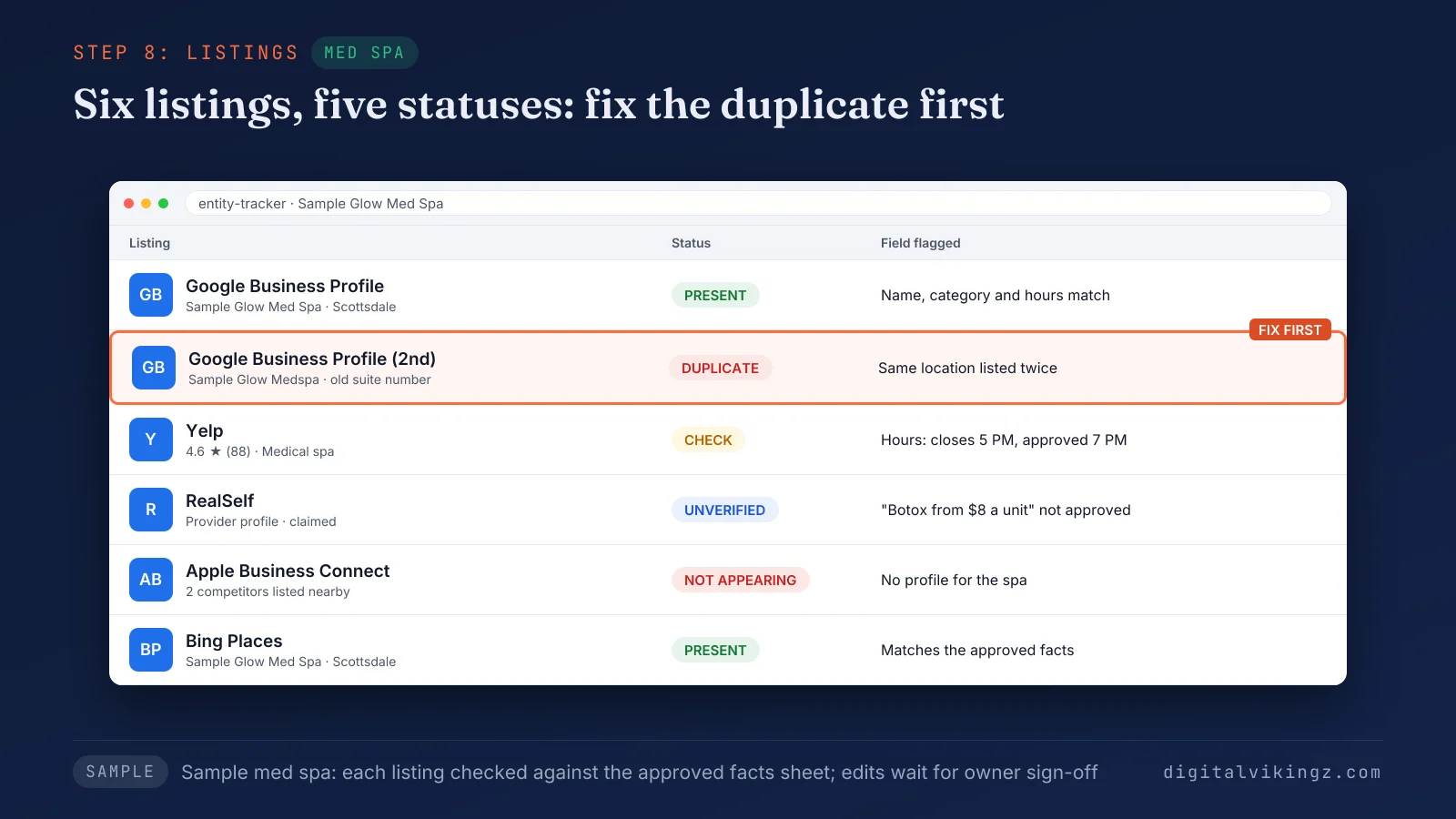
Figure 3 shows a sample med spa with one DUPLICATE listing, one NOT APPEARING profile, old hours under CHECK and an unapproved price claim marked UNVERIFIED. Local brands carry the most rows, as the sources AI assistants read to choose a local business show.
Eight steps of findings then become a set of working files.
What are the deliverables of an AI visibility audit?
The audit delivers nine working files, from the prompt set and the baseline by engine to the 90-day plan.
The nine files the audit hands over are listed below:
- Prompt set: 20 to 50 buyer prompts by type under our method, versioned.
- Baseline sheet: mentions, citations and share of voice by engine and competitor.
- Engine diagnosis: the weakness pattern per engine and the next check.
- Citation map: every cited domain by source type.
- Cited-page notes: format, date and brand presence per sampled URL.
- Source-gap list: tiers and DO NOT PITCH rows.
- Objection log: claims, sources and statuses.
- Directory and entity tracker: one status per field per listing.
- 90-day plan: three streams with owners and dates.
The day-90 rerun report is the tenth file, delivered when the plan ends. Figures 1 to 4 are samples of files 4, 6, 8 and 9.
None of the nine files is a single score.
Why does an AI visibility audit not end in a single score?
The audit does not end in a single score, because one number hides which prompt, engine and source produced each finding. Tools that score AI visibility use different prompts, engines and weights. One site can receive very different scores from different tools on the same day.
A single percentage hides what was measured, which is why our free checker counts passed checks instead of printing one score. The audit reports counts per engine and share of voice per competitor, each traced to the prompts behind the count.
An AI visibility tracker reruns a fixed prompt set on a schedule and counts mentions and citations. Our comparison of AI visibility tools by type and documented features shows how the five tracker types differ.
Counts per engine are what the 90 days try to move.
What happens in the 90 days after an AI visibility audit?
The 90 days after the audit run three streams: listing fixes, outreach to Tier 1 sources, and objection fixes at the source. The three streams start in the first week and run side by side. Files from steps 6 to 8 set the order inside each stream.
The three streams of the 90-day plan are listed below:
- Fix listings and entity facts: work the step 8 tracker in order, DUPLICATE first, then CHECK, then NOT APPEARING.
- Pitch Tier 1, then Tier 2 sources: give each editor or site owner a reason to include the brand, with approved facts only.
- Fix objections at the source: correct OUT OF DATE sources first, then publish counter pages for COMPETITOR FRAMING.
Every outreach email and every listing edit waits until the owner approves the exact text and the recipient. Engines that search the live web can pick up a corrected source within weeks, and the day-90 rerun shows whether the change held.
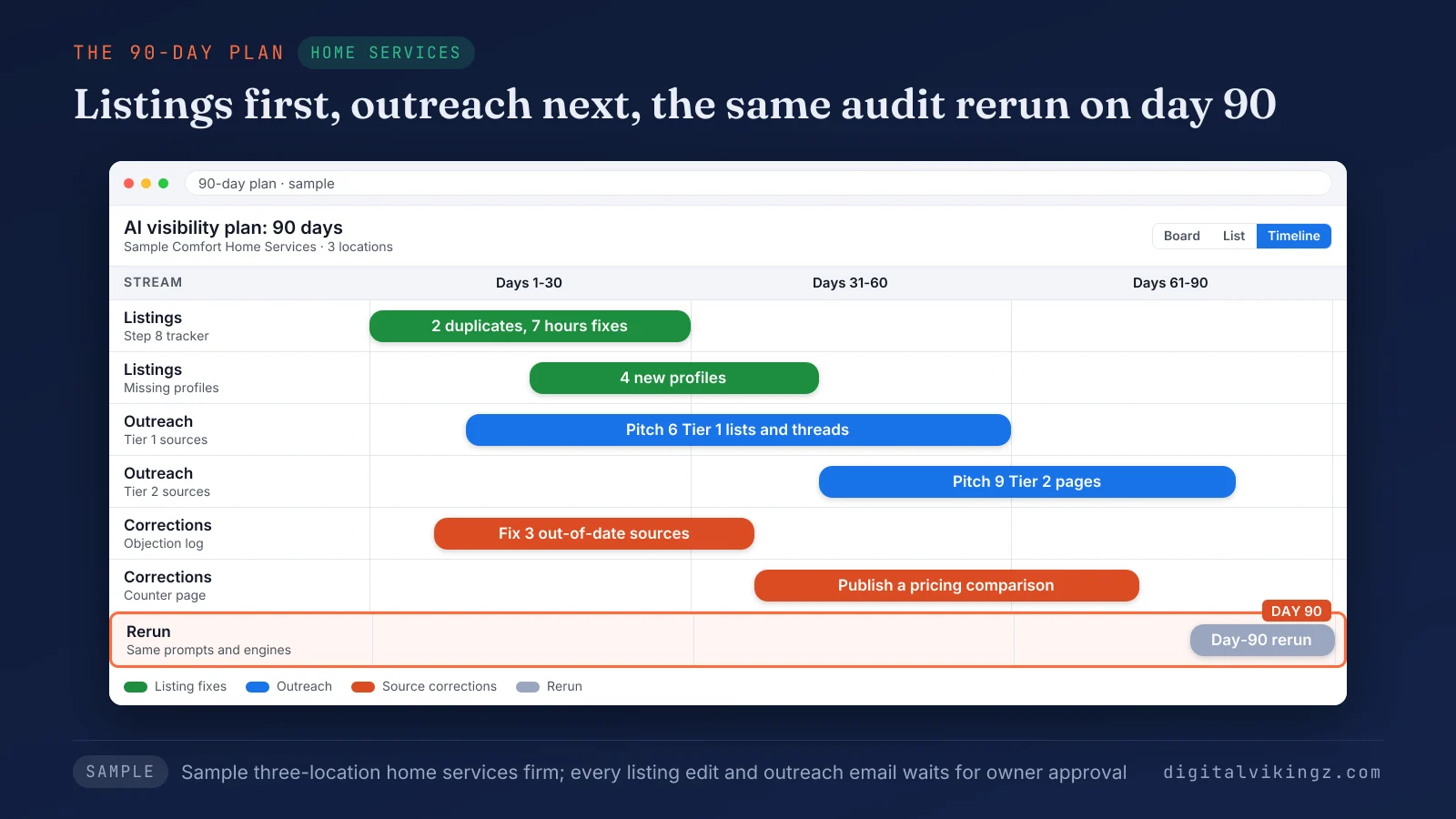
Figure 4 shows a sample three-location home services firm with listing fixes front-loaded in days 1 to 30 and the rerun on day 90. Day 90 closes the plan with a like-for-like rerun.
What does the day-90 rerun compare?
The day-90 rerun repeats the baseline with the same prompts, engines, competitors and collection window, then compares five numbers. Any change to the prompts, engines or competitors breaks the comparison with the audit baseline.
The five numbers the day-90 rerun compares are listed below:
- Non-branded visibility by engine: mention and citation shares on category, problem and comparison prompts.
- Share of voice: the brand against each named competitor.
- Directory status counts: PRESENT up, DUPLICATE and NOT APPEARING down.
- The headline objection: still repeated, softened or gone.
- AI referral traffic: sessions from ChatGPT, Perplexity and other assistants in GA4.
Referral sessions show only the floor of AI influence, because many AI answers end without a click. Who runs the 90 days is the next decision.
Should you run an AI visibility audit in-house or hire an agency?
An in-house team can run the audit from the eight steps, while an agency also carries the outreach and listing work. Our AI Search Visibility service reruns the same prompt set and adds the on-site passage work the audit does not cover.
The differences between an in-house audit and an agency audit are listed below:
- Access and time: an in-house team needs API access for each engine, a spreadsheet and two weeks of runs; an agency brings the collection setup.
- Category knowledge and method: an in-house team knows the category best; an agency brings a fixed method and templates for the nine files.
- Outreach and listings: an in-house team owns the relationships; an agency runs the pitches and edits after the owner approves each one.
No agency controls which sources an engine cites, so the audit shows the path to being named without promising the result. Small B2B prompt sets produce small counts, so a change of a few answers reads as a direction, not a percentage.
API collection can differ from what a signed-in buyer sees, as step 2 explains. In-house teams can follow steps 1 to 8 above and keep the self-check for spot checks between audits.
Brands that want the audit and the 90 days handled can book a strategy call for AI Search Visibility, starting with an off-site audit. Scope also sets the price.
How much does an AI visibility audit cost?
The audit has no fixed market price, because the cost follows the number of prompts, engines, competitors and listings in scope. Exact scope is quoted in writing after the strategy call.
The scope questions are how many offerings need a prompt set, how many engines and competitors, and how many locations or listings. Outreach is the last scope question, either included or left to the in-house team.
The on-site half costs nothing to check, because the AI Visibility Checker is free and shows the result without a sign-up. Business type changes the scope more than any other factor.
How does an AI visibility audit change for local businesses and online stores?
The audit changes most for local businesses and online stores, because both are named from data outside the website. Local businesses add the town to each category prompt and keep one tracker per location, since assistants can name closed branches.
Multi-location brands audit each location against local competitors, then roll the counts up to the brand. Service-area businesses with a hidden address use the towns they serve in prompts. The tracker checks that the service areas match on every listing.
Online stores keep two surfaces apart: cited pages in AI answers, and product results in ChatGPT shopping. Our ChatGPT shopping guide lists four routes for product data: Shopify Catalog, direct merchant feeds, third-party data providers and crawled web pages.
Store owners can see the product side in how Shopify products get recommended in ChatGPT shopping. The audit covers citations and mentions, and product data upkeep belongs to Shopify and WooCommerce SEO.
Software brands usually carry more review-platform and comparison-page rows, because category prompts ask for alternatives. Every business type reruns on the same rhythm.
How often should you rerun an AI visibility audit?
The audit should be rerun every 90 days in our method, the length of one plan. The prompt set is tracked monthly between full audits, the rhythm our AI Search Visibility service reports on.
The events that call for an early rerun are listed below:
- A new competitor: a rival starts appearing in answers.
- A name or offer change: a rebrand, merger or new service line.
- A new location: a branch opens, moves or closes.
- A sharp answer change: answers shift across engines after a model update.
Each rerun starts from the step 1 prompt set, versioned only when buyers change how they ask. Brands with several topic clusters keep one prompt set per cluster on the same cadence.
More questions about running an AI visibility audit
How long does an AI visibility audit take?
The audit takes at least two weeks, because the competitor baseline in our method runs for two weeks before any diagnosis. Steps 3 to 8 and the plan follow once the baseline closes.
Can an agency guarantee that ChatGPT will name a brand?
No agency can guarantee that ChatGPT will name a brand, because each AI system chooses its own sources. The audit shows which sources to win, and the rerun shows what moved.
Does an AI visibility audit replace a technical SEO audit?
No, the audit does not replace a technical SEO audit, because a site crawl never reads the sources outside the site. The technical audit still covers crawling and indexing, so the two audits run side by side.
Do you need a paid tracker for an AI visibility audit?
No, the audit does not need a paid tracker, because engine APIs and a spreadsheet can hold the baseline. A tracker saves time on repeat runs, and choosing one is a separate decision.
Does an AI visibility audit cover Google AI Mode?
Yes, the audit covers Google AI Mode, read separately from AI Overviews. Google says both may use query fan-out, so the two surfaces can cite different pages for one prompt.
How long does it take to improve AI visibility after an audit?
Improving AI visibility after an audit has no fixed timeline, so the plan runs 90 days and the rerun measures what moved. First changes can show sooner in engines that search the live web.
How many competitors does an AI visibility audit compare?
The audit compares the brand with three to five named competitors in our method, fixed at the start so the baseline and the rerun match. Every competitor runs through the same prompts and engines, so share of voice compares like with like.
Where should an AI visibility audit start?
The audit should start with 20 to 50 buyer prompts and the names of three to five competitors, the ranges our method uses. Run the free AI Visibility Checker for the on-site half first, so crawler access is never the hidden reason for an absence.
Digital Vikingz runs the eight steps and the 90 days as part of AI Search Visibility. Our guide to what AI SEO is and how to get cited by AI covers the wider discipline the audit belongs to.