 Digital Vikingz
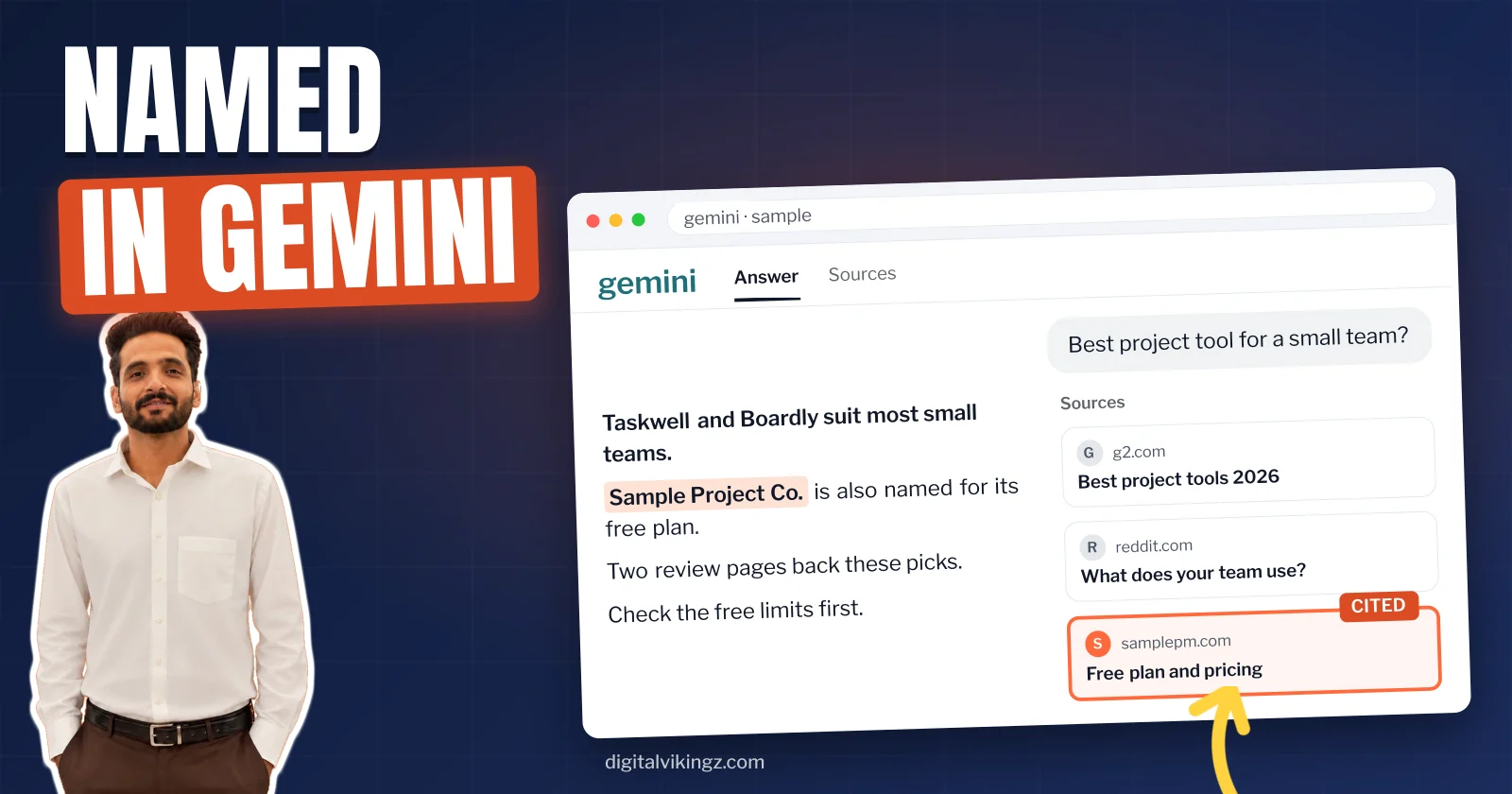
To rank in Gemini, Google's AI assistant, a brand has to be named in the answer or linked in the source list. Gemini picks its sources through grounding with Google Search, in which the model decides when to search and runs its own queries.
Profound reports that Reddit, YouTube and Wikipedia are the three domains Gemini cites most, from its May 2026 tracking. A brand is easy to name when its name, service and place read the same on every source. Run the same prompts each month and log the brands and sources.
What is Gemini in search?
Gemini is Google's AI assistant, and the Gemini app answers a question in text, often with a list of web sources. A user types a question, and the app writes an answer, then shows a Sources button when it has links. Simple. Gemini Apps Help describes that button.
Sample, not a measured result: a marketer asks Gemini for the best project tool for a ten-person agency and sees four tools named. That is the whole contest. The marketer opens those four vendors and skips the rest.
The app differs from Search features, Google publishes few rules for it, and one crawler token touches it.
The Gemini app compared with AI Overviews and AI Mode
The Gemini app is a chat assistant, while AI Overviews and AI Mode are answer features inside Google Search. Google said on 19 May 2026 that Gemini 3.5 Flash became the default model in AI Mode, so the Gemini name appears in Search.
The shared name confuses many owners, who read a Gemini mention in Search as proof that the app follows one rulebook. We keep the two apart.
A brand can appear in one surface and not the other, because the app and the Search features are separate surfaces. Our guide to how AI Overviews and AI Mode pick their sources covers those two features.
Does Google publish ranking rules for the Gemini app?
No, Google's guide for AI features in Search names AI Overviews and AI Mode, and the guide does not name the Gemini app. We read Google's guide for AI features on 22 November 2026, and the page shows no date.
The guide says a page needs to be indexed and eligible for a snippet, and nothing special beyond that. Google lists no special schema or AI text file as a requirement.
Nobody outside Google knows how the app weighs its sources, so every Gemini tactic is a reading of Google's search documents and of studies.
We have not run a controlled Gemini test of our own, and that is a fair place to start. Treat each tactic below as a reasoned bet, and check it in your own log.
Does Google-Extended affect Gemini answers?
Yes, Google says Google-Extended controls if crawled content may be used for Gemini training and for grounding in Gemini Apps. The Google-Extended entry in Google's crawler documentation is the one control Google publishes for the app.
Google adds that the token does not affect a site's inclusion in Google Search and is not a ranking signal there.
Blocking the token is a decision about Gemini, so make it on purpose and write down the date. A dated note tells you later what changed.
What is Gemini SEO?
Gemini SEO is the work of getting a brand named in Gemini's answers and cited in its source list. No ranked list of pages appears in a Gemini answer, so ranking in Gemini means appearing in those two places.
The wider work is AI SEO, and Gemini SEO is one part of it, next to the work for each other engine.
Sample, not a measured result: Gemini names a project tool in the answer, and no page from that tool sits in the source list. The word rank misleads here. Appearing is the better aim.
Named in the answer versus cited in the source list
A brand is named when the answer text mentions it, and cited when the source list links one of its pages. A brand can be named without a link, and a page can be linked without the brand name appearing.
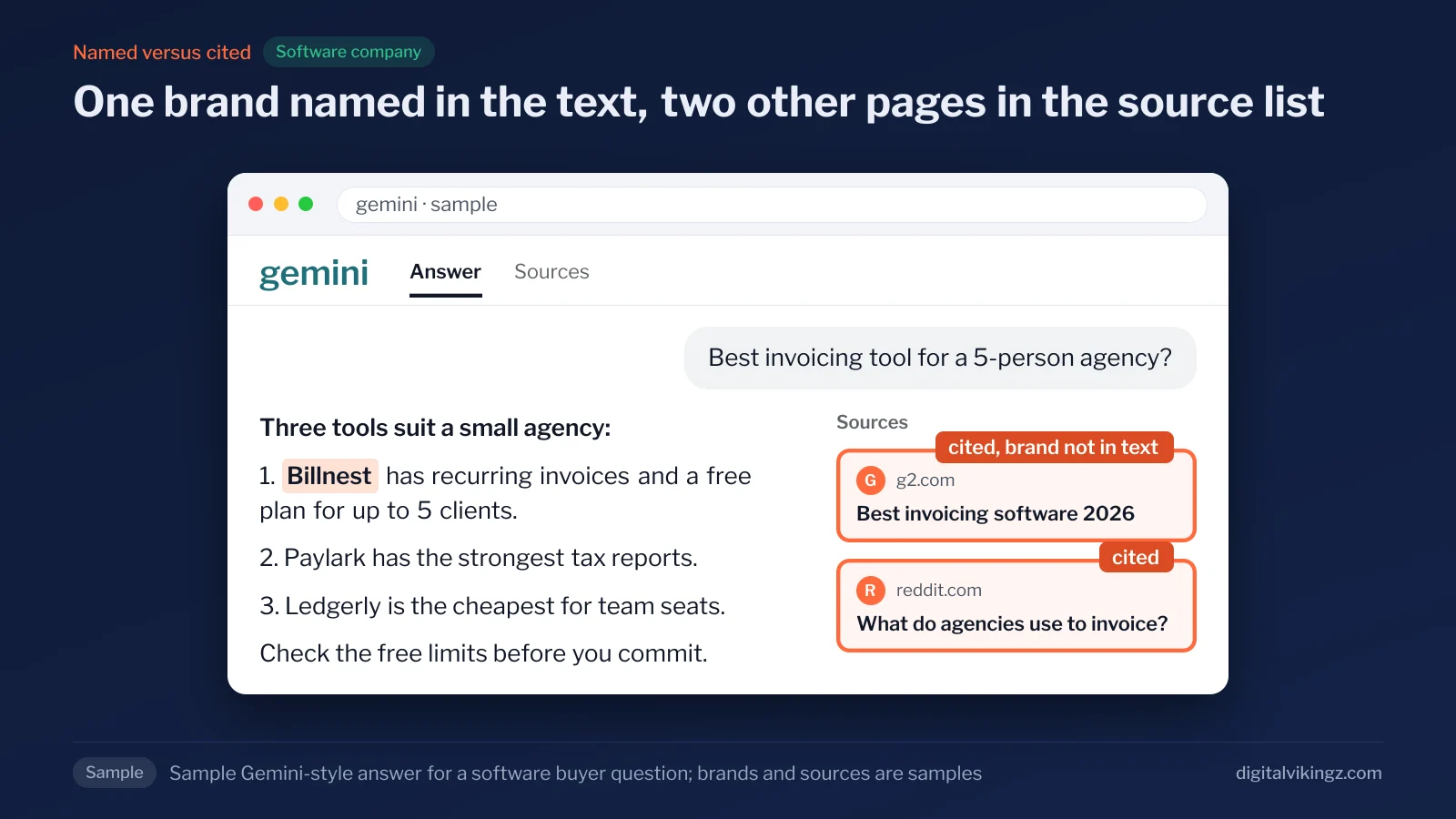
In the sample, a software brand sits in the answer text, and a review site and a forum thread fill the source list. Where the source list comes from decides which pages can be cited.
How does Gemini choose its sources?
Gemini picks sources through grounding with Google Search, in which the model decides when to search and runs its own queries. Google documents that process for the Gemini API, and Google has not published the same steps for the Gemini app. The Gemini API documentation lays out the steps.
We use the API steps as a model of the app, not as a rule for it. One question can lead to more than one Google search, so a page can be retrieved for a query the user never typed.
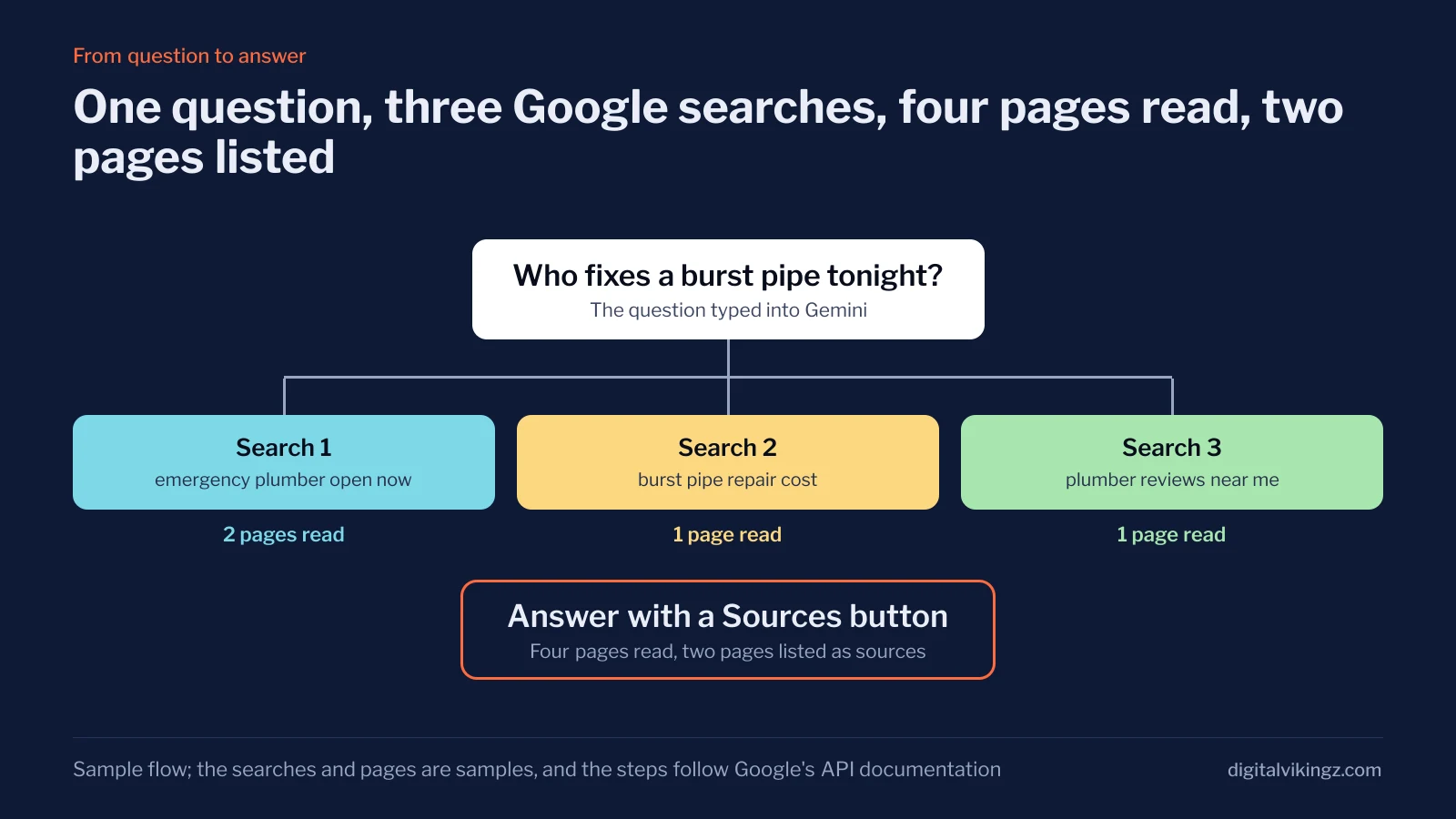
In the sample, three searches pull in four pages, and two of those pages reach the source list. Google describes the model as the one that decides when to search, so it may search once, several times or not at all.
Some questions get an answer from the model's own memory, with no search at all.
Sources come from Google's index, some answers list none, and the lists are short.
Does Gemini use Google's index?
Yes, Google's grounding documentation describes the web results as coming from Google Search. Indexing is therefore the first check, since Google's guide for AI features asks for indexed pages. Check it first.
A page missing from Google's index is unlikely to reach that pool. The URL Inspection tool in Google Search Console shows whether a page is indexed.
Our guide to how AI search engines decide who to cite covers crawl access across every engine.
Does every Gemini answer show sources?
No, Google's Gemini Apps Help says a response without a Sources button carries no links. When the Sources button is missing, the answer has no page to win, so mark it in the log.
Suppose a plumber runs ten prompts and finds three answers with no button (a sample, not a measured result). Those three runs tell you nothing about pages. Count them apart.
Sources and brands in a typical Gemini answer
Profound reports that Gemini cites 6.6 sources and names about 4.4 brands in an average answer, from tracking in May 2026. Profound tracked 15,155 brand setups across Gemini, AI Overviews and AI Mode.
The same report puts AI Mode at 15.2 sources per answer. We read that as fewer chances per answer, not as a rule for any one prompt.
The report is one vendor's count, and we found no Google figure for the app. A short list means every slot counts.
Which source types does Gemini lean on?
Profound reports that Reddit, YouTube and Wikipedia are the three domains Gemini cites most, from its May 2026 tracking. These are outside reads on a brand, not the brand's own claims. Gemini may treat threads and videos from other people as a second opinion.
We read that as a reason to treat video and reference pages as part of the work, not a side task.
Sample, not a measured result: take a Denver roofer who sees three rivals named and finds that each rival has review threads and videos.
Does Gemini cite a brand's own website?
Yes, Google's Gemini Apps Help says a response that quotes a large passage from a page adds that page to its source list. The Gemini Apps Help page on related sources gives the wording.
That puts the weight on passages that stand alone, with the fact and the brand in the same sentence. A vague page gives Gemini nothing to quote.
Picture two sample sentences on a plumber's page. One says the team is passionate about pipes, and the other says the business repairs burst pipes in Austin, a fact with a service and a place. Only the second gives Gemini something to quote.
Entity signals that make a brand easy for Gemini to name
A brand is easy for Gemini to name when its name, service and place read the same on every source. Google's guide for AI features says structured data must match the visible text on the page.
The checks we recommend for a brand's name are listed below:
- Brand name: one spelling on the site, the Business Profile and every social profile.
- Business description: one sentence on what the business does and where, worded the same on the About page and the profile.
- Author or owner: a named person on the pages that carry advice, linked to one profile page.
- Organization markup: a name and sameAs links that match those profiles.
A business written two ways gives any matching system two candidates instead of one. Our article on why most SEO audits miss the entity layer covers the same ground.
Sample: a dental practice that writes its name two ways, once on the site and once on the profile. A matching system sees two candidates, and it may name neither.
Our guide on how to get a Knowledge Panel for a business covers one visible sign of that match.
Page changes that make a passage easy for Gemini to quote
Start each section with one sentence that answers the heading and makes sense when quoted alone. The page changes we recommend are listed below:
- Answer-first passages: one sentence under each heading that gives the answer with the brand or topic named.
- One fact per sentence: each sentence carries one entity, one attribute and one value.
- Dated facts: a visible date next to every figure, updated when the figure changes.
- Text in the HTML: the main copy loads without JavaScript, so any crawler can read it.
- Video on the brand channel: a YouTube video for the questions buyers ask, titled with the same brand and topic names.
The AI citation readiness test for a verifiable passage applies here as well.
Sample, not a measured result: for example, a pricing page that opens with a dated price range gives Gemini a passage to quote. A slogan gives it nothing.
Our guide to content pruning covers when to refresh, consolidate or remove an old page.
Why does Gemini name a competitor for a local search?
Gemini is likely to name local businesses whose profile, reviews and website agree on the service and the place. AI assistants match each candidate to one business across web, maps and listing sources before they name it.
Our guide on how AI assistants choose a local business to recommend lays out the five steps.
Nobody outside Google knows how Gemini weighs reviews against the website. Sample: an Austin plumber asks Gemini for the best emergency plumber near me, sees three rivals named and does not find the plumber's own business.
The named rivals may take the calls, and that gap is the one to close.
Our guide on local SEO versus organic SEO sets out the difference between the two.
Does a Google Business Profile affect what Gemini names?
Google's guide for AI features says Business Profile data should stay current, and the guide does not name the Gemini app. Keep the name, categories, hours and services on the profile identical to the website.
Google names the Business Profile as local data to keep current, and Merchant Center data sits beside it. Photos are part of a complete profile, and our guide covers Google Business Profile photos.
A local SEO audit compares the profile with the website in one pass.
What research says about how stable Gemini answers are
A 2026 arXiv study found that cited sources in AI answers overlap by only 34 to 42 percent between consecutive days. The paper, Don't Measure Once: Measuring Visibility in AI Search (GEO), is an arXiv preprint by Julius Schulte and two co-authors, submitted 8 April 2026.
The study ran four campaigns of eight prompts on ChatGPT, Gemini, Google AI Mode and Perplexity. The range covers four engines, so it is not a Gemini-only figure.
Gemini had 22 to 26 collection days per campaign, against 38 to 44 for the other engines. The authors conclude that one-off checks mislead and that visibility is a distribution, not a single point.
Our AI Search Visibility service reruns a fixed prompt set every month for that reason.
Two limits follow, and both matter for any brand that wants proof: citation rates moved in 2026, and Search Console does not report Gemini. A brand cannot fix one answer. It can fix its name, its pages and its log.
Sample, not a measured result: a prompt run on Monday names five brands, the same prompt on Friday names four, and neither run is wrong.
Did Gemini change how often it cites sources in 2026?
Yes, Seer Interactive reported in April 2026 that Gemini's citation rate fell from 99 percent in February to 76 percent in March. Seer Interactive published the data on 13 April 2026, written by Nick Haigler.
The data covers 82,000 responses for 20 brands, tracked since November 2025. The drop came between 16 February and 2 March, Seer reports.
Prompts that ask for the best or top options moved most, Seer reports. A log that marks no-source answers keeps a citation drop apart from a ranking drop.
Treat 99 and 76 as one vendor's snapshot of 20 brands. They do not describe your category.
Can Search Console show Gemini traffic?
No, Google's Search Console generative AI report covers AI Overviews, AI Mode and Discover, not the Gemini app. Google announced the report on 3 June 2026 on the Search Central blog, and it counts impressions only.
Gemini visits arrive in analytics as referral traffic under the assistant's source name, as our guide to the Google Search Console generative AI report notes. Google's help pages name Gemini as a source of the GA4 AI Assistant channel.
So measure it elsewhere. Our guide shows how to track ChatGPT, Perplexity and Gemini traffic in GA4.
What not to chase in Gemini
Four things are not worth chasing in Gemini: a rank number, a guaranteed spot, hidden text and schema as a promise. The four things to leave alone are listed below:
- A rank number: Gemini shows no position for a page, so a tool that reports a Gemini rank reports one run of one prompt.
- A guaranteed spot: no agency controls the answer, and we do not promise a spot in Gemini.
- Hidden text and prompt injection: Google's spam policies list hidden text as abuse, and we do not use it to steer AI answers.
- Schema as a promise: Google says AI features need no special schema, and structured data must match the visible text.
Our guide on schema markup and AI citations covers what markup does and does not do.
Each of these sells certainty, and Gemini offers none.
Sample: an email pitch promising page one of Gemini in 30 days promises something no one outside Google controls.
How to test and track Gemini every month
Run the same prompts in Gemini each month, log the brands it names and the sources it lists, and compare the logs. A single check says little, because answers change from one day to the next. Keep the prompts boring. A fixed list beats a clever one, because only a fixed list lets you compare one month with the next.
The steps of a monthly Gemini check are listed below:
- Write ten fixed prompts: three about the brand, three about the category, two with a place and two that state the problem.
- Open a fresh chat for each run, and keep the same account and place.
- Run each prompt three times.
- Log the brands named, the sources listed, and any appearance of the brand or its pages.
- Mark each answer that has no Sources button.
- Repeat on the same day each month, and compare the share of runs, not single runs.
The monthly log uses the eight columns below, shown with one sample row:
| Date | Prompt | Run | Brands named | Sources listed | Brand named | Page cited | Sources button |
|---|---|---|---|---|---|---|---|
| 2026-12-01 | best emergency plumber near me (sample prompt) | 2 | three brands | two URLs | no | no | yes |
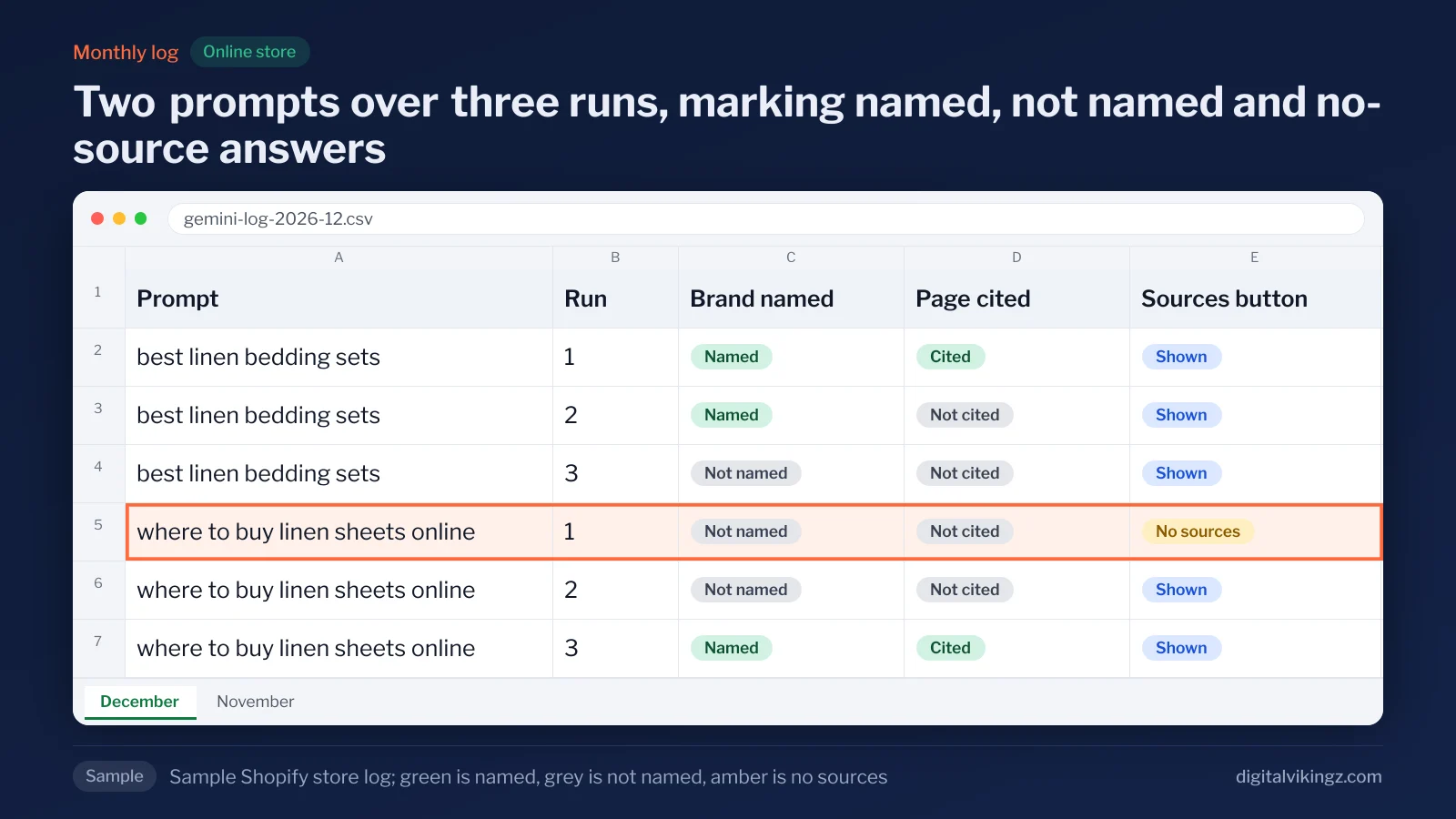
The sample log marks named runs in green, misses in grey and no-source answers in amber. A brand named in two of three runs holds a different position than one named in one of three.
Our guide on how to check what ChatGPT and AI Overviews say about a business uses the same repeat runs. The free AI Visibility Checker reviews crawler access and page structure, the site side of this work.
Questions about ranking in Gemini
Is Gemini SEO different from traditional SEO?
Partly, indexing and clear pages still come first, and the goal moves from a position to being named and cited. Our guide to how AI SEO differs from traditional SEO covers the wider difference.
Why does my brand appear in AI Overviews but not in Gemini?
Profound reports that only about a third of companies named on one Google AI surface appear on the others. The surfaces differ, so check each one on its own.
How long does it take to show up in Gemini?
Nobody outside Google knows, and published ranges from vendors conflict, from a few weeks to several months. A monthly log shows movement, and a single check does not.
Does Gemini name the same brands every time?
No, an arXiv study found brand sets overlap by 45 to 59 percent between consecutive days, across four engines.
Should a business hire an agency for Gemini SEO?
A business can hire one to run the monthly log, and no agency can promise a spot in Gemini.
Is Gemini SEO different from Perplexity SEO and ChatGPT SEO?
Yes, each engine has its own sources and controls, so we keep one guide per engine. Read Perplexity SEO for the second engine page, and ChatGPT has its own guide on the site.
Where to start with Gemini this week
Write the ten prompts, run each once today, and note which brands Gemini names and which sources it lists. Ranking in Gemini means being named in its answers, and the monthly log shows a brand when that happens.
Digital Vikingz runs the monthly Gemini check inside AI Search Visibility, and the report shows each month against the last. Start with the free AI Visibility Checker if the site side needs a look first.
Book a strategy call and we will set the prompt set for your category.