 Digital Vikingz
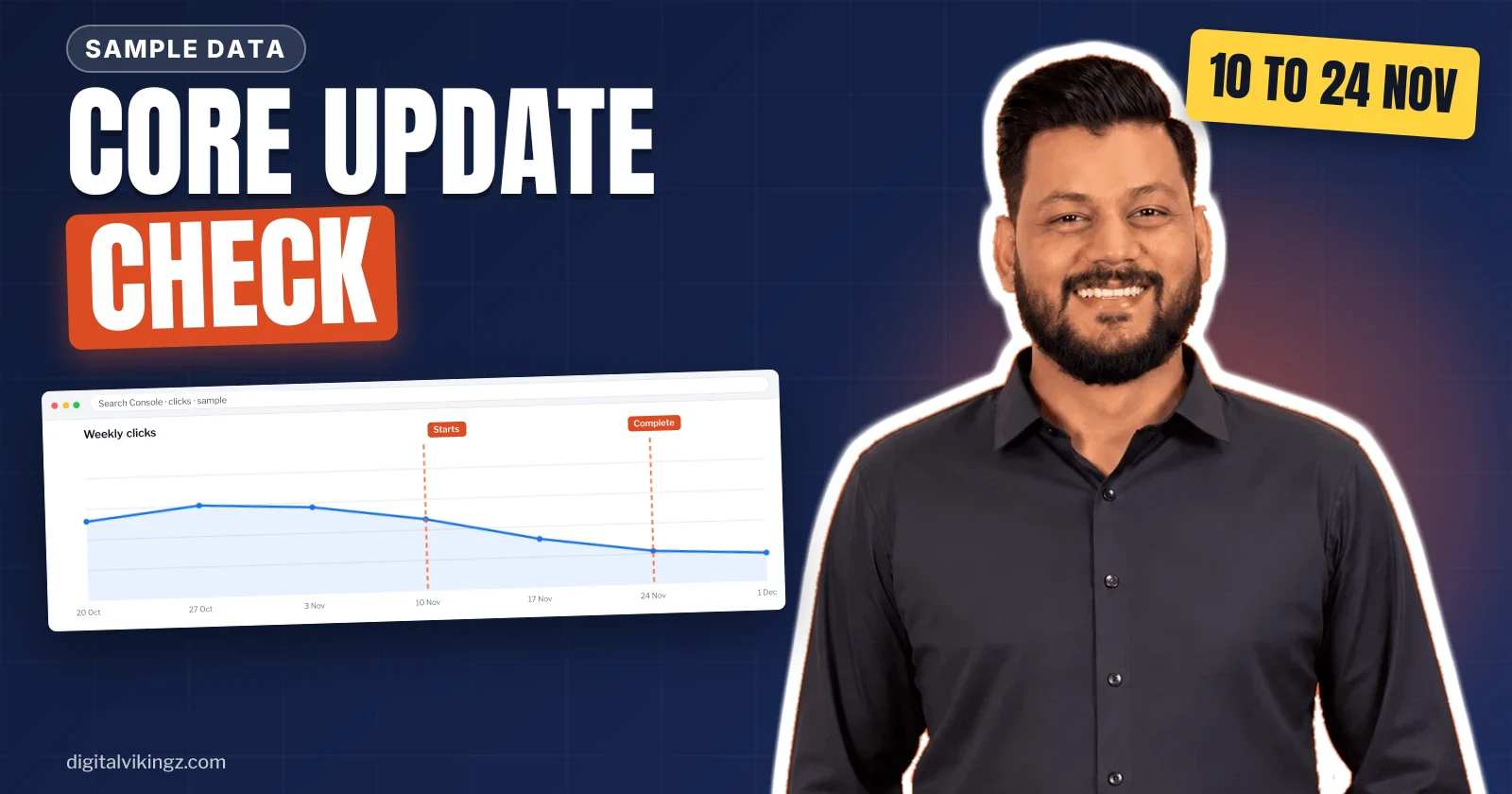
Your clicks fell sometime in November and someone on the team wants to rewrite half the site. Hold that for an hour. The November 2026 core update finished on 24 November, and several other things moved Search Console numbers in the same weeks.
This guide gives you the dates, the two weeks to compare and a check you can run yourself. It also says what to leave alone, because Google has already announced a December 2026 core update. Start with the dates.
When did the November 2026 core update start and end?
The November 2026 core update started on 10 November 2026 and was complete on 24 November 2026. The Google Search Status Dashboard logs the start at 18:06 UTC on 10 November and lists the duration as 13 days, 20 hours.
Google's start notice said the update "applies globally and to all languages" and that the rollout "may take up to 2 weeks". The closing line reads: "The rollout was complete as of November 24, 2026."
One more entry matters. On 24 November, an hour after that closing line, Google pre-announced the December 2026 core update. The dashboard says it "is scheduled to be released in December 2026" and gives no start date.
Google named no target for the November update. Nobody outside Google can tell you which pages it was "about". We will not guess.
Other changes in the same weeks
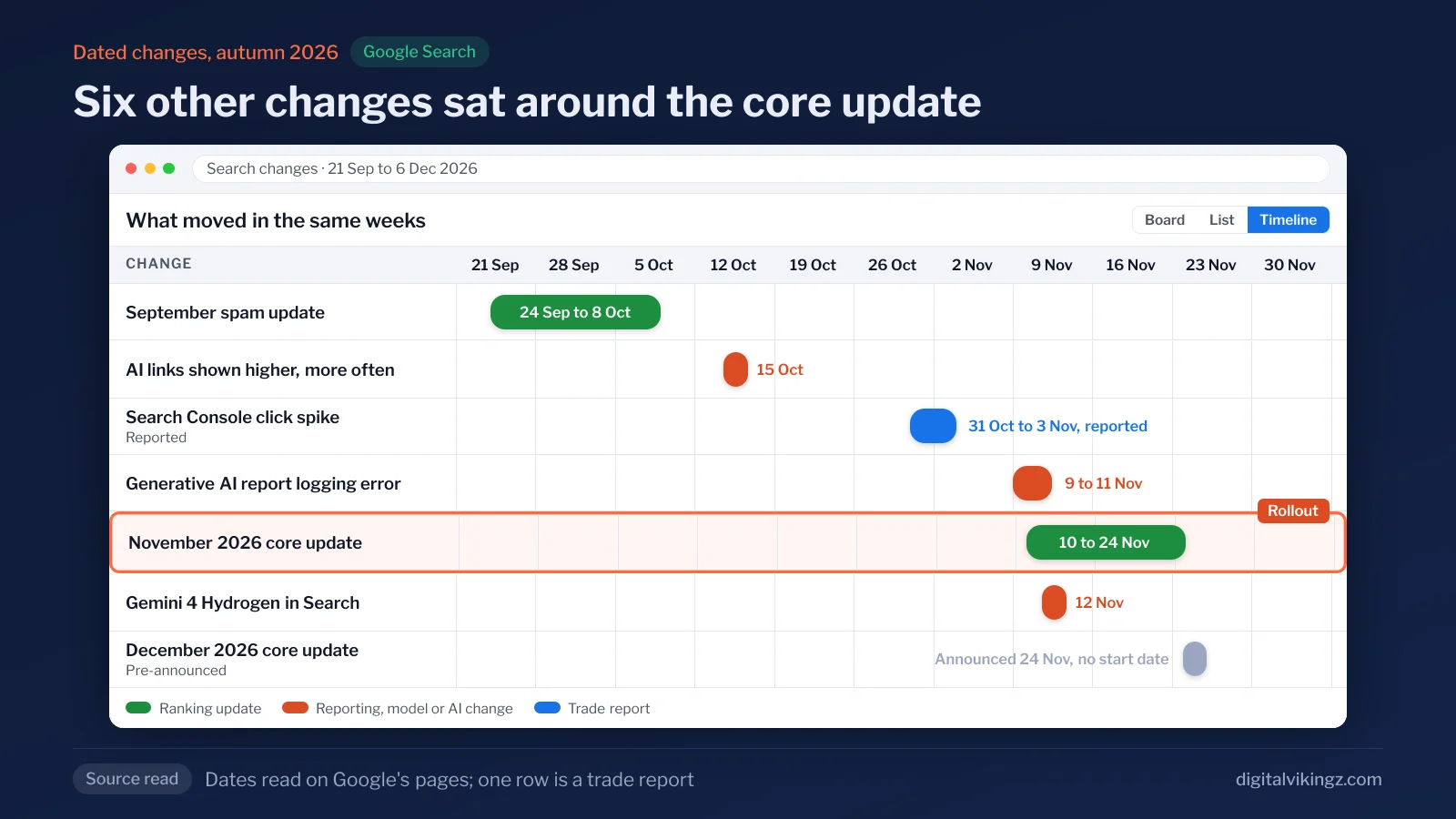
The November 2026 core update shared its weeks with a spam update, a reporting error, a click spike and a new AI model. Any one of them can bend your graph.
| Date (2026) | What happened | Source | Label |
|---|---|---|---|
| 24 Sep to 8 Oct | September 2026 spam update | Status Dashboard | Documented |
| 1 Oct | Google updated its guidance on using generative AI content | Search Central updates log | Documented |
| 15 Oct | Google said AI Mode and AI Overviews will show inline links higher up more often | Google's post | Documented |
| 31 Oct to 3 Nov | Search Console clicks spiked on some sites for a few days while impressions stayed flat | Search Engine Roundtable | Reported |
| 9 to 11 Nov | Logging error lowered impressions in the Generative AI performance report | Google's Data anomalies page | Documented |
| 10 Nov | November 2026 core update starts | Status Dashboard | Documented |
| 12 Nov | Gemini 4 Hydrogen "now available globally in Google Search" | Google's Hydrogen post | Documented |
| 24 Nov | Rollout complete; December 2026 core update pre-announced | Status Dashboard | Documented |
The Data anomalies page says the 9 to 11 November issue "affects data logging only". A dip in that report on those days says nothing about your rankings. Our guide to the Generative AI performance report shows where that report sits.
Hydrogen is harder. Google calls it "the biggest model upgrade to Search yet", with better "query fan-out and linking". Google does not say it is part of the core update, so keep the two apart in your notes.
The two date windows to compare
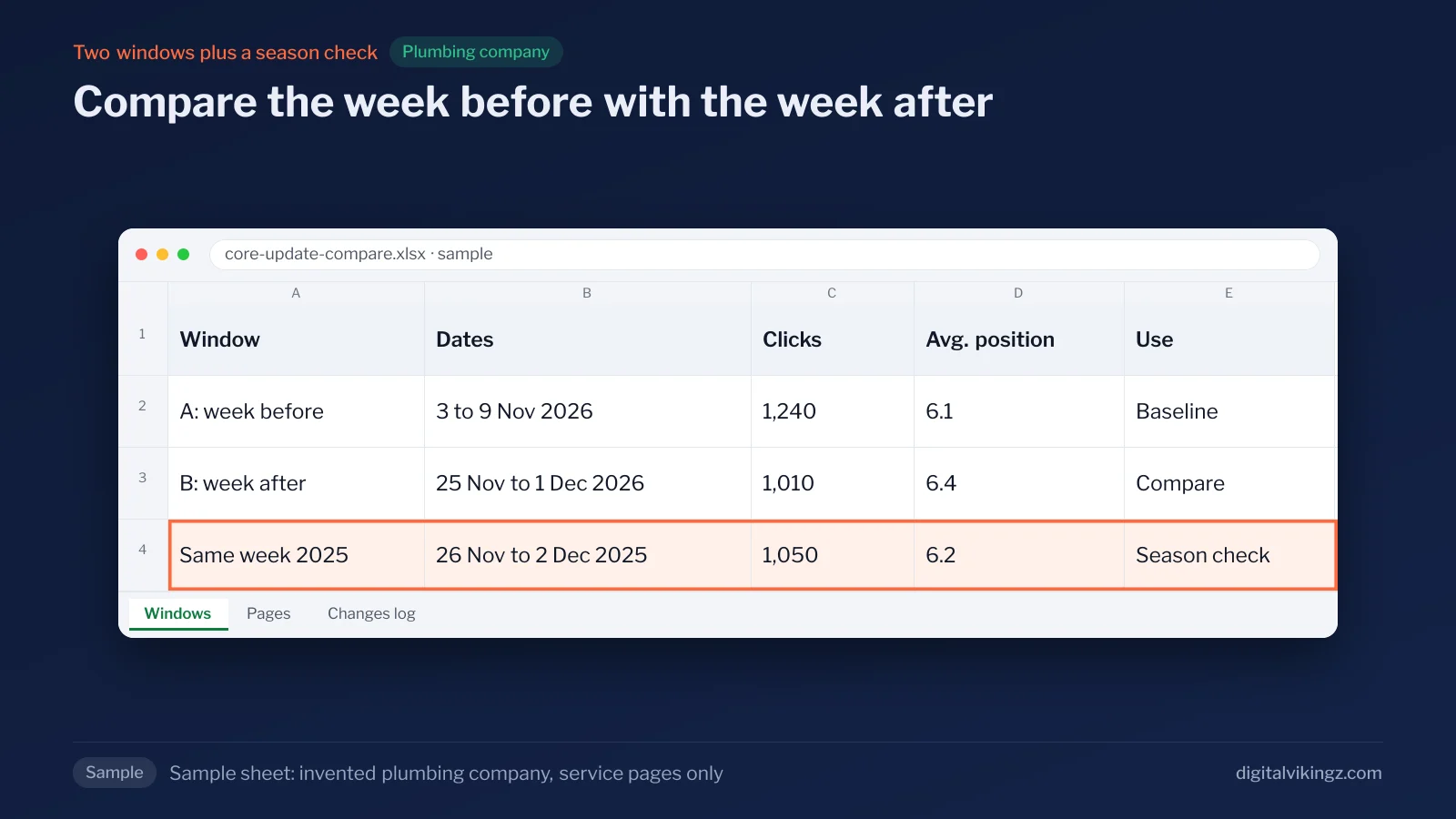
Compare 3 to 9 November 2026 with 25 November to 1 December 2026. Google's core updates page advises "waiting at least a full week after a core update completes". It then compares that week "with a week before the core update started rolling out".
The week before 10 November is 3 to 9 November. The first full week after 24 November ends on 1 December, so your earliest clean read is about 1 December. Google's newer page on staying informed repeats the rule: "plus at least a week of post-rollout data".
There is a catch this year. Keywords Everywhere points out that Thanksgiving, Black Friday and Cyber Monday fall in that after week. Picture an online store's category pages on Black Friday: clicks may jump whatever the update did.
So add a third column. Put the same calendar week of 2025 beside the other two. Google's guide to debugging traffic drops suggests the 16-month view for exactly this kind of seasonal check.
How do you check it in Search Console in an hour?
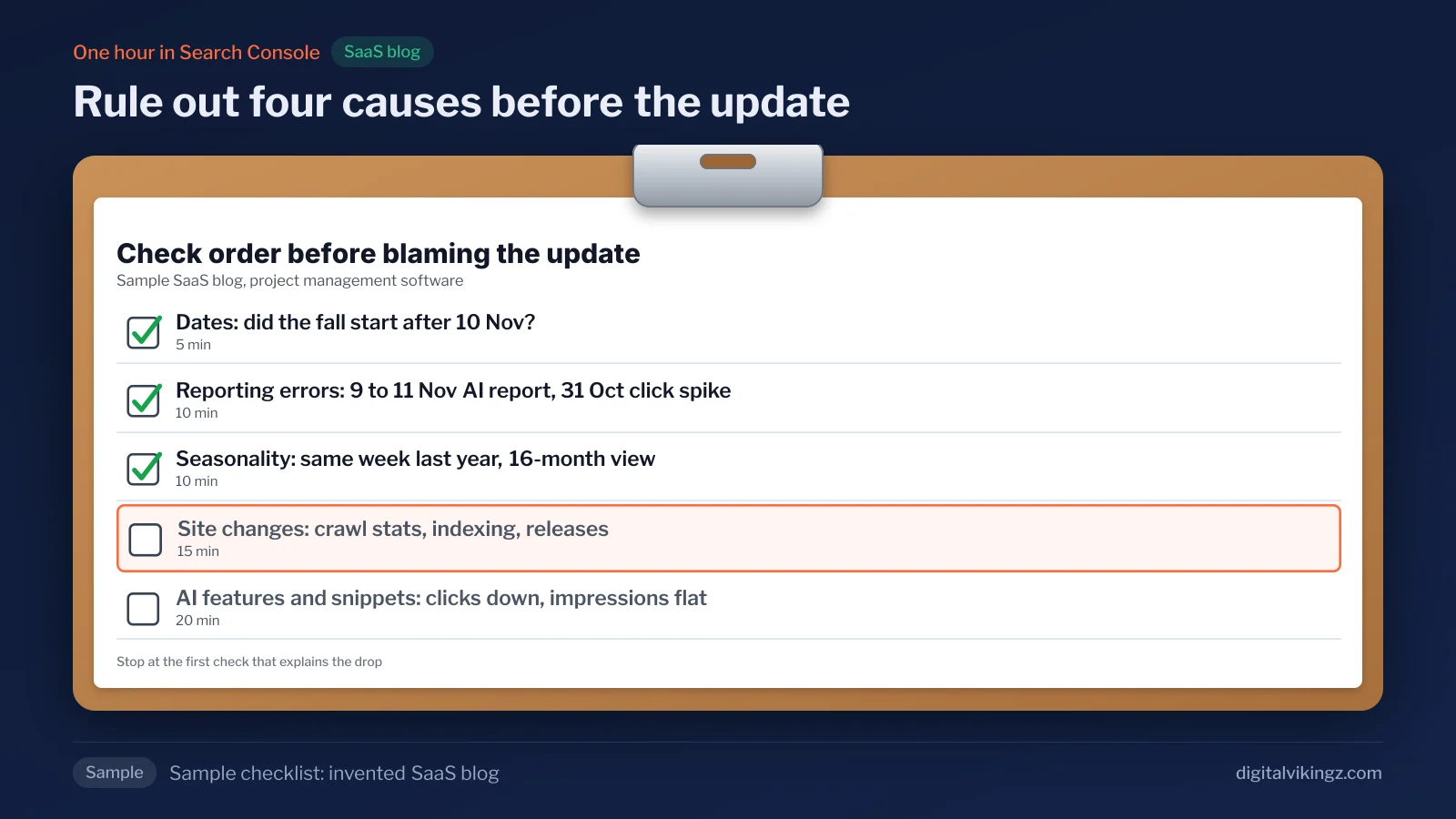
You check the November 2026 core update in Search Console with five checks: one on the dates and four on other causes. Run them in this order, because each one is faster than the next.
- Dates (5 minutes). Mark 10 and 24 November on the Performance chart. A fall that starts before 10 November did not start with this update.
- Reporting errors (10 minutes). Open the Data anomalies page. Ignore the 9 to 11 November dip in the Generative AI report. Treat a click spike from 31 October to 3 November as a bad baseline, especially when site visits never showed it.
- Seasonality (10 minutes). Switch to 16 months. If last November fell the same way, the season explains most of it.
- Site changes (15 minutes). Check Crawl stats, Page indexing, Security issues and Manual actions. Then ask who shipped what. Changes such as a theme release, a migration or a new redirect land on a date too.
- AI features and snippets (20 minutes). Use the Compare tab and sort pages by Clicks difference. Google's debugging guide says flat impressions with falling clicks point to titles, snippets or competing results.
Split by search type while you are there. Google's debugging guide reads Web, Images, Video and News separately. A SaaS blog, for example, can lose image clicks while web holds steady.
Flat impressions with fewer clicks have their own guide: impressions without clicks. And when two of your URLs trade places on one query, check for two pages swapping on one query before you call it a loss.
Small drop or large drop
A small drop after the November 2026 core update needs no action, and a large drop needs a site-wide assessment. Google's core updates page gives two examples: a page moving from position 2 to 4 means "no need to take drastic action", while a move from 4 to 29 calls for a "deeper assessment". Size decides the next step.
For the large case, Google asks you to judge the whole site as "helpful, reliable, and people first". It also suggests asking people who do not work for you. Our page on how we read a traffic drop after a core update shows what that assessment covers.
What Google says to do, and what to skip
Google says to confirm the rollout has finished, wait a week, compare fairly, and avoid quick fixes. The core updates page lists those steps. It warns against "quick fix" changes and calls deleting content "a last resort".
Google also says core updates "don't target specific sites or individual web pages". Pages that move down "aren't necessarily bad". Somebody else may simply be more useful for that search now.
AI results follow the same standard. Google's ranking principles, published on 24 November, say AI Overviews, carousels, images and videos "are evaluated using the same criteria". Google's AI optimization guide says no special AI markup or file is needed.
What should you leave alone until the December update?
Leave structural changes alone until the December 2026 core update has finished and you have a week of data after it. That means no noindexing a folder, no mass deletes and no rewrites of pages that still earn clicks.
The reason is measurement. Google has not dated the December update. A change you ship on 3 December could be judged by two updates at once, and you would never know which one moved it.
Some fixes cannot wait, though. Broken pages, wrong prices, a blocked section in robots.txt and outdated facts are faults, so fix them now. We log every change with its date in one sheet.
For content, pick one change, leave a matched group of similar pages untouched, and give it 8 to 12 weeks. A content configuration pass is how we batch that work. For weak pages, our guide on whether to refresh, prune or merge covers the choice.
When is a drop not about the update?
A drop is not about the November 2026 core update when it began before 10 November, follows a site change or shows only in sales. Several owners on a webmaster forum describe traffic that has been falling since August or September. That slide is older than this update.
Migrations fool the winner tables too. SISTRIX found a large health site whose old domain fell from a Visibility Index of 50.09 to 25.36 after it moved to a new one. The domain move explains that line in the table.
Conversions are a separate question, and one forum post reported rankings up and sales gone. Search Console cannot see that gap, so open your analytics and your call log first. For example, a plumbing company's service pages may hold position while calls drop because the booking form broke.
What third-party datasets saw
Third-party datasets saw movement from about 13 November, uneven within sectors, with no clear content-type winner. These figures are Practitioner data with their own samples, and none of them is your traffic.
| Source | What it saw | Sample and limits |
|---|---|---|
| SISTRIX | Changes from 13 November, tailing off from 22 November; "no stand-out sector or content-model shift" | UK Visibility Index, UK winners and losers table; visibility is not traffic |
| Rheinwunder | 36 of 134 large German domains gained 5% or more, 23 lost 5% or more, 75 stable | Germany only; read on 18 November, mid-rollout |
| Search Engine Roundtable | Chatter "more muted than most"; tool volatility peaked on 14 November | Forum and social posts, no sample size |
| A single-site write-up | Clicks down 4%, impressions down 37%, position 11.2 to 14.8 | One site; its compare window spans before and during the rollout |
Rheinwunder also found that 37% of domains were moving more than 2% a day on 1 November, before the update began. That figure is a useful warning. Volatility was already high before 10 November.
Questions about the November 2026 core update
Did the November 2026 core update hit your site?
The November 2026 core update hit your site only if the drop starts after 10 November and survives a fair compare. Put 3 to 9 November against 25 November to 1 December. Rule out reporting errors, seasonality and site changes first.
Should you wait for the December core update before changing pages?
Waiting for the December 2026 core update makes sense for big structural changes. Google gave no start date, and a second update can move the same pages again. Fix technical faults and wrong facts now.
Should you delete or noindex a weak section?
Deleting or noindexing a weak section is the last step. Google's core updates page calls deleting content "a last resort". Test one change on part of the section first.
Is Search Console data wrong this month?
Search Console data is partly unreliable this month. Google logged an error that lowered Generative AI report impressions for 9 to 11 November 2026. Practitioners also reported a click spike from 31 October to 3 November.
Is Gemini 4 Hydrogen part of the core update?
Google has not said that Gemini 4 Hydrogen is part of the November 2026 core update. Google announced Hydrogen in Search on 12 November as a model upgrade. Treat it as a separate change in the same week.
How long until traffic comes back?
Traffic after a core update can return in a few days or take several months, according to Google. Google adds that there is "no guarantee", and that some sites wait until the next core update. We measure one change at a time over 8 to 12 weeks.
Start with the date pair
The November 2026 core update is finished, so the compare comes before any rewrite. Put 3 to 9 November beside 25 November to 1 December and add last year's week. Then work down the five checks and stop at the first one that explains the drop.
If the drop survives all of that, read what recovery looks like in Search Console before you plan changes. And if you want a second pair of eyes on which pages lost which queries, our Semantic SEO Audit maps it page by page.