 Digital Vikingz
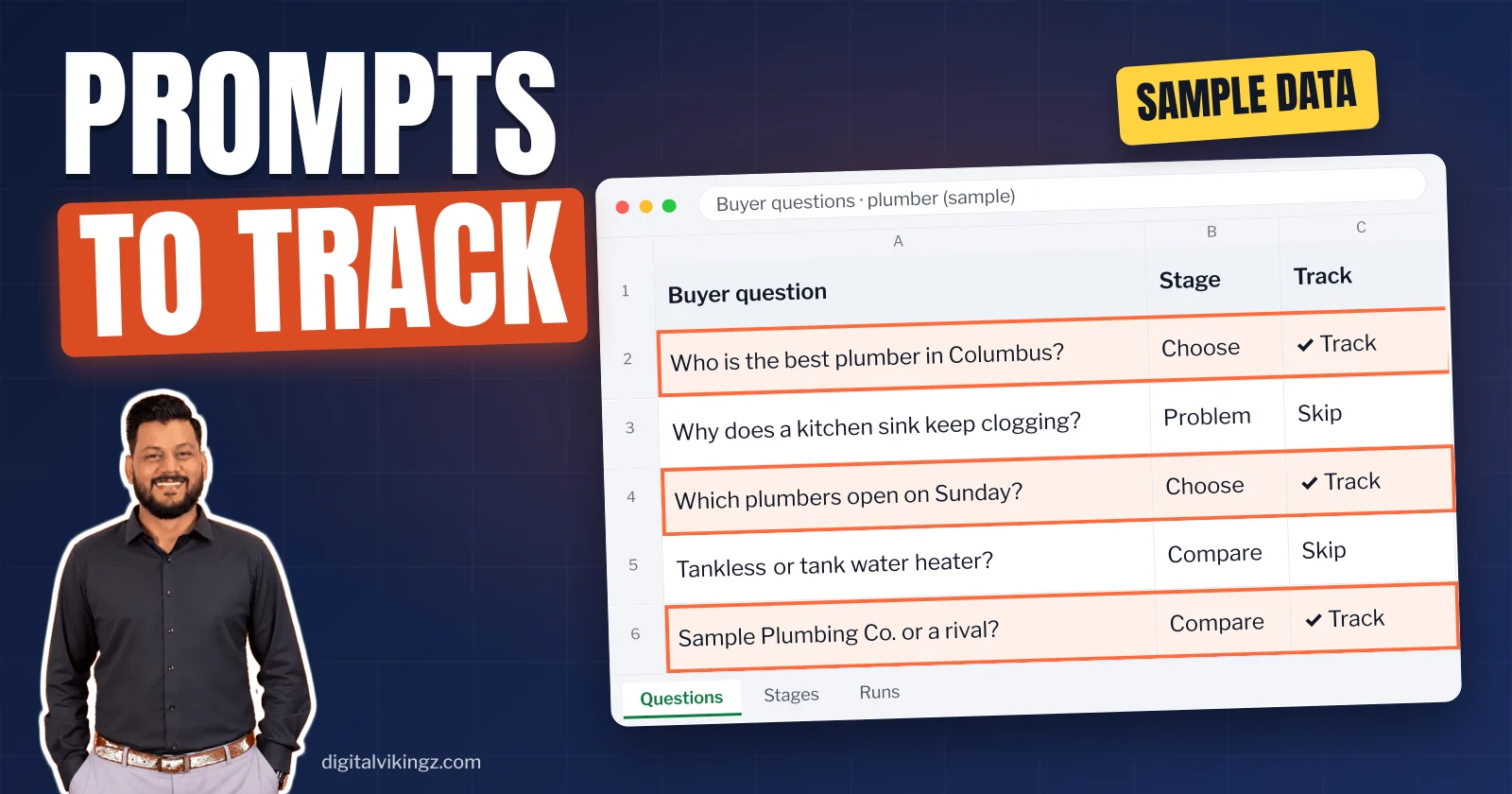
You opened a tracker, and the prompt box is empty. The prompts to track for AI visibility are the questions your buyers ask an assistant, held fixed and re-run on a schedule. Start with about 25 prompts, split into problem, comparison, recommendation and local questions, with branded prompts kept apart.
Nobody outside the assistants can name the perfect set, so we give a method and a labelled sample. The method runs from sources and types to the split, the size, the wording and the upkeep.
What is a tracked prompt?
A tracked prompt is a fixed question that you ask AI assistants on a schedule, then check for your business in the answer. The prompt set is the full list of tracked prompts, and every score a tracker shows depends on that list.
A prompt is not a keyword, because a buyer types a whole question and describes a situation. A keyword names a topic. A prompt names a need, and the assistant answers that need.
A tracker does three things with each prompt. It sends the question to an assistant, then records if your business appears in the answer. On the next run, it repeats both steps.
The score you see at the end is a count over your list, so a weak list gives a weak score, however polished the dashboard looks.
Prompt tracking is one measurement step inside AI SEO, so treat it as a habit and not a project. The pillar guide covers the rest in AI SEO in full.
Sample: a homeowner asks an assistant who fixes a leaking water heater in Columbus, and that question becomes one tracked prompt. Run it every week, and you hold a record of who the assistants name.
Why the set stays small and fixed
A small, fixed prompt set lets you compare the same questions week after week. Each prompt you add is one more answer to read, and a changed prompt breaks the comparison.
A tracker samples answers, so the set you choose decides what the numbers can tell you. SE Ranking adds a cost point: it says prompt tracking costs scale with volume. A long list can cost more money and take more reading time, yet still tell you less than a short list read in full.
SE Ranking calls tracking data directional and not definitive. Backlinko's guide includes a section on when prompt tracking is not worth the effort.
Every size you read is a starting point.
Small sets also let a person read every answer. Read the set by group, and act on a group that stays weak across the month. Three missed prompts in one group, across four weekly runs, is a lead worth following.
Teams with many products and markets need more than 25 prompts, and the enterprise framework for LLM visibility covers that scale.
A set that small needs strong questions, and strong questions have to come from somewhere.
Where do prompts to track come from?
Prompts to track come from the questions your buyers already ask, in the words they use. A tracker does not pick the prompts for you, so you choose the sources.
Four sources cover most of the work: sales calls and support tickets, Google Search Console queries, communities and People Also Ask, and old keywords rewritten as questions. We take them in that order.
We start with calls and tickets because the buyer wrote those words. The other sources add reach.
The keyword rewrite fills the gaps that remain, and it works best on services you sell but rarely hear questions about. Collect more questions than you need, then cut the list to the 25 that lead closest to a hire.
Sample: a plumbing company in Columbus lists the questions its dispatcher hears on Monday morning.
Sales calls and support tickets
Sales calls and support tickets hold the exact questions buyers ask before they hire you. Read ten recent calls or tickets, and copy each question word for word.
Take a call about a burst pipe, for instance. The buyer says what broke, where, and how soon it must be fixed.
A question from a call is the best source, because the buyer said it. Nobody shaped it for a search box. That is its value.
Mark each question with the stage it belongs to, so the split in the later sections takes minutes and not an afternoon. Merge the ones that ask the same thing in different words, and keep the clearest wording. Skip any question that names a competitor, because competitor prompts get their own group later.
Sample: a plumbing company reads its call notes and finds the question, Who fixes a sewer backup on a Sunday?
Search Console queries
Search Console queries show how people already phrase a question when they find your pages. A long, conversational query in Google Search Console is the best candidate for a prompt.
Use long queries as wording for prompts, and read the query list as phrasing, not as an AI visibility score. Google's guide to generative AI features, last updated 10 July 2026, points to the Generative AI performance report. The report covers how your content performs, so your prompts still come from you.
Google counts AI Overviews and AI Mode data inside the Web search type of the Performance report (Google Search Central, AI features page, last updated 10 December 2025). Those features may use query fan-out, which issues several related searches for one question, so a prompt is a sample and not a count of searches.
Pick queries that sound like a person talking, and leave out single-word queries. Keep the original query in a note next to the prompt, so you can see where the wording came from.
The report walkthrough sits on what the Search Console generative AI report shows.
Communities and People Also Ask
Forum threads and People Also Ask boxes show the follow-up questions buyers ask next. Open a handful of threads on your topic, note the wording, and write down only the question.
People Also Ask gives short question forms, and a thread gives the long, messy version. Type your main service into Google, open the boxes that appear, and write down each follow-up. The order of those follow-ups hints at what buyers ask next.
Leave usernames and thread links out of the set. We do not advise posting in a thread to shape an answer.
How do you rewrite a keyword as a prompt?
Rewrite a keyword as a prompt by adding the situation, the place and the decision the buyer faces. A keyword has no situation, and an assistant answers a situation.
Sample: the keyword drain cleaning becomes the prompt, Who clears a kitchen drain in Columbus on a weekend?
Sample: the keyword water heater repair becomes the prompt, Who repairs a water heater that stopped heating in Columbus today? The second version adds a symptom, a place and a time.
Keep one question per prompt. Keep the wording a buyer would say aloud, the way you would ask a friend who knows the trade and has a minute to answer. With the questions in hand, the next choice is which types of prompt the set holds.
Which types of prompts should the set hold?
The set holds three types of prompts: non-branded, competitor and branded. HubSpot's guide, updated 23 October 2026, says to track a representative sample of branded, unbranded and competitor prompts.
Keep branded prompts in their own group, because the brand name in the question inflates the score.
Each type answers a different question. Non-branded prompts ask if buyers find you at all, before they know your name.
Competitor prompts ask who sits beside you. Branded prompts ask if the facts about you are right. Three questions, three groups.
Sample: a plumbing company in Columbus tracks one prompt of each type.
The non-branded one reads, "Who is the best plumber in Columbus, Ohio?" The competitor one reads, "Sample Plumbing Co. or Sample Rival Plumbing for water heater installation in Columbus?" The branded one reads, "What services does Sample Plumbing Co. offer in Columbus?"
Branded prompts
A branded prompt names your business, so the assistant already knows which brand to describe. Branded prompts check accuracy, such as the hours, services and licences an assistant states about you.
Accuracy prompts test the facts an assistant holds about your business, which many audits skip. A wrong opening hour or a missing service shows up here first. Fix the source of the fact, and the next run shows if the answer changed.
Engines connect a name to facts, and why most SEO audits miss the entity layer explains the gap.
Non-branded prompts
A non-branded prompt never names your business, so a mention in the answer shows discovery. Non-branded prompts show how buyers find you before they know your name.
Most of the set should be non-branded. The 25-prompt sample set holds 19 of them.
You read this group first. Say a buyer asks for the best plumber in town, and the assistant names you. That mention counts for more than any branded one, because nobody handed the assistant your name.
Competitor prompts
A competitor prompt names a rival, so the answer shows who the assistant places next to you. Use two or three competitor prompts, and name the rivals buyers already compare you with.
Sample: "Sample Plumbing Co. or Sample Rival Plumbing for water heater installation in Columbus?" Sample Rival Plumbing is an invented rival.
Skip rivals that buyers never weigh against you. A competitor prompt about a company in another city only adds noise to the group, and the group is the unit you read every month.
Do branded prompts raise the score?
Yes, branded prompts raise the score, because the brand name in the question makes a mention near certain. We report branded prompts apart from the rest, so the average reflects discovery.
Should you drop them, then? No, keep branded prompts anyway, because they catch wrong facts. That is our advice, and no source sets a rule here.
Report two numbers. One covers the branded group, and the other covers everything else in the set, so a high branded score never hides a weak discovery score.
The first tells you if the facts are right. The second tells you if buyers find you, and that is the number a manager asks about.
How should the prompts split across the funnel?
Split the prompts by funnel stage, so each stage that leads to a hire has its own questions. The guides we opened set different splits, so ours is a starting point and not a rule.
Our sample uses four stage names: problem, choose, compare and brand accuracy. Everyday labels work better than marketing jargon, because they match the words buyers use.
Picture a buyer with a flooded basement.
First comes the problem, then a short list of plumbers, then a hire. Prompts that sit on that path show where an assistant drops you. A set made only of problem questions never reaches the moment of the decision, and that moment pays the bills.
Problem, comparison, recommendation and local prompts
A problem prompt describes a need, a comparison prompt weighs options, and a recommendation prompt asks who to hire. A local prompt adds a city or a neighborhood to any of the three.
Local prompts mirror local search, and how local SEO differs from organic SEO explains why they get their own group.
The four sample prompts, one per intent, are given below:
- Problem: "Why is a water heater leaking at the bottom?"
- Comparison: "Is a tankless or a tank water heater better for a family of four?"
- Recommendation: "Who is the best plumber in Columbus, Ohio?"
- Local: "Which plumber serves Clintonville and nearby neighborhoods?"
All four are samples for a plumbing company in Columbus.
The four intents overlap in practice. A recommendation prompt with a city in it is also a local prompt. Tag each prompt with its main intent, and add the city flag as a separate column.
A starting split for a service business
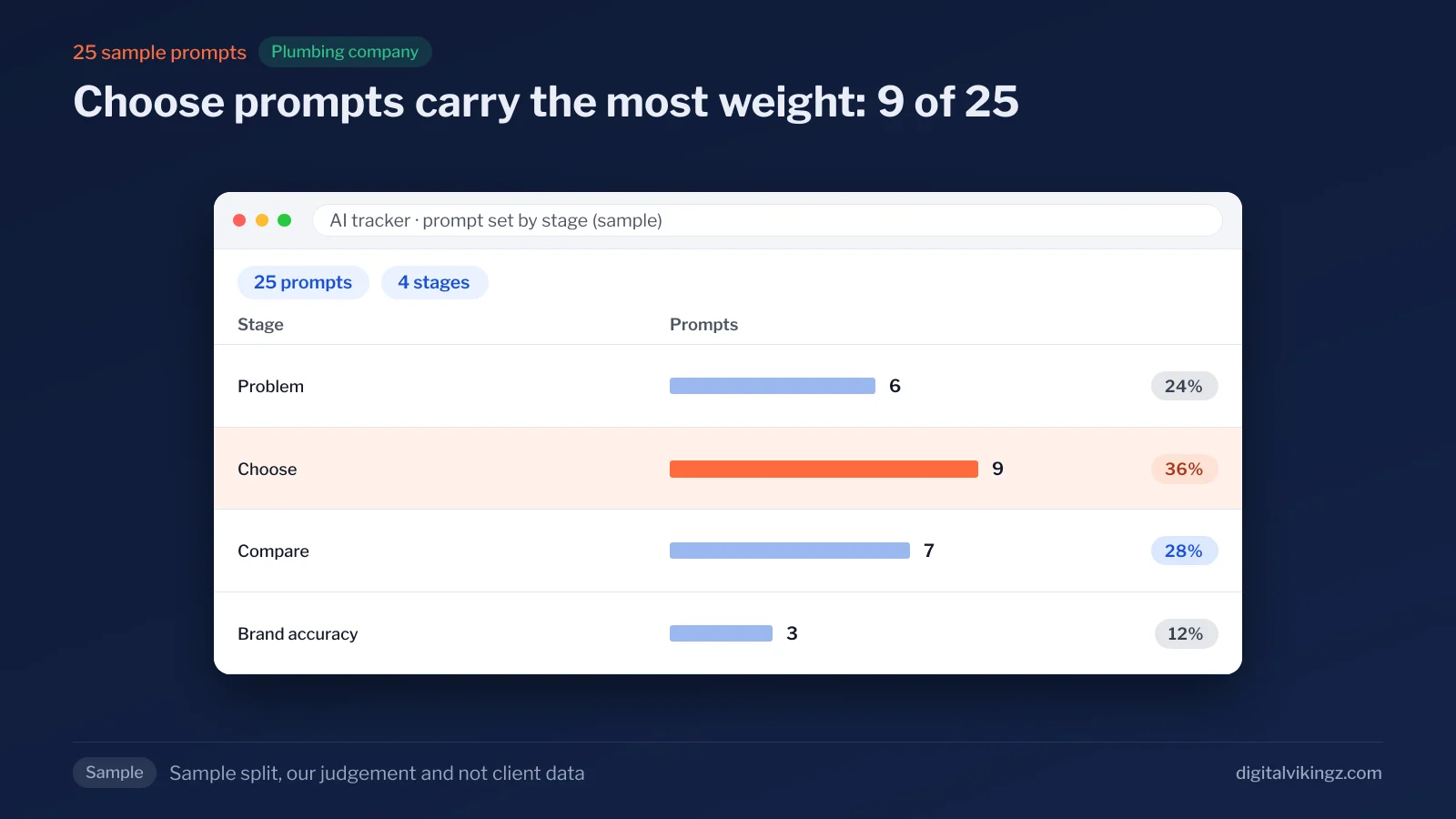
A starting split for 25 prompts is 6 problem, 9 choose, 7 compare and 3 brand accuracy prompts. Choose prompts are recommendation and local questions, the ones closest to a hire. The split is our judgement and not a sourced figure.
The table gives the starting split for a set of 25 prompts. The values are a sample for a plumbing company.
| Stage | Prompts | Share | Covers |
|---|---|---|---|
| Problem | 6 | 24% | Problem prompts |
| Choose | 9 | 36% | Recommendation and local prompts |
| Compare | 7 | 28% | Comparison and competitor prompts |
| Brand accuracy | 3 | 12% | Branded prompts |
The bar chart shows the same four counts, so the weight of each stage is visible at a glance.
Move the weights when the business changes.
A plumber who gets emergency calls leans on choose prompts, because the buyer decides in minutes. A company that sells large projects may lean on compare prompts, because the buyer weighs options for weeks. Both shifts are our judgement.
A SaaS startup with a long buying cycle may weight comparison prompts higher, and SEO for a SaaS startup covers that buyer.
How many prompts should you track, and on which assistants?
Start with about 25 prompts on two or three assistants, and add more only after you read the first month. Size, assistants and wait are three separate choices, so we take them one at a time.
Reading effort sets the limit.
A set of 25 prompts on three assistants gives 75 answers per run. Four weekly runs give 300 answers in the first month. That is a lot to read with care.
A starting size of 25 prompts
SE Ranking gives 20 to 40 prompts as the range for a first set, and we start at 25. A set of 25 is small enough to read every week and large enough to cover each stage.
Other guides quote larger sets, and every size rests on the vendor's own assumptions. You adjust after you read the first month, and you add whole groups only.
With a larger team and a budget, add prompts in whole groups, never one at a time. A group is a unit you can read, and a stray prompt is not.
Sample: the plumbing company in the sample set runs 25 prompts and reads every answer in one sitting.
Which AI assistants should the set run on?
Run the set on the two or three assistants your buyers use, and read each assistant on its own. A blended number hides which assistant names you, so report each assistant on its own.
Reading each assistant alone also gives you the comparison across models. You see where you are named and where you are missing.
We have no data on which assistants your buyers use.
Ask five recent customers instead. One question is enough, for example: where did you look before you called us? The sample set uses ChatGPT, Gemini and Perplexity as a labelled choice.
Which tracker runs which assistants is a tool question, answered in five types of AI visibility tools compared.
How long before you read the results?
Wait at least 30 days before you read the results, so the set has several runs behind each number. SE Ranking also advises tracking for at least 30 days before drawing conclusions.
We pick 30 days because four weekly runs show how often an answer repeats.
Weekly runs also show drift. Say an answer flips in week two and returns in week three. You have learned how steady that prompt is, and that is worth knowing before you act on it.
When a group looks weak after the wait, an AI visibility audit and 90-day plan turns it into fixes.
How do you word each prompt?
Word each non-branded prompt as a neutral question a buyer would type, with one situation and one place. Size and assistants are settled, so wording is the next choice.
Three rules cover it: stay neutral, add a persona and a place where they matter, and expect answers to change between runs.
Two habits keep the wording clean. Ask one question per prompt, and never stack two questions in one sentence. Leave out superlatives that you want the assistant to repeat, such as best, fastest or cheapest, unless a buyer would really type them.
Neutral wording, with before and after pairs
A neutral prompt asks the question and leaves out the answer you want. A leading prompt names your brand or praises your work, and the assistant may echo the praise.
Write the prompt once, store the exact text, and paste the same text every run. A single changed word can move an answer, and then you cannot tell if the assistant or your wording caused the shift. Two samples show the change.
Sample pair one.
Before: "Why is Sample Plumbing Co. the best plumber in Columbus?"
After: "Who is the best plumber in Columbus, Ohio?"
Sample pair two.
Before: "Which affordable, fast plumber in Columbus should homeowners call?"
After: "Which plumbers in Columbus offer emergency service at night?"
Do prompts need a persona and a location?
Yes, add a persona and a location to the prompts where they change the answer. HubSpot says to cover buyer stages, personas and priority markets in the prompt set.
Put the city in the wording for local prompts, and state any persona in the same sentence. A tracker may also hold a location setting, so read its help page before you rely on one. A setting that the tool ignores gives you a number that looks local and is not.
Sample: a property manager and a homeowner ask about plumbing in different words. The manager asks, Which Columbus plumbers handle backflow testing for apartment buildings? The homeowner asks, Which plumbers fix a leaking water heater in Columbus?
Do you need one set per city? Start with one city and one persona, and add a second only when you serve a second market.
Does tracking work when answers change each run?
Yes, tracking still works when answers change, if you re-run each prompt and read the share of runs. SE Ranking says its research on local queries in AI Mode found that only 35% of domains repeat in AI answers.
Two-thirds of domains vanish between runs in that research, according to SE Ranking. SE Ranking also says two users who ask the same prompt can get different brand recommendations.
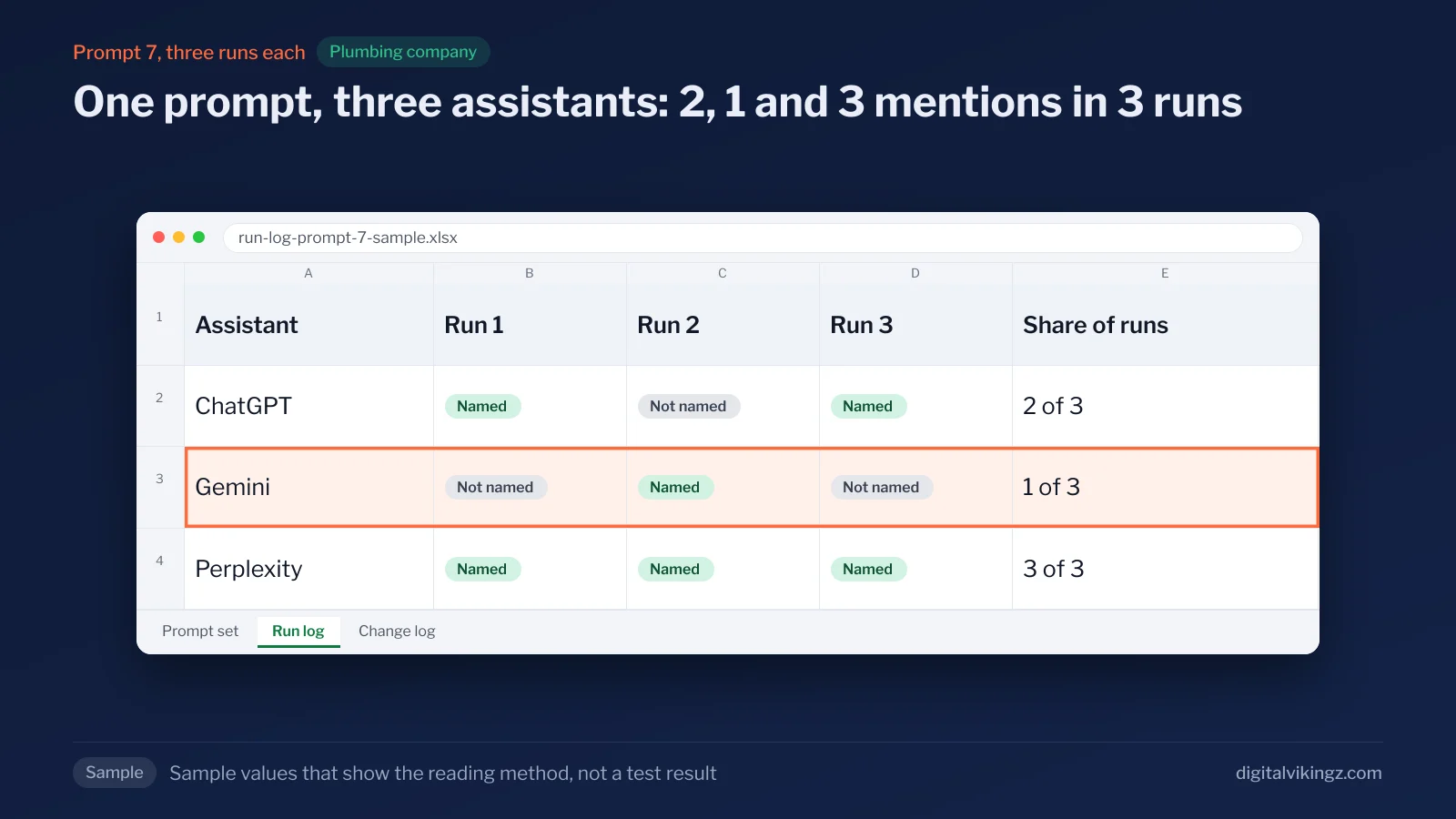
Run each prompt at least three times per assistant before you log a result. A single run shows a moment, and three runs start to show a pattern.
Treat each result as a share of runs, such as 2 of 3, and not as a yes or no. Sample: prompt 7 from the set, run three times on each of three assistants, gives ChatGPT 2 of 3, Gemini 1 of 3 and Perplexity 3 of 3.
How do you group the prompts and keep the set stable?
Group the prompts by topic, then keep the set stable for a quarter so each number can be compared. Name one owner for the set, so nobody edits the wording by accident.
The owner keeps the prompt text, the run dates and the change log in one place. One person reads the groups each month and writes down what to fix. Shared ownership usually means no ownership.
The owner can sit in-house or at an agency, and in-house or agency semantic SEO shows how to choose.
Group prompts by topic, not by wording
A topic group holds the prompts that lead to the same decision, whatever their wording. Name each group after its service, such as water heater installation.
A group gives you a unit to read, and a single prompt is only one sample of that group. When three prompts in a group never name you across several runs, the group has a gap. When one prompt misses, you have noise.
Sample: the plumbing company uses four groups, water heaters, drains and sewer, emergency service and trust and licences.
Keep the set fixed for a quarter
Keep the same prompts, with the same wording, for 90 days before you change any of them. Add a new group when the business changes, and never reword an old prompt.
Write the date, the old text and the new text in a change log. Add one line for the reason.
The next owner then knows why a prompt moved, and nobody has to guess in the third month of the quarter. HubSpot's guide advises limiting changes to about 20% of the set at each quarterly review.
A quarter is about 90 days, the same window as the first 90 days of a semantic SEO engagement.
What does a 25-prompt set look like for a service business?
A 25-prompt set for a service business holds questions from four stages, and the sample uses a plumbing company in Columbus, Ohio. Sample Plumbing Co. is an invented business, and no prompt here comes from a client. The assistants for the sample are ChatGPT, Gemini and Perplexity.
The table lists the 25 sample prompts with their stage, intent and name type.
| Number | Prompt | Stage | Intent | Name type | City in wording |
|---|---|---|---|---|---|
| 1 | Why is a water heater leaking at the bottom? | Problem | Problem | Non-branded | No |
| 2 | What should a homeowner do when a pipe bursts in the basement? | Problem | Problem | Non-branded | No |
| 3 | Why does a kitchen sink keep clogging? | Problem | Problem | Non-branded | No |
| 4 | How do homeowners know when a running toilet needs a plumber? | Problem | Problem | Non-branded | No |
| 5 | What causes low water pressure in an older house? | Problem | Problem | Non-branded | No |
| 6 | Who fixes a sewer line backup in Columbus? | Problem | Problem | Non-branded | Yes |
| 7 | Who is the best plumber in Columbus, Ohio? | Choose | Recommendation | Non-branded | Yes |
| 8 | Which plumbers in Columbus offer emergency service at night? | Choose | Recommendation | Non-branded | Yes |
| 9 | Who should a homeowner hire to replace a water heater in Columbus? | Choose | Recommendation | Non-branded | Yes |
| 10 | Which Columbus plumbing company is best for a small bathroom remodel? | Choose | Recommendation | Non-branded | Yes |
| 11 | Which plumbers handle older homes with galvanized pipes in Columbus? | Choose | Recommendation | Non-branded | Yes |
| 12 | Who installs tankless water heaters in Columbus? | Choose | Recommendation | Non-branded | Yes |
| 13 | Which plumber serves Clintonville and nearby neighborhoods? | Choose | Local | Non-branded | Yes |
| 14 | Which plumbers serve Dublin, Ohio and Hilliard? | Choose | Local | Non-branded | Yes |
| 15 | Which Columbus plumbers are open on Sunday? | Choose | Local | Non-branded | Yes |
| 16 | Is a tankless or a tank water heater better for a family of four? | Compare | Comparison | Non-branded | No |
| 17 | Should a homeowner repair or replace a 12-year-old water heater? | Compare | Comparison | Non-branded | No |
| 18 | How do Columbus plumbers compare on drain cleaning prices? | Compare | Comparison | Non-branded | Yes |
| 19 | What should a homeowner compare when choosing between two plumbing companies? | Compare | Comparison | Non-branded | No |
| 20 | Sample Plumbing Co. or Sample Rival Plumbing for water heater installation in Columbus? | Compare | Comparison | Competitor | Yes |
| 21 | What are the alternatives to Sample Rival Plumbing in Columbus? | Compare | Comparison | Competitor | Yes |
| 22 | How does Sample Rival Plumbing compare on emergency response times? | Compare | Comparison | Competitor | No |
| 23 | What services does Sample Plumbing Co. offer in Columbus? | Brand accuracy | Branded | Branded | Yes |
| 24 | What are the opening hours of Sample Plumbing Co.? | Brand accuracy | Branded | Branded | No |
| 25 | Is Sample Plumbing Co. licensed and insured in Ohio? | Brand accuracy | Branded | Branded | No |
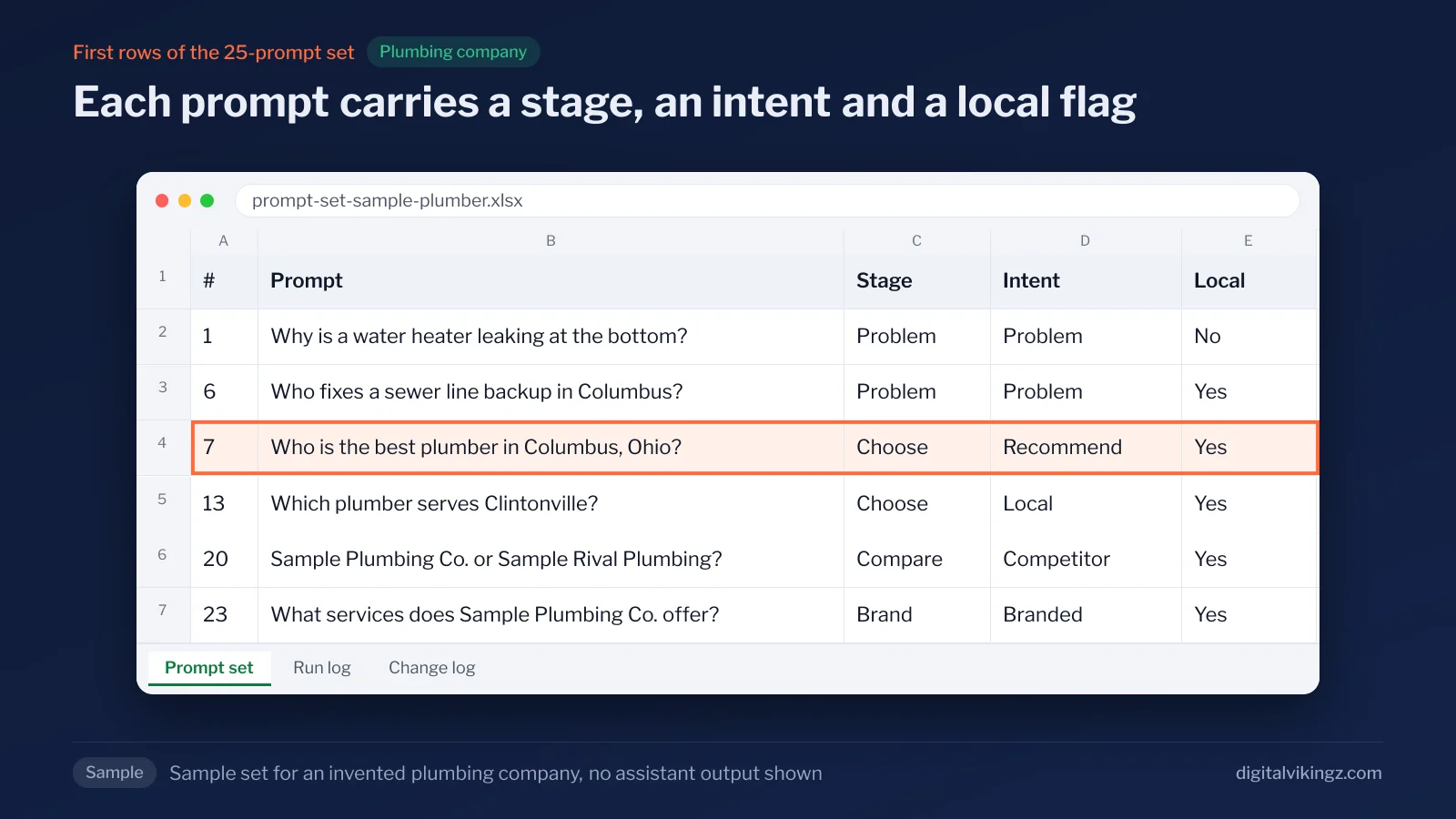
The spreadsheet image shows the first rows of the same set, laid out as you would keep it in a tracker or a sheet.
Keep the number column fixed, and never renumber. A prompt keeps its number for life, even when you retire it. The change log and the run history then always point to the same row.
What the sample set will and will not tell you
The sample set shows how the questions are built, and says nothing about how any assistant will answer them. Your set will differ, because your services, cities and rivals differ.
Swap the city, the services and the rivals first. Keep the counts per group.
Say an HVAC company in the same city adopts the set. It swaps water heaters for furnace repair and air conditioner installation, adds its own two rivals, and keeps the 6, 9, 7 and 3 split. The method carries over, and only the nouns change.
What do vendor guides and Google say about prompt sets?
Vendor guides agree on the method and disagree on the size, and Google adds a measurement report. We read the HubSpot, SE Ranking and Profound guides and two Google pages on 22 November 2026.
The sizes and the report matter because they decide how far you trust your own starting set. None of these sources studies a service business with 25 prompts, so each one gives context and none gives proof.
Why do vendors quote 25 to 50, 20 to 40 and 100 prompts?
Vendors quote different sizes, and each guide ties its size to its own tool or its own buyers. The table sets the four sizes beside what each source ties them to.
| Source | Size quoted | Date shown | What the page ties the size to |
|---|---|---|---|
| HubSpot | 25 to 50 prompts | updated 23 October 2026 | A free trial that covers 25 prompts, and a claim of "enough to spot patterns" |
| SE Ranking | 20 to 40 prompts on 2 to 3 models | page dated 23 April 2026 | A shorter, well-filtered list, and costs that scale with volume |
| Profound | 100 prompts to start | dated 10 February 2026 | Its users, who track 100 to 1,000 prompts |
| Practitioner answers on Quora and Medium | 10 to 25 prompts | read in November 2026 | A first set a person can review |
Our start of 25 sits inside the first two ranges and below the third, which suits a service business with one or two cities. Every size in the table comes from a vendor or a practitioner, and we found none from an assistant maker.
The spread is why we give a start and not a target.
Use the table as a map and not as a verdict.
A vendor that sells a tool tends to quote a size that follows its plans. A practitioner who reads every answer tends to quote a smaller number. Neither view is wrong, since each fits its own reader.
How do you start in week one?
Start with five steps in week one: pick the sources, write 25 neutral prompts, choose assistants, run the set, and wait 30 days. The five steps are given below:
- First, pick the sources, and gather ten questions from calls, tickets or Search Console.
- Second, write 25 neutral prompts, and store the exact text.
- Third, choose the two or three assistants your buyers use.
- Fourth, run the set once, and log each answer by assistant.
- Finally, wait 30 days, and read nothing before then.
Each step is small. None needs a tool. Together they take one week and cost only time, for example an hour on Monday for sources and an hour on Tuesday for wording.
Choose the tracker after you write the set, because the set decides what you need from a tool. A set with three assistants and one city needs a different plan than a set with ten cities. The checker looks at your pages, and your prompts look at what assistants say about you.
Try the free AI Visibility Checker before you pick prompts. The free AI Visibility Checker reads your homepage and up to four sample pages the way a crawler would.
Sample plan: the plumbing company writes its call-note questions on Monday, runs the set on Wednesday, and reads nothing until day 30. In week two it only repeats the run, because a second run of the same text is the point.
Agency account leads can run the same method for a client, and white-label SEO for agencies explains how delivery under your brand works.
Our AI Search Visibility with prompt tracking each month service is the monthly version of this work.
AI Search Visibility covers answer-first passages, entity signals, mention building, AI Overview and prompt tracking each month. Pricing is a written quote after a strategy call. We do not promise a citation, a ranking or a mention.
Read the first 30 days by group, then move to an AI visibility audit for the fixes.
Questions about prompts to track
Can you track prompts without a paid tool?
Yes, a spreadsheet can hold the set, and API calls to an assistant can run the prompts. We have not compared API answers with web app answers for the sample set. We do not advise running prompts by hand in the assistants' web apps.
Is prompt tracking worth it?
Yes, prompt tracking is worth the effort when someone reads the groups each month and acts on them.
Do you still track prompts when assistants already name your business?
Yes, because branded prompts catch wrong facts and non-branded prompts show how steady the mention is.
Should you retire a prompt that never names you?
No, not inside the quarter, because a prompt that never names you still marks a gap. Retire prompts that led to no action at the quarterly review.
Where can you find prompts to track for free?
Your sales calls, your support tickets, Search Console and People Also Ask cost nothing.