 Digital Vikingz
A landscaping company sells projects and routes, and homeowners search for each one differently. Someone wanting a patio and someone wanting Thursday mowing never type the same words.
Landscaping SEO is the work of getting a landscaping company found for each kind of job on Google and in AI answers.
Design and install buyers compare finished projects before they call. Maintenance buyers compare reliability, reviews and the towns a crew serves.
Seasons set when each search peaks, so pages and posts go up before the peak. Quote requests and booked projects, counted by service line, show what to fix first.
What is landscaping SEO?
Landscaping SEO is the work of getting a landscaping company found for each kind of job on Google and in AI answers. Google shows a landscaping company in three places: the map results, the organic list and AI answers.
Each place reads different facts. So the work covers the profile, the website and the listings that name the company.
Google names three local ranking factors, relevance, distance and prominence, and our guide covers the three ranking factors behind Google Maps results. Nobody outside Google can say how much each place weighs, and no tool shows it to us. So we count quote requests.
Take a sample. Someone types "landscape designer near me" and sees three map listings. Profiles that name only the broad category compete with every crew in town, and that is a hard fight.
Which landscaping services share one website?
A landscaping website usually carries four service lines: design and install, maintenance, lawn care and hardscape. The four service lines are given below:
- Design and install is a one-off project planned and built for a property.
- Maintenance is a set of recurring visits that keep a property in shape.
- Lawn care is a recurring turf visit sold as a route.
- Hardscape is a patio, wall or walkway built from stone, pavers or concrete.
A company that sells one line needs one set of pages, and a company that sells all four needs four. Picture a crew that mows, plants and builds patios. It has three buyers on one homepage.
Design and install against maintenance: two buyers, two sets of pages
Design and install work and maintenance work need separate pages because the buyer, the search and the proof differ. The two lines differ on five attributes:
| Attribute | Design and install | Maintenance and lawn care |
|---|---|---|
| Buyer | One project planned for a property | A recurring service for a property |
| Search | "landscape designer near me" | "lawn care near me" |
| Decision | Compares finished projects, then asks for a quote | Compares reviews, reliability and towns served |
| Page type | A service page per project type plus project pages | A service page per recurring service plus service-area pages |
| Proof | Photos with scope and materials | Reviews that name the service and the town |
Ticket size differs too. A project is paid once and is larger, while a route is paid over many visits.
We read six landscaping SEO guides on 22 November 2026, and none of them splits design and install work from maintenance. A design firm and a mowing crew can share one company name, one phone number and one homepage. Their best searches still share no words.
What a design and install buyer searches and checks
A design and install buyer searches for a project or a designer, then checks finished work before asking for a quote. Searches look like "paver patio installer" or "landscape designer near me".
The page that wins that visit shows a finished project with its town, scope and materials. Hardscape sits here too, because a patio or a retaining wall is a one-off build that a homeowner studies for weeks before picking a crew. Weeks, not minutes.
Take a sample: someone types "retaining wall contractor" plus a town, then opens three galleries side by side.
What a maintenance and lawn care buyer searches and checks
A maintenance and lawn care buyer searches for a recurring service in one town, then checks reviews and reliability. Searches look like "lawn care near me" or "weekly mowing" plus a town.
The proof that fits this buyer is a review that names the service and the town. Pages should name the towns the crew already drives, because a route needs neighbours.
Some buyers cross lines, such as a maintenance client who later orders a patio. Take a sample: a homeowner two streets from an existing client searches "lawn care" plus the town name.
Residential and commercial buyers need separate page sets
Residential and commercial buyers need separate page sets because a property manager and a homeowner ask different questions. Owners know their own split best, so the call log decides whether a commercial set is worth building.
Landscaping is one of the local service businesses we cover under semantic SEO for landscaping and other local service businesses.
Here is a reading, not a record. An office park asks for a written scope and a maintenance schedule. A household asks for photos of similar yards.
Does one landscaping page work for every service?
No, one landscaping page serves design, maintenance and lawn care badly, because each buyer searches differently. What goes on the shared homepage?
The homepage names every line and links to one page per line. Each line page links to its own projects, reviews and towns.
Take a sample. The homepage lists four lines, the patio page shows three finished patios, and the mowing page shows the towns on the route.
How does seasonal demand shape landscaping SEO?
Seasonal demand shapes landscaping SEO by moving which service line gets searched each month, so pages and posts go up before each peak. Spring brings cleanup and planting searches, summer brings mowing, fall brings leaf removal, and snow work follows where it falls.
Six guides mention seasons briefly, and none gives a calendar by service line. Peak weeks differ by region and nobody can give one date for every state, so our calendar shows order, not dates. Order is what you plan around.
Which searches rise in each season?
Searches rise by season and service line, from spring cleanup and planting to summer mowing, fall leaf removal and winter snow removal. Snow removal applies only where it snows, and some companies do not sell it.
Design and install enquiries start before the build season, because a design needs planning time. We have no demand figure for any month. So we state none.
Your call log shows the first date each service line was searched in your region. A crew in a snowy region plans one winter page, and a crew where it never snows plans none.
Which pages and posts does each season need?
Each season needs one page per service line and one post series, published before the peak starts.
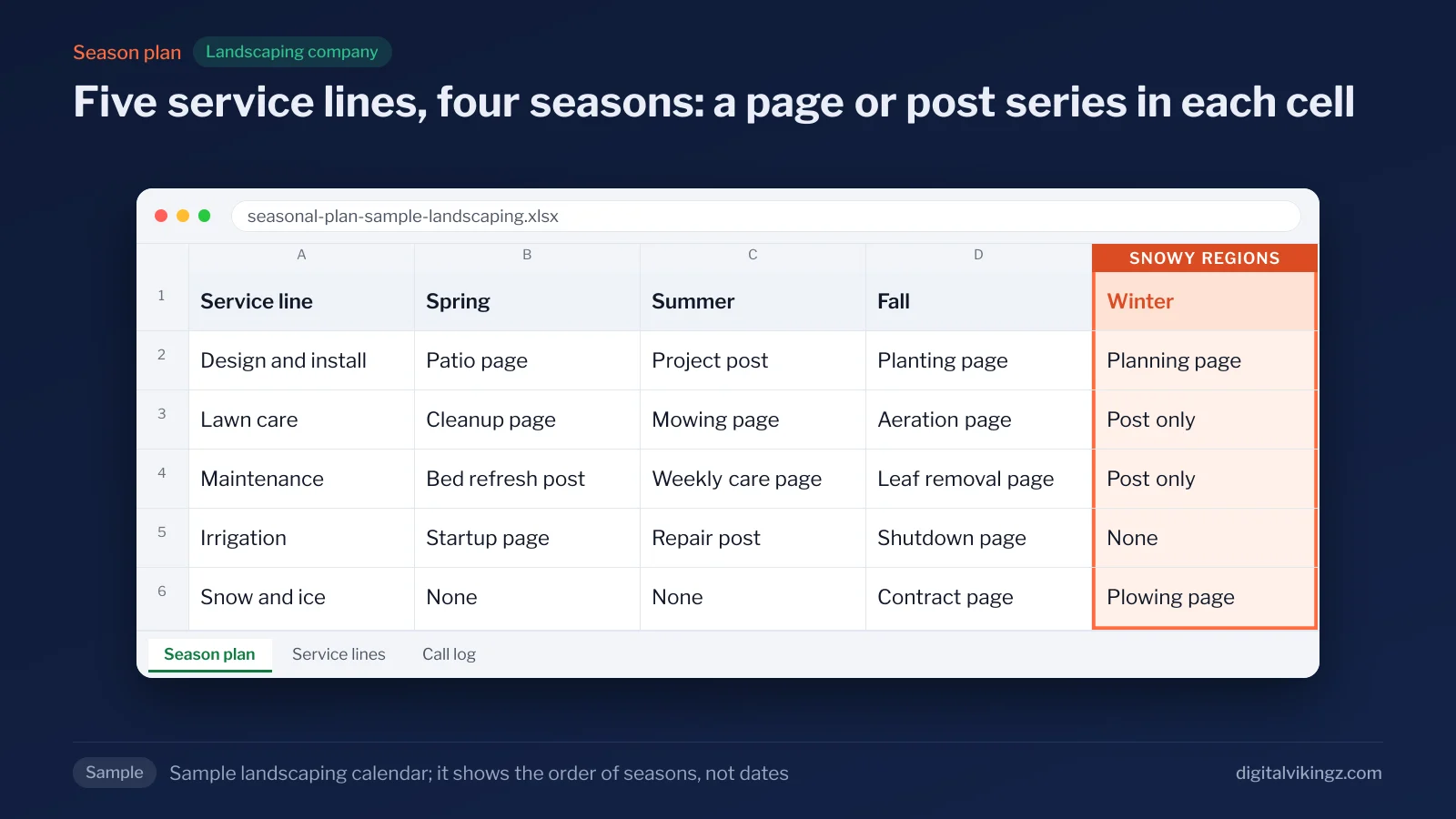
Sample seasonal calendar for a landscaping company, built by Digital Vikingz; it shows the order of seasons, not dates.
A spring cleanup page names the service, the towns served and a request path. Posts on the Google Business Profile announce the season and link to that page.
Pages go up ahead of the peak, because a new page needs time to be crawled and indexed. A busy crew can compare done-for-you Google posts and scheduling tools before the season starts.
Should seasonal pages stay up all year?
Yes, seasonal pages should stay up all year, because the same page serves the same search next season. What changes between years?
Update the photos, the dates and the services listed, and keep the URL so links and history stay with the page. Last year's page already has both. Our guide on how to refresh, prune or consolidate content explains when an old page earns an update.
What makes a landscaping project page work?
Design buyers compare finished work first, so the page answers what was built, where and with what.
A landscaping project page works when it shows one finished job with its town, scope, materials and before and after photos. The six fields of a project page are given below:
- Title: name the project type and the town.
- Scope: say what the crew built in two sentences.
- Materials: name the stone, pavers or plants used.
- Photos: show a before and after pair from the same angle.
- Customer words: quote the customer only with permission.
- Request path: put a quote form or call button on the page.
A page names the town or neighbourhood and never the customer's street address.
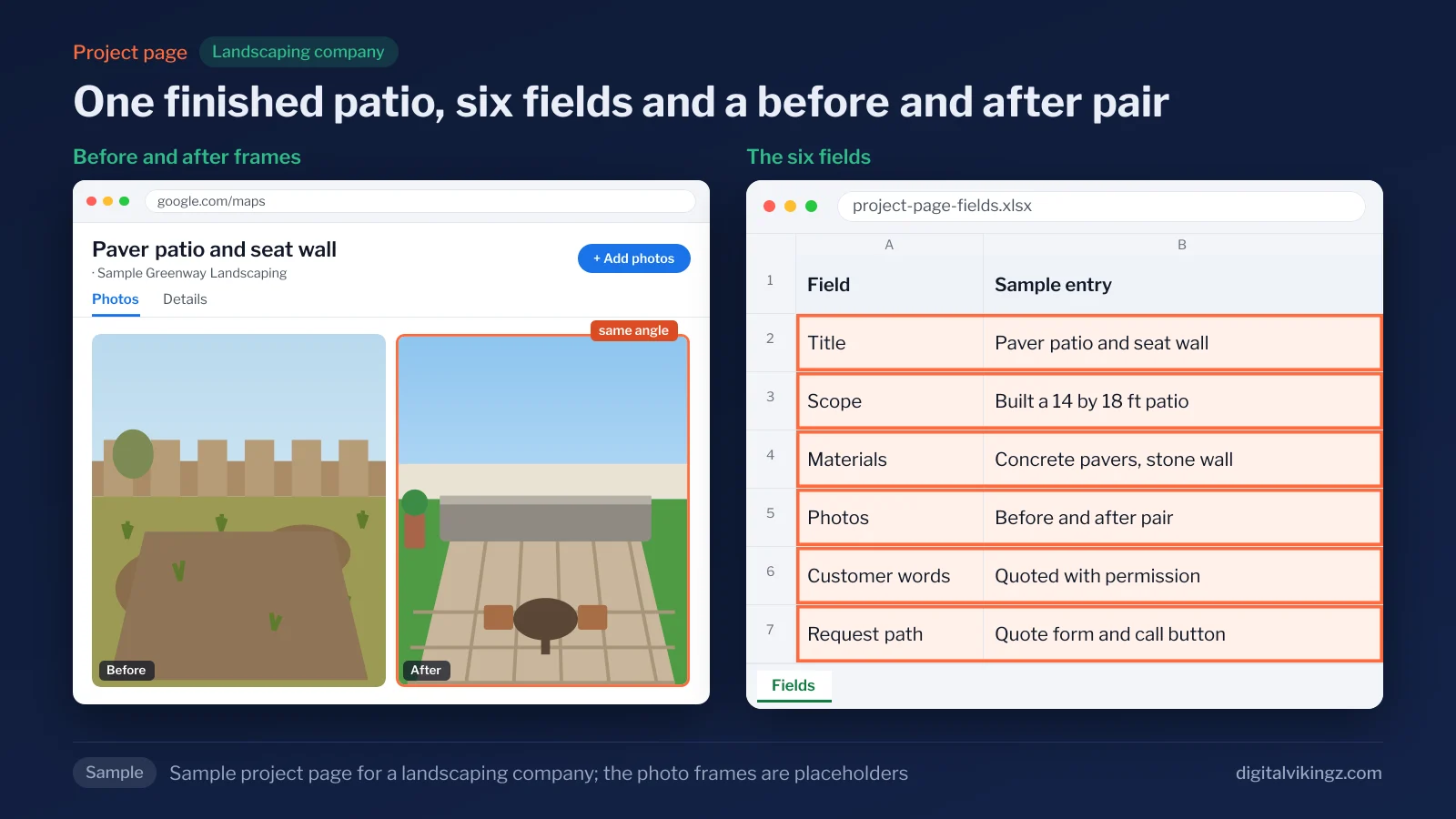
Sample project page for a landscaping company; the photo frames are placeholders, never a client's photos.
We have not tested how much a project page lifts map rankings, and nobody outside Google knows. The page earns its place with buyers either way. They read it before they ever call, and they compare it with the next crew's page in the same minute.
Before and after photos need a caption, alt text and a true record
A before and after photo needs a caption, alt text and a descriptive file name, because Google reads the page around the image. Google's image guide says it "extracts information about the subject matter of the image from the content of the page, including captions and image titles." That comes from Google Search Central, Google Images SEO best practices.
Google calls alt text "the most important attribute" for image metadata. Its own example puts a descriptive file name ahead of IMG00023.JPG.
Google's Business Profile help says "the image should represent reality." That line sits in Google Business Profile Help, Manage your Business Profile photos and videos. Only photos of the company's own jobs belong on the page and the profile, and stock images do not.
A patent gives one more angle. Google filed US20080002916, titled Using extracted image text, on 29 June 2006. The filing describes searching keywords taken from image text to retrieve a matching image.
Our reading is that text visible in a job photo, such as a crew truck sign, may be readable to a search system. Whether Business Profile photos pass through such a system is unknown to us. Either way, the advice holds, because Google's image guide already asks for captions and alt text.
The size, format and upload rules for the profile are in our guide to photo rules for a Google Business Profile.
Which finished jobs deserve their own project page?
A finished job deserves its own project page when it has a town, a clear scope and photos the crew owns. Smaller jobs belong in a gallery grouped by service line.
Maintenance has no finished job, so its proof is a review that names the service and the town. Here is a sample. A patio with a seat wall gets a page, and ten spring cleanups share one gallery.
Service-area pages need a local project behind each town
Which towns does the company actually serve? Start with the towns where the crew has finished jobs or already holds clients.
A service-area page needs a local project or a local review behind each town it names. A town with no finished job and no review has not earned a page yet.
Near-copies of one page with the town swapped read as doorway pages. Google's spam policies describe doorway abuse as pages created to rank for "specific, similar search queries." The wording comes from Google Search Central, spam policies.
Take a sample. A crew with three finished patios in one town and none in the next gets a page for the first town only. The method for service area pages built on local projects covers what each page needs.
How should a landscaping company set up its Google Business Profile?
Does the profile show an address? A crew that works at the customer's property is usually a service-area business.
Google says "If you hide your business address, your Business Profile will only show your service area." That sentence is from Google Business Profile Help, Manage your service areas. Google allows up to 20 service areas, within about 2 hours of driving time from where the business is based.
A business that also receives customers at its address is a hybrid business. The settings for a service-area business on Google cover the address and the areas.
A landscaping company sets up its Google Business Profile by choosing categories, services, photos and reviews that name each service line.
Categories follow the service lines
Categories follow the service lines: one primary category for the main line and extra categories for the others. Google's help says "The categories you select affect your local ranking on Google." The source is Google Business Profile Help, Manage your business category.
Google's category help says "You can select up to 9 more categories." Its guidelines say "Choose the fewest number of categories it takes to describe your overall core business." Both live on Add or change categories and in the Google Business Profile guidelines.
Practitioners disagree here. Sterling Sky, a local SEO agency, argues for using all ten category slots. It reported in August 2025 that a landscaper ranked higher for "landscape designer" and "landscape architect" after adding those categories.
That is one business, so it sets no expected gain for another. Nobody outside Google knows the best count, so we add one category for each service line the company sells today.
Category names come from Google's list, so each name is checked in the profile editor before use. The service lines map to category names as follows:
- Design and install maps to Landscape designer.
- Lawn care maps to Lawn care service.
- Hardscape has no confirmed category name here, so pick the closest one the profile editor offers.
- The main line maps to Landscaper.
The main category comes first, and our guide covers choosing the primary category for a Google Business Profile. Each extra category must pass five checks in our guide to Google Business Profile secondary categories.
Services carry the project type in their names
The services list carries the project type in each service name, so a profile shows paver patios and weekly mowing separately. Google's services help says you can "group services into categories and include additional details, like descriptions and prices." See Google Business Profile Help, Manage your services.
Google's help page keeps prices and phone numbers out of custom service names.
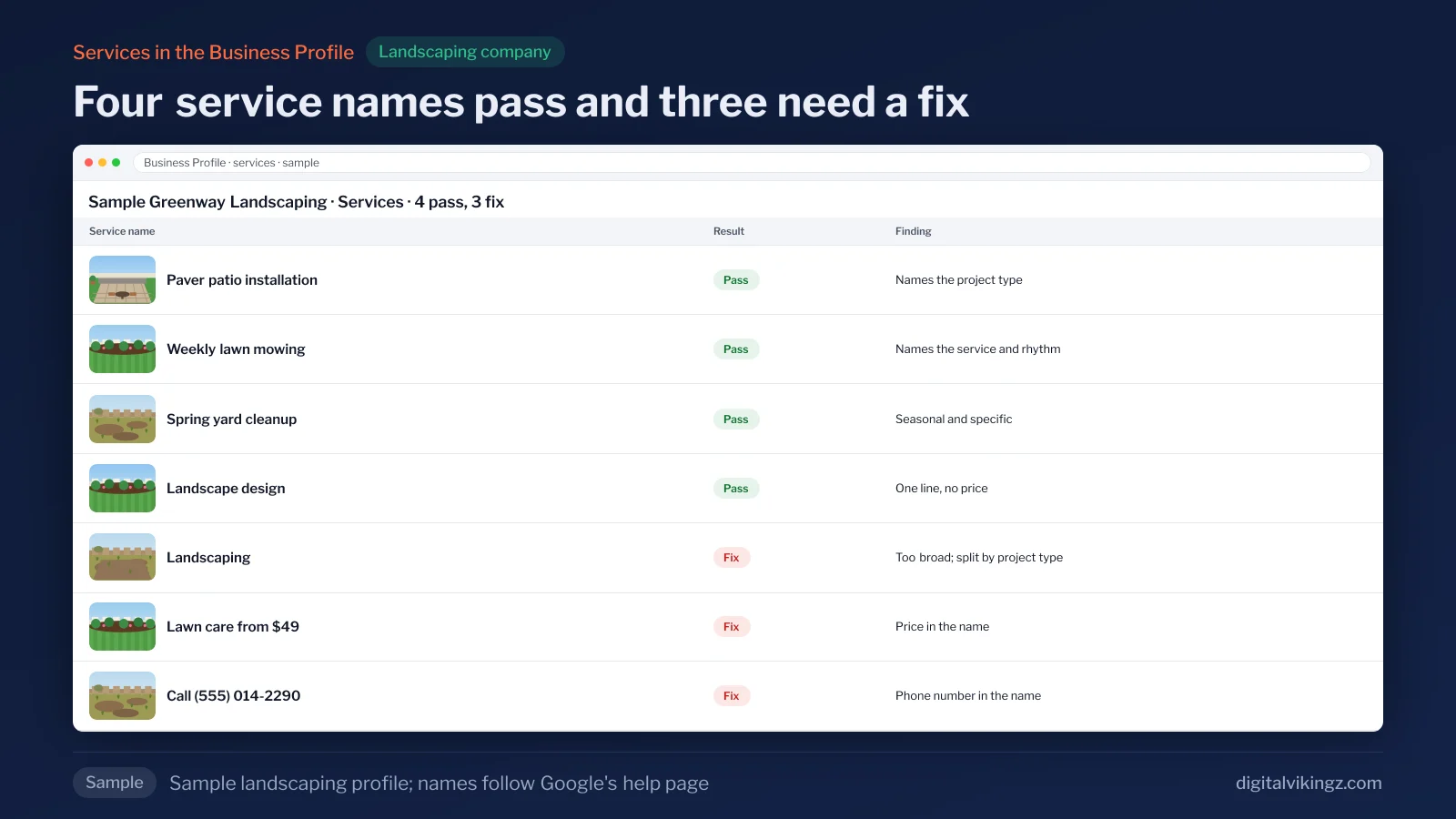
Sample Business Profile services panel for a landscaping company, marked pass or fix; service names follow Google's help page.
Each field of the editor is covered in our guide to the services editor on a Google Business Profile.
Photos and reviews name the job
Photos and reviews help most when they name the job, such as a paver patio or a weekly mowing route. Upload the crew's own photos from finished jobs, and keep stock images off the profile.
Ask each customer for a review that mentions the service in their own words, and never write one for them. A crew that drafts its own reviews breaks Google's rules and loses the trust the review was meant to earn. The steps are in our guide to review requests that follow Google's rules.
A Business Profile has more fields than these four, and our step-by-step Google Business Profile optimization guide lists each one.
How do you measure landscaping SEO by booked projects?
What counts as a result? A call is a lead, a quote request is a lead with a job attached, and a booked project is a sale.
A landscaping company measures SEO by quote requests and booked projects for each service line, not by rankings alone. The profile's Performance report counts calls, direction requests and website clicks, and the crew's own log adds the rest.
Missed calls and slow quotes lose leads before SEO matters, so the log records the reply time too. A spam form fill inflates the count, so the log marks unqualified enquiries.
Google shows no booked projects. Only the crew knows them, and the crew has to write each one down.
A quote log records the service line, the source and the outcome
A quote log records the date, the source, the service line, the town, the quote sent and the outcome. A sample log, with no real names or amounts, looks like this:
| Date | Source | Service line | Town | Quote sent | Outcome |
|---|---|---|---|---|---|
| Sample row 1 | Profile call | Design and install | Town A | Yes | Booked |
| Sample row 2 | Website form | Maintenance | Town B | Yes | No reply |
| Sample row 3 | Direction request | Lawn care | Town A | No | Lost |
Ask each caller one question: which job are you calling about? Count a project only when a signed or paid job exists.
Profile links tagged with UTM values show up as their own row in GA4, as our guide to Google Business Profile UTM tracking shows.
How do AI answers fit into landscaping SEO?
Where does an AI answer get its facts about a local business? Our guide on the five stages an AI assistant follows to name a local business shows the sources it reads.
AI assistants can name a landscaping company when the website, the profile and the listings match on name, address, phone and category. For a landscaping company, that means the project names on the profile and on the website agree.
One vendor says AI answers dominate planting and lawn care searches, and we found no data behind it. No assistant publishes its selection formula, so the check is to ask the questions and read the answers.
The AI Visibility Checker for a landscaping website covers the on-site half of that check.
Questions landscaping company owners ask about SEO
Is landscaping SEO worth it for a small crew?
Yes, when the crew counts booked projects by source, because the log shows within a season whether the work pays. Map results and organic results are different jobs, and our guide to local SEO and organic SEO separates them.
How long does landscaping SEO take?
Nobody can name a date, because timing depends on the profile's starting point, the competition and the season. Our guide on how long local SEO takes covers the checkpoints. The order of work in the first 90 days is in our guide to the first 90 days of a semantic SEO engagement.
How much does landscaping SEO cost?
The cost depends on the service lines, the towns and the work already done, so we quote it in writing after a strategy call. Our Local SEO and Google Business Profile optimization for landscaping companies starts there, and Daily Google Posts start at $99 a month per listing. Agency guides we read quote different monthly ranges, and none cites a study.
Does a landscaping company need a blog?
No, a landscaping company needs service pages, project pages and a profile before it needs a blog. Posts help when they answer a question a buyer asks before calling. Who writes them in season is a staffing choice, covered in our guide to in-house semantic SEO or an agency.
Should design and maintenance have separate Google Business Profiles?
No, the design and maintenance crews of one company share one Business Profile. Google's category help gives separate profiles to departments that are "separately owned and operated" within a location. Two crews of one company do not qualify. A second profile for the same company is handled as a duplicate Google Business Profile.
What should a landscaping company fix first before the next season?
A landscaping company fixes first the profile entry and the page for its biggest service line, ahead of the next peak. The fix order is given below:
- Count last season's quote requests and booked projects by service line.
- Pick the line that matters most to the company.
- Fix that line's category and services entry on the profile.
- Publish or refresh its season page and one project page.
- Add a town page only where a finished job or a review exists.
- Tag the profile links and keep the quote log running.
A local SEO audit in seven steps lists what else is missing, in order. A free preview of Daily Google Posts for a landscaping profile puts the season's first post on the profile at no cost.
We start with a strategy call for Local SEO and Google Business Profile optimization, and the plan follows your service lines and towns.