 Digital Vikingz
A managing partner pays an agency every month and still cannot say how many signed matters came from the work. Legal SEO starts with one page for each matter type, one profile for each office and a report on signed matters.
The work helps a legal practice appear in Google Maps, organic results and AI answers. The sections below cover each part of that work, then the questions to ask a provider before signing.
What is law firm SEO?
Law firm SEO is search optimization that helps a legal practice appear in Google Maps, organic results and AI answers for nearby clients. Google's local ranking help page states: "Local results are mainly based on relevance, distance, and popularity."
Clients search by matter type and place, such as a family lawyer in their own city. Lawyers who say a rival shows up on the map mean the map pack, the short list of map listings above web results.
AI Overviews and chat assistants add a third surface, and a later section covers it.
Picture a sample, not client data. A three-attorney firm in a mid-size city handles personal injury and family law.
A searcher types "family lawyer near me" on a phone and sees map listings first. The firm's profile and its family law page decide whether it appears there.
What does law firm SEO cover?
Legal SEO covers eight areas: practice-area pages, attorney pages, Business Profiles, directory listings, reviews, advertising checks, AI answers and measurement.
The eight areas are listed below in the order the sections follow:
- Practice-area pages: one page for each matter type.
- Attorney and firm pages: credentials a client can check.
- Business Profile: one profile for each staffed office.
- Legal directories: the same name, address and phone everywhere.
- Reviews: requests and replies that reveal no case detail.
- Advertising checks: wording reviewed against the state bar's rules.
- AI answers: the pages and profiles assistants read.
- Measurement: consultation requests and signed matters.
Site speed, security and links support all eight areas and need their own plan. Map results and web results run on different signals. Our guide on local SEO versus organic SEO explains why a firm needs both.
What law firm SEO leaves out
Law firm SEO is marketing work, so the scope leaves out legal advice, case strategy, fee questions and ethics rulings. Paid search ads are a separate channel with a separate budget and a separate plan.
Intake speed, staffing and follow-up sit with the firm, so SEO supplies the searches and the firm answers the calls. A firm that ranks and then misses the phone loses the matter anyway.
Every example and rule in the sections below is SEO guidance only, and the firm's own counsel decides what to publish. We stay on the SEO side of that line.
Practice-area pages: one for each matter type
A law firm defines a practice-area page, builds one for each matter type and keeps city pages for staffed offices. A client with a custody question and a client with a car crash need different first answers.
What is a practice-area page?
A practice-area page is a page about one matter type, written for the client who has that problem. The first line states the question that client asks before calling.
The page also names the attorneys who handle that matter type and links to their pages. Keep it to one problem.
Does a law firm need a page for each practice area?
Yes, a law firm needs one page for each practice area, because one general page cannot answer the questions of every matter type. A firm with a personal injury page and a family law page answers two different first calls.
Overlap is the trap. Pages that overlap are merged, not multiplied, so the firm compares each page before adding another.
Firms with many thin pages decide page by page what to keep. Our guide to refreshing, pruning or consolidating content shows how to decide for each page.
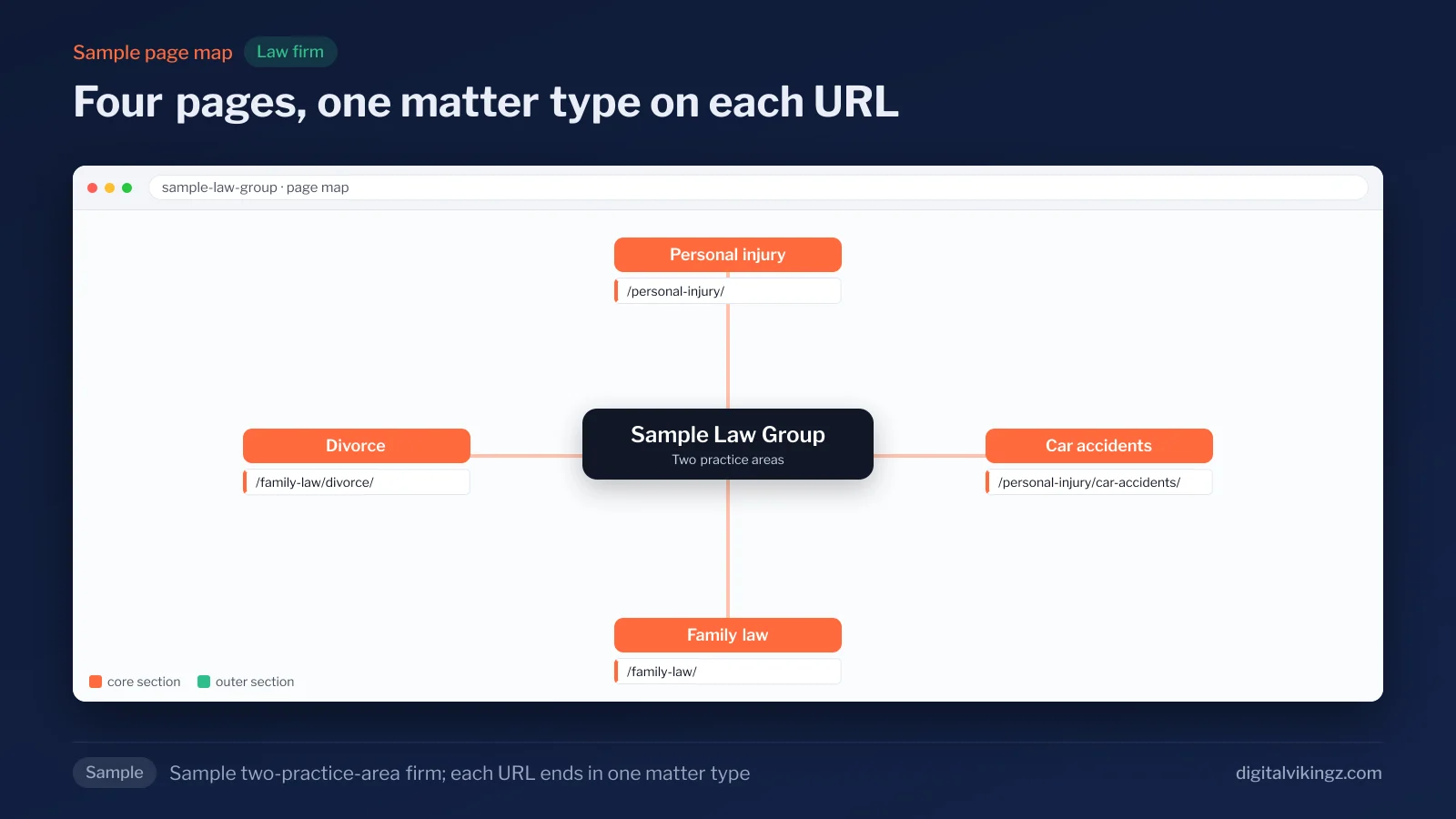
Sample page map for a two-practice-area law firm.
Figure 1 shows a sample page map with four pages: /personal-injury/, /personal-injury/car-accidents/, /family-law/ and /family-law/divorce/. The pages cover personal injury, car accidents, family law and divorce, and each URL ends in one matter type.
Practice-area pages versus one city page for each keyword
Practice-area pages target a matter type, while city pages target a place, so a law firm keeps city pages for the offices the firm staffs. A firm with offices in two cities gives each office its own page with the attorneys, address and matter types handled there.
Service area pages explain where a city page ends and a doorway page begins. A city without an office needs a different page type. Our guide to service area pages that do not become doorway pages sets the line.
Attorney and firm pages that carry credentials
Each attorney gets one page with checkable credentials and matching markup, and the firm page links every attorney to a practice area. In our view, a fact a client can check earns more trust than a claim the client has to believe.
A firm's own entity signals feed how Google shows the firm itself. Our guide on how to get a Knowledge Panel for a business covers the firm-level signals.
What goes on an attorney page?
An attorney page states the attorney's name, bar number, jurisdictions, education and matter types. The bar number may give a client and a search engine one fact to match against the state bar's public listing.
The page also shows the office the attorney works from, with the same address and phone as the Business Profile. The firm confirms with its state bar which fields the firm may publish.
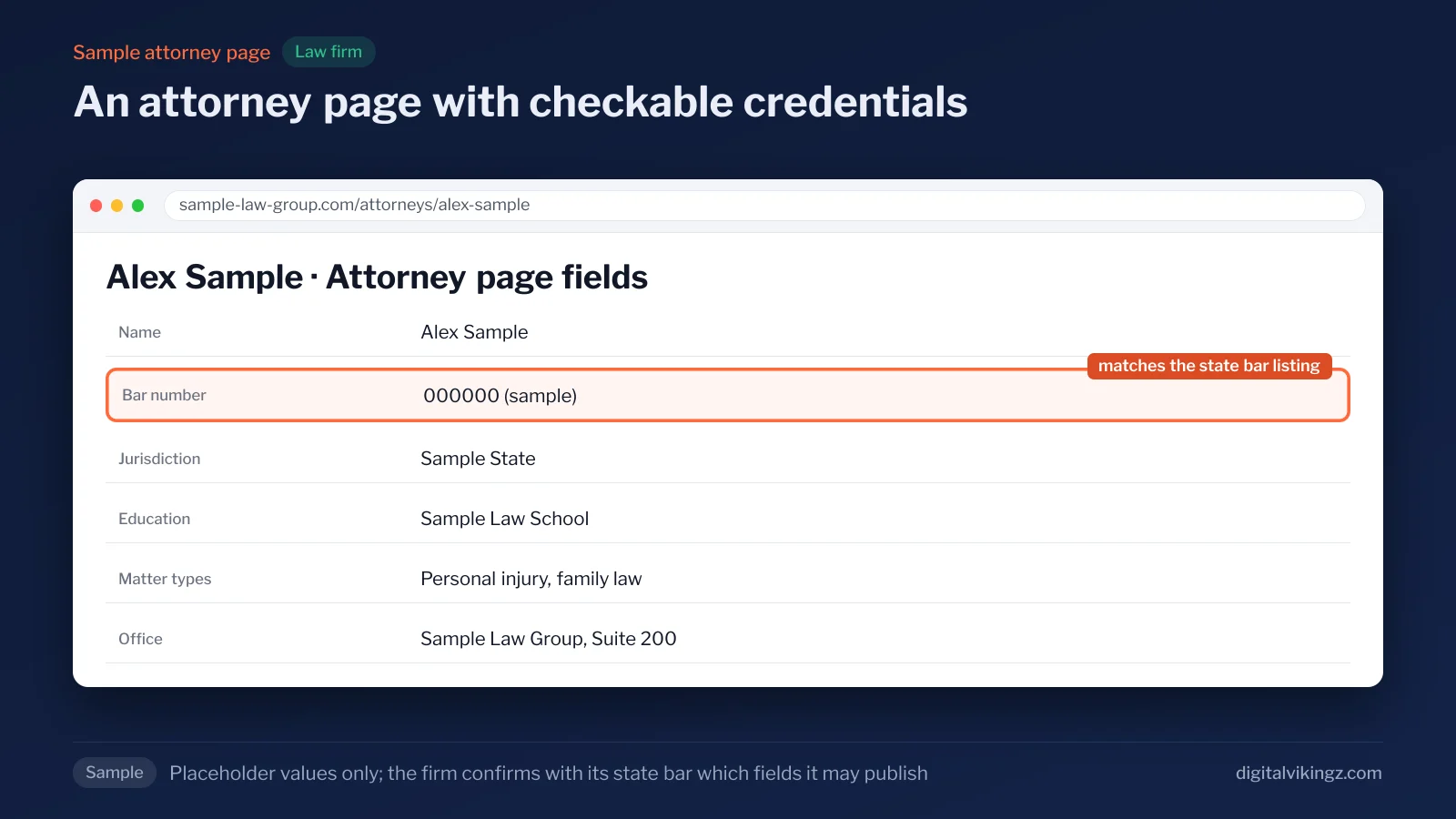
Sample attorney page fields with placeholder values.
Figure 2 shows a sample card for Alex Sample with bar number 000000, jurisdiction Sample State and education Sample Law School. The card lists personal injury and family law as matter types and Sample Law Group, Suite 200 as the office.
Most audits stop at the page and never check the entity behind the page. Our guide on why most SEO audits miss the entity layer explains the gap.
Does an attorney page need schema?
Yes, an attorney page can carry LegalService markup for the firm and Person markup for the attorney, matching the visible text. Schema.org marks the Attorney type as deprecated and states: "LegalService is more inclusive and less ambiguous."
Google stopped showing the FAQ rich result in May 2026, so FAQPage markup brings no rich result to a law firm page. Markup supports clear reading and promises no ranking, so the firm adds no markup the visible page does not show.
The website side is now set. The map side comes next.
A Business Profile for each office
A law firm gives each staffed office one Business Profile, picks its categories with care and checks attorney profiles and shared suites. The profile is one part of a larger Business Profile plan. Our complete guide to Google Business Profile optimization sets out the full profile setup in order.
Sample, not client data: a solo attorney rents a desk in a shared suite and lists the suite as the office. Google's guidelines ask for signage, staff and customers at that address. The profile needs all three.
Which primary category should a law firm choose?
A law firm should pick one primary category for its core matter type and add secondary categories only for matter types the firm staffs. Google's Business Profile category list has one entry for the firm type and separate entries for matter types, so the firm opens the category picker in its own profile and reads the options before choosing.
Google's guidelines tell businesses to "Choose the fewest number of categories it takes to describe your overall core business." Google publishes no rule that ranks Law firm above a practice category, so the firm compares the map results for its top matter types.
The category choice follows the same steps for every business. Our guide on how to choose your Google Business Profile primary category walks through the five steps.
Should each attorney have a separate profile?
Yes, a public-facing attorney can have a separate profile when clients reach the attorney directly at the verified office during stated hours. Google's guidelines state: "A practitioner shouldn't have multiple Business Profiles to cover all of their specializations."
At an office with several attorneys, the firm keeps its own profile, and each attorney profile carries the attorney's name only. A second profile at one address can be blocked, and practitioners on the Local Search Forum describe workarounds that we have not tested.
Each profile then competes on the same Maps factors. Our guide on how a business ranks higher on Google Maps explains what moves each profile.
Shared suites and virtual offices
Google does not accept a virtual office for a Business Profile, and a shared suite qualifies only with signage, customers and staff on site. Google also asks for permanent fixed signage of the business name at a shown address.
Photos of the entrance and the signage back up the address. Our guide on Google Business Profile photos covers what to upload.
Legal directories and consistent listings
A law firm claims the legal directories that clients and Google read, and keeps the same name, address and phone on every one. Patent application US20060149800A1, filed in December 2004 and assigned to Google, describes finding documents that are authoritative for a location.
Google Patents lists the application as abandoned, which is that site's own assumption. The application may describe a firm's own pages and its listings as signals for one address, so they should agree. Treat the patent as a hint.
The advice holds even if Google never used the patent, because a client who finds two phone numbers also loses trust.
Which legal directories matter?
Avvo, Justia, FindLaw and the state bar listing are the legal directories that law firm SEO guides name most. A directory profile is a citation, a listing that repeats the firm's name, address and phone.
Directories work as citations, not as the firm's home base, so the firm owns its site, domain and Business Profile. Free profiles come first, and a paid tier needs a stated reason, such as a tracked source of consultations.
No source states how many signed matters a directory sends, so the firm tracks each listing. Sample, not client data: a solo attorney who handles personal injury and family law finds the firm on four directories under four different suite numbers.
The listing check: name, suite and phone
A listing check compares the firm's name, suite number and phone across the website, the Business Profile and each directory. Google's guidelines state: "Provide a phone number that connects to your individual business location."
Each mismatch is logged with its source, such as Suite 200 on the website and Ste 200 on a directory.
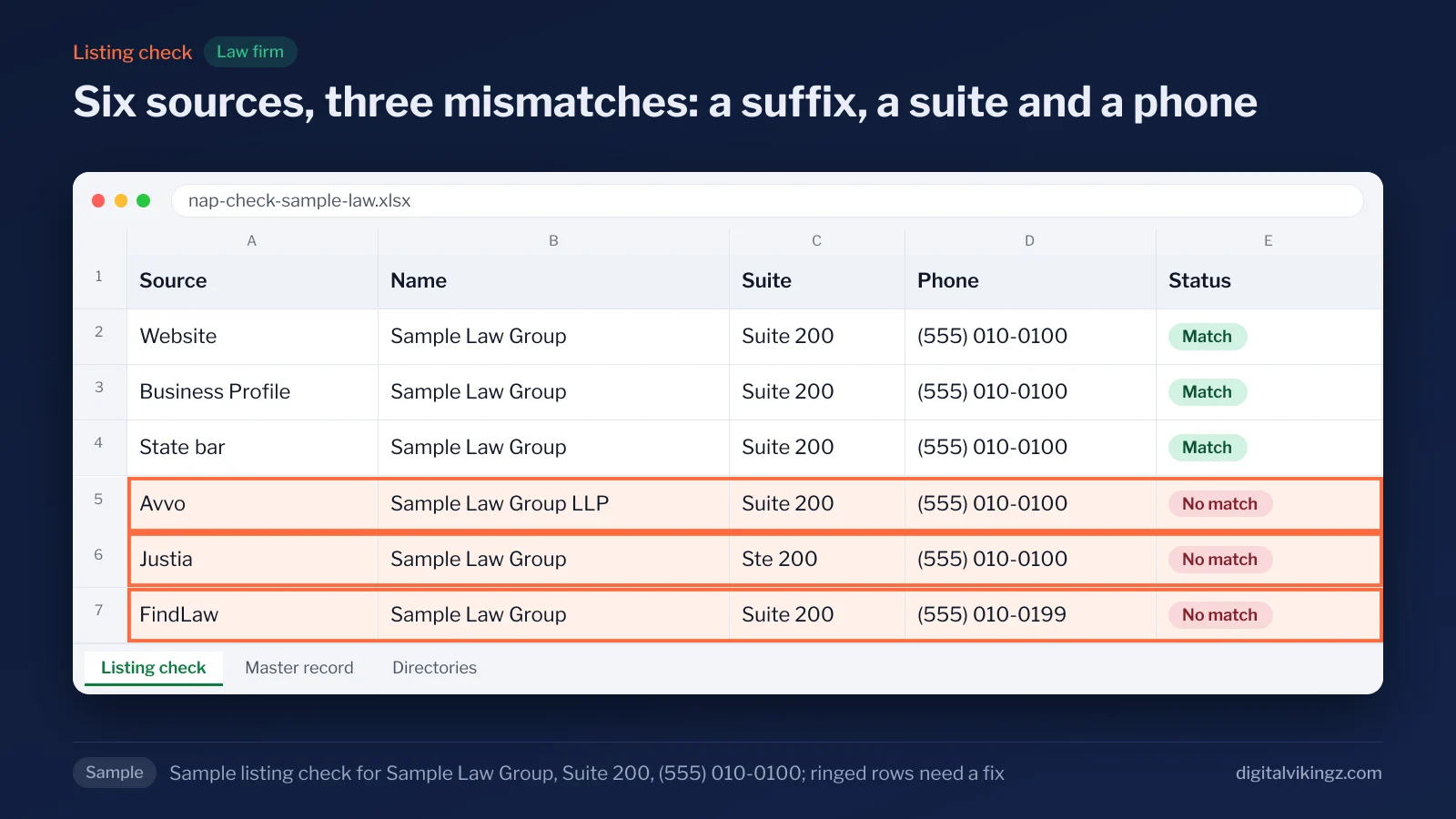
Sample listing check with three mismatches.
Figure 3 shows six sample sources for Sample Law Group, Suite 200 and (555) 010-0100. Avvo lists Sample Law Group LLP, Justia lists Ste 200 and FindLaw lists (555) 010-0199, so three sources need a fix.
Three sources are clean. The website, the Business Profile and the state bar listing match on all three fields.
A local SEO audit runs the same check with the other steps. Our local SEO audit with a citation check lists every mismatch in a ranked fix list.
Reviews that reveal no case detail
A law firm asks every client the same way, replies without confirming anyone's case and reports reviews from people who were never clients. Reviews are public, so the wording we suggest below is wording the whole town can read.
What may a law firm ask clients for?
A law firm may ask clients for a review of their genuine experience, and may not offer incentives or ask only happy clients. Google's review policy tells merchants they should not "request that specific content be included."
Google added a guideline on fake and undisclosed incentivized reviews to its review snippet documentation on 24 July 2026. A firm therefore asks for a review of the experience and leaves the case itself out of the request.
The request wording depends on the channel. Our guide on how to get more Google reviews without breaking Google's rules gives the wording for each channel.
How should a firm reply to a review?
A firm replies to every review in public, in the firm's voice, without confirming or denying that the reviewer was a client. Google posts the reply as the business, so the attorney's personal name does not show.
Reply wording that names no matter, date or outcome reveals nothing beyond what the reviewer posted. Here is a sample reply: "Thank you for sharing your experience. Please call our office so we can talk."
Whether a reply risks client confidentiality is a question for the firm's own counsel and state bar, not for SEO. Every reply follows the same short steps. Our guide on how to reply to every Google review lists the steps.
Reviews from people who were never clients
A review from someone who was never a client breaks Google's rule that a review reflects an actual experience with the business. The firm reports the review from the profile and names that policy in the report.
A Google Business Profile Community thread dated 1 November 2026 describes two office profiles with such reviews and no policy violation found. Nobody outside Google knows why one report succeeds and another fails, so the firm keeps a dated log of each report.
Removal steps and appeals have their own guide. Our guide on how to remove fake Google reviews lists the reporting options.
Advertising rules: SEO guidance, not legal advice
A law firm checks its own state bar's advertising rules before publishing a claim, a testimonial or a case result. The check covers four law firm SEO surfaces: practice-area pages, attorney pages, review replies and Business Profile posts.
A provider sends each new page and post to a named attorney for approval before the page goes live. We name no rule number here, and the state bar is the source for every rule.
A guide that names a rule second-hand is a lead to check, not a source to trust. Go to the bar itself.
Take a sample, not client data: a family law firm drafts a page that calls the firm a specialist. The attorney checks the state bar's rule on that word before the page goes live.
What do AI answers say about a law firm?
Google says the best practices for SEO stay relevant for AI Overviews and AI Mode, with no special optimization needed. A page must be indexed and eligible to show with a snippet to appear as a supporting link in AI Overviews or AI Mode.
Google also lists matching structured data and a current Business Profile among its best practices. Google's documentation notes that Google Search does not need llms.txt files.
Ask Maps, a chat feature for detailed questions about places, began rolling out in the United States on 12 March 2026. Nobody outside the assistants knows why one firm is named over another, so the firm checks what they say today.
The sources an assistant reads for a local business follow a pattern. Our guide on how an AI assistant picks a local business to name lists the sources.
Sample, not client data: a searcher asks an assistant for a family lawyer in a mid-size city. A firm whose profile, pages and listings agree gives the assistant one story to read. The assistant may or may not name it.
What a law firm should measure: consultations and signed matters
A law firm measures consultation requests and signed matters for each practice area, because rankings and traffic do not show signed matters. A visit is not a client, and the rest of this section works from that.
Why rankings and traffic miss signed matters
Rankings and traffic count visits, while signed matters count the clients who hired the firm, so reports built on visits hide the result. A 2022 Medium post and a LinkedIn post from about March 2026 call reports of keyword rankings and traffic a common agency complaint.
Both authors sell agency services, so we read them as one view. Intake speed and staffing sit with the firm, so the report separates consultation requests from signed matters.
What should a monthly report show?
A monthly report shows the work shipped and the consultation requests and signed matters for each practice area.
A monthly report lists the items below for each practice area:
- Pages shipped or changed.
- Business Profile changes.
- Listings fixed.
- Calls and direction requests.
- Consultation requests.
- Signed matters, from the firm's intake.
The website link on each profile needs a tag to count its visits. Our guide to Google Business Profile UTM tracking shows how to tag the link.
Sample, not client data: a firm with personal injury and family law gets one report page for each practice area. A rise in calls from the family law profile shows on its own line.
How long does law firm SEO take?
Law firm SEO takes months, because profile edits take days while reviews, links and pages build over a longer time. Google states that Business Profile edits can take up to 3 days to appear.
Map pack gains usually build over two to four months in our experience, while agency pages report noticeable gains in 3 to 6 months. Crowded trades and cities can take 6 to 12 months or longer, according to the same agency pages. Plan for months.
Nobody can fix the date, because competition and the starting state set the pace. Our guide on how long local SEO takes to work lists what moves first.
What does law firm SEO cost?
Legal SEO costs vary widely, because the matter types, the city and the scope of work set the monthly fee. HawkSEM's law firm page, modified 24 September 2025, lists a range of $500 to $30,000 per month.
Local SEO averaged $1,557 a month in an Ahrefs poll of 439 SEO providers that Ahrefs updated in August 2024. Both figures come from providers, so a firm treats them as reference points, not as a quote. Ask for the scope in writing.
Digital Vikingz quotes the work in writing after a strategy call and publishes prices only for Daily Google Posts. Pricing models and what each budget buys have their own guide. Our guide to local SEO pricing in 2026 compares the models.
How does law firm SEO compare with SEO for other local trades?
A law firm shares profile, review and page work with other local trades and adds attorney credentials, matter types and advertising checks. HVAC SEO plans around cooling and heating seasons, and plumbing SEO plans around emergency calls at any hour.
Dental SEO is the closest model, because a dental practice also publishes one page for each treatment and a page for each dentist. The dental pattern shows the same one-page-per-service idea from the healthcare side. Our guide to dental SEO for practices shows the same pattern.
Every local business pairs a service with a place, and a law firm fills the service with a matter type. Semantic SEO for local service businesses builds the profile, page and review work into one plan. Our semantic SEO plan for a local service business starts from that shared base.
Sample, not client data: "AC repair near me" pairs a service with an urgent need. "Family lawyer near me" pairs a matter type with a place.
What should a law firm ask an SEO provider before signing?
A law firm should ask an SEO provider seven questions about scope, ownership, review, reporting, the first 90 days and who does the work.
The seven questions to ask a law firm SEO provider are listed below in the order a proposal answers them:
- What does the monthly fee cover, page by page and profile by profile?
- Who owns the website, the domain, the Business Profile and the directory logins if we leave?
- Who writes the practice-area pages, and which attorney approves them before they go live?
- How do you word review replies without confirming that a person was a client?
- Which report shows consultation requests and signed matters for each practice area?
- What changes in the first 90 days?
- Who does the work: your team, contractors or a reseller?
A provider that answers in page names and report columns has a plan, and one that answers in adjectives has a pitch.
The first 90 days of a semantic SEO engagement follow a set order. Our guide to the first 90 days of a semantic SEO engagement shows what the answer to question 6 can look like.
Some legal marketing consultants resell the work. Consultants who resell the work can read how white-label SEO is delivered.
Our site carries no law firm case study yet, so every figure in the guide is a labelled sample or a Google page.
Suppose a solo attorney receives two proposals at similar prices (a sample, not client data).
One names fifteen pages and a report with signed matters. The other lists keyword packages. Question 1 and question 5 separate them.
Law firm SEO questions
Is SEO worth it for a law firm?
Yes, SEO can pay off for a law firm when the value of a signed matter exceeds the cost of the work. A firm tests that by counting signed matters from search for each practice area.
Can an SEO provider promise a first-page ranking?
No, no provider can promise a ranking, because Google states there is no way to request or pay for a better local ranking. A proposal that promises a position is a warning sign. We would walk away from it.
Can every attorney use the firm's main phone number?
No, each profile needs a phone number that connects to its own location, and Google asks for a local number over a call center line. Practitioners on the Local Search Forum advise a separate number for each attorney profile.
Should a solo attorney hire an agency or start alone?
A solo attorney can start alone, because the first steps need time and care more than a large budget. Some work outgrows the week. Our guide on in-house semantic SEO or an agency sets out when outside help pays.
Where should a law firm start?
A law firm should start with the listing check, then the profile, then one page for its best matter type, then the report.
The first four steps for a law firm are listed below in order:
- Compare the firm's name, suite and phone across the website, the profile and the directories.
- Choose the primary category and decide which attorneys get a profile.
- Write one page for the matter type that brings the most signed matters.
- Set the report to count consultation requests and signed matters.
The ongoing profile work is where most firms stall. Our Local SEO and Google Business Profile optimization covers the profile, pages, listings and reports, and a strategy call starts the written quote.
Daily Google Posts is our daily posting tool for Business Profiles, from $99 a month per listing, with each post checked by the firm. Scheduling tools and done-for-you posting solve different problems. Our comparison of done-for-you Google posts and scheduling tools shows the difference.
Start with the listing check in the next seven days.