 Digital Vikingz
A pest control owner opens the call log in a slow month and the number is lower than last year. The cause sits in one of three places: demand, the Google listing or the website.
Pest control SEO is local SEO that gets a pest control company found in Google Maps, organic results and AI answers by nearby homeowners. Pest control searches follow the seasons, and each pest has its own months.
A pest page names the pest, and a treatment page names the method. A pest control Business Profile needs a verified listing, one primary category, every service named and current hours. Fix the surface that fell first.
What is pest control SEO?
Pest control SEO is local SEO that gets a pest control company found in Google Maps, organic results and AI answers by nearby homeowners.
Pest searches add a pest, a season and a treatment plan to the usual local search.
The map pack is the three business listings Google shows beside a map. Organic SEO ranks the website pages listed below the map pack. AI answers are replies from tools such as ChatGPT, Gemini and Google's AI Overviews.
Sample: a homeowner types 'termite treatment near me' and sees three listings first.
Maps and organic results follow different rules, and our guide on local SEO versus organic SEO for a service business sets them out.
We measure the work in calls and booked jobs. Calls are the goal. Four kinds of searches bring those calls.
Four kinds of pest control searches
Pest control searches fall into four kinds: identification, treatment, recurring plan and emergency.
The four kinds of pest control searches are listed below:
- Identification searches ask what a pest or a sign of pests is, such as 'what are these bugs in my house'.
- Treatment searches name a pest and a method, such as 'termite treatment' or 'bed bug treatment'.
- Recurring plan searches ask for repeat visits, such as 'quarterly pest control'.
- Emergency searches ask for a company now, such as 'same day pest control near me'.
All four searches above are samples, not Search Console data. Which kind fell shows up in your call log.
How do you find out why pest control calls dropped?
We read a drop in pest control calls three ways, by comparing the same 90 days last year.
The table below sets out the three readings:
| What you see | What it points to | Where to look next |
|---|---|---|
| Listing calls and form fills both fell | Weak demand, often the season | Pest control searches by season |
| Listing calls held and form fills fell | A change in how people search | How do pest control companies show up in AI answers? |
| Listing calls fell and form fills held | Lost Maps visibility | How should the Business Profile be set up for a pest control company? |
None of the three readings is proof. Check each against your own numbers.
The profile performance page shows calls, and Search Console shows the site's clicks.
Calls can fall for reasons SEO does not control, and a closed phone line is one of them. A mild season that sent fewer pests indoors is another.
Our checklist for Google Business Profile calls dropped and what to check first covers the listing side.
A listing missing from the map is another problem, covered in our guide to a pest company not showing on Google Maps. The first reading to rule out is the calendar.
Pest control searches by season
Pest control searches follow the seasons, and each pest has its own months.
HVAC companies see the same seasonal searches. Our guide on how HVAC companies rank for seasonal searches shows the calendar in another trade.
Which pests peak in which months?
Housecall Pro's guide ties termites to spring, mosquitoes to late spring and summer, ants to summer and mice to fall and winter.
That is one vendor's view. Climate moves the months. Your own Search Console shows them best, because it lists the searches people typed to reach your site in your own towns.
The table below turns that list into a calendar of pages and profile posts:
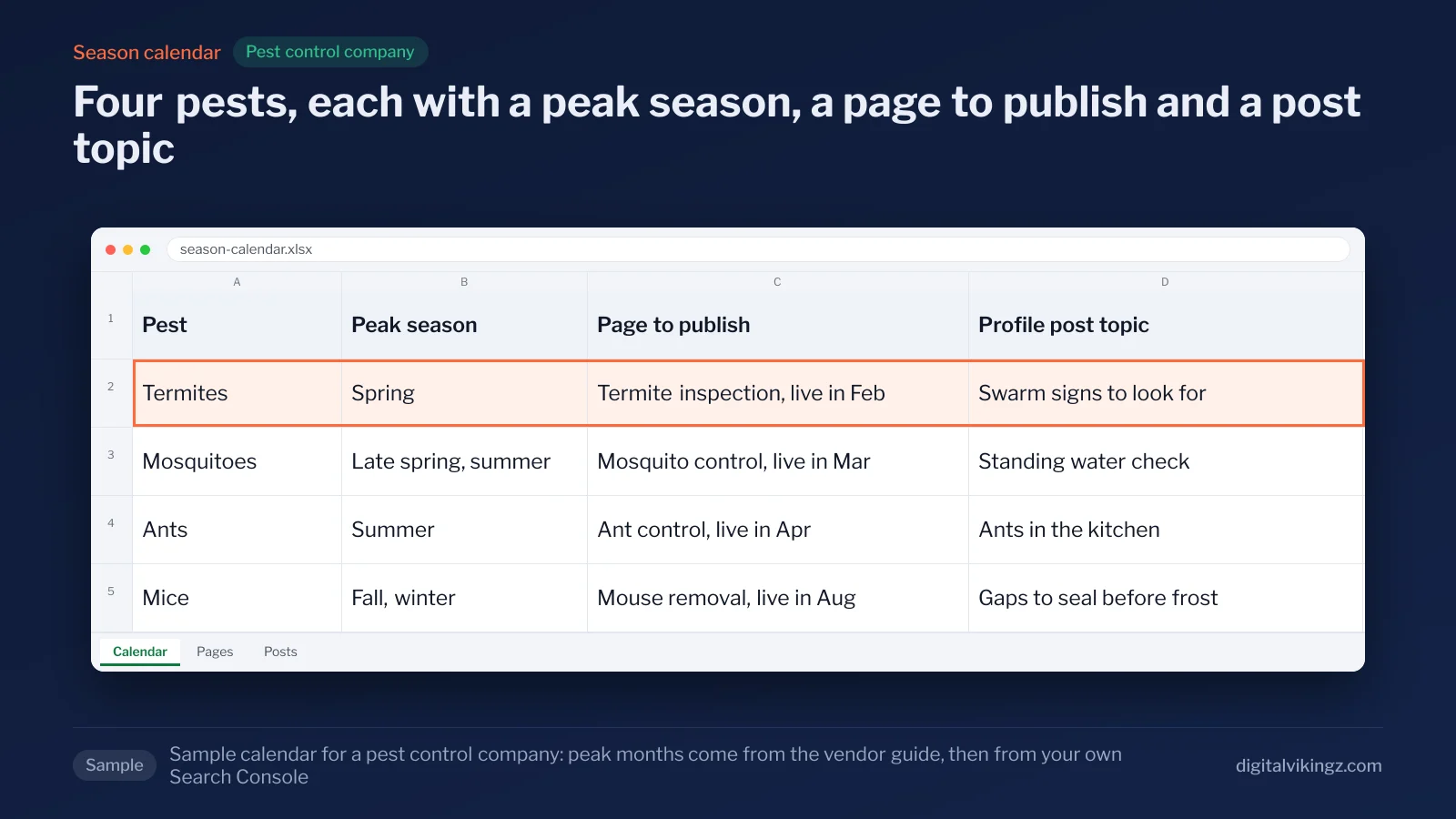
A sample season calendar lists four pests with a page and a post for each peak.
The sample calendar lists four pests with the vendor's peak season, a page to publish before it and a post topic.
How far ahead should seasonal pages go live?
Seasonal pages should go live before the pest's peak months, not during them.
Google does not guarantee that a page is indexed or served. Publishing early gives the page time to be crawled before searches climb. Sample: a mosquito page published in March has April and May to be found before late spring searches.
Plan ahead.
Profile posts follow the same calendar, with one topic for each pest as its season nears. Who writes them every month? Our comparison of done-for-you Google Business Profile posts versus scheduling tools covers cost, time and who writes.
Some searches arrive before the buyer is ready.
Identification searches and the pages that answer them
An identification page names a pest from what the searcher describes and then points to the treatment page.
Sample: a homeowner photographs a bug on a counter and opens the first page that names the pest.
An identification page should name the pest, show lookalikes and link to the treatment page. That way a searcher who is not ready to book still finds the next step.
Photos on the page should be the company's own, with a caption naming the pest. A stock picture tells the searcher nothing about your company.
Nobody outside Google knows how often an identification visit turns into a call. Track every page.
Does answering identification searches give away business?
No, an identification page puts a pest control company in front of homeowners early and carries them to a treatment page.
Practitioners in a Local Search Forum thread on pest control sites say identification content wins informational results. That is one practitioner view and no Google statement.
Keep the page to what the searcher asked. Then link to the treatment page, where the booking step lives and where the searcher can see how the company works.
Pest and treatment pages, one for each
A pest page names the pest, and a treatment page names the method.
Each page carries the pest or method, the service, the towns served and the next step. A pest or treatment page holds four parts, listed below:
- Name: the pest or the method, written the way owners search.
- Service: what the visit covers and how to book.
- Towns: the places served, linked to the service area pages.
- Proof: the company's own photos and review replies for that job.
Jobber's guide lists rodents, termites, bed bugs, ants, cockroaches, fleas, mosquitoes and wasps as keyword ideas. Dental practices build the same page set for treatments, as our guide on how dental practices get found on Google Maps shows. How many pages a company needs comes next.
Do you need a page for each pest?
Yes, a pest that people search by name needs its own page, and rare pests can share one.
Two pages that answer one search compete with each other. Merge them. The choice between merging and removing is covered in our guide to content pruning: refresh, consolidate or remove.
Recurring plan and one-time treatment pages
A recurring plan page sells repeat visits on a schedule, and a one-time treatment page sells one visit.
The two pages answer different searches, so each gets its own URL. Keep them apart. The table below compares the two pages side by side:
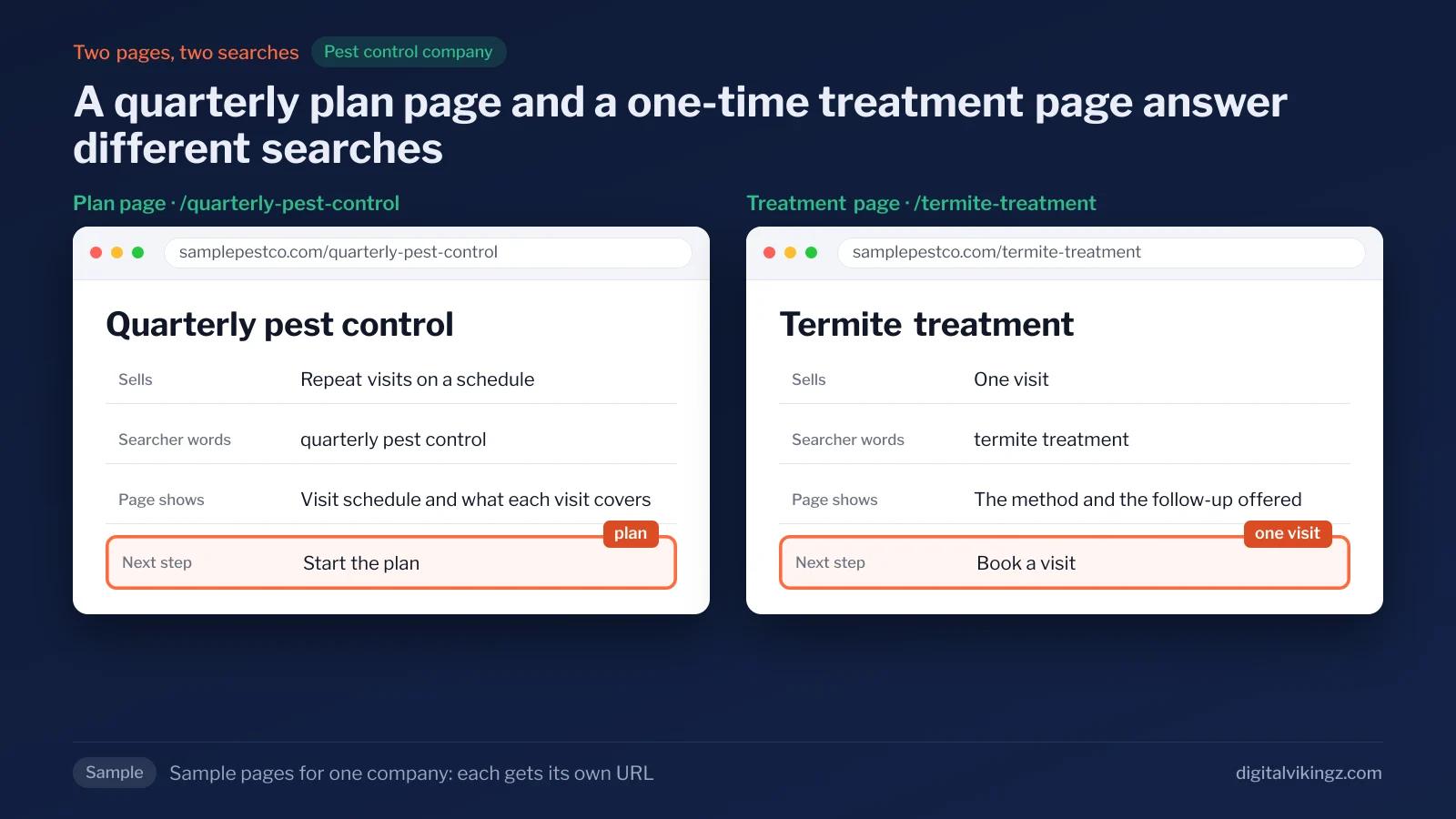
A plan page and a treatment page answer different searches.
The sample compares a quarterly plan page with a one-time treatment page for the same company. The quarterly plan page answers 'quarterly pest control', shows the visit schedule and what each visit covers, and ends with a start-the-plan step. The one-time page answers 'termite treatment', shows the method and the follow-up the company offers, and ends with a book-a-visit step.
How should a plan page explain price?
A plan page should state how the price is set, such as per visit or per year, and name the factors.
Most pest control guides we read leave plan pricing vague.
Any price on the page must be one the company will honour, because a searcher who reads a number will hold you to it. Price ranges for pest control are yours to set. We quote none here.
Emergency, same-day and service-area searches
Same-day and emergency searches ask for a company to come now, so the call button and the towns served come first.
Sample search: 'pest control Lakeside today'. Speed matters here.
Each town served can get a service area page. Our guide on service area pages for each pest control town without doorway pages sets the limits.
The listing decides who sees those pages first.
Can you rank in a town where you have no office?
Yes, a company can appear in any town the company serves, and distance to the searcher still counts.
Google names distance as one of three local ranking factors, with relevance and prominence. Sample: a company with a rural address 70 miles from the nearest city starts with a weak distance signal there.
Nobody outside Google knows how far a listing reaches for one search. Our guide on service area businesses on Google covers hiding the address and setting areas.
How should the Business Profile be set up for a pest control company?
A pest control Business Profile needs a verified listing, one primary category, every service named and current hours.
Google says complete and accurate business information makes a listing more likely to show in local results.
The name field holds the company name as used on the storefront and website. Keep it clean. Google says extra information in the name can get a profile suspended.
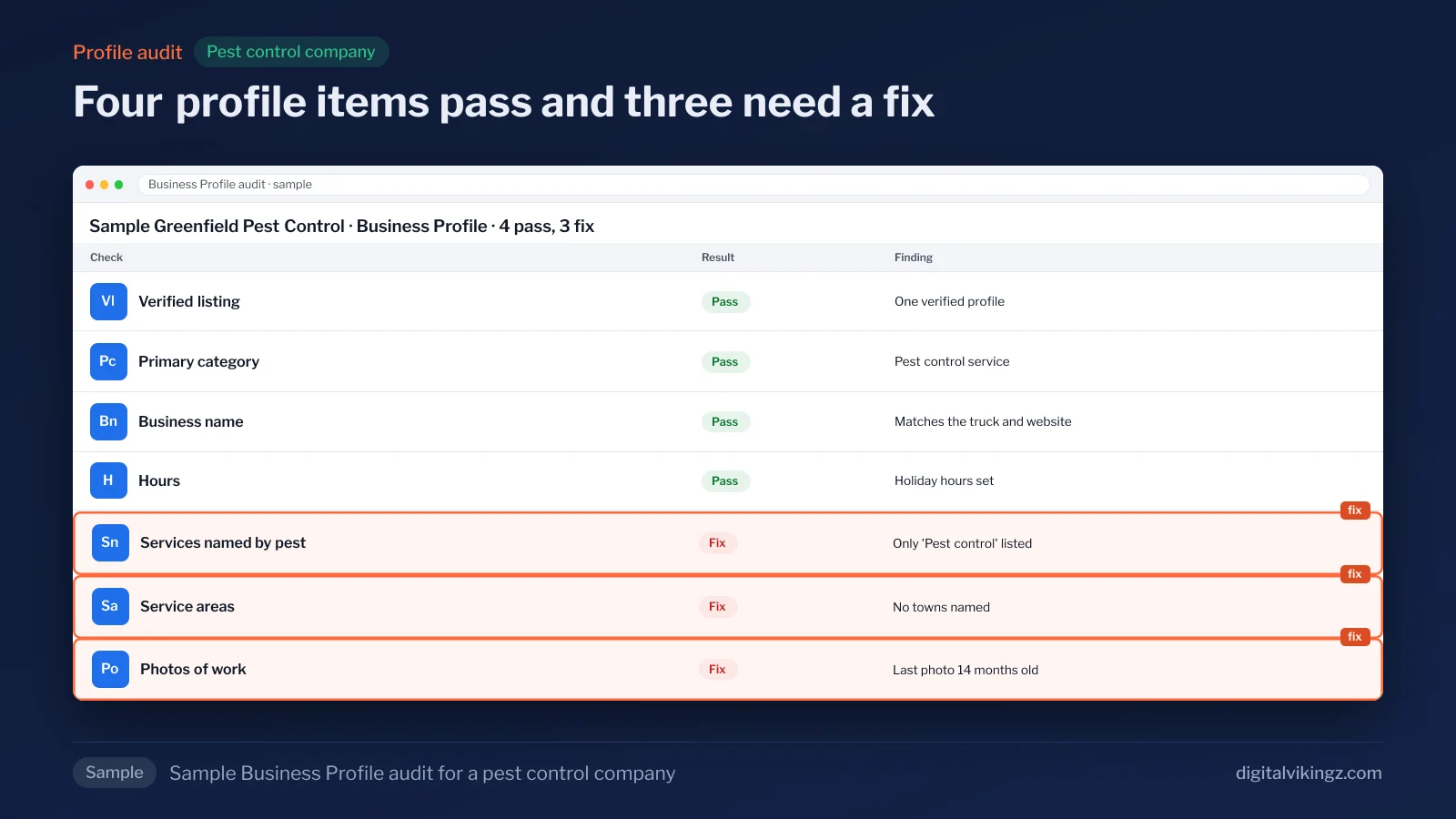
A sample audit marks four profile items pass and three items fix.
The sample audit marks four items pass and three items fix. Services named by pest, service areas and photos of work are the three fixes.
Our guide on how to optimize a Google Business Profile from setup to upkeep lists every field in order. Our guide on ranking higher on Google Maps with relevance, distance and prominence covers the levers.
Categories that fit a pest control company
A pest control company should pick the primary category that names its main paid service and add secondary categories for the rest.
Some owners say exterminator and others say pest control, so check the category picker's own names. Sample: a company that earns most from termite work puts that service category first. Pick one.
Our guide on choosing the Google Business Profile primary category for a pest control company walks through the steps.
Review language that names the pest and the town
Reviews that name the pest and the town come from customers describing the job in their own words.
Ask every customer after every job. Never script the words.
Google's review policy bars companies from asking only happy customers, which it calls selectively soliciting positive reviews. Google also says replying to reviews shows customers you value their feedback.
Our guide on how to get more Google reviews from pest control customers in 7 steps gives request wording. Photos of the company's own work help too, as our guide to Google Business Profile photos: what to upload and how often explains.
How do pest control companies show up in AI answers?
A pest control company can appear in Google's AI Overviews and AI Mode with the same SEO work that ranks the page in search.
Google says no additional requirements exist beyond SEO best practices.
A page must still be indexed and eligible to show with a snippet, and indexing and serving are never certain. We have not tested pest control prompts in ChatGPT, Gemini or Perplexity yet. Treat any claim about them, ours included, as untested.
Each tool reads other sources too, and nobody outside the company knows the full list. Sample prompt: 'best pest control company in Lakeside'.
Our guide on how an AI assistant chooses which local business to recommend sets out the steps. Our guide to how Perplexity chooses its sources covers one engine in detail. Calls from any surface need counting next.
How do you measure booked jobs and cost per booked job?
A booked job is a call or form that ends with a scheduled visit, and cost per booked job divides spend by those jobs.
The table below is a blank sheet for your own numbers:
| Source | Calls or forms | Booked jobs | Spend | Cost per booked job |
|---|---|---|---|---|
| Google listing | (your number) | (your number) | (your number) | Spend divided by booked jobs |
| Website form | (your number) | (your number) | (your number) | Spend divided by booked jobs |
| Paid source, if any | (your number) | (your number) | (your number) | Spend divided by booked jobs |
Blank sheet, no data.
The profile shows direction requests too, and Search Console shows site clicks. Profile visits show in GA4 once the link carries UTM parameters, as our guide to Google Business Profile UTM tracking in GA4 explains.
Your booking software holds the booked jobs, and no SEO tool can see them for you. Count what you book. Paid ads and lead vendors report calls too, so the comparison needs the same sheet.
How does pest control SEO compare with lead vendors and paid ads?
SEO builds pages and a profile the company keeps, while lead vendors and paid ads stop when the spend stops.
Pest control leads for sale is a separate search. We do not cover vendors here. Semantic SEO for local service businesses covers the pages, the profile and the entity signals together.
The table below compares the three routes on what stays after the spend:
| Route | What you keep | What stops when the spend stops |
|---|---|---|
| SEO | Pages, profile and reviews | Nothing stops at once; results can fade without upkeep |
| Lead vendors | The leads you bought | New leads |
| Paid ads | The clicks or leads you paid for | New clicks and leads |
Nobody outside Google can say how many calls organic results give against ads in your town. A company that wants the whole plan can start with our page on semantic SEO for local service businesses such as pest control companies. Google's own ad change comes first.
Local Services Ads are moving into Performance Max
Google is moving Local Services Ads campaigns into Performance Max campaigns with pay-per-lead goals, starting with select US home service advertisers including pest control.
Google Ads Help dates the first phase to August 2026. Later phases reach service area businesses without storefronts in late 2026 and remaining categories in 2027. Business name, address and hours sync one way from the Business Profile into Google Ads.
Ad setup sits outside this guide, so check Google Ads Help for the steps. Phase dates can move, so read the page again before you act.
How much does pest control SEO cost?
Pest control SEO costs depend on the pages, the profile work and the reporting an agency includes, so ask for a written quote.
Published prices vary widely across the agencies we read, and each price is the agency's own claim. Ask what a price covers: pages, profile work, reports and review replies, and whether the agency or you pays for any tools. We price our work by written quote after a strategy call.
How long does pest control SEO take?
Pest control SEO takes 3 to 12 months to show results, by the guides we read.
Housecall Pro and SEO.com give 3 to 6 months for local results. Loganix says at least 6 months, and Jobber says 4 to 12.
Nobody can promise a position by a date, and we do not. A seller who does is guessing.
Cash runs short in the slow months, so the work should start before they arrive.
How do you choose a pest control SEO agency?
Choose a pest control SEO agency by what the agency shows you: pest pages, profile changes and calls tracked to booked jobs.
The five questions we ask of any pest control SEO agency, ours included, are listed below:
- Pages: which pest and treatment pages has the agency built, and can you open them?
- Reporting: does the report show calls and booked jobs, or only rankings?
- Writers: who writes the pages, and who reviews them?
- Promises: does the agency promise a position or a date?
- Exit: do you keep the pages and the profile if you leave?
Our weak points: we are not a pest control specialist, and we have no pest control case study yet. A specialist agency may know pest routes better than we do. Ask any agency to show its SEO audit first.
Our note on why most SEO audits miss the entity layer says what to look for. Our page on what happens in the first 90 days of a semantic SEO engagement shows how we start.
What should you fix first?
Fix the surface that fell first: the Business Profile when listing calls fell and the pest pages when form fills fell.
Do them in order. The first five fixes are listed below:
- Compare listing calls and form fills with the same 90 days last year.
- Correct the profile: category, services by pest, service areas and hours.
- Publish the top pest page and its treatment page before the peak month.
- Add a recurring plan page that states how the price is set.
- Count calls and booked jobs on the sheet each month.
Our guide on how to run a local SEO audit and fix the biggest gap first covers steps one and two. Local SEO and Google Business Profile work covers the first two fixes.
We run these fixes inside our Local SEO and Google Business Profile optimization for pest control companies, and the first step is a strategy call. Our Daily Google Posts written from a pest control company's own website start at $99 a month per listing. The first post is free.
Start with your call log.
Frequently asked questions
Can you do pest control SEO yourself?
Yes, an owner can do the profile and the pages in-house, and an agency can take over when time runs short.
Our guide on in-house semantic SEO or an agency sets out which fits which business.
Should the homepage target the town of the listing?
Yes, the homepage should name the listing's town, and service area pages should cover the others.
The homepage names one town, so every other town needs a page of its own.
Can anyone promise a position by a date?
No, Google says there is no way to request or pay for a better local ranking.
A promise of a position by a date claims more than anyone can deliver.
Does posting on the profile raise rankings?
Google's local ranking tips do not list posts, so we treat posts as an update for people who look.
A post about a pest in season tells a searcher the listing is active.
Should a pest control company start a new domain?
No, a new domain starts without the old site's history and links, so keep the domain and fix the pages.
Pages and the profile on the current domain keep the history and links the site already has.
Can a suspended profile come back?
Yes, a suspended profile can be reinstated after an appeal, and our guide on reinstating a suspended Google Business Profile gives the steps.
Open your call log, compare the numbers with last year and fix the surface that fell. Book a strategy call when you want Digital Vikingz to run the fixes.