Digital Vikingz
Perplexity SEO is the work of making a website one of the sources Perplexity retrieves and cites with a numbered link inside its answers.
Perplexity searches its own web index for every question, extracts the answering passages and attaches numbered citations to those pages. The sources include open-web pages and licensed data such as Statista, and some cited sites carry a Government, Academic or Trusted label.
A site raises its chance of citation by allowing PerplexityBot, writing answer-first dated passages and earning mentions on sources Perplexity already cites. Progress shows in a fixed prompt log, run several times, and in GA4 as perplexity.ai / referral. The work pays when buyers ask Perplexity questions in the market, and the page that wins depends on the type of question.
What is Perplexity SEO?
Perplexity SEO is the work of making a website one of the sources Perplexity retrieves and cites with a numbered link inside its answers. Perplexity's Help Center states that "each answer includes numbered citations linking to the original sources."
Perplexity AI is the company behind the answer engine. A citation inside a Perplexity answer is the unit of success, not a position in a list of links.
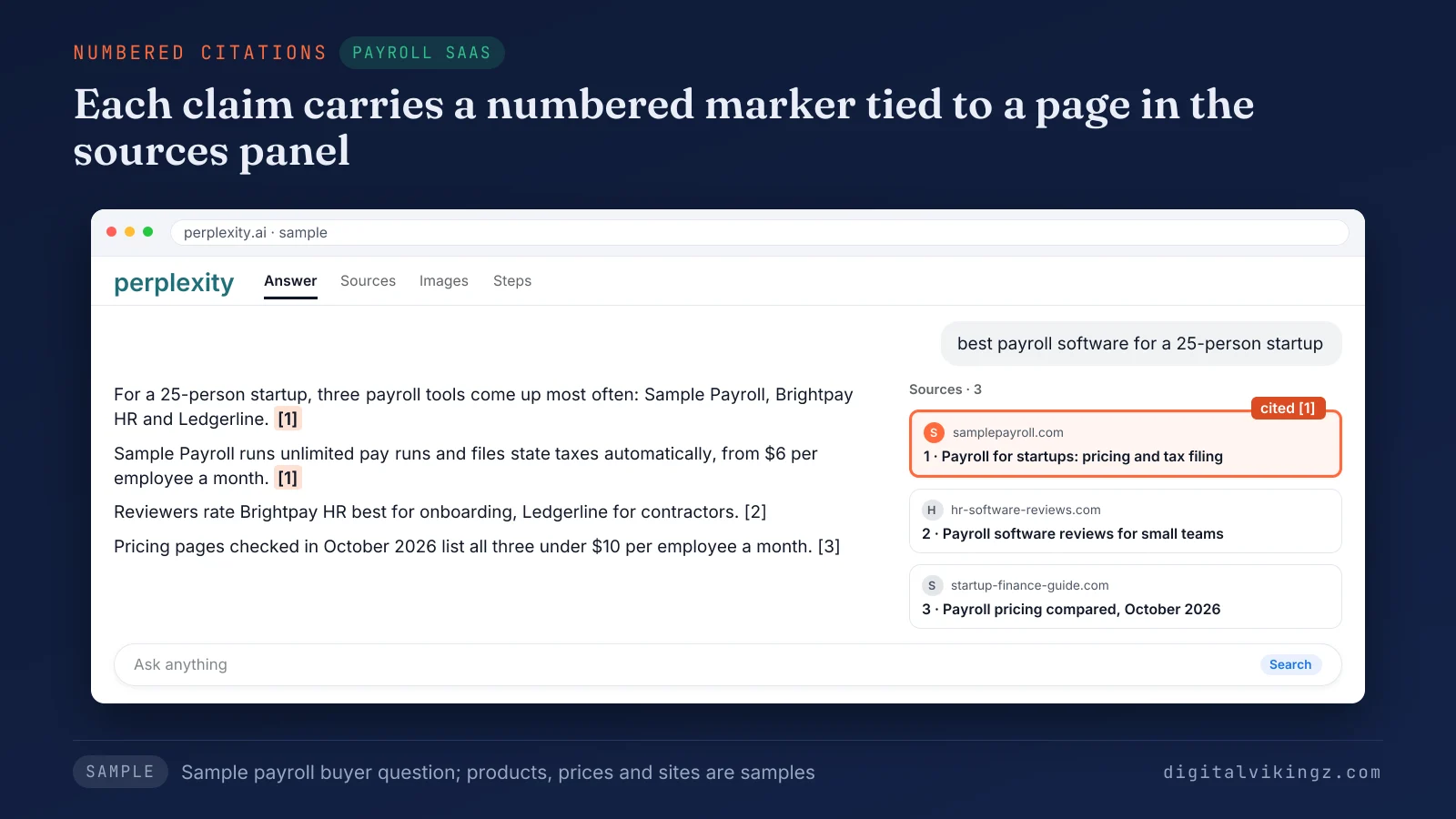
The numbered markers in the sample tie each claim to a source, and the sources panel lists every page behind the answer. Perplexity SEO is one part of the wider practice that an AI SEO guide to AEO, GEO and LLM visibility covers across every engine.
The term Perplexity SEO also describes using Perplexity as a research tool inside SEO work, which Perplexity's own use-case page covers. Being cited in that panel depends on rules that Google SEO does not share.
How is Perplexity SEO different from Google SEO?
Perplexity SEO differs from Google SEO because Perplexity cites passages it retrieves for each question, while Google ranks whole pages as links. The main differences between SEO for Perplexity and Google SEO are compared below:
| Point | Google SEO | Perplexity SEO |
|---|---|---|
| Unit of success | A ranked page in the results | A numbered citation inside an answer |
| Index | Google's index | Perplexity's own web index |
| What is read | The whole page | Query-relevant text extracted from the page |
| Crawler | Googlebot | PerplexityBot |
Both engines still need a crawlable page, a clear answer and a trusted source, so Google SEO work stays the base. A Google ranking does not move a page into Perplexity answers by itself, because Perplexity searches its own index.
The difference starts with how Perplexity picks its cited pages.
How does Perplexity choose its sources?
Perplexity chooses its sources by searching its own web index for each question, extracting the passages that answer it, and citing those pages with numbers. The source pool, the index behind the pool, the source labels and the fit of each passage all shape that choice.
The four stages Perplexity describes for every answer are listed below:
- Question reading: Perplexity interprets what the user is asking before any search runs.
- Live search: Perplexity searches the web at the moment of each question, through its own web index.
- Passage extraction: The search returns query-relevant text from each page, not the whole page.
- Cited answer: The answer attaches numbered citations that link to the original sources.
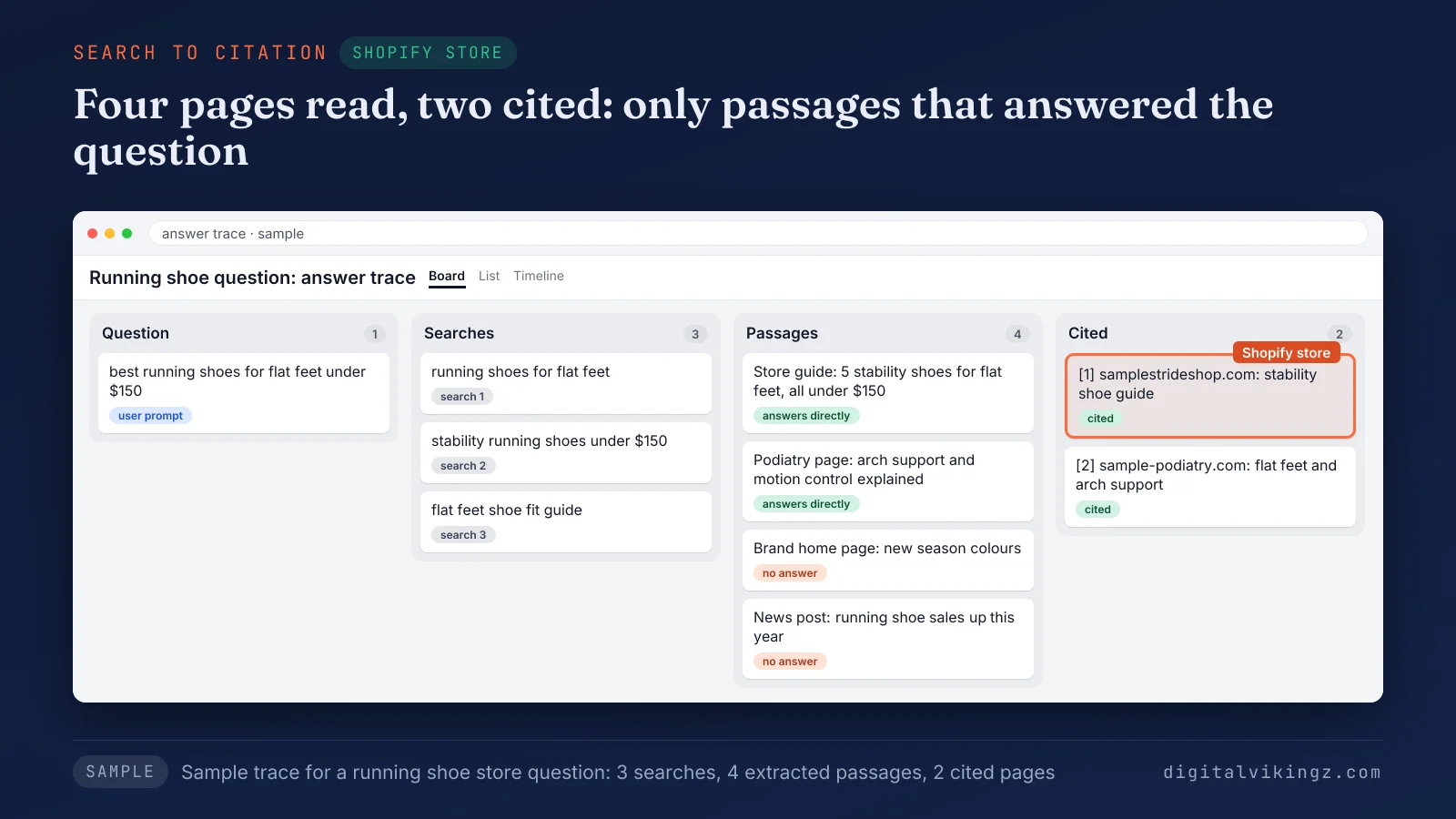
The sample shows four pages read and two pages cited, because only two passages answered the question directly.
Does Perplexity run more than one search per question? Perplexity says Deep Research "performs dozens of searches automatically", while one 2026 study observed default searches usually running one near-verbatim search. Suganthan Mohanadasan published the study in July 2026, based on one logged-in Pro account.
Perplexity publishes no ranking formula, so any list of Perplexity ranking factors is an inference from outside. Every AI search engine shares part of the same pattern of retrieval, passage choice and citation. The rules shared by every engine are in the guide on how AI search engines decide who to cite.
The four stages draw on a defined set of sources.
What sources does Perplexity use?
Perplexity uses pages from the open web, read through its own web index, plus licensed premium data sources such as Statista, PitchBook and CB Insights. The two source groups inside Perplexity answers are listed below:
- Open-web pages: Articles, websites and journals reach Perplexity answers through its own web index.
- Premium data sources: Licensed content that is "not available on the open web" comes from Wiley, PitchBook Essentials, CB Insights, Statista and Midpage.
Statistic-led buyer questions can be answered from licensed data, according to Perplexity's premium source list. A business figure therefore competes with Statista inside the same Perplexity answer.
First-party figures, such as a company's own benchmark or survey, give Perplexity a number the licensed sources do not hold. Readers often ask which search engine feeds the open-web part.
Does Perplexity use Google or Bing results?
Perplexity does not describe Google or Bing as its search source today, and its Search API documentation says queries run against Perplexity's web index. Perplexity's API documentation states that a search "runs your query against Perplexity's web index and returns ranked pages."
SEO consultant Ethan Lazuk records that Perplexity relied on Bing in 2022, before Perplexity invested in its own crawler and index. Some agency guides still claim Google and Bing feed Perplexity today, and none of them cites a Perplexity source.
Perplexity also marks some cited sites with a label.
What are Perplexity source labels?
Perplexity source labels are shield icons that mark a cited website as Government, Academic or Trusted after Perplexity's source review. The three source labels Perplexity gives are listed below:
- Government: Perplexity reserves the label for "the official website of a government organization."
- Academic: Perplexity describes academic sources as "scientific sites", such as peer-reviewed journals.
- Trusted: Perplexity calls Trusted "a broad category" for sites that appear often in results and publish within their own expertise.
Perplexity states that it "rates the whole website a source comes from, not each individual page." The review asks whether a site corrects its mistakes and says who wrote each piece, two signals any SaaS or clinic site controls.
Perplexity adds that most domains carry no label and that payments do not affect a label. Perplexity does not say that a label changes which sources get cited.
A cited page needs more than a label, because Perplexity reads more pages than the answer cites.
Why does Perplexity retrieve a page and not cite it?
Perplexity reads more pages than it cites, and a page can lose the citation when another source's passage answers the question more directly. One 2026 study of Perplexity's answer stream observed more pages retrieved than cited on every logged query.
Perplexity extracts the text that matches the question, so a page whose answer sits deep in a long paragraph gives a weaker passage. Broad prompts tend to cite the few sources Perplexity already trusts, while narrow task prompts can cite a smaller specialist page.
Google-ranked pages that stay uncited usually match one of the seven reasons a page ranks in Google and is not cited by AI. Passage fit and prompt breadth set the order of work for a site that wants numbered citations in Perplexity.
How do you get a site cited by Perplexity?
A site raises its chance of Perplexity citations by allowing PerplexityBot, writing answer-first dated passages and earning mentions on sources Perplexity cites. Readers often call the goal ranking in Perplexity, and the measurable result is a numbered citation.
The steps to get a site cited by Perplexity, in priority order, are listed below:
- Open the door: Allow PerplexityBot in robots.txt and its published IP ranges in the firewall.
- Serve readable HTML: Keep the core answer in the raw HTML, not only in JavaScript.
- Answer first: Put a direct answer in the first sentence under each question heading.
- Date the page: Show a visible updated date and refresh figures when they change.
- Publish own figures: Add first-party data that the licensed sources do not hold.
- Earn mentions: Get the brand named on pages Perplexity already cites for the target prompts.
No step guarantees a citation, and Perplexity publishes no paid route into organic citations. Perplexity SEO work follows that order because each step depends on the one before.
Access comes first, because Perplexity has no way to cite a page its crawler never reached.
Should you allow PerplexityBot in robots.txt?
Sites that want Perplexity citations should allow PerplexityBot in robots.txt, because Perplexity uses PerplexityBot to surface and link websites in its search results. Perplexity's crawler documentation states that PerplexityBot "is not used to crawl content for AI foundation models."
Perplexity-User is a second agent that fetches a page when a user asks a question. Perplexity says the fetcher "generally ignores robots.txt rules."
A robots.txt group that allows PerplexityBot reads as follows:
User-agent: PerplexityBot
Allow: /
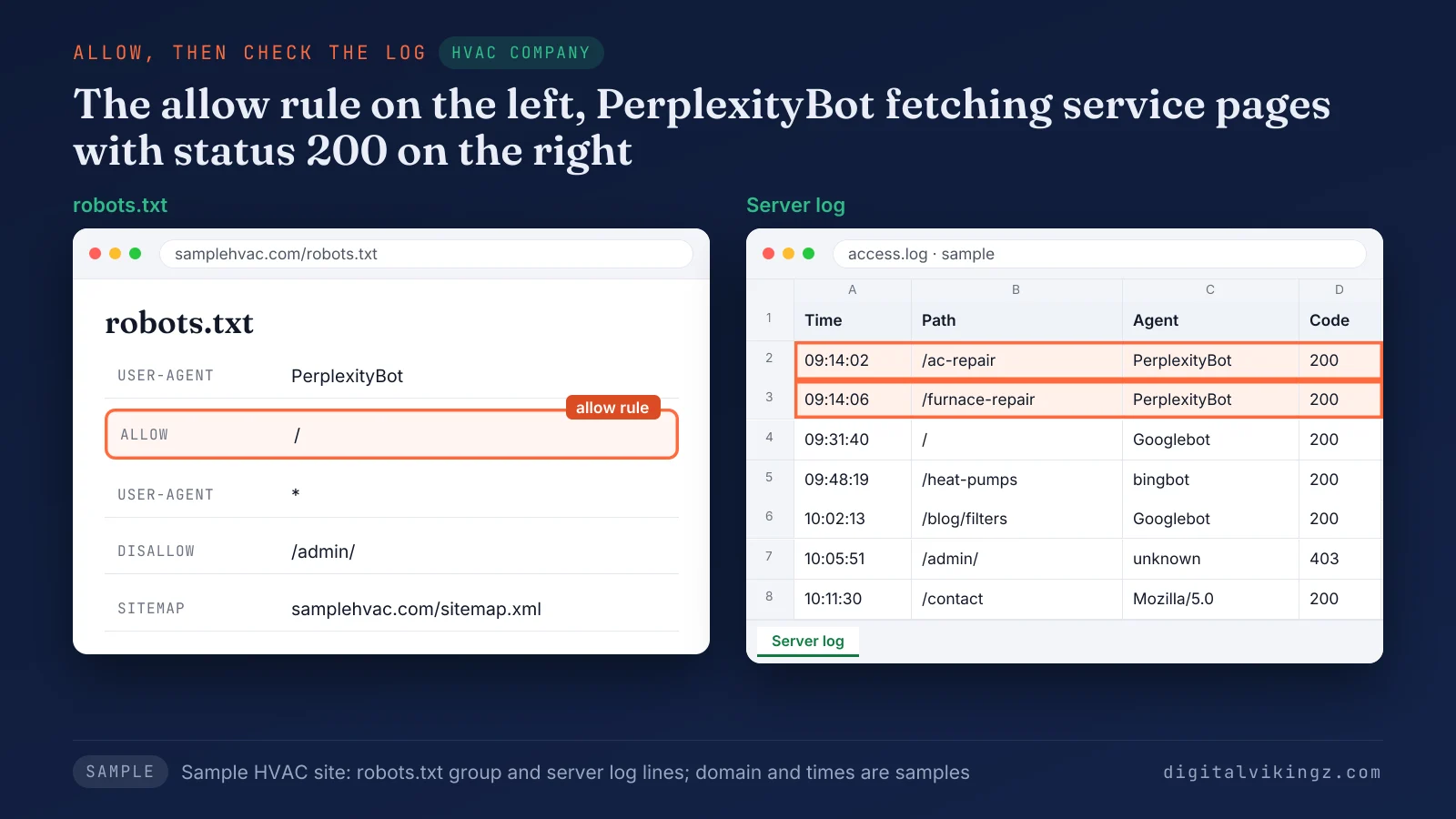
The log lines in the sample show PerplexityBot fetching two service pages with a 200 status after the allow rule.
Firewalls should allow both agents by matching the user agent to Perplexity's published IP lists, perplexitybot.json and perplexity-user.json. Perplexity notes that "Cloudflare's Bot Fight Mode can't be skipped with WAF custom rules." Perplexity says robots.txt changes may take up to 24 hours to take effect.
Cloudflare reported in 2025 that Perplexity reached some blocked sites through undeclared crawlers, and Perplexity documents only the two named agents. The full list of AI crawlers and their robots.txt rules needs a separate guide, with AI crawlers explained one by one.
A crawled page still needs a passage that Perplexity can lift.
How do answer-first passages help Perplexity cite a page?
Answer-first passages help a page get cited because Perplexity's Search API returns query-relevant text extracted from a page, not the full page. Perplexity's documentation adds that "the same page can return different text for different queries."
Each question heading should open with a one-sentence answer that names the subject, followed by the figure, the condition and the source. Lists and tables should carry dense comparisons.
Search results carry a date and a last updated field, so a visible updated date helps a page show its freshness. Perplexity documents both fields for its API and does not publish how the answer engine weighs them.
A Perplexity passage that stands alone with its source passes the test of AI citation readiness of a passage. Perplexity also cites pages that talk about a brand, not only the brand's own pages.
How do mentions on other sites affect Perplexity citations?
Mentions on sites Perplexity already cites can bring a brand into answers that its own pages do not reach. A founder tested two buyer prompts in Perplexity and shared the result on Indie Hackers. A practitioner replied that a mention on one of the cited sources usually beats a better page.
The target list comes from the sources panel: every page Perplexity cites for a buyer prompt is a candidate for a brand mention. Planted reviews, fake forum accounts and paid posts without disclosure break platform rules and can be removed.
The case for mentions over links is set out in brand mentions compared with backlinks. Each step needs a measure that shows when Perplexity citations follow.
How do you track Perplexity citations and traffic?
Perplexity citations are tracked by running a fixed set of buyer prompts several times, logging every cited source, and reading Perplexity referrals in analytics. The steps to track Perplexity citations are listed below:
- Write the prompts: List the buyer questions a customer would ask Perplexity, one per main service and prompt type.
- Run each prompt: Run every prompt at least three times in a clean session, because answers vary between runs.
- Log three states: Mark each run cited, mentioned or absent, and note every domain behind a numbered citation.
- Check by API: Repeat the prompt set through the Perplexity API or one of the AI visibility tools to scale the log.
- Read referrals: Compare the log with Perplexity referral sessions each month.
The same routine across assistants is the five-step check of what ChatGPT and AI Overviews say about a business. Perplexity now points developers from the older Sonar API to its Agent API, and its Search API can filter results by domain.
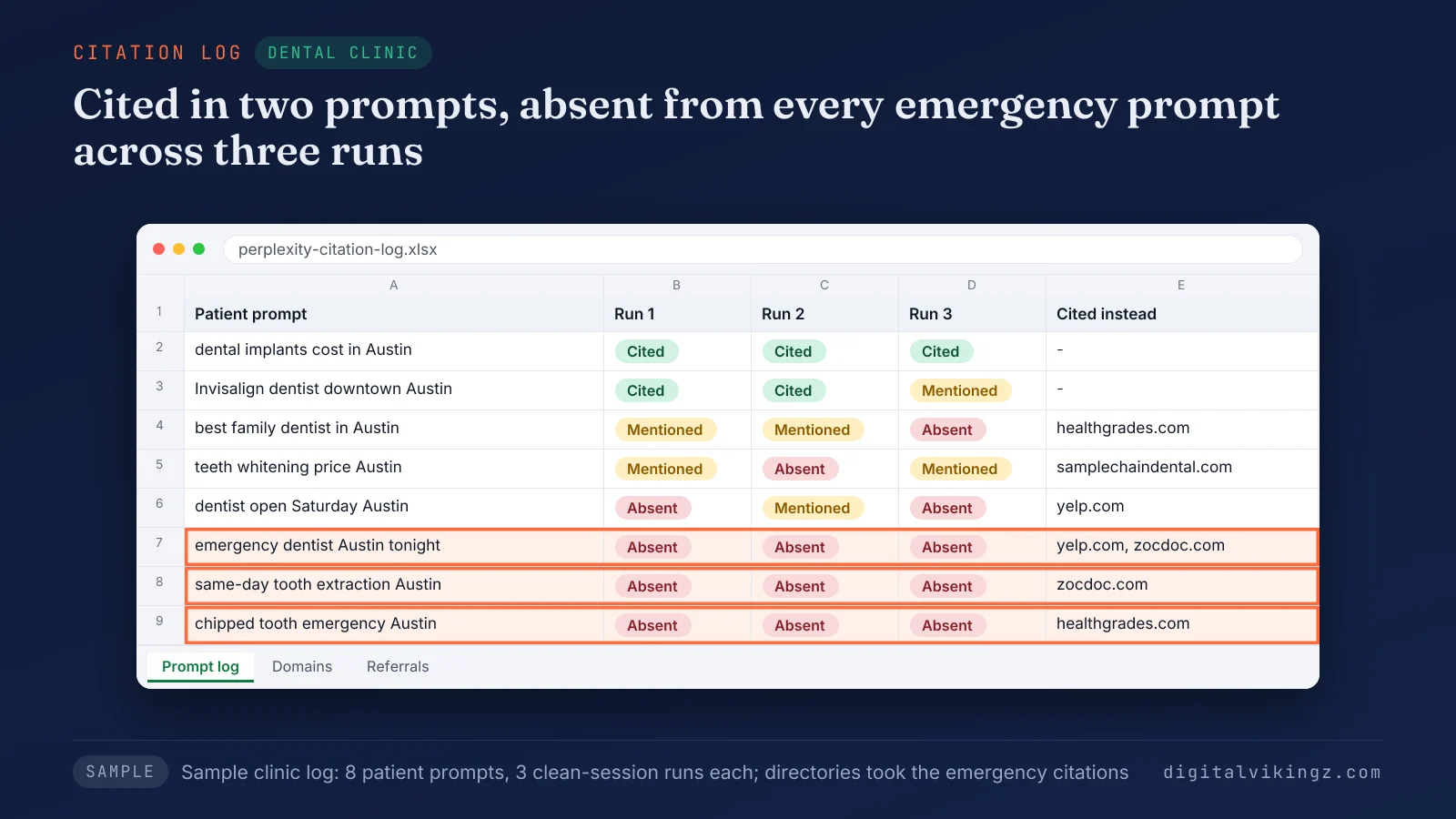
The sample shows the clinic cited in two prompts and absent from the emergency prompts, where directories took every citation. Cited and mentioned are separate rates, as the guide to mention rate and citation rate in GEO explains.
The traffic half of the log comes from GA4.
How does Perplexity traffic show in GA4?
Perplexity traffic shows in GA4 as perplexity.ai / referral, because Google's default channel group does not name Perplexity as an AI assistant. A custom channel group with Perplexity in its rule moves those sessions out of Referral and next to other AI traffic.
Some Perplexity visits arrive with no referrer and land in Direct, so the prompt log stays the main measure. The channel group set-up is in the guide to track ChatGPT and Perplexity traffic in GA4.
The log and the referrals together show the business value of Perplexity SEO.
Is Perplexity SEO worth it for a business?
Perplexity SEO is worth the effort for a business when buyers in its market ask Perplexity questions and Perplexity names competitors in the answers. The test has three parts: run the buyer prompts, count the answers that cite competitors, and read the Perplexity referral share in GA4.
Some SEOs argue that Perplexity traffic is too small to track. The referral share in a site's own analytics settles the question for that site.
Buyer questions such as "best payroll software" or "dentist open Saturday" are the prompts to test first. Perplexity SEO is one part of AI search visibility, alongside Google AI Overviews and ChatGPT.
Our AI Search Visibility for Perplexity work runs that test, fixes access and passages, and tracks citations every month. Two popular fixes are often suggested first, and neither is documented by Perplexity.
Does schema markup help Perplexity cite a page?
Perplexity has not stated that schema markup changes which pages it cites, so schema stays a practitioner recommendation for Perplexity, not a documented input. Perplexity's crawler, help and API pages read in November 2026 say nothing about structured data.
A commenter on one founder's Indie Hackers test showed a cited page and an uncited page carrying the same schema. Category coverage was the difference between the two pages.
The evidence across engines is in what schema markup does and does not do for AI citations. A second file gets the same claim.
Does llms.txt help Perplexity find a site?
Perplexity has not documented llms.txt as an input, and one 2026 crawler log study recorded no PerplexityBot fetch of the file. EZY Research placed the file on 83 sites from 27 April to 19 July 2026 and logged 0 PerplexityBot fetches against 775 robots.txt fetches.
robots.txt and readable HTML do the job that owners expect from the file. The file itself is covered in what llms.txt is and whether a site needs one.
Perplexity also behaves differently from the engine most readers test first.
How do Perplexity citations compare with ChatGPT citations?
Perplexity citations differ from ChatGPT citations because Perplexity searches the web for every answer, while ChatGPT runs a web search only on some questions. Perplexity shows numbered citations on every answer, so a missing citation in Perplexity is easier to see than in ChatGPT.
The same site can be cited in one engine and absent in the other, so each engine needs its own prompt log. Gemini, Claude and Microsoft Copilot follow their own retrieval rules as well.
The ChatGPT side is set out in how a new brand gets cited by ChatGPT. The page type decides much of the result in every engine.
Which pages does Perplexity cite for buyer questions?
Perplexity cites different page types for different buyer questions, according to a 2026 study of its answer stream. The page types Perplexity tends to cite for each buyer question are listed below:
- "Best" questions: Perplexity cited current-year list articles, while big brand pages were retrieved and not cited.
- Comparison questions: Perplexity cited the vendor's own comparison page most, so B2B SaaS teams should build "X vs Y" and alternatives pages.
- How-to and shopping questions: Perplexity cited YouTube videos, so a Shopify store should add how-to and product comparison pages with clear answers.
- Local questions: Perplexity gave the citations to place entries, so a dental clinic or HVAC company should keep its business profile and service pages complete.
A narrow task page can win where a broad category page is ignored, as one founder's test showed. The study used one account and called its counts directional, so each site should confirm the pattern in its own prompt log.
Perplexity SEO for buyer questions therefore starts with the page type the question rewards. Page type, passage and crawler access together decide which sources Perplexity cites for a buyer question.
Questions about Perplexity SEO
Perplexity SEO raises six further questions, on timing, blocking, payment, repeat runs, Google rankings and JavaScript.
How long do changes take to show in Perplexity?
Perplexity says robots.txt changes may take up to 24 hours, and Perplexity publishes no timeline for content changes. A fixed prompt log, run each week with the same prompts, shows when a content change starts to appear in Perplexity answers.
Does blocking PerplexityBot stop Perplexity from reading a site?
Blocking PerplexityBot removes a site from the crawler Perplexity uses for search results, while Perplexity-User can still fetch pages a user asks about. Perplexity recommends allowing PerplexityBot and its published IP ranges for any site that wants to appear in Perplexity search results.
Can a business pay Perplexity for organic citations?
Perplexity publishes no paid route into organic citations and states that payments do not affect source labels. Perplexity's partnerships and other business arrangements do not affect a label either, according to Perplexity's source labels page.
Does Perplexity cite the same sources every time?
Perplexity answers vary between runs, so one check shows a moment and repeated runs show the pattern. Each buyer prompt should run at least three times in a clean session before a result is logged as cited or absent.
Does a Google ranking carry over to Perplexity?
A Google ranking does not carry over to Perplexity automatically, because Perplexity searches its own web index. A page that ranks well in Google is often well linked, crawlable and clearly written, which counts in both engines.
Does PerplexityBot render JavaScript?
PerplexityBot has no documented JavaScript rendering, so the core text of a page should sit in the raw HTML. Loading the page in a browser with JavaScript turned off shows the text that a crawler without rendering reads.
Perplexity SEO in short
Perplexity SEO comes down to three things: a reachable page, an answer-first passage and mentions on sources Perplexity already cites. Digital Vikingz runs that work as part of AI Search Visibility, with monthly prompt logs.
The free AI Visibility Checker checks crawler access and answer readiness on up to five public pages. Run the AI Visibility Checker for a Perplexity baseline before the first prompt log.