 Digital Vikingz
AI SEO is the practice of making a brand and its pages retrievable, citable and named in answers from AI search engines and assistants. The work builds on classic search engine optimization (SEO), because AI answers draw on pages that engines can crawl, index and rank. The AI Search Visibility service for AI search optimization runs that work every month.
A free AI Visibility Checker reads up to five pages of a site. AI search engines retrieve pages, split a question into several searches, select passages and check facts across sources. The answer can then name a brand, link a page as a source, or both.
The practice differs from traditional SEO in its unit, the passage, and in its scoreboard, mentions and citations. The work runs in five steps: open crawler access, write answer-first passages, clarify the entity, earn mentions and measure. The core measurement split is mention rate versus citation rate, sampled on a fixed prompt set.
Search Console adds AI impressions for Google's AI features, and GA4 adds visits from AI assistants. Google's guide also lists what its AI features do not require, including llms.txt files, content chunking and special schema. ChatGPT, Perplexity and Claude run their own retrieval, so a brand can be cited in one engine and missing from another.
No method guarantees a citation, and answers change between runs and engines. Brands missing from AI answers often lack the outside sources those answers check. The first step is a check of what AI engines can read on a site and what they say about the brand today.
[VIDEO: YouTube walkthrough "What Is AI SEO?" with Usman or Abad on screen; embed when the URL exists]
What is AI SEO?
AI SEO is the practice of making a brand and its pages retrievable, citable and named in answers from AI search engines and assistants. The engines in scope are Google AI Overviews, Google AI Mode, ChatGPT, Perplexity, Gemini, Claude and Microsoft Copilot.
Some vendors use the same phrase for SEO work done with AI tools, a separate meaning the sections below do not cover.
The practice builds on classic SEO, because AI answers draw on pages that search engines can crawl, index and rank. The practice adds three layers on top: answers written as self-contained passages, a clearly defined business entity, and mentions on other trusted sites.
Many buyers search for the same work as AI search optimization. Digital Vikingz delivers the work monthly as the AI Search Visibility service for AI search optimization. Each month covers passages, entity signals, mentions and prompt tracking.
The AI Visibility Checker is a free tool that reads pages the way crawlers do, without running JavaScript. A first look comes from the AI Visibility Checker for a first AI SEO check, which reads up to five public pages.
What is AI SEO called?
AI SEO is also called generative engine optimization (GEO), answer engine optimization (AEO) or LLM SEO, and the labels describe one discipline. Generative engine optimization comes from the research paper "GEO: Generative Engine Optimization", posted on arXiv in November 2023.
Google states that, from the Google Search perspective, optimizing for generative AI search "is optimizing for the search experience, and thus still SEO." Some vendors still separate the names, and GEO, AEO and LLM SEO compared as one discipline lays the names side by side.
Measurement teams often call the same outcome LLM visibility. Large brands track that outcome across several AI engines with an enterprise LLM visibility measurement framework. Whatever the label, AI answers select their sources through the same mechanism.
How does AI SEO work?
AI SEO works by preparing pages for four steps an AI search engine runs before answering: retrieval, query fan-out, passage selection and corroboration. Large language models answer from fresh sources when the engine searches an index first, a method Google calls retrieval-augmented generation, or grounding.
The four steps an AI search engine runs are listed below:
- Retrieval: the engine searches an index and pulls candidate pages for the question.
- Query fan-out: the engine splits one question into several related searches to fetch more results.
- Passage selection: the engine picks the single passages that answer each part of the question.
- Corroboration: AI answers favor facts and brands that several independent sources state the same way.
A brand appears in two ways: named in the answer text, a mention, or linked as a source, a citation. Owners often call both "ranking in AI", yet AI answers select passages and sources, not a ranked list of pages.
Figure 1 shows a sample answer for a dental clinic prompt.
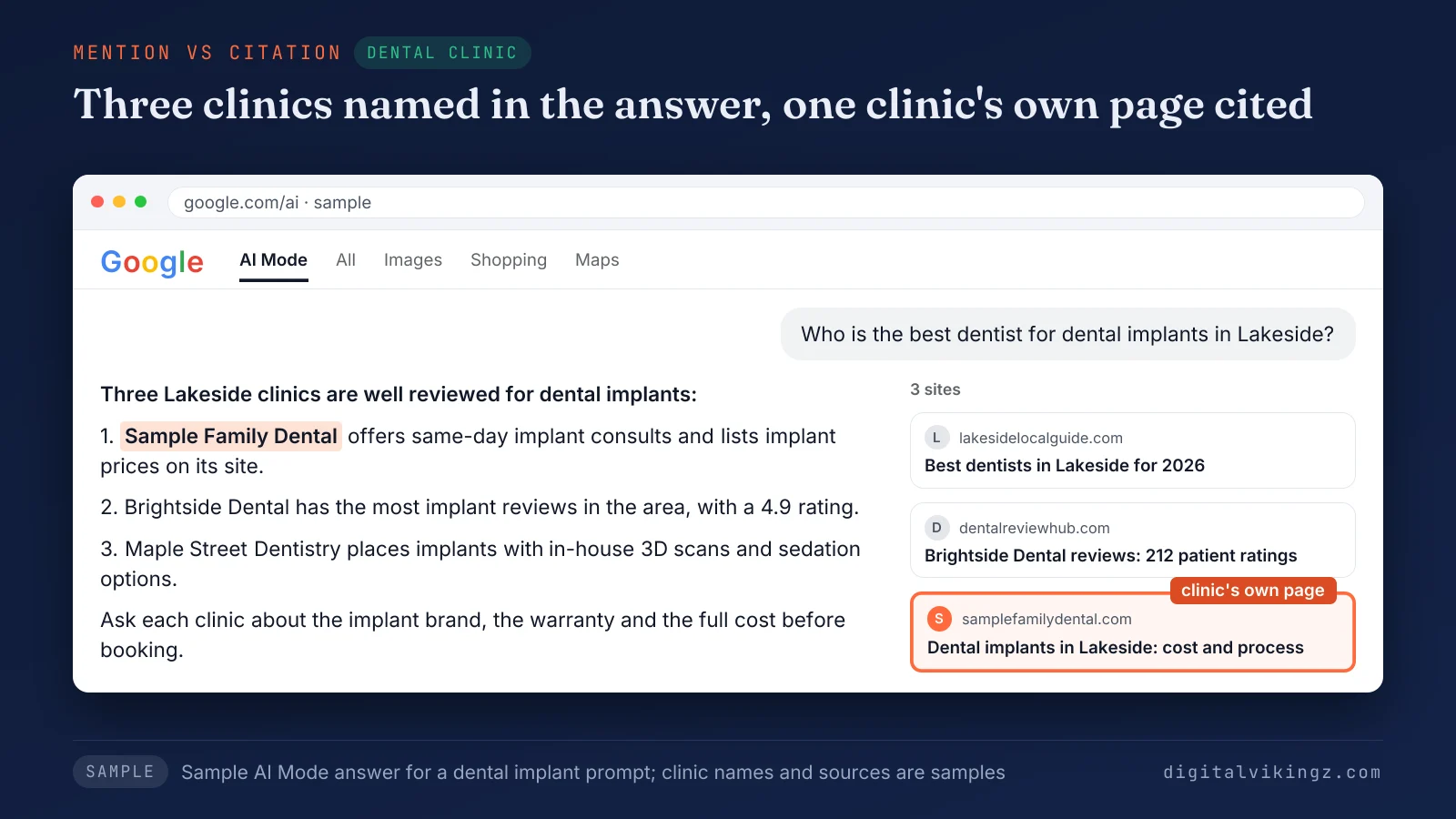
The sample answer names three clinics, but only one clinic's own page appears among the three cited sources.
ChatGPT, Perplexity and Google each pick sources in their own way, and how AI search engines decide who to cite compares their citation pipelines. Passage selection explains why a page can rank and still miss the answer.
Why does a page rank in Google and not get cited by AI?
A ranking page can miss AI citations because AI answers select single passages, and the page may hold none that answers the prompt. Rankings and citations overlap only partly, so a first position on Google does not promise a place in the AI answer.
Missing outside mentions and an unclear business entity are two other reasons AI engines skip a ranking page. The practice treats each section as a candidate passage, so every section opens with its answer. The full list sits in seven reasons a page ranks in Google and is not cited by AI.
How is AI SEO different from traditional SEO?
AI SEO differs from traditional SEO in unit and scoreboard: AI answers use passages and are scored by mentions and citations, not clicks. The foundation stays the same for both.
Google Search Central sets out that shared base in Google's Guide to Optimizing for Generative AI Features on Google Search. The guide says Google's AI features are "rooted in our core Search ranking and quality systems."
The table below compares the two approaches across five attributes:
| Attribute | Traditional SEO | AI SEO |
|---|---|---|
| Goal | Rank a page and earn the click | Be retrieved, cited and named in the answer |
| Unit | The page | The passage and the brand entity |
| What decides selection | Relevance and quality signals for the page | The same signals, plus passage fit and agreement across sources |
| Off-site signal | Links from other sites | Links plus mentions in reviews, lists and forums |
| Scoreboard | Rankings, clicks and conversions | Mention rate, citation rate, AI impressions and AI referrals |
Four of the five rows keep the classic SEO work and add a layer for AI engines. The added layers raise a fair question about renaming.
Is AI SEO just SEO with a new name?
No, AI SEO is not just SEO with a new name, because the SEO foundation stays and three layers are added on top. The three layers are self-contained answer passages, a clearly defined entity and corroboration from other sites. Google treats the work as SEO for its own features, which is why the foundation matters most on Google.
Existing SEO work still counts: crawlable pages, indexed content and useful answers carry straight into AI answers. The same logic answers the louder claim that AI engines have ended SEO.
Is SEO dead because of AI?
No, SEO is not dead because of AI, since Google's AI features draw on the Google Search index and core ranking systems. Other AI engines also retrieve from web indexes, so pages that search engines fail to find rarely reach an AI answer. The discipline adds layers to that index-based work instead of replacing SEO.
Click patterns do change, with fewer clicks when an AI answer appears above the results. The two Google formats shift traffic in different ways, as how AI Overviews and AI Mode change your clicks shows.
How do you do AI SEO?
AI SEO is done in five steps, in order: open crawler access, write answer-first passages, clarify the entity, earn mentions and measure results. We run the steps in that order because each step depends on the step before.
The five steps are listed below:
- Open crawler access: let search and AI crawlers fetch the pages, and get the pages indexed.
- Write answer-first passages: open each section with a sentence that answers its heading alone.
- Clarify the entity: state the same business facts on the site, in schema and in listings.
- Earn mentions: win genuine coverage on the review sites, lists and forums AI answers read.
- Measure results: track mention rate and citation rate on a fixed set of buyer prompts.
Steps one to four follow below, and measurement has its own section after them.
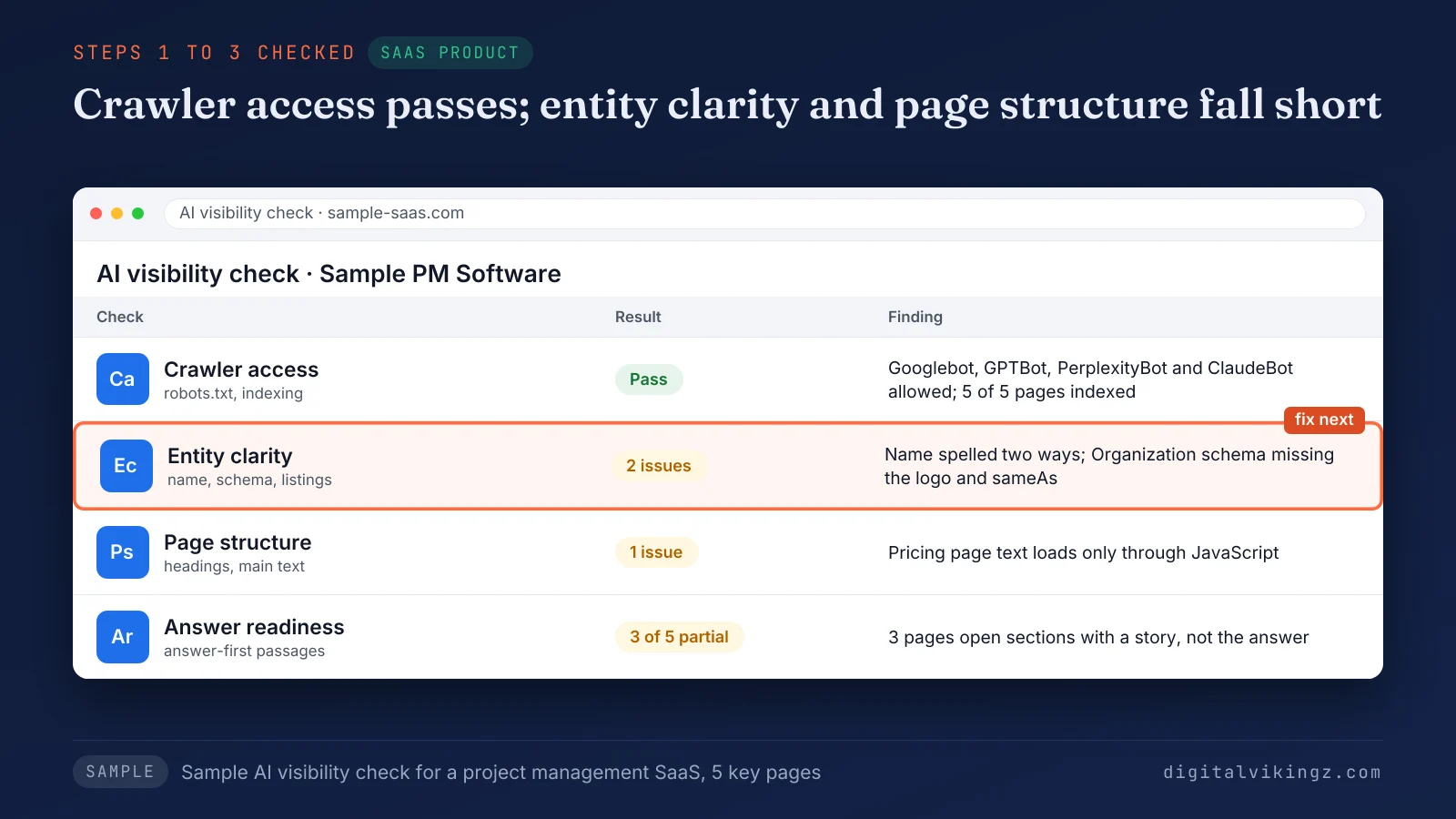
The sample SaaS result passes crawler access and flags two entity issues and one structure issue. Three of the five sample pages are only partly answer-ready. Crawler access comes first, because nothing else matters on a page no AI engine can read.
How do crawler access and indexing affect AI visibility?
Crawler access and indexing decide whether AI visibility is possible, because AI engines answer from pages they can fetch and read. Google says a page "must be indexed and eligible to be shown in Google Search with a snippet" to appear in its AI features.
A site must also stay included in the Search generative AI setting in Google Search Console, which is on by default. A crawler audit checks robots.txt, because ChatGPT, Perplexity and Claude send their own crawlers.
The robots.txt file can allow or block each crawler by name.
Main text that loads only through JavaScript can stay invisible to crawlers that do not run scripts. A readable page then needs passages worth quoting in AI answers.
What makes a passage citable in AI answers?
A citable passage answers one question in its first sentence, states one fact per sentence and stays clear when read alone. Named sources, dates and numbers inside the passage make each claim checkable.
The practice applies those rules section by section, without cutting pages into fragments. Google says there is "no requirement to break your content into tiny pieces," and no ideal page length exists.
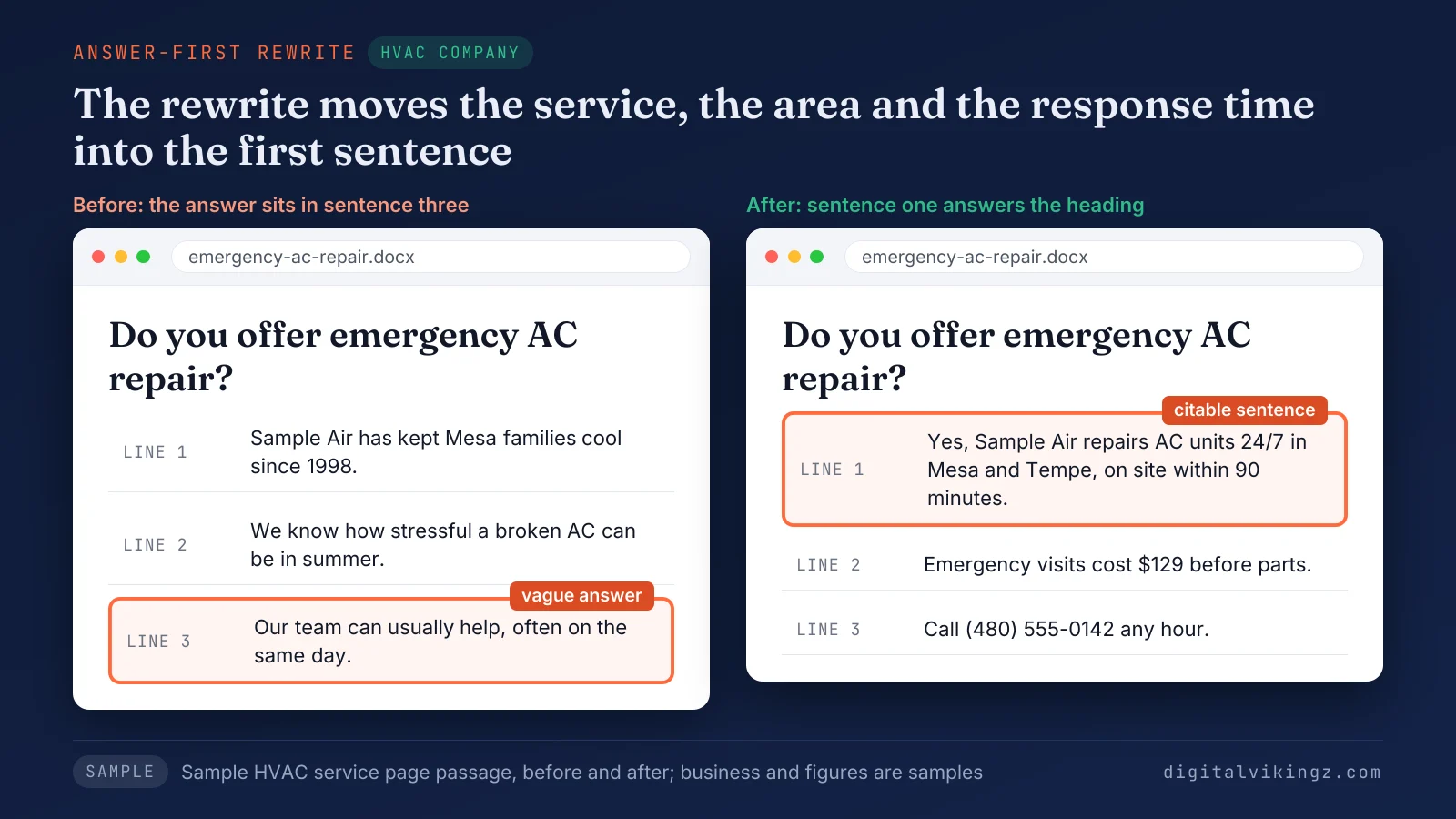
The rewritten HVAC passage moves the service, the area and the response time into one opening sentence that AI engines can quote.
Pages written to these rules meet a standard called AI citation readiness. The standard is defined in AI citation readiness for verifiable passages, with a check for each sentence.
Why does entity clarity matter in AI answers?
Entity clarity matters in AI answers because AI engines describe a business from its sources, and conflicting facts can cause wrong or missing mentions. Entity clarity means the site defines the business in one sentence and spells the name one way everywhere.
Organization and Person schema can restate those facts, although Google requires no special schema for its AI features. Named authors with consistent profiles tie each page to a person with experience.
Authors and organizations are both entities that AI engines try to identify. The trust inputs behind them are set out in author and organization entities.
How do off-site mentions shape AI answers?
Off-site mentions shape AI answers because AI engines can check a brand against reviews, comparison lists and forum threads before naming the brand. Google says its AI features "can show what's being said about products and services across the web, including in blogs, videos, and forum discussions."
Google also says seeking inauthentic mentions "isn't as helpful as it might seem." Mention work starts by noting which sites an engine cites for "best" prompts in the category, then earning a genuine place there.
Mentions now carry weight beside links, as brand mentions compared with backlinks explains. Mentions and citations then need counting.
How is AI SEO measured?
AI SEO is measured by mention rate and citation rate on fixed prompts, plus AI impressions in Search Console and AI referrals in GA4.
Mention rate is the share of generative answers that name a brand in the answer text. Citation rate is the share of generative answers that link to a page on the brand's domain as a source. Comparing both rates with competitors gives a share of voice across the prompt set.
AI answers vary by run, AI engine and prompt wording. Both rates are therefore sampled on the same prompts every week or month, by hand or with AI visibility tracking tools. Google warns that "no third-party tool has access to our internal ranking or AI systems."
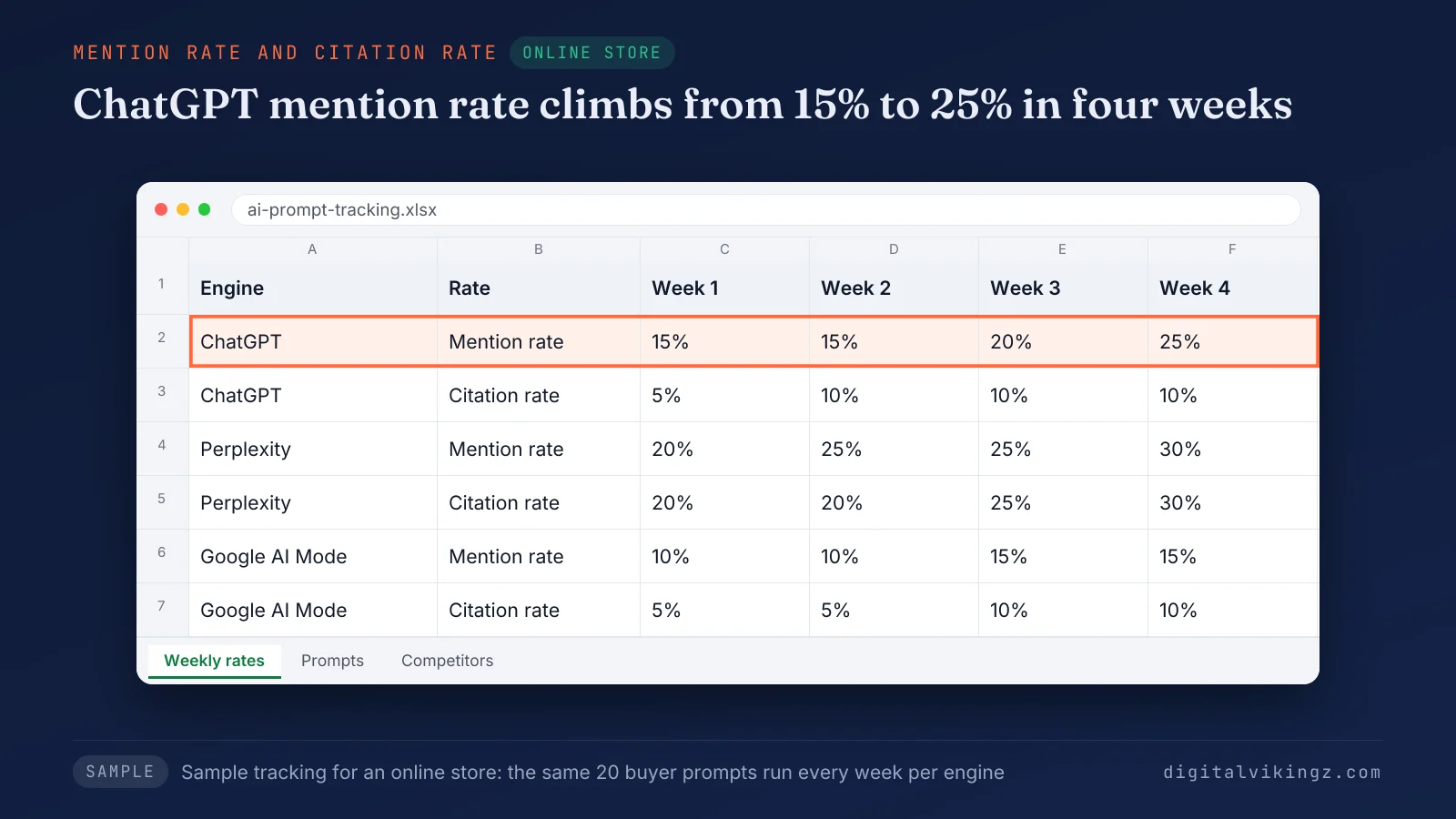
The sample store sheet shows the ChatGPT mention rate rising from 15 to 25 percent over four weeks. Perplexity cites the sample store in about as many answers as Perplexity names the store.
Each rate answers a different business question, which mention rate versus citation rate sets out in full. Two free reports add Google's own numbers.
What do Search Console and GA4 show about AI answers?
Search Console shows AI impressions for Google's AI features, and GA4 shows visits referred by AI assistants such as ChatGPT. Both reports sit beside the prompt rates, because each report covers a different surface.
The Generative AI performance report, announced on 3 June 2026, counts impressions in AI Overviews and AI Mode. The report shows impressions only as of November 2026, with no clicks or queries. The fields and filters are covered in the Search Console Generative AI report walkthrough.
GA4 has sorted visits from recognized AI assistants into an AI Assistant channel since 13 May 2026, according to Google. Visits with no referrer land in Direct, so the AI Assistant number is a floor. Perplexity and Gemini need a custom channel group, explained in tracking ChatGPT traffic in GA4.
How do you check what AI answers say about your business?
A business checks AI answers by running a fixed set of buyer prompts in each engine and recording who is named and who is linked. A set should hold ten to twenty buyer prompts, run monthly, because one run shows no trend. The method is the five-step check of what ChatGPT and AI Overviews say about a business.
Page readiness is a separate test: whether crawlers can read the pages and whether each page answers clearly. The free AI Visibility Checker for page readiness runs that test on up to five pages. Google has also published what the work does not need for Google Search.
What does Google say its AI features do not need?
Google says its AI features in Search do not need llms.txt files, content chunking, rewriting for AI, inauthentic mentions or special structured data. Google's guide puts it directly: "For Google Search, you can ignore tactics like 'chunking' content, creating unnecessary AI text files (like llms.txt), or pursuing inauthentic mentions."
The five items Google lists as unnecessary are given below:
- llms.txt and special files: Google Search ignores AI text files, so the files neither help nor harm rankings there.
- Content chunking: Google can find the relevant part of a long page, and no ideal length exists.
- Rewriting for AI: Google's systems understand synonyms, so pages need no special phrasing for AI features.
- Inauthentic mentions: Google's spam systems work alongside its AI features, so planted mentions add little to AI answers.
- Special structured data: schema markup is not required for AI features, though schema still supports rich results.
The list covers Google Search only; ChatGPT, Perplexity and other AI engines publish no equal statement. Other services may read such files, which is why whether a website needs llms.txt depends on the site type. Schema markup needs one more word.
Does schema markup help a page get cited by AI?
Yes, schema markup helps indirectly, by stating entity facts and earning rich results, though Google requires no special schema for AI features. Google states that structured data "isn't required for generative AI search, and there's no special schema.org markup you need to add."
Schema works best for AI engines when every value in the markup matches a sentence visible on the page. Markup that contradicts the visible text gives AI engines two versions of one fact. The evidence is weighed in what schema markup does for AI citations.
Do AI engines choose sources the same way?
AI engines choose sources differently: Google's AI features draw on the Google Search index, while ChatGPT, Perplexity and Claude run their own retrieval. The same prompt can name different brands in AI answers from two engines on one day. The work therefore runs the prompt set in each engine separately, following the engines the buyers use.
ChatGPT is often the first engine a new brand wins. The sequence is described in how a new brand gets cited by ChatGPT first.
Perplexity shows its sources beside every answer, which makes how Perplexity chooses its sources easy to audit.
Each engine also refreshes its sources on its own schedule. A corrected fact can therefore reach one engine before another. No engine promises a place in its answers.
What are the limits of AI SEO?
AI SEO has three limits: no method guarantees a citation, answers change between runs, and Google documents only its own AI features. Google's own guide says "Indexing and serving aren't guaranteed," even for pages that meet every requirement.
Answers can also differ by prompt wording, location and signed-in state. A mention also differs from a customer, so AI visibility belongs next to leads and sales in any report.
Our own check in Google AI Mode on 18 November 2026 named Digital Vikingz in three of seven prompts. Both brand prompts named us, and one category prompt cited our dedicated SaaS industry page.
The four generic category prompts named other providers, which showed us where outside mentions were missing. One AI engine, one day and seven prompts make an example, not a study.
Brands left out of AI answers usually face the same gap. The causes and fixes are listed under not appearing in AI search.
More questions about getting cited by AI
Does AI SEO mean using AI tools to do SEO?
The phrase has a second meaning, using AI tools for SEO work, but the visibility meaning covers how brands appear in AI answers. Research, drafting and audits split into tasks agents finish and tasks people check, as the list of SEO tasks AI agents can take on shows.
Is GEO replacing SEO?
No, generative engine optimization is not replacing SEO, because the label describes SEO aimed at AI answers. Google's guide calls optimizing for generative AI search "still SEO" and applies SEO best practices to AI Overviews and AI Mode.
Is ChatGPT an answer engine?
Yes, ChatGPT works as an answer engine when ChatGPT searches the web and answers a question with linked sources. Answer engine optimization first meant winning answer boxes and voice assistant replies, before chat assistants such as ChatGPT arrived.
Which AI engines should a business optimize for?
A business can optimize for Google AI Overviews, Google AI Mode, ChatGPT, Perplexity, Gemini, Claude and Microsoft Copilot. A business should prioritize the engines its buyers use, and the first month of prompt tracking shows which engines name the brand.
Can AI assistants recommend a local business?
Yes, AI assistants can recommend a local business, because assistants read business profiles, directory listings, review sites and business websites. A top Google Maps position supports a business without promising a recommendation, as how AI assistants select a local business to recommend explains.
Can online stores get products recommended in AI answers?
Yes, online stores can get products recommended in AI answers when product data states price, availability and attributes completely and accurately. ChatGPT reads Shopify Catalog, merchant feeds, third-party data and crawled pages, as the guide on how ChatGPT shopping recommends store products describes.
Does being cited in an AI answer bring visitors?
A citation in an AI answer can bring visitors, though many readers take the answer without clicking. Google states that clicks from results pages with AI Overviews are higher quality, with visitors more likely to spend more time on the site.
Can wrong facts in AI answers be corrected?
Yes, wrong facts in AI answers can be corrected by fixing them on the brand's own site and on the listings assistants read. AI answers change only after the engines read the corrected sources again, so the timing varies by engine and by source.
Can a small business get cited by AI without an agency?
Yes, a small business can take the first steps alone: open crawler access, fix the business facts and answer buyer questions clearly. Mention building and multi-engine tracking take longer, and the guide to choosing a semantic SEO agency lists what to check before hiring.
Does each question need its own page to get cited by AI?
No, each question does not need its own page, and Google warns that pages made for every fan-out query can breach its spam policy. Google names the breach "scaled content abuse" and calls mass page creation "an ineffective long-term strategy."
Where should you start with AI SEO?
AI SEO starts by checking what AI engines can read on a site and what AI answers say today, then follows the five steps. A baseline of mention rate and citation rate on a fixed prompt set makes later progress measurable. The work rests on semantic SEO: clear entities, complete topics and passages that Google and AI engines can trust.
Digital Vikingz runs the five steps every month as AI Search Visibility, for B2B SaaS companies and local service businesses. The scope, checks and reporting of AI Search Visibility, the monthly AI SEO service are set out on the service page.